Showing posts sorted by date for query Santiago. Sort by relevance Show all posts

Monday, 31 August 2026

Going to the dogs

In March this year, I wrote about failing to track and borrow the only copy on the books of a title in the Irish public library system. I mildly moaned about this to Dau.I the Librarian: books are effective fungible, one is as good as another for my edutainment. It turns out that her current role is Acquisitions, Non-Fiction and she responded brightly "thanks for the suggestion, I think We the Library could acquire a couple of copies". And it was so, and she reserved one for me to borrow, and on 13 Aug I was messaged:

  • The following item(s) are being held for you until the date shown below. Title: Winterdance:the fine madness of Alaskan dog-racing Author: Paulsen, Gary

Well, Winterdance (note: not Riverdance auf Nuremburg) is a stitch and deserves to be read much more widely by a dog-loving nation. And yet, because of Der Triumph des Neuen, this 30 year old publication had been remaindered  and culled to make room for 313 copies of The impossible fortune : a Thursday Murder Club mystery (2025) then latest by Richard Osman. And 251 copies of Prize-winning The Adversary by Michael Crummey.

Winterdance is the tale of conjuring up a team of sled dogs [Typhoon Cookie Yogi Max Storm Steven Bill Devil Murphy Ortho BigMac Raven Byron - other people's dogs, other people's names] with the intention of running the 1850km Iditarod Trail Sled Dog Race [whc Bloboprev] in 1983.

About 20 years ago 7 y.o. Dau.II wanted a dog so badly that she spent lots of time as a dog - gruffling, fawning, crawling about on all fours and eating weetabix off the kitchen floor. This annoying behavious did  manifest her desire [R.ashers] in short order. Paulsen reckoned along similar lines. I had to sleep in the kennel, I had to be with the dogs all the time, learn from them all the time, know them all the time. More than sleep [there], I had to be in the kennel all the time. I had to, in some way, become a dog. Without that 100% commitment, his future as a (-40°F = -40°C) sled-runner was going to be bleak indeed and could get him and his dogs killed.

Spoiler: Paulsen finished the Iditarod with all 15 of his starting dogs, nowhere near the prize money but well along in his transition to become a dog. Whiffs like a dog, pulls like a dog, eats sketchy like a dog. I recommended it to Dau.II who has lately been on a Reading Running jag: Feet in the Clouds, -- Tarahumara, -- Zatopek. What's not to love about endurance, adversity, sunrise from the top of the world . . . with pups? Winterdance is not didactic, it's not a diary, it's a distillation of a process. It is funny hilarious. There are now three copies in the Library.

My analysis of the process of pilgrimage [Santiago etc etc] concludes that internal transformation can occur at walking pace (indeed on crutches) if there is intention, if expectation of failure is dumped, if you go a little bit more. Pilgrimage is something you do on your feet not with your feet up with a book. I have seen with mine own eyes: Dau.II is running.

Wednesday, 18 February 2026

Go on! Koan.

 Well, I dunno, which is better? - read a book about Pilgrimage . . . or up-stakes a go on Pilgrimage. My answer from July 2004 [R indicating The Way into the rising sun and across O Ponte do Burgo in Galicia]! I didn't intend to peregrinate, I just went for a walk with The Boy: and that only about 100km. Four days later, we rocked up to Santiago de Compostella . . . upon St James's Day. Big Party. Four days, even with Mass && a fiesta, is not enough for change to be wrought - except in the blister department. But two days later I plodded off to France on my own and arrived in that country 5½ weeks later & 12kg lighter. Something else happened along The Way: I became a Pilgrim. Or at least I became someone who wrote a book[let] about the Process of Pilgrimage. And made several posts about Santiago and related matter. And having got that off my chest, I have been okay to read [and review] books about it: ToCanterbury -  ToRome - ToJerusalem -

21 years after our last walking 'venture, in June 2025 The Boy and I had another bite at the cherry: clocking off 160km in France along the Via Podiensis, one of the filaments of the Camino de Santiago. At the same time, by coincidence, my pal Denécus was walking in the opposite direction along the Via Primitivo. 30 years ago, D and I had parallel jobs in the same Department and ate lunch together pretty much every M-F for a couple of years. He is not the only science friend to go for a Pilgrim.; but he was for sure on my list of likely candidates. Some of my best friends are scientists who are skeptical about everything except science which effectively makes science a Belief System as much as Shinto. Not D. For the first time since ~1995, we had lunch together just before Christmas and compared blisters notes on The Way and its fauna. Because D had his Compostelle [cert affirming his arrival in Santiago], I was able [cw: spoiler alert] to send him a copy of my book about PoP. And he presented me with a >3rd-hand copy of:

The Art of Pilgrimage: The Seeker's Guide to Making Travel Sacred (1998) by Phil Cousineau [who he]? I'm not sure it's good to start such a book with a list of prior pilgrims to make first timers feel inadequate: Abraham, Basho, Chaucer, Dante [St] Egeria . . . etc. But I guess that's not the market, which is rather a) those who've bin that done that or b) people who do their pilgrimage from the sofa through other men's flowers. One of the arrows in Cousineau's quiver is acting as a guide on Sacred Travel excursions, and no better man: because he's clocked hundreds of km finding himself all over the world, so c) seekers who might become clients. The ABCDE list above is part of the package; along with quips & quotes [so many quotes] from Augustine, Buddha, Chatwin, Thoreau, Watts . . . etc. Apart from wearing our expensive education on our sleeves, The Art and The Blob have this is common: the terrible quality of the pictures!

p.128 ""Section V. The Labyrinth. We know all too well that few journeys are linear and predictable. Instead they swerve and turn, twist and double back, until we don't know if we're coming or going."". This is bollix not my experience. I've just made a there [going] and back [coming] trip to the cobbler without swerve. I go to Dublin on the train: linear and predictable. I walk up the hill to Cross-on-Fork: linear and predictable. I fly to France: linear and predictable. Maybe the prime benefit of Pilgrimage is that, by teetering on the edge of comfort, thee is a rare opportunity to swerve and turn, twist and double back. and come up with a different Way of Seeing. Cousineau does come to a similar conclusion- but sometimes he trips over his own rhetoric while getting there.

Midway through the book, Huston Smith, one of Cousineau's gurus and writer of the Foreword, lists 4 requirements for pilgrimage

  • single purpose
  • undistracted
  • ordeal hardship penance
  • offerings

Though missing some of these criteria, the boundaries for Pilgrimage are deemed to include fans having emotional upwellings at Gracelands or the tombs of Jim Morrison or Jack Kerouac.  Despite the Guide in the title, this is not a text-book to Nirvana, it's more a Pilgrim's Miscellany and some of the tales and quotes are sure to resonate with some readers. Your faves probably differ from mine. Cousineau tries not to be prescriptive about the travel habits [sketching, journaling] which worked for him. 

But to have my final sentence echo the rhetoric in the first, Pilgrimage is something you do on your feet not with your feet up with a book. Verdict: worth reading but not worth buying to read.

Friday, 16 January 2026

I have his Wellington

Today is the Feast of St Fursey. I have a comparatively spartan calendar w.r.t. religious practice: StFursey's 16Jan, Darwinday 12Feb, StPs 17Mar, St John's Eve [w/o bonfires - sooo yesterday!] 23Jun, Santiago 25July, Άγιος Ανδρέας 30Nov. As a believer, I should really make the effort appropriate for the genuflect on The Day. I made a dry run preview yest because the sky was clear. Although that is no guarantee about cloud-cover to the East over the Irish Sea:

There was still a skim of ice on some of the puddles when I left the track and headed up the boggy incline to The Altar [whc lower L above]. "dry run preview" because wet ewwww socks. At least my genu's still flex. My ears were accompanied by Sebastian Barry's Old God's Time on borrowbox: the title at least is appropriate for the legwork.

What a difference a day makes! Today, the actual Feast of St Fursey, I startled awake at 0730. Gulped down 2 mugs of tea and a couple of cuts of yesterday's soda-bread, booted up my tired bod, and left the house at 07:57. I couldn't be doing Old God's Time again, so chose a cartographic episode of BBC's Start the Week to keep pace with my present exploration of the landscape between heaven and earth. The sun was rising but invisibly to this earthly domain. The cloud / mist was trying to lift, though:

It had been raining intermittently over-night and the grass was slicker than yesterday. But my feet didn't go-o-o-o from under me until I was almost there-and-back-again at the roadway. St Fursey held my arse out of the mire, however, so I didn't have to squelch home with a soggy bottom like I had a accident. The interceding saint also held the rain off until I was a few steps from our gate. I just made time to nip across the lane to count the sheep [N = 16, phew!] before shedding boots and socks and making a fresh pot of scalding tea. So here we are and there you are, and I wish you

Lá Fhéile Fursa

My Fursey calculus happened too late for The Day in 2021 but I've made the pilgrimage each year since 2022 -- 2023 -- 2024 -- 2025 with variable success on the ☀️ front, and indeed the frost front.

Friday, 17 October 2025

Shelter

It never rains but it pours? The only time a browse shelves in a library nowadays is if I get to the Wexford Science Café early enough to have a pee [it's 50 mins from home and just after tea time] andif there remains still 5 minutes before The Off. For example, I snagged Tamed : ten species that changed our world (2017) by Alice Roberts from the 590.9 shelf just before the Wex Sci Caffeine meeting in September. Usually, I hear about something, discover that it is on a library shelf somewhere in Ireland, then 'place a reservation'. 

In a parallel universe, I restless swipe through borrowbox looking for something anything for an earbook. 10s of thousands of books published in English each year - and so many of them cookbooks or path$-to-million$ or brutal descriptions of murder in the guise of detective novels. But I try to keep both media bubbling along: it's illegal to read deadtree books while driving but they are nice to get under the duvet with.

Then last week I finally landed both
Rough Sleepers (2023) by Tracy Kidder
about a month after asking for it
AND 
Bothy: In Search of Simple Shelter (2024) by Kat Hill bobbed to the surface on borrowbox. 
They both deal with minorities [homeless people in Boston vs hikers on a shoe-string in Scotland] whose mission, every day, is to find somewhere safe to sleep that night which offers minimal services and redefines what is meant by comfortable
Coincidence? I think not!

Rough Sleepers is another fly-on-the-wall reportage by Tracy Kidder. I first came across his The Soul of the New Machine (1981) which won him a Pulitzer (and whc Bloboprev). The next two books follow the fortunes for a year-in-the-life-of a) a construction crew House (1986) and b) an elementary school teacher her pupils Among Schoolchildren (1989). That was the 80s, Kidder wrote a number of books after that, but I didn't have /make much time for reading books after / because I got busy and productive at work in the 90s. 

I nearly stopped [as in fling across the room] reading Rough Sleepers a couple of times as the central theme of the book gelled around a supposedly charismatic homeless fellow called Tony Columbo who becomes an accretive sinkhole for [dozens of] other folks' care and attention. I try not to indulge in victim-blaming; and I know it's a journalistic trope to give structure to the book by concentrating on one story. Because homelessness is the shame of our times and can seem insurmountable from any other perspective. But some people are really high-maintenance.

The hero of Rough Sleepers is their carer Dr Jim O'Connell who worked their patch for more than 40 years. Dr Jim is/was fond of  quoting from Camus' The Myth of Sisyphus. Sisyphus was condemned to roll a stone uphill each day only to have it tumble down hill as the top is approached in the evening. Homelessness is like that. But Camus concludes «La lutte elle-même vers les sommets suffit à remplir un cœur d'homme. Il faut imaginer Sisyphe heureux». aka "The struggle itself towards the heights is enough to fill a man's heart. One must imagine Sisyphus happy." Exec.Summ [YT 10min]. tl;dr? Just shut up and listen to the people you care [soak feet R] for/about.

Bothy also concentrates on a single person - the author - and their travails. Ignoring Sisyphus, Bothy might be the antidote to RLS's "To travel hopefully is a better thing than to arrive." Because, for some people [getting to the] Bothy is destination driven more than the journey. Bothies offer rudimentary shelter in remote areas, there is no warden to take bookings, so getting there first secures a roost. In this sense it is like the unbookable refugios of the Camino de Santiago. When I was on the walk, anxiety about the next bed [starting as soon as you turned out of the current one!] fuelled a lot of crazy behaviour - getting up before dawn, not caring about waking everyone else, not pausing for beer or chat, walking too fast. But Kat Hill expands on the charity [kindness of strangers] of bothies: leaving more fuel than you consume; trekking out trash; leaving a bit of pasta. But as with Tony Columbo in Boston, we get perhaps a little TMI about abusive past relationships. ymmv maybe its my blunted affect again. Then again, Bothy's message is that embracing some rural simplicity can be transformative. If you're already perfect, why bother getting your feet wet in a peat hag?

Before her Bothy years Dr Hill was an academic historian: poring over old, scraggy hand-written mss in to ferret out the truth about old religious feuds. One evocative aspect of Bothy is the research into bothy guest-books, some of which go back 100 years and have been archived off-site. Entries in these records are optional and give great insight into the minds (and artistic talent) of these ghosts of the past. One entry at Corrour on the Lairig Ghru was made by Charles Drinkwater in the Summer of 1939 full of post-Appeasement hope for the future and promising to return next year. In 1940 he is back - on leave from the army but still hoping to return. Thereafter silence. Kat Hill is not the only trained researcher in this affair and I popped off to the Commonwealth War Graves Commission CWGC to see if therein lay an answer. Seemingly yes. Pte Leonard Charles Drinkwater #14721196 of the Ox & Bucks Light Infantry was killed 17th February 1945 and is buried in Germany never to ramble no more. The pity war distilled.

We've been in the wilds of Scotland before with John "Last Hillwalker" Burns. Burns and Hill got together for a podcast last year: which I found . . . rambling? Hill also cites with approval David Gange and his Frayed Atlantic Edge. Outposts by Dan Richards [blob] is also adjacent to the theme of sleeping off-grid. And my trip to Cape Wrath with The Boy was wild and wonderful.  

Footnote: In discovering the sorry end of Charles Drinkwater, I noticed they had an option for Civilian Dead and found the record for Pat the Salt's mother who died in the Cardiff blitz in March 1941 - aged 46. She left  a dozen children, who all survived WWII although their home was 'beyond economic repair'. There is no CWGC record for Pat's father PJ because he died in 1945 from wear&tear and/or pneumonia and that doesn't count. When Pat returned from WWII he and his two older brothers had a string of orphan siblings to keep fed and clean&tidy and ready for school.

Monday, 30 June 2025

Sisnedop aiv - suite et fin

When the walking stops, the Camino continues. But only if the trudge has tilted the scale a bit?  In Just- spring when the world is mud-luscious early June, The Boy and Me, we walked 100 miles 160km the wrong way up the Via Podensis. Prev I - II - III - IV - Vwrong? only in the sense that most people are walking that section of the GR65 towards Compostella, or at least Roncesvalles, rather than towards Le Puy or Geneva. On the straight sections we saw them shimmering through the heat-haze stacked in diminishing size like planes coming into to land as night falls. Rarely did any pèlerins stop to talk - bonjour et bon chemin was enough acknowledgment. But from those who did pause we gleaned valuable information about our road ahead and its resources . . . and gave as good as we got. There was time enough talk at dinner each night. 

Apart from my trip-and-fall old chap's accident we scraped through uninjured. The Boy confessed to being shagged out at the end of Day 1, a clicking hip on Day 2, and a blister on his pinkie toe on Day 6. My feet had been pushed beyond integrity by a 40km route march towards Santiago in 2004. Too many blisters to ignore, so I went at them with a clean needle >!pop!< and surgical spirit. Truth to tell, my heels never really recovered from the insult. In my preparation for this year's trek, I did consider going to a podiatrist to trim down my keratin burden heel-and-toe . . . either a podiatrist or a farrier. But I put that plan on the long finger for so long, that it was too near to The Off to risk change down there.  Likewise, getting my EU passport in hand. Likewise updating my EHIC European Health Insurance Card. My 10 digit EHIC number from 2021 [enough to give a unique # to every person on the planet] has been replaced for 2029 with a 14 digit EHIC number [enough to give a unique number to every cell in my body].

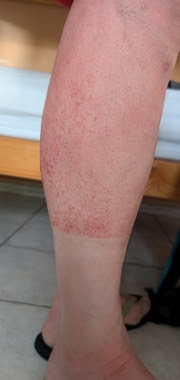
Because we were walking in a state of grace, we were both spared The Wolf aka Tinea crurisscrot rot, dhobi itch, jock itch, intertrigo inguinal, Eczema marginatum. But my legs were brightened by a rather wonderful case of Disney Rash aka exercise-induced vasculitis, hiker's rash: an inflammation, commonest in elderly women, of the subcutaneous capillaries of the lower leg [as R on my own-self leg]. The combination of unwonted exercise, high temperature and susceptibility will do it for you. Not the same as sunburn which is a) epidermal b) uniform in colour c) painful. A case of the Disney's is a good example of the breakdown of a homeostatic system as we age. Although it looks alarming, it resolves itself quickly once the insult is mitigated. Children don't get hiker's rash because their peripheral temperature control is much better regulated and their capillaries are springy.

You can see [R] also that socks provide some protection - against sun and as support-hose. It also seems that we made our move in a timely manner. This last weekend the Béarn sections of the GR65 were suffering 40°C daytime temperatures. Phew wot a scorcher!

Friday, 27 June 2025

Lavendaria

The late Duke of Edinburgh had a quip "biggest waste of water in the world: pee half a pint and flush two gallons"; which I've cited before. I give similar side-eye to putting clothes, and household 'linens' through a washing-machine after a single use. This partly driven by the easy availability of the tech [cheap electricity; the complex of builders, surfactants, enzymes, and fresh-smell in detergents; cheap water] and partly by a fear of smelling of anything other than  fresh-smell and flowers. My students generalized this anti-pong aversion from their own and others' oxters to pretty much everything in the lab - especially anything wafting from a Petri-dish. Believe me, you wouldn't be so keen on the scrub-a-dub if you had to suds the clothes in the bath - which I did for a couple of years in a rented flat in the 1980s - let alone toting a basket down to the communal lavendaria down by the river. When I walked up the remote Atlantic coast of Portugal in 1989, communal clothes-washing by hand was still A Thing. In 2004, walking from Portugal to Santiago with The Boy, the village lavendaria were still there, but unused. I packed two shirts for seven weeks. Part of the ritual of landing for the night was to wash today's shirt and hang it out to dry while wearing tomorrow's for the evening.

For the second week in June this year, I was again marching with The Boy, and living out of backpacks. At the first gîte, a washing machine was available for a nominal €2 extra. One of the other pilgrims said we could throw our kit in with his, which worked out well for everyone. It was the south of France, the sun was still up, the clothes bone-dried before we went to bed. At the Gîte Communal in Navarrenx, two days later, Aurélien l'hôte had formalized this water-saving practice: Please don't wash your smalls in the hand-basin, throw them in that basket and I'll put on a wash before dinner. If they are not dry from hanging in in the morning, I run everything through the tumble-drier. I'd rather not, and I guarantee they'll be dry before you leave tomorrow.

Laundry on the Via Podensis is now institutionalized and hand-sudzing is a thing of the past. 

Apart from the laundry water that disappears down the plug-hole to add enormous volume to the water needing treatment, there is also the residual water in the damp clothes. M'daughers are sharing a tiny flat in Dublin and have to dry clothes on a rack in the living room. The water has nowhere to go so there is a perennial damp problem. Now that everyone has a washing-machine at home, the next white-goods must-have will be a de-humidifier.

There is no truth in the the etymology of laundry having anything to do with laying sheets out on a lawn to dry. Laundry is rather a corruption of old French lavandier one who washes, ultimately from Latin lavar to wash. And lavender Lavandula spica [as above L] has nothing to do with it either, despite the old fashioned custom of putting sprays of that plant in amongst the bed-sheets.  Lawn  n., a fine white linen/cotton 'Cambric' fabric, associated with the vestments of Anglican bishops derives from the town of Laon in NE France. Cambric aka otoh comes from Cambrai = Kamerijk a weaving town 100km further North in French Flanders.

Monday, 23 June 2025

The church as refuge

I promised more copy on the process of pilgrimage. Which seems a little pretentious because we were only a week on the chemin at the beginning of June; we were going the wrong way; I don't believe the credo. Nevertheless we chose to walk the GR65 because it was the direct continuation of my solo run from Santiago to France in 2004. the GR65 also happens to be the Via Podensis, one of the main pilgrim autostriders to Santiago de Compostella. 

Actual practicing religious pilgrims are a minority, even amongst those who are collecting stamps in their credentials along the way towards obtaining their Compostelle certificate when they finally arrive at the City of God. The Boy was toting a [gîte and restaurant locating] device with access to GBs of data. On about Day 4, after asking for requests, he fired up Spotify to play a bewildering number of different versions of Ultreïa. He was in his on-line element. A while later, noting ear buds attached to a hiker, he stopped the feller and offered to swap Spotilists. The other chap wasn't interested: he was listening to prayers with an occasional break for Gregorian chant.

Compared to the Spanish section of the Camino Frances, the Via Podensis not too busy, it doesn't require crampons and is reasonably well served for dinner bed and breakfast . . . and water.

Nature I loved, and, next to Nature, Art Water I loved, and, next to water, shade:

The striking commonality of all the medieval churches along The Way is how chill they are; even if the sun is broiling your hat outside. Cool and quiet, a bit dusty, maybe; but there are seats and anyone can afford to take five minutes for reflection. If you can't spare five minutes in your race to the next hostelry; then your need to take 15 minutes!

Churches have graveyards, graves have flowers, so there is usually water somewhere in the churchyard. If it is roof-water caught in a rain-butt, you may not fancy drinking the stuff; but you can slop some over your face and neck. Several isolated churches announced the presence of eau potable from a reg'lar tap. Fill your water bottle chaps, it may be 10km to the next village. 

We had planned to stop in the village of Pimbo on our penultimate night but had been advised by a kind and energetic fellow earlier in the day to push on to a magical gîte in Miramont-Sensacq. But the church in Pimbo had a pretty garden and an invitingly cool interior: so we stepped inside. There to find that the parish recognised that some travellers might be penniless but nevertheless need shelter:

Yes, a rough blanket and a sleeping mat will be sufficient. It was now 13:20hrs, we were 2 hours from Miramont and day's end. We could power onwards in the hope of getting the best bunks . . . or . . . we could wait until 2pm when the gelataria in the square opened. "Black cherry for me" I announced and sacked out under a tree. When I came to, The Boy was coming out of the shop with two bowls of ice cream and two ice cold drinks. "Black cherry sorbet for me", he said "and I couldn't resist a boule de stracciatella on the side".  And that, folks, is how the village became known as Pimbo-les-trois-boules.

Friday, 20 June 2025

Honey I'm un homme

Two weeks ago, I checked in to checkout: planning to catch my first plane in 5 years and make my first trip to continental Europe since I don't know when. A two-handed Thelma&Louise with The Boy was more-or-less mission accomplished and we are now back on our respective, and respected, sofas. Turns out that my français d'ecole affreux is good enough to ask/give directions on le chemin or engage in dinner-table chat. Not enough to make 
1. a convincing political solution to the disaster that is Brexit 
2. discuss the differences between a buzzard and a blackbird 
3. hold a torch for Michel de Montaigne [whom prev], though.

Normal people walk the Via Podensis along the way-marked GR65, starting at Geneva [for hard-chaws and Swiss peeps] or Le Puy and walk West towards The City of God Santiago de Compostella. Very few of those on The Way are through-hikers: it is a privilege of the retired, the independently wealthy and the completely indigent to be able to take 100 days out of their lives to trek the 2,000km in one go. Most folks we met, were doing the pilgrimage / walk is sections: a week or a fortnight at a time over several years of Summer holidays. Wherever and whenever you start, there will be others walking in the same direction at more or less the same pace and they'll keep turning up in your life as you pause to pop blisters or drink beer. You'll talk more to these people, more intensely, than anybody outside your immediate family.

Bat-shit folks walk au contraire, against the tide of humanity, and meet a lot more people but for no more than one night and two meals. That's what me and The Boy opted to dothis year and the way I approached the Camino Frances in 2004: slouching from Santiago to St Jean Pied de Porte in the Pyrénées-Atlantiques départemente of Aquitaine. St Jean PdeP is where started on Saturday 8th June; having bought sandwiches, water, some postage stamps and an Opinel #6 clasp-knife. It will surprise no Irish person that, coming out of the boulangerie, we were hailed by another walker, who lives in the Wexford village about 3km from home. She was yomping the GR10 another waymarked route which stretches from the Med to the Atlantic on the French side of the Pyrenees. All the GRs are designed and marked with 🇵🇱s to go both ways but there is much more additional signage for Direction Compostelle.

We were only led astray through inattention [and super-discrete to absent signage]on three occasions out of hundreds of cross-roads or forks in the path. Last time The Boy and I walked in 2004, Google Maps was not yet born. 21 years later, if you have a phone with data, navigation is a cinch. 

We slept [more or less this route in reverse]

  • Ostabat Sat
  • Saint Palais WhitSun
  • Navarrenx Mon
  • Arthez-de-Béarn Tue
  • Fichous-Riumayou Wed
  • Miramot-Sensacq Thu
  • Aire sur l'Adour Fri
  • train to Bordeaux for Sat

That's the bare bones, I am still distilling the experience and will have more to say in the coming blobdays. Depending on sources, MiamMiam DoDo, GoogleMaps, many different commercial, municipal and non=profit URLs we done walk ~170km. Power User Hint: don't buy the Miam-Miam Dodo guide to the Vezelay Chemin de Compostelle  = GR654 if you're determined to walk the GR65 Via Podensis! The GR65, GR655 and GR654 all converge on the (one church, one boulangerie) village of Ostabat one stage North of St Jean PdeP causing accommodation to creak at the seams.

Friday, 6 June 2025

yellow brick road

A New England. ♩ was 21 years when The Boy was bor♬ . . . ♪'m 70 now but I won't be for lo♫ g. In 2004, I'd just turned 50 and retired [retire early and retire often has been my lifetime strategy] and announced that I was ready for a long walk in Spain. The Boy did me a solid by saying he'd komm mit. We pulled into Santiago on The Day:

Looking [too] closely, it is apparent that the older man is still portering 10kg of lard. That had all gone by the time I arrived, 800km later, at St Jean Pied de Porte in September. 

This evening we're meeting in Bayonne 64 with the intention of walking North a piece out of St Jean along the GR65. That is one of the many sentier de Grande Randonnée which criss-cross Western Europe in a largely car-free network of walking routes. GR65 is the French section Chemin de Saint-Jacques aka Via Podiensis and starts / finishes in Geneva / Santiago. In 2019, I was getting ready to retire [retire early and retire often has been my lifetime strategy] in the Summer of 2020. I fantasized about walking from St Jean to Cherbourg as the third and final stage of my 25 year walk from the furthest tip of Portugal to Home. Coronarama put the kibosh on that but my plan was taken aboard by The Boy who said he intended to komm mit agane

Ho Ho, he is now the age I was in the photo above and much fitter so def'n'y able for a 150km yomp along a waymarked sentier. Me, maybe not so much: I've been moaning that it's 5 years too late for me. But, as I mentioned a tuthree weeks ago, I've been in training for a month, and can now "sprint" 2km up a 10% slope in less than 25 mins. That's only vaguely related to being able to keep going at that pace for 30km. We have dinner booked on Saturday that far away from St Jean - so my knees had better be good enough.  Ultreïa!? ♬ ♪ ♫ ♩

Blob posts will be patchy to absent! 

Monday, 19 May 2025

Walking the line of nicety

Last Saturday, like every 3rd Saturday of May for the last 30+ years, The Wayfarers Association ran organized, the Blackstairs Challenge: a 33 km up hill and down dale yomp from Killanure to Glynn via Mt Leinster [780m] and Blackstair [735m]. In earlier times, the route took in Knockroe [540m] with walkers lepping off the S face of the hill and tumbling 300m in less than 1km horizontal. That hard-chaw route is now deprecated and everyone [N=180 this year] comes down our lane. Last year and most of the previous 20+ years, we have serviced this worthy endeavour: first with a) water, then b) seats, then c) flapjacks. There is no doubt these trifling courtesies are used & appreciated:

. . . especially on years like 2025 when the weather is cloudless because shade trees are absent.  The hike starts at 07:30-08:30 and there is a 13:00 ½-way checkpoint just South of us. If you're not there, by then, you are obliged to bug out. The first runners trotted past our gaff at 09:30 and the sweepers paused to finish the flapjacks at 12:30. The sweepers are super fit Effectives with calves like knotted cords who ensure that nobody is left behind in the hills.

In that window, the participants came through in pairs and clumps, not all of them stopping to bide-a-wee in our yard. In between groups, I nipped out to make sure the tap was shut and there were still flapjacks in the tin. Imagine the mortification when, on such a foray at ~10:30, I noticed a jam-jar full of coins beside the tap. Donations have been made before and they aren't refused, but someone had put a "Trail Fairies" label on the jar, which echoed the "Trail Fairies" I put out on the >>Water>> sign several years ago. The shame that walkers might think we were soliciting money for water like it was transactional!! I was instructed to disappear that jar forthwith. Which solved our face-saving issues but put subsequent walkers to a dilemma . . . solved by putting folding money [as L] under a weight on the flapjack table. The jar? enough for 4 trips across the Waterford toll-bridge!

I, for sure, do not spend the morning chatting with the walkers - they have things to do and places to go. But I was caught at the tap by a feller who said thanks for all the fish cookies: "It's not about the cookies; it's about being seen and received" which I thought was a very gracious way of putting the trail fairy relationship. Being on the tramp (Blackstairs or Santiago or PCT) can be lonely and exhausting, so it's nice to be cared for as you might be at home.

Shortly after the hullabaloo faded away, a delegation from The Wayfarers materialized in the yard to present us with a bottle of whiskey; which is getting to be a habit with them. Even without being a boozer, a bottle of Paddy is always handy to have about the house . . . in case someone faints, like. I intend to make a batch of whiskey marmalade with the frozen sevilles left over from this year's marmalade jamboree.

Friday, 7 February 2025

Harry's Gate

No, not Harry's Game; read on.  In March 1996, after six years a-lookin' we bought an old farm-house (with 7 hectares and some outbuildings) halfway up a hill in the Irish Midlands. It required A Lot of work: the 1941 vintage house had no plumbing (inside or out); the electric was rudimentary; half the front-door was missing; and there was a long-ignored hole in the roof. The Beloved was the contractor - sourcing well-borers, plumbers, sparkies, central heating ppl able for underfloor heating, tilers, builders, carpenters . . . who all came in series or parallel as required. It took a year of unremitting effort, by-passing obstacles great and small; incl. driving the lads to keep working till 6pm rather than gawping at Comet Hale-Bopp. Don't imagine I did much on site - I was usually in town

We threw a party for everyone and their families on the Sunday of St. Patrick's weekend 1997 and woke up in our own new beds, in our own new bedrooms, in our own new home. We had exhausted all our treasure and stamina and had still only made the farm-house habitable. But it was enough core infrastructure to start raising two small girls, a few sheep and some chickens; and living the good life. It took ten (10) years to get our mojo back for building.  In 2007 a couple of craftsman builders Harry and James coursed over our horizon and were tasked to put a slated roof on the most solid of the derelict sheds. They were only in roofing for the money: James was an architectural heritage bloke: all lime-mortar and details; while Harry was an artist in metalwork who would have stopped in his forge if there was any market for his craft. They were a bit on the blow-in side, like ourselves, and I remember a few hilarious lunches when they came up to the kitchen for soup and cold-cuts.

When the slating was done, we had pity on young Harry and commissioned him to make two steel arty "pedestrian" gates to keep dogs and sheep out of the garden while allowing easy human access [it's all in the hanging and the hinges]. I had recently returned from Santiago and the design referenced the concha de peregrino. A very few of the hikers up our lane have caught the reference and talked about their own camino. Here is Harry's top gate between the two granite pillars that I made a bit more vertical to frame (and hang) the steel.

Now, I ask you: does it look like a gate? Despite the the sunburst / scallop design, it still looks like a gate, yes? rather than a bedstead . . . or a toilet?? 

but one walker last week was bamboozled enough, by a trick of the light or an optical illusion, to squat in the lee of the gatepost for a piddle. Fine, fair enough, but also thought it was fine fair enough to leave her tinkle tissue for me to pick up and contribute to our compost heap. They say that Chinese peasant farmers with holdings abutting the road would install a closet with a bucket in the hope of securing some humanure as free fertilizer. But we're not in Kansas China anymore! It's not the first time I've had to clean up after the entitled.


Monday, 27 January 2025

Ewe woo

John Connell [prev] is getting traction as spokesman for the Irish countryside, although the competition Manchán Magan [prev] has landed his own TV series. And don't dismiss Kerri ní Dochartaigh [prev] just because of the missing Y-chromosome. It is certainly possible to speak {to | of | for | from} The Land as a wordsmith [Wordsworth wandering lonely as a cloud; Yeats having nine bean rows]. And shite happens in the countryside that is nothing to do with farm yard manure. But of the three living spokesppl cited above, only Connell has had his hand regularly up a sheep's vagina and we should therefore listen to him on that facet of rural life.

We were up in Dublin recently and Dau.I the Librarian pushed John Connell's 2024 Twelve Sheep life lessons from a lambing season at me because a) I'd read a couple of his earlier books b) I count a similar number of sheep every day c) we'd both trudged to Santiago at some time in the past. The conceit here is that young(ish) John buys 12 hoggets [equivalent to a heifer; a female sheep up until her first lamb delivery] from his farmer father, and tracks them through twelve chapters sort of based on the agricultural year. Or at least on the 5 months of sheep gestation. 

Early on, Connell floats the idea that the has-to-be-twelve chapters could be based on, or informed by: the zodiac [one of which is ♈︎Aries?] or the Labors of Hercules [mucking out the Augean stables?] or the Lives of the Apostles [good shepherds all?]. But (correct me if I've missed a trick) he lacks the discipline to chunk his anecdotes by these constraints. Joyce's Ulysses is a classic because he did follow through: holding the Odyssey up to mirror one inconsequential day in the life of Dublin.  

Whatever the initial aspiration of structure, the book gets flubby soon enough with too many rambling thoughts unrelated to caring for sheep and delivering lambs. The Sheep Game it is not. In current public discourse, there is a lot of Nobel Hubris about and not only among winners of The Prize. N.H. occurs when, because you've got the gong, people will listen to what you have to say about any damn bee you might have a-buzzzing in your bonnet. Connell has an ingrained expertise in scratching a living from The Land - and nobody claims farming is either lucrative or easy. But when it comes to philosophy (how we can live our best lives) he is no wiser or more competent than you or me. Been to Santiago [✓] doesn't count: I know . . . that I don't know.

There could be another story in there: a bildungsroman about the growth and development of the lambs Connell Jnr as he battles mental health and the patriarch[y] to discover his true self but that theme is very much noises off. And may have been resolved in Connell's earlier books.

A lot of the usual suspects get a mention because something they've said has been written in Connell's writer's notebook . . . and that'll do to pad out this book. Because despite 176 dead-tree pages and £12.99 rrp the generous margins, nice colophons [as above L] and 1.5pt spacing, makes Twelve Sheep only 36,000 words long. 

Influencers in Connell's journey include: John Clare; Rachel Carson; Henry Thoreau; Henri Nouwen; John O'Donohue; Hermann Hesse; Heinrich Harrer; Martin Heidegger; Erich Hartmann; the Dahlia Lama; the Buddha; Narcisse Blood; John McGahern; Thomas Merton; Father Sean, Bruce Chatwin; Erling Kagge; Thích Nhất Hạnh; Fran Contreras; Paolo Coelho; Saint Francis;  Fergus Kelly; E.M. Forster; David Malouf; Carlo Rovelli; Michael Kelly; Rover Thomas; Raven; Maria Gonzales; Wendell Berry; Nicholas Shakespeare; John Bergman; Karen Emslie; Robert Hughes; Don Watson; Adrian Stimson; Bruce Pascoe; Chief Joseph; Alex Haley; August Schenck; Padriag Colum; Pauline Matarasso; Yukio Mishima; Sam Shepard. They are all given parity of esteem word-count with an unnamed Longford neighbour who claims to cure strawberry orf [contagious pustular dermatitis; a bit like a viral impetigo] by muttering prayers down the phone. Life lessons for the reader? I don't think so.

Monday, 19 August 2024

Bangor to Bobbio

I've been circling round Teagasc, the agri-food semi-state institution, since it was An Foras Talúntais. Some of my best academic-adjacent friends have worked or are working there. But despite this leaven, Teagasc is generally conservative, complacent and dull. This long week (18th-25th August) is Heritage Week and Teagasc's Friday agri-zoom call went early with a talk: Discovering Heritage Through Old Routeways - Ireland's Pilgrim Paths by John G O'Dwyer (Chair of Pilgrim Paths Ireland) with promo by Ronan Healy (Project Manager National Heritage Week at the Heritage Council). With a redundancy typical of the feather-bedded Irish semi-states, it requires two Teagasc people to introduce these talks, one of whom is nail-bitingly poor at public speaking; did I say 'dull'?

This year there are 2,200 events comprehending a very broad definition of Heritage: walks, talks, bees, lighthouses, gardening, painting, baskets, céilí, science. Chekkitout? especially for kids?? they've made efforts to be inclusive.

John G has written The Book on Irish (hill) Walks, but more to the point he's written Pilgrim Paths in Ireland - A guide from Slieve Mish to Skellig Michael. He was also one of the main movers to establish St Declan's Way from Cashel to Ardmore which was officially opened in 2021 [Event tomo!]. Dau.II and I clocked the finger posts where the St.Dec crossed the N25 on the couple of pandemic trips we made to&from Cork. Here's a JGO'D mnemonic D.A.R.E.S. to suss pilgrimage:

  • D iscovery, self-
  • A ppreciation, for grace and favours from the almighty
  • R emembering those gone before
  • E scape from the press and stress
  • S implify, simplify [Thoreauprev]

Oddly enough, in the question session on Friday, O'Dwyer professed to know nothing about Turas Columbanus despite the fact that the local-to-me part of that trek has finger posts all over Co Carlow.

"All over" because the route zig-zags back and forth across the county after it lurches away from the River Barrow at Borris or at Clashganny heading for Mt Leinster and Myshall before rejoining the River at Bagenalstown. We cross the Turas 3x getting to our nearest Aldi. This turns a lovely flat [kingfishers, dragonflies, swallows, otters, buzzards, fish] 12 km walk along the towpath of the Barrow navigation into 36 km of schlep along country roads shared with litter, boy-racers, tractors roaring past with trailers of livestock shitting themselves on the way to termination. There are no verges on much of this voyage, let along footpaths; so you must be prepared to plunge into nettles and briars or meet your maker plastered on a front bumper like an extra in Herzog's film about driving-while-txtn. Much as I deprecate sanitizing the Camino de Santiago by taking all the hard bits out; I can't approve of paying for and setting out a set of laminated pilgrim story-boards linked by finger-posts without contemplating how pilgrims are going to navigate with reasonable safety. 

Turas Columbanus follows the life story of St Colmán aka Columbanus starting at Bangor, Co Down and jinking hither and yon until it finishes in Bobbio between Milan and Genoa in N Italy. It takes in pretty much everywhere where legend has it that Columbanus laid his head or knelt at a tomb. Fermanagh, Cornwall, St Malo, St Coulomb [no surprises there?] Rouen, Luxeuil-les-Bains, Soissons, [Hildegard von] Bingen,Tours, Nantes, Schengen, Koblenz . . . all over.

When they / we do the Camino de Santiago, most pilgrims acquire their "credential" = passport at the start of their journey, and get it stampe at each refugio and hostel. Although there are many Camino to Santiago, they all finish at the City of God. In Ireland it's more of a free-for-all. Several Saints, several destinations. Presenting your credential at an office in Santiago gets you your Compostelle: a document asserting that you've walked at least 100 km in the right direction.  Ballintubber Abbey in Co. Mayo has taken up this bureaucratic mantel: taking €5 for a passport and €15 for your personalized Teastas Oilithreachta:

Whoa! and, like, Whoo-hoo. There's our own St Fursey hanging out with more famous saints like Patrick, Kevin, Brendan, and Finbarr. Maybe Ballintubber will up-date their docs to include St Declan of the Déise. At least we know where to walk in his footsteps. I cannot get any handle on a Camino Fursana, but hazard a guess that it involves Headford.

Time was that tourists came to Ireland for the fishing - they said in 1990 that every rod-caught salmon added £1,000 to the economy (B&B, pints, car-hire, dinner, céilí, souvenirs). But we sacrificed the salmon on the EU altar and shat in all the rivers, so that was the end of that. Folks like John G O'Dwyer are starry-eyed about the possibility of making up the deficit in the rural economy through pilgrimage. May the road rise to meet them!

Wednesday, 7 August 2024

Rockie Cake

Part of my adoptive US family (4) have moved back to Colorado. They (there are six in my generation) all grew up in Michigan but liked to acknowledge that, in the 19thC, they came from the same Townland as we now reside. I rendered them, particularly their Mère, a trifling kindness 20+ years ago and they've been visiting ever since. It's nice to know that me and mine can find a cup of tea and a sandwich in several widely scattered locations across the contiguous 48 states. Anyway, Coz Tom and his 3 generation family are back in the Rockies and their youngest member had a birthday at the end of July. As is my wont, I facetiously sent them a picture of an extravagantly decorated cake in lieu of an actual card.  Tom replied "Thanks again for thinking of us and wish you were able to bring that cake in person. Looks delicious!"

That tumbled me down the rabbit hole of memory to baking Betty Crocker cakes in Boston 40+ years ago. I did so make from-scratch cakes also but baking cakes straight from a packet - just add water and 1 egg - was/is part of the American Dream. One of the intriguing / evocative aspects of reading the packet was special hoops that people from Denver had to jump through lest their cakes failed to rise and/or experienced a soggy middle. Denver is affectionately known as The Mile High City because it is 1,600m above sea-level.

Because air pressure is lower, cakes tend to be fizzier, boiling temperatures are lower and liquids evaporate faster, and you shouldn't follow the standard recipe. The scientists at Betty Crocker give some hints about what to do above 3,500 ft = a tad over 1,000 m. The atmospheric issues require some of:

  • less fat
  • more flour
  • more water
  • more time

But the exact details are probably too much for the average recipe-following cook to work out for themselves - and why re-invent the wheel? 

But here's the thing, I went for a yomp up our hill (1500m horizontal; 300m vertical) for reasons with 3 other people, two of which were struggling [1 sinus; 1 smoking] for wind. I'm good for that but the ould knees are less resilient than they used to be for the downhill. Just getting to that elevation (500m) let alone Ireland's highest mountain Carrauntoohill (1040m) requires exertion. Our effort occurred on Dia do Santiago a date notable for aspects of pilgrimage and at least one member of the party crossed themselves discretely for/at/to the Blessed Virgin: perhaps in gratitude for not pegging out on the way. Meanwhile Coz Tom and his family are cruising to the Mall (and adjusting their cakes) without a bother at 1,500 m.

Monday, 19 February 2024

Spirit of Place

Que vengan los peregrinos! Not everyone who walks to Canterbury, or Rome, or Jerusalem is a believer. But such pilgrims are likely to be changed by [getting off the sofa, leaving the daily and] going. It's a bit like people with an OU degree: it's often worth biding a while to talk with those who've been there, done that. My book about Santiago and the process of pilgrimage remains [ahem!] unpublished. As they say, though: "When the walking stops, the Camino continues".

Over the last tuthree years, I've been sitting on my sofa watching two men, once-and-future-pilgrims, getting physical with, and making their mark upon, the unforgiving terroir of a mountain in Piedmont. It turns out to be quite close to the Franco-Italian borrrder, where we were graciously - miraculously - sustained with Found Soup in 1978. 

  • Martijn Doolaard is a graphic designer and film-maker from Amsterdam with two Long-distance bike trips [A'dam-Singapore; Vancouver - Patagonia] behind him. [TMI about his prev life]
  • Fr. Johannes Schwarz is a diocesan Catholic priest from Austria. He walked from home to Santiago as a chap in 1998, then from home to Jerusalem - and back. Fr.J. also has a photographer's eye so, as well as chasuble and pyx, he toted a GoPro along The Way.

These two men washed up on different sides of an inaccessible mountain in the Italian Alps. Both chose to restore tumble-down stone buildings clinging to the side of the mountainside by their finger-nails. Both decided to document the process of transformation [internal, external] in the medium in their tool-kit. Both have established successful YouTube channels by doing stuff the hard way. Both were helped to YT-click-fame by the attention of Kirsten Dirksen who takes a film-crew to aspirant sustainability steaders and asks them to explain themselves: Johannes [05 Dec 2021] and Martijn [01 Nov 2021].

I have a couple of things to say about The Hard Way - informed by 25 years experience of chopping water and hauling wood. We spent the month of July 1996 camping out on our newly acquired property: with hand-tools, two wheel-barrows and a sack-truck. It was fine, we were putting manners on the place while finding trades-folks to do the skilled work. Doran-the-Well lived at the other end of the townland and he came to see how close he could get his drill-rig to the house. Which was not close enough: because the original farm-gate required too tight a turn for his mobile derrick to get in the yard. But, his BiL was Nolan-the-Digger [bloboprev] and he could surely open up that ditch . . . next Saturday, maybe? Not only could the digger move rocks impossible to shift with hand-tools; it also moved a lorra regular dirt and could scart off the bushes from the top of a ditch with a single comprehensive sweep. I didn't stop using a wheel-barrow but I did thereafter book a day from The Digger when heavy lifting was required.

Me and Johannes agree on the virtues {warms you thrice} of reducing firewood to billets and stacking them by hand. Chain saws are so bloody noisy you can't work away while listening to an ear-book. But, it's a good idea to leave felled timber at the cutting site [under rain-cover] for a few breezy months before moving the logs to the firewood processing place nearer the house. Wood gets lighter as the water blows off. Martijn does this, Johannes apparently not. Likewise no sane person will carry building stone up-hill if there's a choice but it's got to be possible to use gravity to help stones downhill that doesn't involve having gravity destroy your knees [as above R].

And further to the picture: building drystone walls is a doddle if the geochemistry generates parallel flat sides as above. If you have a choice don't settle in granite country, the stones are irregular, lumpy and too hard to shape with a hammer-tock or two. Ask me how I know!?

Vernacular architecture inhabits a known place and can build on [lit and fig] the lived experience of those who sojourn there. Johannes' gaff faces South and is tucked into the hill. So, like our place, the snow and frost burns away soon after the sun comes up. And he can see the prevailing wind thrashing the trees on the other side of the valley but not feel it. Martijn's place is, rather, exposed to the weather which can be darkly destructive [L tumbled solar panels] so high on the ridge. And, for him, the sun rises later and sets earlier so the snow lingers for days or weeks longer. Yet, these two steadings are only 1 km apart.

Like the underlying geology, the local micro-climate may make or break your rural dream homestead. Johannes is very conscious about microclimate for growing plants at the very edge of their ecological tolerance. Man, does he relish late season tomatoes and salad!

But I'm here to recommend Johannes' sub-channel One Year in the Life of a Part Time Hermit where he runs through 2023 with a 45m episode of every month. Usual fly-on-wall view of projects and general chopping wood, heaving rocks and weeding the veg-beds: gorgeous film of weather, sunsets, birbs and butterflies; minimal voice-over; informative on-screen notes [check the bot tight corner of screen for ID]. He had, or had at one point, left three holes [one shown R] in the render of the sunny side of his hermitage - so that the resident common wall lizards Podarcis muralis could bunk down at night. The Cave of St George for the teeny dragon!

But, as he warns in the short intro to the series, the last ten minutes of each video is a thoughtful under-stated ramble on religion, philosophy, history, science and the meaning of life. Here's part of what he has to say in May: So let me make this clear. I'm not a guru. I'm not a spiritual master. I'm not a person to aspire to meet or even talk to. You don't need me. You don't need to discern any secrets in my life or take me as an example. I am fundamentally like you – a man, a fallible man, a human. If you find any of the propositions in these videos helpful; if anything that is said rings true – or at least, if any of the questions do, it is not because I'm a source of wisdom. Jan - Feb - then you're on yer ownio. He's been putting them out at the rate of one episode a week since New Year.

Wednesday, 9 August 2023

Pilgrim's Progress

. . . from this world to that which is to come. [that's Bunyan] I'm sorry to hear that John "Camino" Brierley, enthusiastic writer about, and facilitator of ,the process of pilgrimage, is dead. Cancer; at Dartmouth in the S.W of England.  He's a few years older than me but still had a lot to give. I gather that his daughter Gemma has been recently taking up the slack on the relentless process of churning out his useful and appealing guides to the several Caminos leading to Santiago de Compostella. Few indeed achieve satori from the exercise and many are disappointed that their pilgrimage hasn't worked. But lookit, one of the wise people I met on my Camino in Regresso in 2004 quipped: "When your camino ends, the journey begins". Because change is hard; but the most difficult task is to change ourselves.

It's easy to give a tetchy harrumph to the idea of pilgrim guidebooks. That elusive satori may slip through your fingers if you treat the journey as paint-by-numbers. I remember space-time being disturbed by a turmoil of anxiety when I encountered a group of pilgrims at one of the rare forks in the road which were missing the    to show The Way as if that direction was the only option at any intersection. But heck, it's hard enough to walk 100km or 700km to Santiago without doing it on your knees . . . or without a Brierley booklet. No need to go all Joshua Slocum circumnavigating the globe with an old alarm clock for a chronometer - GPS is okay. And, for sure, the demand is there: 1 million copies have been sold in several languages.

 My sister met Johnny Brierley in the 1980s when they were both finding their way in Findhorn. Years later, we all went for a pint in Slad, Gloucs about 5 years after I returned from Fisterra. I was on the fifth draft of my own Analysis of the Process of Pilgrimage and realising that writing the goll-dang thing was enough and it didn't need to be published. As you do, we swapped yarns and ideas about Santiago, the Camino and life-the-universe-and-everything. I liked him and wasn't off-put by the inner light which made his gaze a bit intense. I sent him a message and he replied

I, likewise, enjoyed our brief encounter and stories of El Camino. Thank you for sending me your treatise on the adventures through Portugal and Spain – I found it delightful and illuminating to read and I particularly endorse the tripartite nature of an extended walk and the need to 'allow the time it takes'. It is also my experience that the journey only really deepens to a spiritual dimension once sufficient time has been spent in the physical and psychological realms. Alas too often we allow time constraints to interfere with the alchemical process and to rob us of the potential of achieving altered states (whether body, mind or soul).
Let the journey continue with joy and lightness of step. Johnny.

Gemma Brierley has apparently been instrumental in getting the Camino Inglés to Santiago from Reading to Southampton into a state fit for pilgrimage - more yellow arrows are doubtless needed! Johnny's death created a bit a stir at the time [Obits - Guardian -- Camino Society wch was syndicated to The Reactograph] but not enough to ring my doorbell then. Here's Johnny talking quietly YT-4½min about empty mind. Ultreïa? Sing it!

Wednesday, 2 August 2023

Pedigree etymologee

 I secured my first proper job in a British University in NE England. I spent a lot of time in the University library. Reading to work out what I wanted to teach in my course Evolution: from primeval soup to hominid nuts; at evening book-binding class / workshop; scouring the stacks in search of something for the weekend. I was six years = 300 weekends in post, so by the time I jacked it in to walk up the coast of Portugal, I had borrowed a lot of books. Butterfly me never thought to keep a record of my butterfly reading until I was so many books under the bridge that it seemed futile. Part of me wanted to ask for a download of the electronic records of my borrowings but I was too shy and that never happened. I do remember looking at the date-stamp fiche in the fly of each book and reflecting that I was either a) the first person ever to borrow that book or b) it was years and years since the last person. Reading off piste gave an airing to so many minority books. 

I was reminded of those distant days when I ordered up a 50 year old book from Libraries Ireland towards the middle of July. It arrived (from Limerick) rather quickly because nobody else had wanted to read it since 1976! I was induced to read it by Brett Westwood talking to Michael Rosen in an episode of the latter's Word of Mouth podcast: Lords and Ladies: Folk Names for Plants and Flowers. And the book is Pedigree : The Origins of Words from Nature (1973) by Stephen Potter & Rev. Laurens C. Sargent, which is #56 in Collins New Naturalist series.

There are no car-chases or explosions in this book which was compiled from a ragged collection of Potter's notes after he died. Potter is better is better known for his book Gamesmanship or The Art Of Winning Games Without Actually Cheating (1947). Indeed, notwithstanding the book-plate [L] it is not the book to borrow from the library and read over the next 20 days: it is too dense with Indo-European roots and 17thC citations to be a breezy read. There is a microfont index at the back with 2,000+ entries you need to absorb that much detail over several sessions. Dang but I thought from the context that "from Willughby" was a placename in England but it turned out to be the naturalist Francis Willughby FRS (1635 – 1672). Taking notes from Potter's book of notes could be a Korzybski's Errand because the map will be the territory.

Still and all, I did learn a lot by judiciously plucking words, phrases and explanations from the data-deluge as it roared past my eyes. Potter notes that raven seems to be a long old way etymologically from corvus . . . unless you know that Anglo-Saxon hraefn shares a legitimate first syllable root with cor. That rang a bell because of a similar connexion between our and L. cor, cordis. Both derived from *ḱérd (“heart”):

  • either M.E. herte, from O.E. heorte  from Proto-West Germanic *hertā, from Proto-Germanic *hertô 
  • or L. cordis via Gk καρδιά

With great good timing Aedin Ni Thiarnaigh, of Bláthanna Fiáine Walking Tours was talking up the naming of plants on RTE on Dia do Santiago last week.

Friday, 21 October 2022

Slouching to Jerusalem

 I was quite snitty about Tim Egan's reportage on the Via Francigena from Canterbury to Rome. My main gripe was that he embarked on his journey specifically to monetize the experience with another of his well-crafted books: it was performative. My experience of pilgrimage is that it can be a massive fail if you start with expectations - those expectations tend to blinker the pilgrim to the new . . . including the numinous. I remember St James's Day 2004: lining up with The Boy in the broad stairwell to get our Compostella in Santiago. Slumped on a step another pilgrim wailed "is that all?" to his mates: all that trudge, all those blisters and still untransfigured - robbed.

The Lawd The Borrowbox Algorithm must be calling me back to The Way because, no sooner had I ticked off Tim Egan, but I was reading The Crossway [2018] by Guy Stagg. He walked the Via Francigena in 2013 starting in midwinter and crossing the Col du Grand St-Bernard . . . in a whiteout. He should have died, but he figured that in the old days many pilgrims made it, so it was possible. Being from The Arts Block, he didn't care to get out the back of an envelope to determine probable? He arrived in Rome, did the sights but had not intended to stop. Rather, he set out across Italy on the Appian Way to Bari, picked up the Via Egnatia in Durrës, Albania and walked to Constantinople. Loving but leaving a green-eyed Albania girl called Esme.

He had a tent and a sleeping bag but generally he was handed off from one refuge to another, sharing dinner with monks and sleeping in austere bunks. He stayed briefly in Meteora, Greece [R] as well as Mount Athos. The week he arrived in Istanbul, the riots against Erdoğan kicked off and the journalist in him hung around to get tear-gassed . . . but not pepper-sprayed or, like, shot. But The City, like Rome, was only a way-station to The Promised Land. 

Turkish hospitality took him further along the way to more flat-bread, olives and cheese in Cyprus, Lebanon and Israel. He couldn't go through Syria because Sarin. He arrived in Jerusalem and did the round of sites in the various quarters of the city. He had accepted that he too was going to be untransfigured at the Dome of The Rock but healing and redemption had been dumped from his agenda a good many miles back along the journey. Like a real pilgrim, who goes beyond Santiago to Fisterra, the End of the World, Stagg shoulders his pack and heads East into The Desert. That's not enough either, but it doesn't matter because he's been there under his own steam. If he doesn't believe, he can at least roll back through the (gorgeous) photographic evidence of his journey. Because he is not the same, troubled, youth as he was before he left London. 

Pilgrimage has much to recommend it for unbelievers.

The darkness drops again; but now I know   
That twenty centuries of stony sleep
Were vexed to nightmare by a rocking cradle,   
And what rough beast, its hour come round at last,   
Slouches towards Bethlehem to be born?