We lost a lot of trees in the Darwinday Storm on 12th February this year . . . and gained a lot of fire wood. Or potential firewood, because reducing tons and tons of fallen tree to some sort of order that looks reasonably safe was a couple of days work for two foresters. After that, the urgency to deal with the change was off but we had some heaps of logs ready for splitting, some branches ready to be sawn into log-lengths, five main trunks that were now seven horizontal . . . and several mountainous heaps of brash. Brashing is a technical term for removing side-branches from a tree-trunk prior to sawing it into lengths suitable for processing off-site. Typically the trunks will be sawn into lengths of 8 ft (2400 mm) or maybe 12 ft (3600 mm). The brash is what gets left on the forest floor. If the trees have be processed by a forwarder [watch this 3 min vid-clip: engineers are amazing] the brash tends to get left in rows that follow up the contours of the hill. These remains take forever to rot down but provides habitat for animals and some sort of shelter for the new treelets that often get planted immediately after the last of the trees have been clear-felled.
In a domestic situation like ours the volume of brash (it packs light) is often as great as the useful timber and in the old days folks used to burn it where is lay as a bonfire-in-waiting. But The Man has satellites scanning the land on a 24/7 basis and the plume of smoke from an illicit bonfire will bring the carbon-footprint police down before you've barbequed the first sausage. If left unburned, the brash-heaps become habitat for brambles, nettles, noxious weeds, rats and camping boy scouts.
Yesterday, accordingly, I met Chris del Bosque and the chipping-machine on site for a full day's work pushing the crappy branches through a machine that crushes and dices them and showers the residue out into a dense heap of wood-chip. It was a brilliant late-Summer day, and it was a shame that from 0830 hours we destroyed the peace of the neighbourhood with roaring and grinding sounds. Jings, we could have been down on the beach quietly picking up buoys. But work had to be done and I was really grateful that it hadn't rained for a few days, so everything was dry to handle and nothing was slippy under foot. At the end of the day, we had more of less finished chipping for the foreseeable future and had gained walking access to the whole area that in February was filled with fallen tree. I brought the first six of many bags of wood chip back home to make weed-suppressing paths in the garden. Job well done, Thanks Chris!
Showing posts sorted by relevance for query darwinday. Sort by date Show all posts
Showing posts sorted by relevance for query darwinday. Sort by date Show all posts
Wednesday, 3 September 2014

Monday, 13 January 2025
Bouncing the polytunnel
Did I mention that we had a dump of snow last weekend? I did, in passing. It's true that fallen snow is, like ice-cream, mostly air - let's say it has a density of 10% of liquid/solid water. But that can still be a lorra weight it spread out across a large structure. An under-engineered flat roofed sports complex in Tralee collapsed at 06:00hrs during the recent orange snow and ice warning for the South of Ireland [Galway to Dublin downwards, not the 26 counties]. I'm sure the structural specs took data on 100 year snow events, adding 50% for safety, to determine the size of the trusses. It's a roof: you don't want to over-engineer it because you then have to up-spec the walls to carry the additional weight. There will be an enquiry, everyone will lawyer up, nobody will lose their jobs or be sanctioned. Not least because the structure was opened in 1977, so most of those responsible are dead in the 80s or older.

You can see the effect in the picture for 2 of the eight bays of the tunnel: a gurt hape of heavy snow on the ground and a clean-ish track on the plastic where the snow has scoured off the algae. You can also see one end of the 2014 Darwinday rip covered with fresh white Fablon® since the 2022 refurb by Rene and Kamil.
We hazarded leaving the sheep [N = 15] in the 0.4 ha field adjacent to the tunnel and they've been getting a breakfast of sheep muesli and some rather tasty-smelling hay which we've had in reserve for the last few years [hey, thanks Syl!]. The sheep seem to be doing okay on such short commons.
Wednesday, 12 February 2014
Darwinday 2014
Wake up me hearties and hear the clarion call.
Today is Darwin's birthday, a science-geek festival
This time last year, I wrote an essay about Darwin's careful science and attention to detail, only through which he was able to construct the bigger picture. In 1982, almost a whole career ago, it was the centenary of Darwin's death. I was graduate student in Boston University coming to the end of my PhD program. Boston is filled with colleges - Boston College, BU, Brandeis, Harvard, MIT, Tufts, U.Mass, and so on to 50 less well known places. But IIRC, the only place that chose to celebrate this event was Salem State College. So me and some pals from the Ecology basement went North and spent the day taking part in a symposium in honour of the Great Man. It was pretty good - worth the 50km round trip - but I could not remember whom I'd heard. The line-up apparently included my mentor Lynn Margulis, Ernst Mayr who wrote The Book, and Don Johanson who discovered Lucy who walked the Earth upright 3.5mya. Good indeed!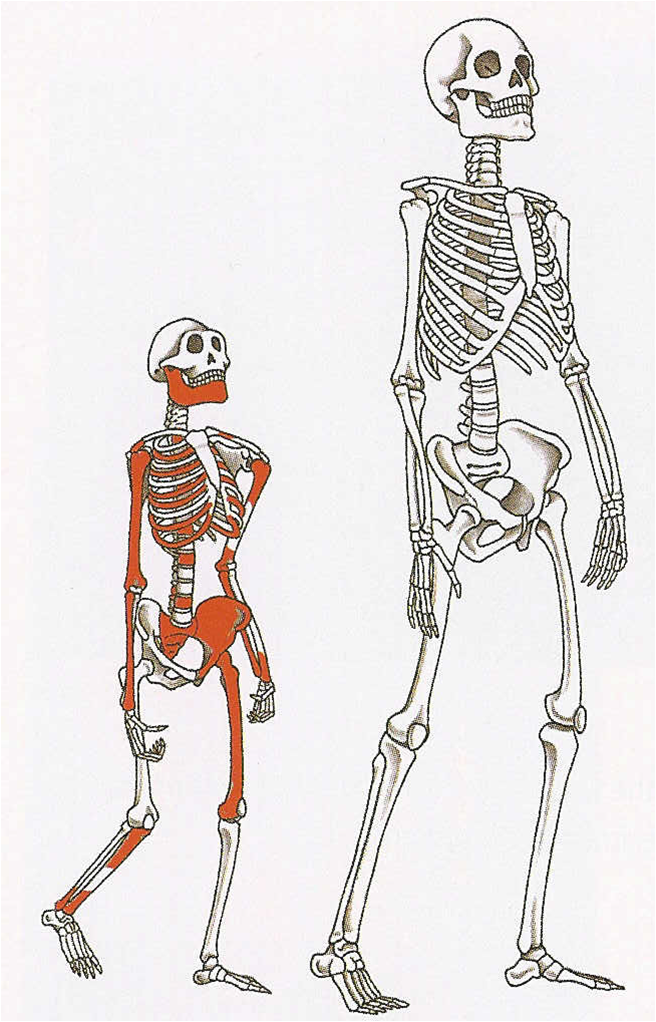
Things were much bigger in 2009 at the bicentennial of Darwin's birth but his cult is sinking a little below the horizon again. It is only the few, like me, who have kept the faith and remember The Great Man's Birthday every year. For about a decade, when I was i/c a slush fund at work, I'd buy 6 dozen Dunkin' Donuts (the large gaudy ones in a pink and orange box - mine's a maple-frosted) and stagger into coffee-break with them on Der Tag. When the slush-fund dried up, I paid with me own money. Everyone was duly appreciative - free food was still important to graduate students in the early 1990s - but a little bemused. You could see them thinking "Oh, it's that time of year again . . . glom!" rather than knowing already. Eventually, I got tired of pushing this tradition single-handedly up-hill and stopped doing the donuts,
You can try and find a Darwinday event near you, but don't hold your breath, the site is only as good as what it is told, and knows nothing about the talk in Dublin this evening. My российские читатели will have to go to Новосибирск where events start at 4pm local time, which if the surreal promotional video is anything to go be, should be exciting and weird.
I think its salutary in this era of ultra-specialisation to remember that Charles Darwin was a bit of a polymath. He wrote full-length books on (ABC) Annelid earthworms, Barnacles, Coral Reefs, Coleoptyles and plant hormones, Climbing plants, Descent of Man, Expression of the emotions, Fertilisation in Orchids (wild and wonderful), Insectivorous plants. These tend to be written in a ponderous Victorian style but are probably more worth reading than racier stuff published last year.
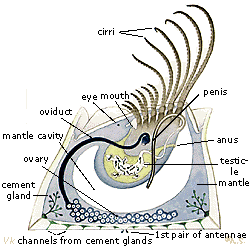
Here's a quiz. Darwin spent 20 years of his life working on barnacles, so they must be important. But which Phylum (major division of the living world) are they part of?
| Phylum | Description | No. Species |
| Annelida | segm. worms | 17,000 |
| Arthropoda | beetles/spiders | 1.1 million |
| Bryozoa | Moss animals | 5000 |
| Chordata | us | 100,000 |
| Cnidaria | jellyfish | 11,000 |
| Echinodermata | starfish/urchins | 7000 |
| Mollusca | snails/oysters | 112,000 |
| Nematoda | roundworms | 1 million |
| Nemertea | ribbonworms | 1200 |
| Platyhelminthes | flatworms | 25,000 |
| Porifera | sponges | 5000 |
| Tardigrada | waterbears | 1000 |
Thursday, 13 February 2014
The Darwinday Storm
I wrote just over a month ago about The Night of the Big Wind which ripped across Ireland on the night of 6th Jamuary 1839. I'm told that the storm which made landfall in the WEA yesterday afternoon is being dubbed the Darwinday Storm in England, that's fine with me. It was all forecast by the boffins at Met Eireann, so there was time to prepare for the worst that Mother Nature can deliver. Probably not enough time, because there are still drains blocked and infrastructure damaged from the last storms which have been tooling in from the Atlantic these last two months.
At 1400hrs, I was settling in to reach a lab on introductory microbiology with my first year cell biologists. My office mate reported that her class (mostly mature students with their own cars) had fled for home before they were benighted in The Institute. This was probably a foolish move because in the space of about 20 minutes before our eyes, the weather got really wild out there. Sheets of horizontal rain licked across the car-park below us and people were seen tottering about barely under control. The trees were 'lively'. As the storm raged, I got a series of txts from The Beloved reporting which roads were (im)passable nearer home. Then she announced that power was down in the mountains. After class at about 1730 when I was settling in to makey-uppy another exam, she phoned to urge me home while there was still light in the Western sky; so I left.
It wasn't 'mayhem out there' because the storm (gusts 170km/h recorded at Shannon Airport) had travelled through and was now duffing up the Scots, but there was a lot of loose stuff on the road and I had to stop three times and divert once because of crews clearing the roads of gurt big lumps of fallen timber. I was pulled up short 60m from home because a medium sized sciach (Crataegus monogyna) had come down like a toll-barrier across our lane. I was then glad that I'd sharpened the chain-saw on Sunday and chidding myself for not filling it with gas. Our stalwart poly-tunnel is still there, but TB and MFLM had had a busy afternoon preventing it from being frapped into oblivion and disappearing into the next county. I've just been out for a walk in the moonlight and found a large branch of Scots' Pinus sylvestris has descended into our lane beyond our entrance but beside the garden. I'll have to get the chain-saw out as soon as it's light enough to see and reduce that to manageable chunks before work.
The crews who clear the roads in Ireland are 'just folk': our neighbour was off about his business at 2pm when he found a pile of branches and debris across the road. He promptly went home for his saw and spent the next 4 hours clearing the way to the next village. He said that there were 20 saws working through all the obstructions from both ends - when things need doing we don't sit on our thumbs waiting for The County Council to arrive. But we're still waiting for power - thankfully my laptop works on steam. As there are 260,000 customers without electricity across the country, this may be some time.
At 1400hrs, I was settling in to reach a lab on introductory microbiology with my first year cell biologists. My office mate reported that her class (mostly mature students with their own cars) had fled for home before they were benighted in The Institute. This was probably a foolish move because in the space of about 20 minutes before our eyes, the weather got really wild out there. Sheets of horizontal rain licked across the car-park below us and people were seen tottering about barely under control. The trees were 'lively'. As the storm raged, I got a series of txts from The Beloved reporting which roads were (im)passable nearer home. Then she announced that power was down in the mountains. After class at about 1730 when I was settling in to makey-uppy another exam, she phoned to urge me home while there was still light in the Western sky; so I left.
It wasn't 'mayhem out there' because the storm (gusts 170km/h recorded at Shannon Airport) had travelled through and was now duffing up the Scots, but there was a lot of loose stuff on the road and I had to stop three times and divert once because of crews clearing the roads of gurt big lumps of fallen timber. I was pulled up short 60m from home because a medium sized sciach (Crataegus monogyna) had come down like a toll-barrier across our lane. I was then glad that I'd sharpened the chain-saw on Sunday and chidding myself for not filling it with gas. Our stalwart poly-tunnel is still there, but TB and MFLM had had a busy afternoon preventing it from being frapped into oblivion and disappearing into the next county. I've just been out for a walk in the moonlight and found a large branch of Scots' Pinus sylvestris has descended into our lane beyond our entrance but beside the garden. I'll have to get the chain-saw out as soon as it's light enough to see and reduce that to manageable chunks before work.
The crews who clear the roads in Ireland are 'just folk': our neighbour was off about his business at 2pm when he found a pile of branches and debris across the road. He promptly went home for his saw and spent the next 4 hours clearing the way to the next village. He said that there were 20 saws working through all the obstructions from both ends - when things need doing we don't sit on our thumbs waiting for The County Council to arrive. But we're still waiting for power - thankfully my laptop works on steam. As there are 260,000 customers without electricity across the country, this may be some time.
Sunday, 11 February 2018
Sunday Elf Feb
Sorry, I'm late,[tsk!] His Lazyarsedness overslept, and the sheep need feeding before The Blob's readers. Now hear this: tomorrow is Darwinday when evolutionary biologists like me and a raggle-taggle army of unbelievers celebrate the birthday of Charles Darwin (dob: 12 Feb 1809). In the old days I'd celebrate by bringing brightly coloured donuts to work. Oftenyears I felt I was a voice crying in the wilderness. Now there is a website to the concept with a global map flagging the locations of all the Events they know about. But that website is all bark and no trousers because it featured No events in UK or Ireland when I looked on Friday. I registered [borrrrring] to announce the Dublin happening. But when I checked just now darwinday.org was unavailable. So I'll have to plug the Dublin gig again here:
 My old pal Dan Bradley [prev] is addressing the Irish Humanist Association on Where do the Irish Come From? In the Arts Block of Trinity College Dublin at 1930hrs Monday 12 Feb 2018. I have classes until 5pm, but I think I'll pile into my little red Yaris and drive to The Smoke to catch this. Bradley is always good copy and has ranged widely and interestingly over the field of DNA analysis both ancient and modern: maybe I'll make 2018 the Year of Dan Bradley posting once a month . . .there would be plenty enough material. Look at him there: ignoring St Charles's stern glare and looking penetratingly at his next big idea. aNNyway: tomorrowbe sure to check out the local universities and colleges; there is sure to be something similar in Омск, Томск or Петропа́вловск-Камча́тский
What else is happenin'? Lots and lots but it's mostly in the past [borrrring]
What else is happenin'? Lots and lots but it's mostly in the past [borrrring]
- Paranoia
- Save paper towels: save the planet a tutorial on how to dry your hands
- My solution at work is bring a hand-towel like at UCSC
- Note: Towelday isn't until 25th May
- Interesting long-form talk [1 hour] at Oxford Union by Jon Smith the first soccer super-agent
- TimmmmmBER:
- Posch Packfix firewood storage system
- Driving rail-road ties down river in Wyoming.
- Framing a wooden building in France using only medieval techniques
- Heck-and-jiminy building a whole medieval castle: The Vault - Guédelon. Building 13th-century Medieval Castle In France
- In the last century, as a Navy Brat, we used to go up to London to see the Royal Tournament. The highlight was the Naval Field Gun Race which showed that you didn't need a backhoe to move a heavy object from A to Z.
- A Young wan shares her wisdom about long distance treks: it's not about the shoes!
- <wince alert> [not for the faint of heart] Last fall I mentioned my searches through the medical literature for things peculiar. Here's an update: the [annually published] list of material abstracted from human rectums in ERs across the US [we don't do/have aNNything like this in Ireland!] via MeFi.
- Hilariously appropriate joke: Middle class parent receives bill for school fees with typo "€5,000 per anum" and says "Thanks but I'd rather pay through the nose as usual".
Sunday, 13 April 2014
Resonance
After the Darwinday storms I went up the hill behind the house to look at the Coillte forest that was planted 35 years ago on Dreelan's farm. O'Manch had reported that there was quite a bit of wind-throw on the edge, including one tree that had blown down against the prevailing wind to lie across the path. I was surprised at how little damage there was - they say that the Sitka spruce Picea sitchensis plantation on White Mountain, 15 km South of our place, looks as if Hurakan god of storms had scythed it all down. This is predicable as native Sitka grows in extremely wet soils, and is genetically programmed for a very shallow root system: that's partly why it is so extensively planted on marginal land. What really surprised me however was the fact that several trees deep in the Dreelan forest had snapped off 5-10m up with no evidence of them having been struck by a falling tree. I suspected that this was due to harmonic resonance when the wind was gusting at just the right speed to treat trees of a particular height like an insufficiently elastic violin string. I've floated this idea past a number of tree chaps and nobody has said it is complete bollix.
 Yesterday was the anniversary of another example of harmonic resonance: the collapse of the Broughton suspension bridge in Salford. On 12 April 1831 a platoon of the King's Royal Rifle Corps returning to barracks after an exercise out of town were amused by the fact that the bridge appeared to bounce in time with their marching step. It's not often that squadies get access to a fair-ground ride while in uniform. Some of them exaggerated their step for a lark which was enough to snap a defective bolt and the bridge collapsed into the water 5m below injuring some 20 soldiers, some seriously. That caused a policy change in the British Army requiring soldiers to 'break step' when crossing any bridge and you can still see notices advising this on the end of some bridges. Marching soldiers may have the capacity to collapse bridges but the wind definitely does: thrilling newsreel footage of the collapse of the Tacoma Narrows Bridge in 1940. In that case, the wind was far less (about 65km/h) than the Darwinday storm but it was just the right speed to sustain and synergise the movement, like a child thrusting her legs back and forth to get a swing to reach the very sky. When the London Millennium Bridge was opened in June 2000 synchronous movement by large numbers of pedestrians caused a resonant lateral movement of the bridge which came as a total surprise to Arup the consulting engineers.
 There is a study to be done, or at least a Blob-post to utter, on the empathic movement of strangers walking along streets in the same direction - Arup assumed that these would be random but they were wrong! Dublin has her own Millennium Bridge, like London's limited to pedestrians so more more engineering than architecture. I always feel a little queasy crossing it because your foot doesn't make contact with the surface quite when you expected it to, so it is a little like trying to cross the deck on a large ferry at sea. This detectable bounce is generated by the people walking around me - and my enormous self, of course.
 Resonance is not only an issue for horizontal engineering projects, it is also, like the trees in our forest, a significant issue for vertical hubris such as the Burj Khalifa (830m) and Taipei 101 (510m), recent holders of the World's Tallest Building title. (Empire State Building 380m). Taipei 101 springs up in a region prone to typhoons and earthquakes, so cannot be built out of Lego. As it gets higher any structure gets heavier and the foundations need to be more massive. Nevertheless they embedded a 660 ton harmonic mass damper (see right hanging on its suspension cables) near the top of the building. This sphere is 5.5m in diameter! Dublin's Spire in the middle of O'Connell Street, known by local wags as the stiletto in the ghetto, although only 120 m tall, incorporates a mass damper so it doesn't bend itself out of shape in a breeze of the resonant frequency.
Saturday, 10 October 2015
Leif Cheedle Day

At 03:26, 9 October 2015 some smart-ass perked up the Wikipedia entry for Leif Erikson Day with the observation that the banner above, the picture of the the stamp of the statue of Leif Erikson, looked a bit like cheedle. Which is defined on UrbanDictionary as: The sticky orange substance that sticks to your finger tips when you eat Cheetos. Eeeuuuw. The change won't be there for long - Wikipedia is flagging L.E. Day on their front page and as soon as America wakes up someone will restore order-and-respect to Leif Erikson and the Norwegian People. Note added in press - I was right: the Wikipedia community took just under 4 hours to "Reverted to revision 684822981 by Tedickey (talk): Last apparently clean version; later vandalism by more than one user not fully reverted"

Hungarian MEP György Schöpflin is worth listening to about the Syrians, razor-wire, detention and inhumanity.
Friday, 28 March 2014
Surfing the branch down
Forty days, more of less, is how long its taken to start clearing up the raffle of trees, brush and branches which came down in the Darwinday storm. I'm not talking about the small stuff, mostly sceach / whitethorn / hawthorn / may / Crataegus monogyna (all the same species - you can see why we use Latin to communicate). I refer rather to the four enormous, and one merely large, cypress Cupressus sempervirens trees that filled the garden down on the Waterford coast. When we first went down there, the neighbours were jockeying for position and some free fire-wood but a brief consult with Chris "The Tree" Hayes indicated that letting them onto the site was possibly dangerous. For one thing, a couple of tons of roots and earth are likely to sit back into their hole when the counter-balancing tree-trunk is severed. For another, there were some very large broken branches and tree-tops hanging high up in the surviving trees waiting to impale a parsing scavenger, So we decided to hold everyone off until the most obvious problems could be stabilised and/or brought to earth.
Accordingly, I lit out of The Institute after my last class on Wednesday last and hared off South to see if I could help Rossa and Chris, the tree-surgeons from Wexford. They had been working away all day and had reduced the three trees which fell in the farmer's field to neat looking trunks. Anything smaller than about 7cm in diameter had been fed through an industrial-quality wood-chipper and spat out the far end as mulch. That's a mountain of mulch. I was tasked to drag the branches to a heap near the machine, so that Rossa could feed the monster. As I went, I threw any long-dead branches, which can be burned immediately, over the ditch and back into the garden. After that, we went back into the garden and started cutting branches to put some manners on the tangle in preparation for the long day's work the following day. Soon enough it was falling dark and so we stopped.
The next day, I got up early to collect all the ready-to-burn branches into a single heap near the front gate, in case one the neighbours runs out of coal. After a while, the boys came out and I was back to hauling branches to the chipper, but this time I kept my saw handy to cut any big bare pole-ends off for fuel. It was hard to imagine using ALL of wood-chip mulch that had been created. While we were hauling and chipping on the ground, Chris was disappearing further and further up the trees cutting out the hangers. There was a bit of discussion about what to do about a huge lump of timber that was caught at two points about 15m up in the trees. It was suggested that, if it was cut close to the heavier end, it might start to travel earthwards. Failing that, they could attach a rope and pull t'bugger loose. Or somebody could just surf it down. I assumed this last solution was in the nature of ironic banter, but this is what eventually provided the solution. Having attached himself by a rope to a solid part of the tree higher up, Chris stepped boldly onto the branch under discussion and started to jump and bounce and shake until at last it started its descent, leaving the impelling forester dangling above it. It was a pretty good example of the difference between potential and kinetic energy and the earth moved when the branch struck the ditch below the tree. Don't try this at home, kids.
I had to leave at 11am to drive 100km back up the motorway to teach my lunch-time class in human physiology. But I felt much better for having started the day with some physical and useful work. It turned out that the root-balls of both the 'garden' trees did settle back more-or-less into their holes after the top-hamper had been removed, but without any small children or idle spectators underneath.
Wood-chip mulch for sale.
Accordingly, I lit out of The Institute after my last class on Wednesday last and hared off South to see if I could help Rossa and Chris, the tree-surgeons from Wexford. They had been working away all day and had reduced the three trees which fell in the farmer's field to neat looking trunks. Anything smaller than about 7cm in diameter had been fed through an industrial-quality wood-chipper and spat out the far end as mulch. That's a mountain of mulch. I was tasked to drag the branches to a heap near the machine, so that Rossa could feed the monster. As I went, I threw any long-dead branches, which can be burned immediately, over the ditch and back into the garden. After that, we went back into the garden and started cutting branches to put some manners on the tangle in preparation for the long day's work the following day. Soon enough it was falling dark and so we stopped.
The next day, I got up early to collect all the ready-to-burn branches into a single heap near the front gate, in case one the neighbours runs out of coal. After a while, the boys came out and I was back to hauling branches to the chipper, but this time I kept my saw handy to cut any big bare pole-ends off for fuel. It was hard to imagine using ALL of wood-chip mulch that had been created. While we were hauling and chipping on the ground, Chris was disappearing further and further up the trees cutting out the hangers. There was a bit of discussion about what to do about a huge lump of timber that was caught at two points about 15m up in the trees. It was suggested that, if it was cut close to the heavier end, it might start to travel earthwards. Failing that, they could attach a rope and pull t'bugger loose. Or somebody could just surf it down. I assumed this last solution was in the nature of ironic banter, but this is what eventually provided the solution. Having attached himself by a rope to a solid part of the tree higher up, Chris stepped boldly onto the branch under discussion and started to jump and bounce and shake until at last it started its descent, leaving the impelling forester dangling above it. It was a pretty good example of the difference between potential and kinetic energy and the earth moved when the branch struck the ditch below the tree. Don't try this at home, kids.
I had to leave at 11am to drive 100km back up the motorway to teach my lunch-time class in human physiology. But I felt much better for having started the day with some physical and useful work. It turned out that the root-balls of both the 'garden' trees did settle back more-or-less into their holes after the top-hamper had been removed, but without any small children or idle spectators underneath.
Wood-chip mulch for sale.
Monday, 12 February 2024
The Connibeg Fourteen
Yesterday, we linked (Dun Briste 1393) to a sudden, lumpy loss of coast. When the storm abated, the survivors abseiled down the cliff and abandonned their farm forever. Usually it is more insidious: depends on the local geology. It seems worse when more recent, and more countable, people are involved (Guildford Four, Birmingham Six). It is worse when more people are involved. A couple of weeks ago there was [another] report from RTE about the steady diminution of Wexford as storms sweep away the long sandy beaches for which the county is justifiably famous. This is similar coast-scape, same issues as The Blob was uncovering in Norfolk in December. In each case, a sandy beach being the storm-fronting face of sand-dunes and slumping sand+lumps cliffs. The Connibeg Fourteen are two little crescents of houses [14 below] on the seaward side of, the engagingly named, Bastardstown, a village between Kilmore Quay and Rosslare Harbour:

- 1st survey at 6in to the mile = 1: 10,560 (1829-1842)
- 2nd Survey at 25in to the mile = 1:2,534 (1863-1924)
- Revised 6in to the mile = 1: 10,560 (1830s-1930s)
The geohive allows fairly easy flipping among the different surveys. Here's the state of playa at the time of the revised survey. It is, at least as far as the coast in concerned, very similar to the 25in:mile survey. It is possible to determine the survey dates for each sheet of the map but not from my sofa. Let's call it 1880.


Sleep through the next named Met Éireann storm? Don't do this at home, kids!
Saturday, 15 February 2014
A little tip
When the radio feller from AA Roadwatch says "slow down and allow extra time for your journey", do it! I left for work in dry, almost balmy (for February) weather on the morning after the DarwinDay storm had lashed the country and felled numerous trees and man-made structures. As I came over the shoulder of Tomduff Hill there was an abrupt change in the look-and-feel of the weather. You often see this in the Blackstairs: clouds roiling up to the ridge on one side and evaporating there. It must be the updrafts. The Blackstairs run North to South (more of less) so they cast a clear rain-shadow in the East away from the prevailing, wet, Atlantic, weather.
ANNyway, as I came to the top it started to flurry snow, which didn't get blizzardy or notably thick but it was enough to distract me. Down towards the flat-lands of the Midlands I motored along with a little more caution. On the last hillock before the road definitely flattens out approaching Bagnelstown and the River Barrow, there is a sharpish left turn which I always take slowly because you never know what mad lead-foot is going to be coming the other way. That morning, I was that mad lead-foot because the drain had been weeping water across the road surface all night and the snap down in temperature had frozen it to a rink. Accordingly I skated, still parallel to the direction of travel, right across the road, lost a wing and the right side of the mud-guard on the rough grass verge and then continued onwards and upward to mount a much more solid stone wall. I perched there, dazed, at a 45 degree angle for two or three seconds, and then lurched out through the door which at that angle was rather like the escape-hatch on a submarine. I started calling the usual suspects: not The Beloved because I had her phone for charging on company time but our Garagiste, and the AA, and a neighbour on whom I could count to relay the essential facts to home. I also called into work to say I'd be missing the 9am class (at least). Then I sat down to wait. It was sunny, not too cold, I was okay, Then I saw a lady walking along the road towards me. She lived in the nearest house and asked a) was I okay? and b) would I like a cup of tea? Only in Ireland. As I waited I got two more offers or tea and about a dozen enquiries about my well-being and one chap stopped looking for directions to the NCT station.
But the Grand Prize for Community Solidarity has to go to the young chap in his school uniform, who got out of a car and suggested that the AA were never going to pull me off the ditch with their underpowered overladen van and would it help if he went back to get the family tractor. I said "sure"; he trotted off to the "over there - first house on the left beyond the cross". and returned with said tractor and a strap which we threaded round the axel. Two-six heave, and I was down on the road again; the engine was working and so was the steering so I parked in neat enough close to the verge and he went away. Ten minutes later he reappeared still driving the tractor - clearly he was going to drive it to school as he was already late and had missed his lift. Hat's Off. That chap is going to go far, and everyone around him will be better off for his presence.
ANNyway, as I came to the top it started to flurry snow, which didn't get blizzardy or notably thick but it was enough to distract me. Down towards the flat-lands of the Midlands I motored along with a little more caution. On the last hillock before the road definitely flattens out approaching Bagnelstown and the River Barrow, there is a sharpish left turn which I always take slowly because you never know what mad lead-foot is going to be coming the other way. That morning, I was that mad lead-foot because the drain had been weeping water across the road surface all night and the snap down in temperature had frozen it to a rink. Accordingly I skated, still parallel to the direction of travel, right across the road, lost a wing and the right side of the mud-guard on the rough grass verge and then continued onwards and upward to mount a much more solid stone wall. I perched there, dazed, at a 45 degree angle for two or three seconds, and then lurched out through the door which at that angle was rather like the escape-hatch on a submarine. I started calling the usual suspects: not The Beloved because I had her phone for charging on company time but our Garagiste, and the AA, and a neighbour on whom I could count to relay the essential facts to home. I also called into work to say I'd be missing the 9am class (at least). Then I sat down to wait. It was sunny, not too cold, I was okay, Then I saw a lady walking along the road towards me. She lived in the nearest house and asked a) was I okay? and b) would I like a cup of tea? Only in Ireland. As I waited I got two more offers or tea and about a dozen enquiries about my well-being and one chap stopped looking for directions to the NCT station.
But the Grand Prize for Community Solidarity has to go to the young chap in his school uniform, who got out of a car and suggested that the AA were never going to pull me off the ditch with their underpowered overladen van and would it help if he went back to get the family tractor. I said "sure"; he trotted off to the "over there - first house on the left beyond the cross". and returned with said tractor and a strap which we threaded round the axel. Two-six heave, and I was down on the road again; the engine was working and so was the steering so I parked in neat enough close to the verge and he went away. Ten minutes later he reappeared still driving the tractor - clearly he was going to drive it to school as he was already late and had missed his lift. Hat's Off. That chap is going to go far, and everyone around him will be better off for his presence.
Friday, 3 August 2018
Boxing the heart
Last week I was down on the Costa na Déise aka The Copper Coast with my chain-saw to tidy up some of the lumber-piles from the DarwinDay Storm of 2014. There are still tonnes of unprocessed and part-processed logs about the place and every storm brings down more fresher, damper branches. It was low tide when I arrived so I went round the headland East of Eden ; Java Bunmahon looking for fish-boxes before I started the chain-saw <brrm BRRRRM>. All I found was a sand-blasted 4m length of 4"x2" = 100mm x 50mm . I couldn't allow that to be a hazard to shipping when it left on the next spring tide, so I brought it up to the house. It had a terrible twist at one end because 4x2s are milled by the million without a great deal of attention to quality. If it matters then don't get your 4x2s delivered! Some of the batch will be knotty, waney, bendy, warped or shook. Better to go to the yard and pick through the stack, rejecting the obviously defective.
Why was my new board twisted? Because it had been cut from a 'tree' species unknown, age unknown, season unknown but probably pine, spruce or fir. And then thrown in the sea. When boards dry out, maybe especially if kiln-dried to speed things up, the outside sap-wood will dry out at a different speed to the central, harder, more lignified heart-wood warping results to minimise the tension in the fibres. The knots come, as you know, from the foundation of side-branches sprouting from the main millable trunk. Saw-millers have known this since first a board was cut. They want to get as much usable lumber from each log that passes through their hands. In the old, local, pre-globalisation days, trees would be felled for a particular purpose in mind, cognisant of the fact that when planks, especially sap-wood planks, dry out they will have a strong tendency to straighten the rings. Amongst much else that means that floor boards have a natural up-side and a under-side. If you nail it upside down, the centre will 'sag' edges will finish 'proud' and put splinters in your socks. Hogging planks are fine because the edges sit down. Of course, with such long-established knowledge the language will be weirdly medieval.
 The diagram of various cuts is lifted from a super-wonderful page on how to mill a log so that it is fir (sic) for purpose. Obviously if you need a mighty timber to support an upstairs or a fire place then you'll cut a whole piece and use the super-bendy off-cuts somewhere less structurally crucial. And you have to have something to burn in the fireplace too. This all took me back to 1972, when I was wrapping up the school-days under the care and attention of Mr Wilkinson my inspirational biology teacher. My biology notes accumulated in 4 hard-backed exercise books which I've managed to hold on to. For reasons best know to himself, probably because he was really interested, he spend a couple of lessons talking about forestry, coppicing and timber. That was never going to 'come up' on the exams but it stuck to me anyway.

Why was my new board twisted? Because it had been cut from a 'tree' species unknown, age unknown, season unknown but probably pine, spruce or fir. And then thrown in the sea. When boards dry out, maybe especially if kiln-dried to speed things up, the outside sap-wood will dry out at a different speed to the central, harder, more lignified heart-wood warping results to minimise the tension in the fibres. The knots come, as you know, from the foundation of side-branches sprouting from the main millable trunk. Saw-millers have known this since first a board was cut. They want to get as much usable lumber from each log that passes through their hands. In the old, local, pre-globalisation days, trees would be felled for a particular purpose in mind, cognisant of the fact that when planks, especially sap-wood planks, dry out they will have a strong tendency to straighten the rings. Amongst much else that means that floor boards have a natural up-side and a under-side. If you nail it upside down, the centre will 'sag' edges will finish 'proud' and put splinters in your socks. Hogging planks are fine because the edges sit down. Of course, with such long-established knowledge the language will be weirdly medieval.
B for Boxing-the-heart is a compromise, as are all the cuts labelled in the previous picture. The thing about the generic cuts, like 4x2 or 3x2 is that they are good-enough for a wide variety of situations and so long as you keep the timbers dry-enough and airy-enough any old softwood or any old species will do. Even if you make the ceilings 2.4m high because that's half the standard length of sawn timber in the yard, you'll still have off-cuts and you can usually arrange it to discard the cruddy end of some of the timber.
Wednesday, 16 March 2022
Blow out
It's an anniversary of sorts this week because we moved into the house on the evening of 17th March 1997 - 25 years ago! We have a mighty poly-tunnel in the garden behind our house. We reckon it's been there for 15 years now; so we've had the tunnel for longer than we've not had it. I just can't imagine how we handled the the laundry before we had somewhere to hang everything without needing to keep a weather eye open for rain. And the tunnel has been useful for high-ventilation entertaining during Coronarama. The plastic is holding up but is getting opaque from sun-bleach even if I scrub the algae off - this significantly reduces the productivity of things photosynthetic. The failures have almost all been caused by rotting of the ordinary building timber to which we anchor the sheet of plastic. Replacing the punky rotten timbers as and when they fail has been a bodger's [meeeeee!] paradise and the overall look is patchwork.
It took a pounding during the Darwinday storm of February 2014. The Beloved and O'Manch, our then wwooffer, had to hold onto one edge of the plastic which had rrrripped off its foundation. It was like Cape Horn apparently but after 40 mins the wind abated and they were able to tie the thing down. Our neighbour, with a much smaller suburban polytunnel was looking out at the storm through the kitchen window, heard a bang and watched the whole thing thrash over the ditch into the neighbour's field. Mostly through the scots pines and hedges provide a rather sheltered micro-climate: in February, for example, Storms Dudley, Eunice and Franklin were weathered not a bother.
Last Saturday the county was subject to a yellow wind and rain warning, not worthy of becoming a named storm. As evening loomed The Beloved asked if it was okay to leave the door to the tunnel open over-night. I answered in the affirmative and then thought better of it and jinked up through the rain to close up. Imagine my concern to find that half of the door-frame at the far end of the tunnel together with its attached corner of plastic was thrashing about; detached from its bottom moorings.
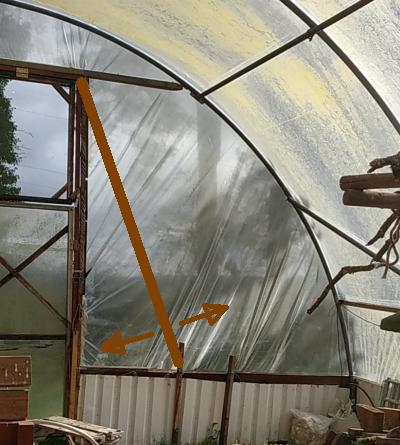
That couldn't be left open all night; not least because it could get thrashed to buggery before breakfast. I don't have an emergency first-aid kit for storm-wracked but I've been beach combing for years and had a handy selection of cordage to hand. It was really just a question of which rope was strong enough but thin enough to thread between the door and its frame. In about 40 minutes, before full nightfall I had secured the flapping spar and cinched it tight with a Spanish windlass, whc I've used before.

- some prosthetic timber to shore up the punky rotten end where the door-jamb met the plastic supporting horizontal
- a packet of miscellaneous steel braces bought many years ago as a too cheap to refuse, these will come in handy somewhere, sometime
- a selection of 5.0 x20, x30, x40 and x60mm woodscrews
- the new Erbauer cordless driver and drill set whc The Boy found me as a hot UK deal before Christmas
- fence staples
- 1.5m square fence posts
- beach-cord to tie bits together
Monday, 16 June 2014
Szombathely
Szombathely is a town in Western Hungary which has in previous times been called Savaria (or more formally Colonia Claudia Savariensum) Steinamanger, Sombathelj, Sambotel, Sombotel, סאמבאטהעלי. I doubt if many people are speaking Latin or Yiddish there any more but perhaps the middle four toponyms are current today. Perhaps any Slovenes in the region could answer? Although all the names begin with S, they have quite different etymology: Szombathely means Saturday-place in Magyar a reference to the day they held a market; Stein-am-anger, contrariwise means Stone on the green/commonage in German, the Yiddish is a transliteration of the Magyar. And to put a Czecho-Slovakian cat among the pigeons, it's also called Kamenec, Kamenica. And we think we're polyglot cosmopolitan when we have two names for Dublin/Baile Átha Cliath.
So, they ask, what's the deal with Saturday-market? Well, I reply, it's not just that it is the birthplace of St Martin de Tours, he of the generous cloak. It's also a place which celebrates Bloomsday.
Bloomsday commemorates the day James Joyce met the-love-of-his-life Nora Barnacle and asked her out for a date which happened on 16th June 1904 on South Leinster Street in Dublin. I doubt if that's why they planted a car-bomb there just under 70 years later. Years later when Joyce was writing his masterpiece Ulysses in Trieste, he decided that his life-in-the-day-in-the-life novel Ulysses would be set in Dublin on the day he met his beloved. He used a copy the 1904 edition of Thom's Street Directory and his walking memory to research the locations because he was in exile from his native land. His fictional protagonist Leopold Bloom was a second generation Dublin Jew whose father Virág Rudolf came from foreign. As a fictional creation, Joyce could have picked any town in Central Europe as the father's birthplace: Antwerpen/Anvers; Wrocław/Breslau; Львів/Львов/Lemberg. But he chose Szombathely and the city fathers, acknowledging the honour, have a bit of a knees-up every 16th of June. So do lots of other people in Dublin and elsewhere. There was an enormous street party in Dublin on the centennial in 2004 with lashing for free sausages and rashers which were served picnic-style on Celtic Tiger skins. Me, I keep my devotional energies for Darwinday on 12th February 2013, 2014.
Now, I have read Ulysses: all 265,000 words of it. It's about as long cover-to-cover as The Blob and if you find me obscure and convoluted at times, you should try Ulysses! Actually, unless you're doing it in college with a group of students and a competent teacher and a bunch of commentaries, I wouldn't recommend Ulysses unless you've over 40. A lot more of it passed over my head when I ploughed through it as an 18 year old, than when I dipped in again at twice that age. But I can't be bothered to read it again and again. I'd rather be flitting about making sense of my real world than trying to get a grip on one man making sense of his fictional world.
I'm posting this early so you have time, like Leopold Bloom, to fix some mutton kidneys with a fine tang of faintly scented urine for breakfast, burned for verisimilitude if you are a purist, and not fill up on toast.
So, they ask, what's the deal with Saturday-market? Well, I reply, it's not just that it is the birthplace of St Martin de Tours, he of the generous cloak. It's also a place which celebrates Bloomsday.
Bloomsday commemorates the day James Joyce met the-love-of-his-life Nora Barnacle and asked her out for a date which happened on 16th June 1904 on South Leinster Street in Dublin. I doubt if that's why they planted a car-bomb there just under 70 years later. Years later when Joyce was writing his masterpiece Ulysses in Trieste, he decided that his life-in-the-day-in-the-life novel Ulysses would be set in Dublin on the day he met his beloved. He used a copy the 1904 edition of Thom's Street Directory and his walking memory to research the locations because he was in exile from his native land. His fictional protagonist Leopold Bloom was a second generation Dublin Jew whose father Virág Rudolf came from foreign. As a fictional creation, Joyce could have picked any town in Central Europe as the father's birthplace: Antwerpen/Anvers; Wrocław/Breslau; Львів/Львов/Lemberg. But he chose Szombathely and the city fathers, acknowledging the honour, have a bit of a knees-up every 16th of June. So do lots of other people in Dublin and elsewhere. There was an enormous street party in Dublin on the centennial in 2004 with lashing for free sausages and rashers which were served picnic-style on Celtic Tiger skins. Me, I keep my devotional energies for Darwinday on 12th February 2013, 2014.
Now, I have read Ulysses: all 265,000 words of it. It's about as long cover-to-cover as The Blob and if you find me obscure and convoluted at times, you should try Ulysses! Actually, unless you're doing it in college with a group of students and a competent teacher and a bunch of commentaries, I wouldn't recommend Ulysses unless you've over 40. A lot more of it passed over my head when I ploughed through it as an 18 year old, than when I dipped in again at twice that age. But I can't be bothered to read it again and again. I'd rather be flitting about making sense of my real world than trying to get a grip on one man making sense of his fictional world.
I'm posting this early so you have time, like Leopold Bloom, to fix some mutton kidneys with a fine tang of faintly scented urine for breakfast, burned for verisimilitude if you are a purist, and not fill up on toast.
Friday, 3 April 2015
Observance
Today is Holy Friday, so I went on a chain-saw binge in the drizzle yesterday evening. We lost another hawthorn Crataegus monogyna in the blustery storm that came through on Monday night 30/Apr/15. It was almost as bad as the Darwinday storm last year, what with a tree down in the lane and damage to the poly-tunnel doors. I spent most of Wednesday rebuilding the door frame at the West end of the tunnel and rehanging the door, so chopping up the tree had to wait a day. Since ever we came to live in the country, I've had a strict observance not to use power-tools on Sunday. There has to be one day in the week when the petulant shriek of the chain-saw or the frupp of the strimmer cannot be heard. It might as well be Sunday, as that's the day when some of the neighbours get to sleep in and others (a diminishing minority, to be sure) are in a contemplative state before or after Mass. If I'm going on a tool-fast on Sundays, how much more should I do so on the day the Son of God was crucified? I should add that I am the only person in the valley who behaves like this, the valley rings with the noise of chain-saw, tractor PTO , kango-hammer, lawn-mower all Sunday long.
I wrote last year about the Fast of the Firstborn which lays an additional obligation on the oldest son to off-set the sense of privilege that he accumulates through the rest of the year. In Ireland since 1927, the sale of alcohol on this day has been prohibited, because drink was seen to profane the memory of the events of 3rd April 33CE. In that year the Intoxicating Liquor Act made it illegal to sell alcohol on Christmas Day, St Patrick's Day and/or Good Friday. Paddy's Day??? Isn't that when Sean O'Phobail gets utterly trashed and forments a riot on the fringes of parades up and down the country? Yes indeed, but only since 1960, when the ban was rescinded to accommodate the visitors to the country who come for the celebrations. The idea of high school marching bands from Ohio slipping into a boozer after their march still wearing their silly hats is deeply appealing.
The Good Friday ban was temporarily lifted in Limerick a couple of years ago because the Black Protestants had scheduled a big rugger match there-and-then and the publicans didn't want to miss racking up some sales. Next Easter is the Centenary of the 1916 Easter Rising. There is a lot of pressure on the Minister of Justice to consign the Good Friday alcohol ban to the dustbin of history before O'Bama and McMerkel come to see the shenanigans.
 What other exceptions? If you're staying in a hotel, you are a bona fide traveller, so can have a drink [R with a barista shamrock] with your meals. If you're at a restaurant, however, you can't. The bona fide exemption kicks in also on trains and at stations, on planes and at airports, on boats and in their associated bars at the dock-side. It used to be common for lads to go to Heuston Station, buy a ticket to Tullamore or Athy, get a few down in the station bar and then return the ticket for a refund. It is also possible to go boozing at greyhound tracks on Good Friday, although I'm sure puritans would object to the idea of going to the dogs on the day that's in it. And for reasons that are not clear to me, military canteens and the National Concert Hall are also allowed to sell alcoholic beverages on this day. When there are anomalies like this, you have to ask who got to the Minister in 1927 with their special interest special pleading. Every year people comment on the sight of supermarket trollies groaning with booze on Holy Thursday as if alcohol was never to be seen again. That's why I was getting my chain-saw out last night, so I can spend the day quietly contemplative with my family . . . and blogging more than usual.
I wrote last year about the Fast of the Firstborn which lays an additional obligation on the oldest son to off-set the sense of privilege that he accumulates through the rest of the year. In Ireland since 1927, the sale of alcohol on this day has been prohibited, because drink was seen to profane the memory of the events of 3rd April 33CE. In that year the Intoxicating Liquor Act made it illegal to sell alcohol on Christmas Day, St Patrick's Day and/or Good Friday. Paddy's Day??? Isn't that when Sean O'Phobail gets utterly trashed and forments a riot on the fringes of parades up and down the country? Yes indeed, but only since 1960, when the ban was rescinded to accommodate the visitors to the country who come for the celebrations. The idea of high school marching bands from Ohio slipping into a boozer after their march still wearing their silly hats is deeply appealing.
The Good Friday ban was temporarily lifted in Limerick a couple of years ago because the Black Protestants had scheduled a big rugger match there-and-then and the publicans didn't want to miss racking up some sales. Next Easter is the Centenary of the 1916 Easter Rising. There is a lot of pressure on the Minister of Justice to consign the Good Friday alcohol ban to the dustbin of history before O'Bama and McMerkel come to see the shenanigans.
Thursday, 15 February 2018
Eurogene - the map

I told y'all that you should go to Dublin on Darwinday to hear Dan Bradley talk about the Genetic Origins of the Irish. But I know that some things you can't delegate: you just have to do them yourself. Accordingly, I leapt into the Little Red Yaris at 1705hrs and drove to Dublin to hear the news from the frontiers of biogeography. But the news is always based on the olds and the most beautiful and informative picture of my 2018 [at top: far better copy] was published in 2008! I may well have been entranced by that map when it came out ten years ago, but I've since forgotten all about it. Heck, I've forgotten my car-keys and where I left my glasses as well.

That map is Fig 1 in a paper in Nature: Genes mirror geography within Europe which sampled the sequenced genomes of 3000 Europeans (and four Turks) and tallied up each person's state at 500,000 different variable sites in their DNA sequence. That's a shed-load of data and you can't make much headway by ticking off (3000 x 3000)/2 x 500,000 cases of Sean is different from Jean here but the same there, while Giovanni is different again. Well actually you can, and that's what John Novembre et al. did in 2008. They put the whole dataset into a hopper called Principle Components Analysis and gave it all a good shake and a jiggle. PCA reconciles all the internal inconsistencies, and calculates the position of each person in N-dimensional hyperspace. No, I too only have a hazy notion of what that really means but in practice it calculates how near or far each person is from each other person in the dataset. It will come as no surprise when it turned out that the quartet of Turks looked really similar to each other genetically and rather different from the Europeans . . . and the Irish too: like each other, quite similar to Brits and Scots and less like Poles and Greeks. A lot of that difference will smooth itself out over the next 100 years as our 200,000 resident Poles make babies with their Irish neighbours.
You can do these sort of studies because the cost of generating the primary data has collapsed over the last 30 years. The first ever chunk of genomic DNA, yeast Saccharomyces cerevisiae chromosome III, was contracted by the EEC (=EU) 30 years ago at 320,000 ecus (=€) or €1 /base. We carried out the first non-trivial added-value analysis of that data - one of my three big ideas in science. With that stepping stone achieved, planners looked to sequencing The Human Genome: it cost €300,000,000 (10c per base) and took ten years. Now you can sequence A human genome for €1,000; it will take a day; and there is enough server power to do many genomes in parallel. So 3,000 genomes is quite affordable in a big science sort of way.
What is most striking about the distribution of genomes across the most explanatory axes of the PCA landscape is how closely it maps onto the geography of Europe. The pale blue of Greece and the Balkans is nearest to Turkey over on the right; the grey Italian peninsula runs parallel and a little more distant; and further away again is a purple peninsula of Iberian genomes. At the opposite end of the continent, the Irish intercalate with the Brits; the Scandinavians have both shared and separate identity etc. etc. If you look closely, you can see Paddy-No-Pals off on his own in the sea like as sort of Uber-Irish outlier. Maybe she is not Paddy at all but Caitlín Ní Uallacháin. Also note the five rogue ITs in the sea at bottom left of the diagram; they do indeed have Italian passports but they are actually Sardinians. There is no evidence here that the compatriots of Szilárd, Wigner, von Neumann and Teller come from Mars.
I was doing a similar analysis waaaay back in 1980s. I took me 2 years of tramping the streets of towns and cites in New England and the Canadian Maritimes, scoring genetic variation in domestic cats Felis catus to gather a sample of 10,000 cats in 35 different populations diagnosed for 7 genetic variants. (35 x 35)/2 x 7 is quite a bit smaller than (3000 x 3000)/2 x 500,000 !! But it was all my own work. One finding was that genetic distance was correlated (highly significant statistically) with geographic distance but that relationship only explained 16% of the variability in the sample. 84% of the variation was noise - some of which could be accounted for by the history of the patterns of French, English and Dutch colonisation in the 1600s. That was what my PhD thesis concluded aNNyway.
When you cough up your $100 to get your DNA sequenced, 23andMe will compare your DNA to a database like this one and place your genome on the map. Unless you are truly and incestuously descended from the Pharaohs, your genome will be a mess of fragments from the miscegenation of your ancestors. 23andMe will give you a summary sound-byte like "50% Irish; 25% English; 20% French; a toe from the Maghreb and a Neanderthal fingernail". You may take that assessment with a huge pinch of salt because the data will be inherently noisy.
Monday, 5 July 2021
Unrat cleansing
When we lived in England, the neighbour's daughter kept an albino rat Rattus norvegicus as a pet. The rat's party trick was to run up inside one arm of the girl's sweater and emerge from the other. Spectators could, of course, track its movements - thinking about Loa loa is optional here. Most people, otoh, consider rats to be a noisome pest [Ger: unrat Schädling], which eat animal feed [dang!] and occasionally transmit Weil's Disease and a variety of other pathogenic bacteria and viruses - plague anyone? Humankind has had a loong-time relationship with rats, the rodents having trained us to gather food into one convenient place for them to sample. As near as dammit, wherever people are, or have ever been, there you will find rats, both brown Rattus norvegicus and black Rattus rattus aka the ship rat. If it was only that they ate the leavings of people, it would be containable. The problem is that rats are omnivorous and "food" includes the eggs and chicks of ground-nesting birds. Native birds which had been living the good life for thousands of years until people, largely European started the Age of Exploration and introducing their domesticates - goats, rats, mice, cats, pigs, foxes, rabbits, donkeys - willy-nilly. It is very difficult, and fabulously expensive, to put the rat genii back in the bottle - it cost about $10million and took 10 years to eradicate invasive rodents from South Georgia. Interesting chemo-ecological relationships between rats and seabirds in Chagos archipelago.
In the news last week was the fact that rats have been eliminated from two of the smaller islands in the Galapagos. To put this is scale: the entire archipelago is a little under 8,000 sq.km in extent - about the same area as County Cork or Las Islas Canarias. The 'clean' islands are Seymour Norte (the speck indicated with the red arrow) and an even smaller islet called Mosquera situated between Seymour Norte and Baltra / South Seymour. The map above [from LatinRoots Travel] neatly shows the parallel system of names applied to the islands since a) Ecuador annexed them on DarwinDay 12 Feb 1832 and b) Darwin himself arrived on HMS Beagle 15 Sep 1835. It was considerably cheaper and quicker to clear Seymour Norte [190 hectare] than South Georgia [390,000 hectares], because scale. But also because they used drones . . . to deliver a payload of 20kg of the rodent specific killer bait. I was talking about this with Dau.II when the news was hot and she thought if might be a great crowdsourced project for the next round of elimination. Recruit teenage Call of Duty first-person shooter fans to fly hunter-killer drones from their bedrooms in Romford. The drone [L] carries a bait hopper and a GPS tracker and is operated from a ship to deliver the poison quickly and precisely. Far quicker and more reliable than a bloke with a rucksack.
Bell Labs designed the rodenticide and are talking large about how non-target species are not at risk from consuming the poison - it dissolves in two or three weeks before native birds get a chance to eat it . . . but hangs around long enough to give the rats every chance to eat a fatal dose. It's not clear which specific "rodenticide" is being used on the Galápagos. Could be any of bromadiolone, brodifacoum or diphacinone [anti-coagulants which are replacing warfarin] or bromethalin [neurotoxin]. In the realpolitik of conservation, a certain amount of collateral damage is tolerable. The project hopes to play the [rat] extinction is forever card, at least locally; so long as enough breeding adults of the birds survive then I guess some considerable by-catch is acceptable.
Note added in press: slight ArsTechnica report on the relationships among islands - rats - seabirds - guano - phosphates - coral - fish biomass.
Wednesday, 26 February 2025
Not all men, science edition
International Day of Women and Girls in Science, is A Thing. This year it was marked [but not by Blob] on 11 February 2025. Wexford Science Café came to the party exactly a week too late . . . because we're on the 3rd Tuesday of the month, not the second. I posted about IDWGS on the correct day [Darwinday - 1] in 2018. WxScCa organized their event by having Amy Hassett a just-starting scientist (chatting with / interviewing) Mary Kelly a just-finishing one. They were about the same age as Dau.II and me, so there was a bit of one generation passing the chalice to the next. Gotta say it started off same-old, same-old with statistics about which areas of science had the most appallingly unequal sex-ratio in the 21stC - geology apparently. Of course we all agreed this was A Bad Thing and that things were getting better than 1925; but nobody in the room had a coherent strategy for how to chip away at the patriarchal monolith. It's pretty clear that having an inspiring female science teacher or auntie makes a difference . . . but quotas don't.
Older scientist has interviewed A Lot of people during her career. Her sense is that blokes present themselves as confident even if they are collywobbling inside; whereas women are more diffident and tend to qualify their abilities with a touch of realism. Interview committees [in my experience on both sides of the table] are cobbled together from available bodies and are kinda crap at sorting wheat from chaff: unwilling to puncture specious confidence or draw out shy competence. So Mr Know-it-Some gets ranked #1.
I've been gunning for a job in a formal interview only twice in my science career: for my first job and my last. The first time, I was shortlisted one of three for the post of sub-assistant lecturer in Newcastle-upon-Tyne in 1983. We three spent the whole day together being shown around, lunched, giving job seminars in turn. At the end of a long day we were sent to wait in one room while the committee made their deliberations across the hall. The other chap was getting antsy because, with luck and a following wind, he might just make a convenient train home; rather than kicking his heels for several hours after dark in a strange town. When the Head of Department burst open the door and beckoned to me to follow him, I demurred. Wouldn't they much rather take Other Chap first so he could get through and catch his train? Nope! They wanted me, and now . . . because my sketchy creds were deemed #1. Only if (on reflection and taking account of one day's lived experience on that campus) I refused the job offer would they move on to the next best candidate. I really was green when I was Dau.II's age. But here I be a few months later:

Almost exactly 30 years later, I was shorted listed for my final job at The Institute [which event spawned The Blob]. Again, I didn't play any cards because I didn't even know what cards to play. Someone asked why I wanted the job. Instead of outlining why I was the bee's knees and the cat's whiskers, I confessed that I didn't want it much but if they looked at my CV, they might decide that I could be a useful member of their team. If they didn't, I was happy-out that something else would turn up. After decades of nepotism and fixing, HR at The Institute was trying to codify the hiring process into a series of check-boxes and attribute scores that would objectively rise the cream to the top. I guess it didn't matter what I said, so long as I was clocking [5] on most of the several desirable qualities.
Despite trying valiantly to shoot myself in the foot, I was offered, and took, both of those jobs . . . and that made all the difference. It wasn't that I lacked blokey confidence; it was just that my ambition genes were shot off in the war.
Meanwhile back at Wexford IDWGS 2025, Younger Scientist made an interesting point: whatever about hiring and promoting more women in Science, could we not just/also hire more different personality types. Earlier it had been suggested that some women had developed successful science careers by behaving like success men: ambitious, focused, selfish, single. Well, heck, we don't need anymore of those personality types - they make everyone else miserable! Caitlin Moran maintains that if you only hire/promote a limited range of people / types then your enterprise finishes up stupider, less agile, less creative, less profitable . . . and less fun!
Saturday, 19 February 2022
Today Tin Day

- Price: $43/kg; aluminum Al $3/kg; copper Cu $10; Nickel Ni $24; Silver Ag $770/kg
- Density: 7.3g/cm3; more than Al 2.7; same as iron Fe 7.8; less than lead Pb 11.3
- Melts in a pizza oven: 230°C, 445°F
- Kernow: Stannary Charters of 1201 and 1305 granted tinners the right to prospect and mine throughout Cornwall but all the tin had to be sent to Stannary Towns for assay: Lostwithiel, Bodmin, Liskeard, Truro and Helston. Geevor [13m] the last commercial tin mine closed in 1990
- Bronze is 10-12% tin. So Cornish tin was in demand through the Bronze Age
- Bronze medal winners are happier
- Pewter: is 90% tin with antimony Sb 5%; copper Cu 2% [and formerly Pb]. Plates pots flagons and tankards from the Mary Rose
- Irish travellers no longer ply a trade as tinkers because plastic utensils are brighter cheaper
- The Creak. Crank up the volume to hear the cry of tin with Andrea Sella [5m]
- Tin pest [11m] with Cody: white β tin will corrupt to a brittle ceramic allotrope called grey α tin if slowly cooled
- Poliakoff and Barnes show and tell [15m]
- ITO: Indium (which also creaks) tin oxide is a transparent conductor for touch screens
- TBT: Tributyl-tin was an anti-fouling paint for ship's hulls. Horribly toxic to marine wildlife: sea snails changing sex, deforming the shells of oysters. Banned since 2008 by the IMO.
- Rin Tin Tin [1m] is not made of tin; Tintin is not made of tin, nor is Milou the dog; tinfoil has been made of aluminum [lighter cheaper] since WWII.
- Plate glass [7m] : is made on tin by Pilkington. Needs an atmosphere of nitrogen and hydrogen to prevent the ultra-smooth molten tin from oxidizing.
- Solder: I know nothing about solder except it uses more of the world's remaining tin than any other product
- Blood
diamondscassiterite SnO2 in Congo

Wednesday, 12 February 2020
DarwinDay 2020
Most years since 1982, the centenary of his Death, I have been celebrating Charles Darwin's birthday 12th Feb 1809 by baking pizza or a slab of flapjacks or purchasing a few dozen donuts and taking them into work. 2013 - 2014 - 2015 - 2016 - 2017 - 2018 - 2019. With retirement looming, I suspect that this will be the last year I'll take anything extra into work on Der Tag. I seem to be the only person among my acquaintance who can reliably remember the 12th of Feb, so I suspect that nobody will notice next year when nothing un-toward happens. Rap it! Baba Brinkman! And . . .
Monday, 12 February 2018
Dollar Street
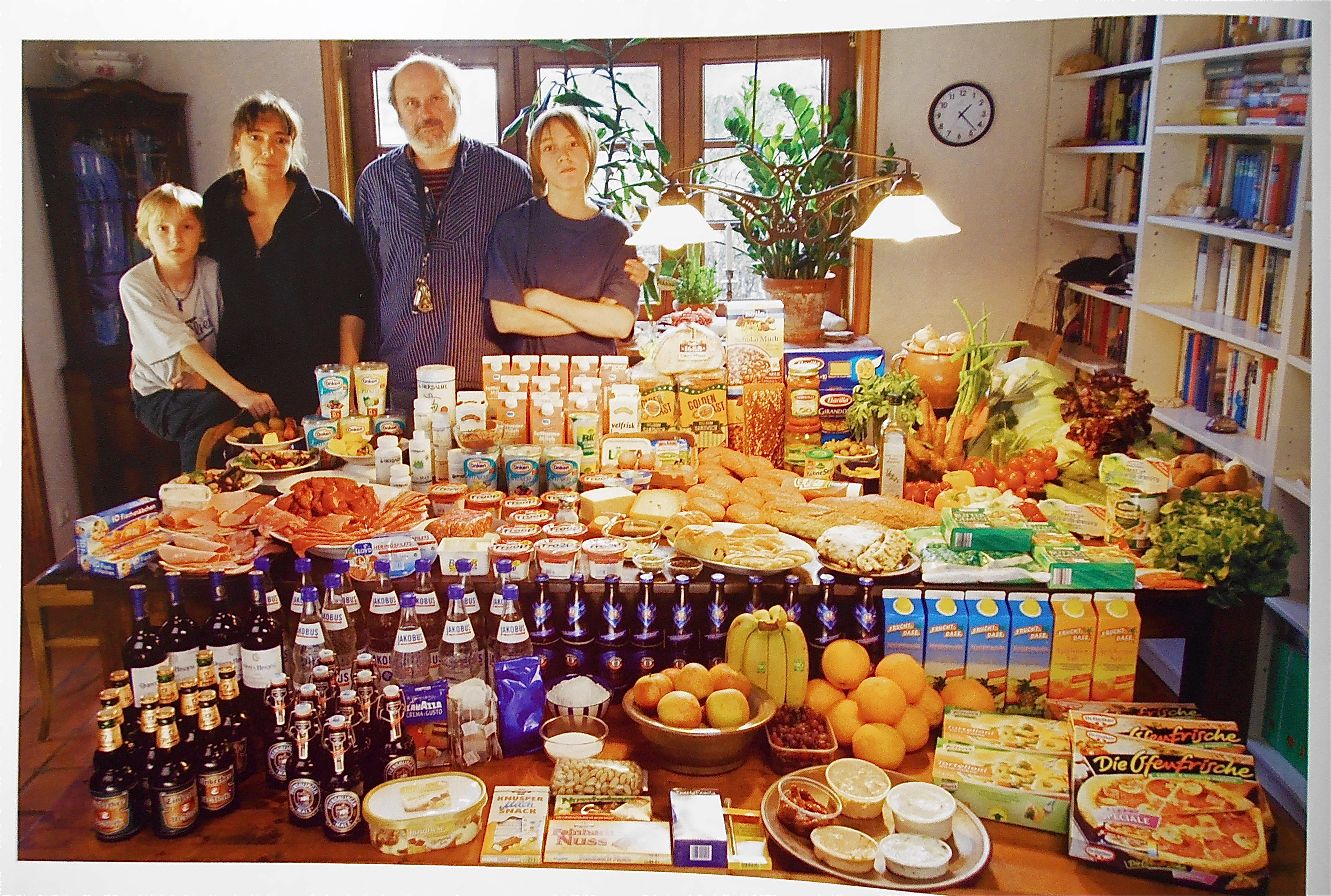
If you haven't seen these compare and contrast photos before, then you haven't been reading the Blog. If you haven't seen pictures like these before, then you should get out and about more. A German family displays a week's food: all that Speck, Wurst, Schinken, Leberkäse and beer :
compared to the sack of rice and a smaller sack of lentils that supports a family from Chad for a similar length of time
Admittedly the lads from Chad are refugees but the local family is not conspicuous for extent of its larder. The last link displays at least a dozen countries by week-food. It may be more difficult to live on $4 / day in NYC than it is to live on $1 a day in Chad. It's well known to obesitologists that it's cheaper to eat badly in America than to eat well.
What about a wider exploration of standard of living round the world - the stuff that folks have is a better indicator of relative wealth than comparing income at the current US$ rate of exchange. We all know food is cheaper in Chad than in German. Dau.II sent us a link to Dollar Street at Gapminder. You'll be familiar with Gapminder at least in its spokesman Hans "Data-display" Rosling, who died a year ago [obit]. Here is Anna Rönnlund explaining how Dollar Street works. The idea is to send photographers out to 250+ family homes in 50 countries to capture a specific list of material goods which you more or less have to possess as a member of the human race. Most homes have something to keep the rain off; something to keep stray dogs out; a place to sleep and a place to sit; a place to cook food, and something to eat it with; somewhere to shit; a pair of shoes; paper and something to write with; something cherished. Dollar Street is all clickable and comparable.
The quality and abundance of the items enumerated and recorded is dictated far more by economics than by geography. A middle class bedroom is essentially the same in China as in Canada and very different from the same thing in a house on the other side of the tracks in the same town. None of this is exactly surprising but it brought me up short (and grateful) aNNyway.
compared to the sack of rice and a smaller sack of lentils that supports a family from Chad for a similar length of time
Admittedly the lads from Chad are refugees but the local family is not conspicuous for extent of its larder. The last link displays at least a dozen countries by week-food. It may be more difficult to live on $4 / day in NYC than it is to live on $1 a day in Chad. It's well known to obesitologists that it's cheaper to eat badly in America than to eat well.
What about a wider exploration of standard of living round the world - the stuff that folks have is a better indicator of relative wealth than comparing income at the current US$ rate of exchange. We all know food is cheaper in Chad than in German. Dau.II sent us a link to Dollar Street at Gapminder. You'll be familiar with Gapminder at least in its spokesman Hans "Data-display" Rosling, who died a year ago [obit]. Here is Anna Rönnlund explaining how Dollar Street works. The idea is to send photographers out to 250+ family homes in 50 countries to capture a specific list of material goods which you more or less have to possess as a member of the human race. Most homes have something to keep the rain off; something to keep stray dogs out; a place to sleep and a place to sit; a place to cook food, and something to eat it with; somewhere to shit; a pair of shoes; paper and something to write with; something cherished. Dollar Street is all clickable and comparable.
The quality and abundance of the items enumerated and recorded is dictated far more by economics than by geography. A middle class bedroom is essentially the same in China as in Canada and very different from the same thing in a house on the other side of the tracks in the same town. None of this is exactly surprising but it brought me up short (and grateful) aNNyway.
Subscribe to:
Posts (Atom)