Showing posts sorted by date for query normal accident. Sort by relevance Show all posts

Monday, 27 May 2024

modern women write

Reader's Log, stardate 15-05-24. I finished Charlie Stross's Dark State [his Empire Games prev] in a bit of a gallop just before a longish solo voyage by car. That's two down in a trilogy; but I'll need a while to recover from armageddon-anxiety before I put myself through Part Three = Invisible Sun.

Needing a new non-fiction earbook available now, I turned to Borrowbox and got a twofer. We'll Always Have Paris (9¾ hrs) by Emma Beddington (50 yrs) and The Hungover Games (5¾ hrs) by Sophie Heawood (45 yrs). If you read the Guardian, you will have read their earlier material, but as both are freelancers, you may have read their pieces in other media - not only print. These books are not entirely rom-com pink & fluffy but the troubles are bounded, normal.

I started with Paris not least because there was the promise of viennoiserie [L]. Bill Bryson realised as a youngster that he should have been born in Dusseldorf not DesMoines. Beddington reckoned that nothing she could buy in Betty's Tearoom in Yorkshire could hold a candle to a wobbly flan - pas trop cuit. She worked as a gap-year assistante in Normandie and read Modern History at University before starting work as a bilingual corporate lawyer. Along the way she fell in with a solid, reliable, lovable Norman, married him and had two children. They tried living in Paris. But she found Parisians cliquey, stand-offish, generally horrible and making no allowance for restless toddlers. Accordingly they retreated back to London but felt displaced and wrong-footed there. The collision of reality with romantic Casablancesque movie script caused poor Emma mental anguish requiring meds and almost destroyed their marriage. Even cakes couldn't make up for it. It didn't help that Beddington's resourceful supportive mother died in a freak accident at about that time. There is a happy ending which sees the family settled in . . . Bruxelles - which most would agree hasn't a patch on either London or Paris.

The Hungover Games is much funnier, perhaps because it is read by the author who knows when to play it for larfs. It is also a family story although one which is exactly half the size. Sophie Heawood moved to Los Angeles to interview celebs for the English press. It suited many publications to have an empathic body, down with popular culture, living at the heart of Celebristan. Much cheaper than flying a staffer out to the West Coast and finding on arrival that the target influencer had gone off the boil over the last 24 hours. Heawood had been in a long-term long-distance relationship with The Musician. Having just been told by her ObGyn that she'd never have children, the on-again couple had one free bonk too many (drink may have been involved) and she was pregnant.

Balking at the cost, emotional and financial, of delivery in Beverley Hills, she returned to a tiny house in the least fashionable sector of the East End of London, UK. Her family and friends are supportive, and as a free-lance she was able to WFH long before Covid opened that possibility to all-comers. The nicest parts of the book describe the close and teasing relationship between mother and daughter. 

A word of AITA advice to fellow patriarchs. If you have unprotected sex with your gfriend and she ends up preg, do not insist on a 3-way DNA test. It's disrespectful. For the rest, I am clearly not the demographic for reading articulate confessional autobiographies of much younger media women. So if I don't sound enthusiastic it's not really a useful datapoint.

Friday, 8 March 2024

Fiction

One way I try to keep my life simple is by reducing choice.

In my Borrowbox universe, I'm overwhelmed by all the books that are there for my reading pleasure, so I only browse the non-fiction section - and obvs leaning to science in that bin. That limits things to reality, rather than some infinite universes model of space and time. I confess to feeling a little smug about this adhesion to Truth, if not beauty. But I recognise that science has very little useful to say about the human condition or inter-personal relationships. Nevertheless, someone needs to shake me to insist "Read This Novel!". On foot of such orders, I read with advantage Small Things Like These and Station Eleven. More recently, I took on board that one of my binfo pals is married to a successful YA author AND that one of my MeFi para-pals is Charlie Stross the prolific Britse SF writer.

Trouble with prolific is that it gives me choice-collywobbles. Stross is about 60 years old and sixty books published. In mid-Feb, feeling that I had to put my toe in Strosswater ,I found that only one earbook was immediately available. No choice? Obliged to plunge! Accordingly, I loaded up  Empire Games  which is the first book in the third trilogy of his 9 volume Merchant Princes series. It is rather good: not dissimilar, in its post-Apocalyptic vibe, to Station Eleven. There is also resonance with Iain M. Banks [obitribute from 10 years ago] insofar as they both write loosely connected stories embedded in a coherent Universe which is quite different from ours.

The Merchant Princes new-normal is that the Earth hosts a large number of parallel universes which through accident and happenstance have gorn all two-roads diverged in a yellow wood on us. We/they only know about the para-historical timelines [tech term] because some people develop the ability to shift among them. We may be thankful that these spacetime travellers are able to bring their immediate baggage, including clothes, [Schwarznegger, we're looking-not-looking at you] with them as they jaunt [tech term] to the same place in a different universe. If that can be achieved, then ideas, tech and stuff can be transported in a way analagous to horizontal transfer of genes between species. As with horizontal transfer this can confer a benefit on the recipients - without causing a loss at the donor end. So it's not a zero-sum game - notwithstanding the possibility of unintended consequences and careful what you wish for

I liked Empire Games so much that I've put a Borrowbox lien on  Dark State , the next book in the series. I guess that's a recommendation, from me to you. PS sorry late launch today - made a PM/AM rookie error on the scheduler.

Wednesday, 6 December 2023

Shingaun shenanigans

Dau.II has been learning to drive. Waiting  for 9 months because of a shameful backlog in slots for getting tested. This is entirely on the RSA Road Safety Authority; the quango which hand-wrings and finger-wags about road fatalities but lacks a budget to, say, re-configure or re-surface known accident blacks-spots. For many years the RSA baulked at recruiting new driving-testers because the bean-counters revolted at being obliged to take on more employees and their pension entitlements; preferring rather to put hundreds of young people on the long-finger and effectively unable to apply for the numerous Irish jobs which require a car to get to work . . . public transport being woeful-to-absent. RSA was recruiting in April 2023 but that effort is now closed.

Finally, many weeks after leaving the sunny south east for Dublin, the RSA found her a test date in Waterford in mid-December. She has been peppering the intervening time with a number of paid lessons with a Waterford-based instructor and as much practice time with her old man as her knees can stand. You can drive for hours [although twee uur rijden, kwart uur rust is better] under normal circumstances but repeated left-hand reverse turns, hill-starts and 3-point turns require significantly more delicate muscle control and repetitive strain so 'er legs start to go all trembly after an hour. And because we live remote, we have to drive for at least 15km to find a quiet residential development to practice, practice, practice.

Last Tuesday she stepped off the train in B'town in the afternoon and we drove about town until we found an older-model housing estate which has, like, roads at right-angles and off-road parking to clear the public roadway. We only mounted the sidewalk s l o w l y twice, so that's a win and a learning experience.

The next day we headed off in the opposite direction to E'town having done some Google Streetview research to locate suitable quiet roadways with suitably configured intersections. We turned off into a 00s-era estate called Shingán [drone-view above L] and didn't mount the sidewalk at all at all. So that's progress. The trouble with learning a new task - like a left-hand reverse turn - is that A Lot is going on. Once you've mastered the skill, it is impossible to imagine why it was so berluddy complicated at the beginning - see prev Curse of Knowledge. Let fall any one of the numerous steps in this simple task and you fail the test and have to wait for yonks again.

My sister and brother both failed the test first time round. Sis quietly mounted the pavement on the left-hand reverse and the tester kept telling her to "continue round the corner, please" until she snapped back that she'd have to go forward or she'd take out a lamp-post. They never recovered the relationship. The Brother's examiner came out of the Test-Centre in a neck-brace having been whip-lashed by a learner-boy-racer the previous week and was understandably quite the cross-patch. 

A recent The Rest is Politics (Question Time) included a question from Sarah Jane Blakemore about limiting the number of passengers in cars driven by recently qualified drivers. It was in reaction to the case where 4 teenagers spun off a Welsh road and drowned. Ooof! We had a 4xdeath in Clonmel earlier this year. In Ireland, novices are required to swap L plates for N plates until they get their road-legs. Rory Stewart learned to drive and passed his test first time in Crieff - population 7000, no roundabouts or traffic lights. In celebration he drove his mother into Edinburgh and nearly lost her in several white-knuckle adventures in, like, traffic. Dr Blakemore is an expert on the adolescent (that's 14 to 24) brain.

Protocol. Stop by curb [30-60cm out?] - gears in neutral - hand-brake on - adjust mirror to see on-side rear wheel - take deep breath - check all round for moving objects - engage reverse gear - release handbrake while multitasking the clutch - when curb starts to veer away from rear-wheel start turning steering wheel (not too much) - quick check all round while moving backwards - ensure that rear-wheel maintains distance from curb - ignore what's happening to front-end of car: that will take care of itself - once round the corner continue in a straight line parallel to give the impression that the wild fish-tailing was all part of the protocol - re-adjust wing-mirror for normal driving - follow tester's instructions for next task. As I say, that's A Lot of processing.

Shingaun maybe from Siongán, a place abounding in ants or pismires. At least they named the estate after the Townland rather than giving it a bucolic English nonsense-name like Meadow Features or Valley View.

Friday, 30 June 2023

Induction and recall

My Favorite Librarian MFL was working for The City all through Coronarama. With all the branches closed, a lot of her colleagues were on furlough: you can't re-shelve the returns if nobody has taken any books out this year. But someone still had to make out the pay-dockets each week and, for various reason of accident and happenstance, that someone was MFL. Which was all good experience [if she ever wants to be a protestant, that Work Ethic 101 will be handy, like] and being there built up a fund of goodwill through the service. Earlier this year, there was a much delayed round of promotions, and that commitment, competence and banked goodwill paid off as an extra letter MFSL (S for Senior) in her job title and a bit more wonga in the pocket. The next step in her rise, and Rise, is to complete her MLIS [Masters in Library and Information Studies] research thesis which will qualify her for the next promotional stage. My ambition genes were shot off in the war; so it's nice to see other people doing things differently.

If I actually know you, dear reader, I may pull on your coat later to complete the survey, the answers to which will be the bulk of the data analysed for the MLIS.

My current ear-book is A Life in Trauma by Chris Luke [blurb] a/the long-time consultant in Emergency Medicine at Cork University Hospital. Dude saved A Lot of lives while toiling at the bloody coal-face of critical care in Dublin, Edinburgh, Liverpool and Cork. I'll get round to reviewing the whole book later. One of the tips and tricks that he attempted implement on his watch was to take an extra 2 minutes at the end of each treatment to write down on a card: a) what the trouble had been b) what A&E had done about it and thrust that into the hand of the patient on discharge [to home, a ward-bed, ICU or the streets as appropriate (*)]. The reasoning is that normal folks are too stressed to hear what the doctor has to say, not least if it includes words never heard before: 

  • "scaphoid"? 
  • "pyrexia of unknown origin (PUO)"? 
  • "contusion of the zygomatic arch w/o fracture"?

Last w/e we were chatting à la zoom to The  Librarian MFL about working at the book-face in a branch library. A colleague was held up as exemplary because when a new customer registered for a library card, he was careful to elaborate all the wonders to which the card entitled them. Not just borrowing books and looking at the newspapers, you may be sure: libraries embrace a far wider range of services nowadays. Triggered by my recent book, I suggested that a word-tsunami of available services could well be a wash [wash-over; TMI!; wash-out; waste of time]. Why not, I said, make a little credit-card sized executive summary of Library Services in bullet-points and a readable font?

Why not, chimed in The Beloved, design a book-mark with the same information?!

High-fives all round!!

(*) It is never appropriate to discharge a sick or injured person back to the streets but it happens every day - because Capitalism.

Wednesday, 2 November 2022

Didn't go down with his ship

In 1879 my grandfather was born, the youngest son, into The Big House in King's County in the Irish Midlands. He was 3½ when his father died and his mother followed 3 years later. The seven kids ran a bit wild as a sense of entitlement kicked off when parental supervision didn't kick in. Anyway, in due course, that sib-group scattered: got careers, got married, left home and only went back to visit. The house  was sold out of the family in 1958: too big, too leaky, for a normal family without servants to run the show. The house and grounds spent the next generation as a girl's boarding school. Over the last decade it has been restored to something close to its former glory and is coming back to life post-covid as an impressive Georgian wedding venue.

The current proprietor cares about history as well as gutters and architraves, and has cut a deal with the descendants of those seven wild youngsters of the late 19thC and we're all going back for a weekend in November. The last of the Magnificent Seven Wild Bunch's F1 [first filial generation] died 6 years ago. But there survive about 40 people from the F2, F3 and F4 generations aged, as they say, from 8 [mo] to 80 and most of them will be there. We have been tasked to bring heirlooms, pictures, docs and deeds; especially those with pictures of striking ladies looking louche beside open-topped motor-cars from 100 years ago.

That's all by way of introduction to a typescript which surfaced among my Father RN's papers consisting of notes about his early naval career. In 1997, he was approached by The Coastal Forces Heritage Trust to talk on video about his time dashing about in motor torpedo boats MTBs in the first part of WWII. The document I have was a sort of notes-to-self or rough script for his perf as Olde Salt Remembers.

Anyway, he and his pals listened to Neville Chamberlain's "sad little speech" on 3rd Sep 1939 from their MTB base in Malta. There wasn't any immediate change in the pattern of exercises and training through September and October but in Early November they were told to plan for a move back to the UK. The older crappier coastal defense craft were to be transport home in a big ship while the more sea-worthy craft were to travel under their own steam to French Inland Waterways via Mers el Kebir, Tunisia; Ajaccio, Corsica and Marseilles.  The Da's boat MTB 06 was a marginal case but he blagged his way onto Team Sea-worthy and they set off from Malta of Armistice Day 1939. The first leg went fine but as the weather turned shitty [worse than in the picture below sketched a month later] as they passed the SW corner of Sardinia and at 01:00, the auto-baling pumps crapped out, then the port-side motor failed and as dawn came up, the starboard engine chugged its last gasp.


They would have to abandon ship! But it was an orderly evacuation and the crew were able to salvage the personal effects and some of the moveable equipment as their escorting destroyer HMS Dainty H53 dropped down to windward to provide some shelter. The Da was the last to leave, being to step off his first command onto the Dainty's accommodation ladder clutching the wardroom clock. The Dainty's skipper took MTB 06 in tow but the line parted in a squall and it was agreed that MTB 06 should be scuttled by ramming [cheaper and quieter than gunfire].  It's in the interwebs: "15 Nov 1939 HMS MTB 6 broke down and was taken in tow by HMS Dainty (Cdr. F.M. Walton, RN). Later she broke adrift and was rammed several times by HMS Dainty. MTB 6 sank shortly before 2100 hours in approximate position 41°07'N, 08°03'E (off the north-west corner of Sardinia)". Could have been worse. A grounding accident 2½ years later spared him from having to confront Scharnhorst and Gneisenau in another cockleshell -  so my father survived the war intact . . . and here I am.

Friday, 29 October 2021

A rough accounting

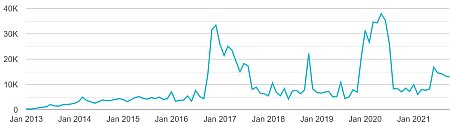
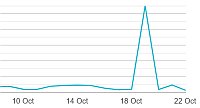
The Blob PageView Stats, wee hours 22 Oct 2021 = a week ago:

At the start of El Pandemico, I spent several weeks listening to the news and clipping cases and deaths into an Excel file to plot the rates. Then I stopped abruptly and with prejudice. Recording the number of cases was futility closet unless I/we knew and believed the baseline - how many people were being tested and so had a chance of becoming a documented case.

I was like that with The Blob. An earlier front-end of Blobspot made it easy to find how many people had read my deathless prose and so I reported, for example, the milestone of 100,000 PVs in 2015 about 3 years and 1,000 posts after the Birth of Blob. Then I gave up and with prejudice because of some frankly incredible fluctuations in these readership numbers. If Blogspot couldn't differentiate between human eyes-on-phone from a data scraping FAANG robot, the numbers offered no solace or feedback. Luckily for The Work, I didn't need to be thanked to continue to churn out my daily 700 words

On the Write Front, I engineered things so that the millionth word I wrote was Zeugma. But the 2 millionth word passed several months ago without any sort of acknowledgement. According to the hive mind these are the best / most clickable Blobs with their rough PVs

  1. Stilt Walking Nonsense 15K a take-down of a meme on the molecular basis of happiness
  2. Mary Anning's Dog 4K a passable short bio of the famous fossilista
  3. Lack for Nothing 2.5K etymology of Waterford slang
  4. GCHQuiz clues and Answers 1K  Ruminations on one 2016 Christmas Quiz
  5. Normal accident 1K a near death experience by medical error
  6. Castle Rackrent 1K an angry polemic about landlords and homelessness
  7. Bellos II 1K a reasonable explanation of how Benford's Law works
  8. Da Nags 1K a neat enough essay on the naming of race-horses
  9. Baltic Ace 1K an anniversary report of a fatal collision in the North Sea
  10. WASH 1K random ruminations on clean water
These are neither better nor worse, by any objective measure, than 10 average posts from The Blob. Note the criterion of average, rather than random. There is a tail of utter bollix in the archive: posts where even I, the author, cannot work out what is going on. So I exclude those but it is a mystery why these posts float to the top. 


It is also a mystery what is happening at the beginning of 2017 and in the Spring of last year. Then, more than a thousand visitors a day were dropping by every day [as illustrated above] Or what happened on 19th October this year when more that 5,000 ppl/robots dropped into Blobland and hopped out again sharpish never to be seen or heard of again? Whatevs! If you're reading this sentence, it means you have stamina; I hope you use any residual energy this day to do your community some service.


Friday, 9 July 2021

TEU

It was different times when The Boy was born in 1975: no cell-phones; no internet; half the number of people. But somethings haven't changed, and the standard intermodal shipping container is one of them. I have internalised this because the first thing I saw when I dazed off the grounds of St. James's Hospital after hearing about his arrival was a Hapag-Lloyd TEU whizzing past on a flat-bed truck. TEU? = Twenty-foot Equivalent Unit. It seemed like an omen, so we added " Hapag " as the poor wee scrap's middle name.

Shipping containers were the brain-child of Malcom McLean the owner of a trucking company from North Carolina. In the early 1950s he bought a couple of WWII T-2 tanker ships [500ft 150m long x 70ft 20mbeam] and converted them to carry corrugated steel boxes port-to-port. He appreciated that sending several truck-loads by sea was more efficient that sending them severally by road. Slower, of course, but much less fuel and time wasn't crucial unless the cargo was lettuce. The first voyage of the SS Ideal-X from Newark to Houston in April 1956 carried just 58 containers 35ft long. That being the maximum load length for NC roads. One of the innovative break-throughs was to separate the trailer chassis from the box containing goods. Many of the other engineering innovations are due to Keith Tantlinger an engineer from Fruehauf Trailers. He invented and perfected the twistlock [L] system for securely connecting containers to the transport base; be that a semi-trailer or the hold of a ship. Connectors need to be strong enough and yet easy to separate at the end of the voyage. The top joint of the twistlock is a round-cornered rectangular pyramid which fits an equivalent hole in the base of the container. a 90° turn locks the pyramid into the hole. Similar "mid-locks" can join two containers vertically. Tantlinger also invented the spreader bar so that a crane could seize one end of the container for lift and transport. Such systems only scale up if everyone agrees to standardisation, and Tantlinger was one of the key movers in this aspect of global trade. If there was a Nobel Prize for Commerce, Tantlinger would definitely have secured at least one. And while we are on secured loads, clock this cowboy [L] delivering fuel in Waterford. It is normal to see coal lorries with piles of Polish coal in 25kg plastic sacks on the flat-bed. It would take quite a jolt to launch a sack off the truck and onto the street and even then it would not travel far even if it didn't burst. Those gas cylinders though? Wouldn't want to be a cyclist having one of those bowling after me.

We all know about the Evergiven backlog in March. On 3rd June 2021 the OOCL Durban had a parallel-parking fail at Kaohshuing, Taiwan: colliding with a smaller moored vessel >!screeeeeeagh!< and carrying away a couple of gantry cranes. Another PoV. That put the port out of commission for a while. At the same time a Covid outbreak put the port of Kantian, China off-limits in a lockdown. 25% of all Chinese trade is funnelled through than port. More importantly, commerce has taken just-in-time inventory to the max because warehousing is a cost. This accident and quarantine has knock-on consequences across the world as ship after ship fails to meet its schedule in a domino cascade. You may have to wait for your lawn-furniture and sweat-shop shirtings.

Saturday, 15 May 2021

Solitary confinement

Dau.I "The Book" came to care for her parents a tuthree weeks ago. Her male parent was behaving strangely and the family were concerned about his stability. It was good to have a good pair of caring hands on site, not least because of an elder-accident that needed attention. In her mind, read a good book is a pretty good solution for many forms of mental disequilibrium, and I guess she didn't lick this up off the stones. Accordingly, she lent me her copy of How to Be a Good Creature: A Memoir in Thirteen Animals by Sy Montgomery. Montgomery is bankable having written a good many books where she has hung out with field biologists and written about what field research is like and how much it is likeable. Quite likeable, is the answer and Montgomery could have been a competent scientific researcher [tenacity, patience, resilience, painstaking] if she didn't prefer writing about the animals in a breezy, intelligent and accessible style. How To Be is a consciously attractive old-style book: untrimmed page edges; rubrics for each section; generous margins ; quirky colophons in red at the header and footer. You don't get that generous treatment by a big publisher [Houghton Mifflin] unless you are, as I say, bankable. Montgomery is one of very few authors who is actually support themselves by what they write.

If you detect a tinge of snottiness from me about writing poety books about science rather than doing, like, actual science, it is because you are well-tuned to emotional baggage . . . not to say hypocrisy. If I was a real scientist, I would have seen a lot more of my scientific papers through the peer-review process. Instead, I crapped out far too often because I lacked finish. On the other hand, I've written thousands of 500-800 word Blobs about all sort of aspects of the scientific process. If I got even 10c-a-word for my efforts, I wouldn't now be driving a Yaris. I guess we work in the same science-lite field. The other thing we have in common (apart from being born in the 1950s) is that we are both service brats with WWII veteran fathers.

The first chapter is about her first puppy acquired when she was The General's Daughter living on a US Army base in the 1960s. After that we are introduced to a trio of emus; an enormous hog; a huge tarantula; a ruthless weasel; 'nother dog; a pair of tree kangaroos; another dog, an octopus; a one-eyed dog. I think that adds up to 13, but I may have left some of the dramatis personnae on the cutting room floor. The conceit is that the unhuman animals have taught the author to live a better life. Not least by developing compassion and empathy for her companions. That's fair enough and worthy of attention but there's an under-current of inequality in many of the relationships described. I'm in the process of marshaling my arguments about the ethics of 'owning' animals but there is something really sketch about the interactions with "Octavia" the octopus.

The New England Aquarium in Boston has acquired a succession of Giant Pacific Octopus Enteroctopus dofleini, [prev Octopus apollyon] because it is a big draw for visitors. A number of books have come out recently pushing the idea that, for all their being invertebrates, cephalopod molluscs are a smart as [insert your favorite mammal here]. I am agnostic about octopus IQ but IF the are as clever as an ass, THEN they should not be isolated in a cage [or a 2,000 litre tank]. The Irish Donkey Sanctuary will not allow people to foster one donkey - you have to take two. For donkeys, in Ireland, in the 21stC; solitary confinement is considered a cruel and unusual punishment. If you think that you're getting a handle on normal octopus behaviour when the creature is so constrained, then you are delusional. It looks like octopus as fashion accessory. harrrrumph! I've had something to say about octopodes in the past including my own contribution towards presenting an octopus to the public . . . after it killed itself.

Saturday, 29 February 2020

Motion sensor

It [L] is me right thigh, patella downwards. It is a leg-selfie [you shd try it - it's the latest thig thing] to show an ActivPal accelerometer, [can this really cost $450 each?] wrapped in a micro-condom and stuck to the flesh with a transparent Tegaderm plastic film dressing [about 60c each]. The point of the condom and dressing is to stop the gizmo getting wet. The crude stick-man is to indicate which side sthould be kept upright - a bit like the glass icon on some packing cases. Anyway anyway, the reason I have this accelerometer attached to my leg is because I am being a guinea-pig for Sean and Cian, two of our Sporty students who are studying "physical activity and sedentary behaviour" among the staff at The Institute. It is, I gather, the first such study inAs I am almost permanently welded to the sofa [blob blob blobbety blob blob] at home, I'll represent the sedentary wing of the party.

We were told to act normal - the lads would not be impressed if I made it seem like I was a really active person. The ActivPal is taking a snapshot of the motion undergone by my right thigh every 15 seconds and storing it on board over a week. At the end of that time, I will report back to the boys and they will download the data for analysis. Every 15 seconds is a good compromise between data-heavy and often enough not to miss a key event. Actually it is quite likely to miss most of my runs up the stairs - I never walk up because I don't do trudge. I often twit the graduate students who habitually use the lift to go to the research lab on the second floor - travelling up by lift has a carbon footprint [costs about 2c a go but if you use it 5 times a day, 250 days a year] that's enough to buy a round a drinks. But I give them a right bollicking if I see them coming down in the lift. Back in the pre-Institute days, my lab was on the 4th Floor, and I always used to run up the stairs . . . and then be unable to talk for 5 minutes. My jog upwards was essentially anaerobic, so I needed that amount of time to suck in enough oxygen to function. In these Covid19 end-of-days days, there are additional reasons not to travel in a lift with Drs Hack, Sputum and Coffin.

The intrusive and ubiquitous nature of the data gathered by these ActivPal devices seem to me to have GDPR issues. It will be clear how many times I get up in the night for a pee - which coincidentally also takes a little over 15 seconds to empty a mammalian bladder; and of course how restless I am in bed; and of course it should record any bouncy-bouncy. It also occurred to me as I sat at stool, that the data readers should be capable of inferring that I was doing exactly that - Motion Sensor, indeed!

A final bit of advice, triggered by the mention of Tegaderm transparent dressings: as well as your torch, shovel, tow-rope and warning triangle, every car should carry a roll of cling-film. If you encounter or participate in a road traffic accident, then cling-film is the paramedic-preferred way of staunching bleeding wounds. It a) stops or slows the flow, b) is reasonably sterile c) allows the professionals to see the damage. I hope you never have cause to thanks me.

Tuesday, 30 July 2019

Access all B-reas

The parallel piece Access All Areas yesterday dealt with the somnolent railway station which serves the village where my mother lives. The connexion is stairs. The station admits to being wheelchair inaccessible and indeed inaccessible to the able bodied under adverse weather conditions. It would take a particularly doctrinaire Inclusion advocate to insist that Chetnole Halt be upgraded to full access to all given that only a couple of handfuls of people use the station every day. Upgrades would cost £100,000s with no guarantee (or even suggestion) that it would encourage any wheel-dependent passengers to use the train service. My mother, for example, moved to Chetnole in 1984 at the age of 64 (the ~age I am now). Last week she told me that it took 13 minutes to stride off to the station because occasionally she'd leave SS Independence, her car, in the garage and launch herself on the buffets of that uncertain and unreliable public transport system. 20 years later when her failing eye-sight finally precluded using any car, she was not really up for walking to the station along country roads without sidewalks but with face-high questing brambles and bat-shit-bonkers car-drivers.

Whoever runs transport infrastructure in Britain continued to send one bus a day to shuttle across N Dorset picking up an irregular supply of passengers, almost of all of whom were on their pensions and having subsidised travel. Most weeks my mother would cast off from home and feel her way across ye village green to the pub where she would wait for the one bus a day. That vehicle passed through about 1030 in the morning and eventually unloaded its passengers in the nearby market town. As the village shop and village post-office had been deemed uneconomic several years ago, this was the only way that these oldsters could buy food with their pensions. Over the years, several people helpfully pointed out to my patient mother that the pub wasn't going to open for a couple of hours: assuming that my sainted mother was only waiting there for the gin.

When Dau.I, Dau.II and BobTheChauffeur went to visit in early June, my mother had just sustained some minor damage in an almost fall and we watched her tottering up the stairs to bed and inching down the incline the following morning. We reckoned that the odds were about 20:1 that she'd miss her footing, but were not quite callous enough to place money on it. As a family, we are a little sensitive to such issues because a fall down those same stairs was the last accident my father had in the house: he died of his injuries four days later. M'sister, as primary carer, wasn't going to take the risk of losing two parents in this undignified and painful manner; so she ordered up a stair-lift as a more-or-less instant gratification solution to that anxiety. One of my tasks on the visit last week was to check out this Elder Launcher <vrrroooomph> and see why my aged, almost blind, slightly wobbly mother experienced such teething problems getting used to using the new technology. "aged, almost blind, slightly wobbly" must be the median demographic for stair-lift customers and there might be a design flaw.

Accordingly, after lunch, I sat into the chair while my mother told me how to make it Go! But nothing seemed to be happening . . . because the chair is designed with a 3 second lag to make sure the passenger is properly settled.
After half a dozen voyages, even the slightly demented can make the muscle memory connexions, expecting the big pause [bear goes into a bar joke here], and go Up [move blue thumb switch right] and Down [move blue thumb switch left] on their own. But for first-time users it is not obvious to all thinking people that an electronic switch is designed to have no immediate effect. Certainly not obvious to me when I gave it a go. A week after delivery, just as Mum had gotten into a normal working rhythm with her new toy mobility aid, the thing packed up on her - totally unresponsive accelerator. She called m'Sister, 140km away to the North. Sister's solution was to call the next door neighbours in Chetnole [both of whom are engineers]. The engineers' solution (have you tried switching it Off and On again?) led to a search for an On/Off switch. It turned out that the young woman from the home-cleaning service, in a bid to hunt out dust under the new machine had accidentally tripped the mechanism [located down near the floor] Off.  Stair lifts are a solution for bringing 20thC (and older) two storey houses up to 21stC inclusion-and-disability specs. The alternative, which we have looked at, is to write off the bedroom floor and build an en suite wet-room somewhere in the foot-print of the ground floor. That is a much greater expense and there is no guarantee that the next owner of this 2 storey, 3.5 bedroom, execuhome-with-garden will see that as an asset. Like upgrading the local railway station to include hypothetical users, it may not be economically sensible.
Design for living must surely include design for a mobility-impaired future.

Thursday, 27 June 2019

MORE wood is needed

When Dau.I and Dau.II were 7 and 9 they played Stronghold, a real-time medieval strategy game, on the computer. Voices, in a variety exaggerated regional British accents, travelled through the house and "MORE wood is needed" became a family catch-phrase. Up until about 1970, wood was The engineering material across the world. Battens, beams, braces, chairs, floors, fascia, fences, gates, joists, lintels, props, purlins, rafters, sheds, shelves, sills, soffit, stakes, studs, table-legs, T&G flooring, trusses. Now we have a variety of other options for some of these uses in metal, plastic, and foam. But there is really nothing better for lightness, cost, ease-of-handling and strength than timber. Evolution has done some serious genetic engineering to make trees and their outspreading branches so wonderfully fit for function. With that-all in mind, let's wing off the other side of the World to Lord Howe Island, a sub-tropical paradise halfway between Sydney, NSW and Norfolk Island:
And, for gawd's sake pay particular attention to Wolf Rock, a tide-washed reef off the East coast of LHI. Zoom in:
In July 2002, HMS Nottingham, a Type-42 destroyer of the British navy, was en route from Oz to NZ when she paused at LHI to allow her crew some R&R on the beach and also to airlift a critically sick sailor to hospital. On the evening of 7th July, a Normal Accident unfolded which ripped a 50m gash in the starboard side, flooded several water-tight compartments and almost caused the vessel to sink. The Admiralty report, which assigns blame to almost all the officers and commendation to almost all the crew, reads like a thriller and reminds us all to focus on what matters: which is not necessarily what causes most anxiety. A Normal Accident [multiblobboprevs] is what happens when a series of events, each comparatively innocuous, pile up on top of each other to bring disaster.

The weather wasn't great, and the ship was trying to depart from the anchorage and secure her Lynx helicopter, at the same time, in the dark. The helicopter was being secured because it had just returned to the ship with the Captain who had been ashore on a courtesy call. With the Captain away, the remaining officers failed to delegate the several tasks needed to get the shop safely out to sea and, fatally, several assumptions were made about the involvement of other personnel in the cascade of tasks that needed to be executed. The Officer of the Watch was, for example, "petrified of damaging or losing the Lynx helicopter". For far too long, for any ship under weigh in an unfamiliar anchorage, nobody thought to consult the admiralty chart on the chart table at the back of the bridge to establish the shop's position w.r.t. known hazards like Wolf Rock; and nobody took any soundings to establish how much water was under the keel. These data were especially important as there was a 500m error of estimate in the location of this obstruction. It didn't help that the Navigation Officer had to swap between 1:150,000 and 1;25,000 scale charts and that someone had drawn a pencil line across the small scale chart obscuring the Wolf Rock hazard.

At the last minute, two of the deck officers spotted a patch of white right ahead of the moving ship and did other, seemingly important, things rather than take evasive action. Ten minutes after the Captain stepped down from the helicopter there was an ominous >!krunk!< and the ship was brought up all standing on the edge of Wolf Rock.

Whatever the deficiencies in experience, navigation and ship-handling by the officers, when disaster struck, the crew jumped out of their bunks to emergency stations and acted in consort to save the ship. "The HQ1 C2 team was calm and decisive throughout. Equipment and manpower resources were well managed and the Marine Engineering Officers' performance was particularly noteworthy as was that of several of the senior rates at FRPPs [Fire and Repair party Post]. Both CMEM(M)s [Chief Marine Engineering Mechanic (Mechanical) as opposed to CMEM(L) ditto ('Lectrical)] provided top quality advice and help with shoring. Many junior rates commented on that their presence, leadership and good humour provided re-assurance in a difficult and dangerous situation and confidence that the ship would survive".

As illustrated in the damage control video I flagged on Sunday, there are no modern technological solutions to deal with water fire-hosing into a ship through a gaping hole in the side. Timber, wedges, mattresses and tarpaulins are still the tools of choice.  The first step is to stem the ingress of water from outside the hull; then the water inside the ship needs to be contained by water-tight bulkheads =walls]; simultaneously or asap the water needs to be pumped out until the water level is at least at a steady state. Water weighs in at 1 tonne per cu.m. and seamen wouldn't trust the integrity of the bulkheads against such a press of water, so they tend to shore them with baulks of timber wedged against something immovable.  Type-42 ships are inventoried with 75m of shoring timber but this was hopelessly inadequate for such a major structural insult. The Royal Australian Navy was able to supply an additional 200m of timber immediately but even this was only about half the final tally (500 m!!) for holding the ship together and above the surface.

HMS Nottingham would have been beyond economic repair but for the fact that she had been refitted and upgraded just 18 months earlier. The Admiralty accordingly spent £39million to fix her up for another 6 years of useful life before she was decommissioned and sold for scrap in 2011.

Friday, 3 May 2019

Lámh eile

In March I was holding forth about Irish Sign Language ISL because Dau.I the Librarian had been giving me an earful on a visit home. She can do that because her on-the-job training was in Cabra just down the road from the Deaf Village which is a deaf ghetto cluster of institutions and facilities for the deaf. In my piece I noted the historical quirk that has ISL more similar to French SL than to the English equivalent. That's all proper because I now know that SLs are not a transliteration of the local speech but each a separate language with its own grammar and syntax.
If you want to get an insight into what fresh hell it can be being deaf, you could do worse than read Seeing Voices by Oliver Sacks, whose The Man Who Mistook His Wife For a Hat I have cited previously. Seeing Voices is A journey into the world of deaf culture, and the neurological and social underpinnings of the remarkable visual language of the congenitally deaf. I have a copy of both Uncle Tungsten and Awakenings and they are both excellent and I also like the montage cover designs of the book series [above].

I'm on about the deaf again, because I was up in TCD this week for a couple of events that lurched at me from the Twittersphere and when I arrived I twigged that it was Trinity Week which this year is themed on SILENCE. Actually I think Trinity people do whatever they feel like whenever they can book a room on Campus and if it fits the theme that's a happy accident.  Certainly the evening event I had in my diary was about the inflammatory prequelae of Alzheimer's; which can get rather more shouty than silent. And the lunchtime gig was not part od silence but rather part of the long tail of Schrödinger [prev] events and (therefore?) held in the Schrödinger Theatre where I learned Physics [from ETS "Nobel" Walton] as a student in the 70s.

It was billed as a 'discussion' on the theme of language. But five talks, completely unrelated and unconnected is rather a Gallop than a Discussion and I'm glad it was before lunch rather than after because I may well have zzzzed off if my circulatory system had been the least bit diverted from brain to bowel. It's a convention in The Arts Block that lectures are read from a script, which is good for time-keeping but makes for poor theatre. Science lectures at their worst are read from powerpoint slides, so you only see the back of the speaker's head. At their best otoh Science talks can be high drama with great narrative pacing, mighty gesture and spittle <eeeeuw> into the front rows of the audience. They got a scientist Fred Sheedy to talk - about the language that is DNA - and he had powerpoints but even he read his script. As planned, probably because of the scripting, the event finished on the dot of 2pm [+2 minutes] so that people could go back to their day-jobs.

One draw for me was that the whole event was to be ISL signed by a bloke called Michael Feeney [R]. Signers can be a bit distracting, like sub-titles, but here added a good bit of dramatic effect to the talks. The middle talk was by Elizabeth Matthews of the School of Inclusive and Special Education where she is the expert on education for the capital D deaf - those usually born thus who identify as a member of the hearing impaired community. Different from deaf like me who is continually asking students to repeat themselves or Pat the Salt my aged father-in-law who has, but hates, hearing aids; we identify as The Patriarchy rather than by our hearing loss. There are 5,000 ISL users-as-a-first-language 95% of whom are born to hearing parents who have to scrabble to catch up with communications with their newly beloved. The kids come to school with an immense learning deficit because of these communication problems. A normal Chomskyan child with ears effortlessly acquires correct grammatical, locally accented language years before school starts and then uses that tool to accumulate all sorts of other knowledge.

Things are not helped by the fact that there are {no | nil | nada | zero} deaf, primary language ISL, national school teachers in Ireland - none. Because most deaf kids are exempted from Irish through school to cut the poor buggers some slack in their silent world. But Nil Gaeilge is not [politically] acceptable when you apply for teacher training college. So whatever little ISL the teacher has must be like trying to learn algebra through Latin for the deaf kid.  And whoa, it turns out that there is a big deficit in the world of STEM words in ISL; so gene, isobar, algebra, statistics, chromosome, gamma-amino-butyric-acid all have to be spelled out. Mild hilarity as Michael the ISLigner tries to keep up with the list!

The Central Praesidium of ISL have decided on signs for 150 key terms in maths and are now working on a similar list for ecology and environment. That's really cool. It forces the relevant committee to address the hierarchy of Essential for each topic. I had a go at this important gateway in discussing David Botstein's revamp of introductory science at Princeton. When they come to populate the ISL committees for genetics, evolution, biology, I'm yer man!

A bunch of us went off to lunch [R & right-on] to try to dry out after the information deluge we'd just experienced and we there heard about what it is like bringing up a child who, although he is able to hear is profoundly aphasic and is unable to express himself or communicate any but the most obvious needs, desires and requirements. Because The Blob is approaching infinity, I was able to contribute the use of the gesture comms method of Sing & Sign with which pre-verbal Gdau.I and Gdau.II were helped through the frustration experienced during The Terrible Twos from being able to articulate what they want. Turns out there is another sign language out there: Lámh is "the manual sign system used by children and adults with intellectual disability and communication needs in Ireland". Because it's a gesture language effectively unrelated to Irish - no fadas! - Lámh can be used by New Irish with as much facility as folks with 4 Irish Grandparents. Like scientific ISL, or Charles Ogden's Basic English, or Globish, Lámh is a reduced instruction set RIS language that is good enough for day-to-day comms but not so hot if you need to discuss Heidigger or learn differential calculus.

Here's a challenge /task.
Look at the list of the Lámh Gs:
Game Garda Garden Gentle Get Girl Give Glass Glasses Glove Go Goat God Good Goodbye Grandfather Grandmother Grass Green Group Grow.
Now edit it so that it has more utility with / for your favorite language-impaired person. Me I'd remove God and add Gay ; and surely Gooooooaaalll rather than Goat; but YMMV.

I'm worn out with just thinking about deaf-comms, I can't imagine what effort it must take to actually do it at the coal face. So here's a little Irish ditty to explain where the post-title comes from.
Sing Lorve lorve ella a hane a doe = A hand, another hand, one, two etc. you can work out the rest
Lámh, lámh eile, a haon, a dó,
Cos, cos eile, a haon, a dó.
Ceann, srón, béil, smig,
Agus fiacla bána i mo bhéal istigh.
Súil, súil eile, a haon, a dó,
Cluas, cluas eile, a haon, a dó,
Ceann, srón, béil, smig,
Agus fiacla bána i mo bhéal istigh.

Friday, 19 April 2019

Exploit the water [again]

Free the water Part I.
Last Friday I was wandering about in Dublin waiting to have my toothy extracted at 1330hrs. As a navy brat, trained to expect lunch at 1pm ± 2 minutes, I got predictably hank marvin as I stepped of the DART to walk into deepest suburbia where the orthodontist has her practice. I had a sandwich to hand [forward planning, me] but had been planning to eat if after the event. I needed something to drink and popped into a convenient Tesco for a 500ml bottle of water. Well what a shower of bad bargains:
  • €0.85 Tipperary  500ml
  • €0.95 Ballygowan 500ml
  • €1.09Volvic  500ml . . . up to
  • €3.29 London Essence Orange And Elderflower Tonic Water !!
€3.29? I could have drunk my tears of frustration! But then, bizarrely to a sheltered chap such as myself, it turned out that you could get twice as much water for a fraction of the price:
  • €0.35 Tesco Sparkling Water Apple And Raspberry 1 Litre
  • €1.59 Ballygowan Sports Still Water 1 Litre
  • €1.59 Tesco Ironing Water Spring Petals 1 Litre
  • €1.69 Tesco Prune Juice Water 1 Litre
  • €2.09 San Pellegrino Sparkling Water 1 Litre
That Tesco Ironing Water Spring Petals sounds pretty good, must go down well in Scotland as an alternative to Irn Bru. But I plunked for The Apple and Raspberry [35c and all] and it was okay; served its wash-down pupose anyway.

I get, as you see, rather exercised about the productification of water. The whole point of having Irish Water [and its predecessors] was to produce clean clear potable water from every tap in the country. More or less coincident with the final delivery of this dream - boiled water notices are no longer normal in Roscommon - is the widespread belief that Chateau Tap is unfit for human consumption. Almost certainly carried forward by the omnipresent marketing of minute quantities of water for fantastical prices. What, you can't afford bottled water? Ye'll never marry my son, y'trollop.

Bad as marketing something quite normal for inflated prices is, at least it is honest capitalosm. There is another crowd who are selling the stuff that falls from the sky but braying an ecoplanet message with their mark-up. They are called Ecofil and I first encountered them as a Youtube ad. Then I checked out their webpage. They provide water fountains [I think] Putting an Elkay ezH2O Bottle Filler in your school will provide:
  • Ready access to drinking water and hydration.
  • Elimination of Plastic bottles in the environment
  • Filtration of Lead, chlorine and other impurities.
Here's the thing, in our house these benefits come fitted as standard - it's called the kitchen tap. The other element of gall is that, for €8+vat, Ecofil will sell you (and everyone in your school) bottles made from Green Polyethylene, a renewable raw material derived from sugar cane ethanol. During their growth cycle, the raw materials used to produce Green Polyethylene absorb and repair CO2 in the atmosphere, reducing greenhouse gases and it’s carbon footprint. That statement, apart from being apo'strophe-, Capitalisation- and subscript2- challenged, is forty shades of bollix . . . even if "for free" Ecofil will print your school logo on each bottle. That's still a t€nn€r for a plastic bottle before you put any water in it. I just got a free bottle when I bought 35c-worth of fizzy water, I'll use that until I drop it under a bus by accident. Economies of scale there are: if you buy 500 (!) of their logo-encrusted fashion accessories aka "our New Bio-degradable sports bottles", Ecofil will throw in a "free" bottle-filler worth €2,000. In no realistic natural situation will polyethylene degrade within the life-time of the children for whom these bottles are purchased.

But that's a good thing! One way of solving the world's runaway carbon footprint is to make lots of things out of polyethylene [86% carbon by weight], use them as long as you can and then pop 'em into nice big anaerobic landfills. It will be like recreating the Carboniferous coal-measures all over again.

Wednesday, 12 September 2018

Chatsworth 10 years on

On this day in 2008, a Metrolink outward bound commuter train was in a head-on collision with a freight-train coming round a corner on a single track part of the Los Angeles County rail network outside Chatsworth, CA. The combined impact speed was about 80 mph = 140kph and 25 people died from blunt trauma. Many dozens of passengers were injured: ". . . head injuries, multiple facial fractures, chest trauma, collapsed lungs, rib fractures, pelvic fractures, leg and arm fractures, cuts in the skin and soft tissue. Some have blood in the brain". And so it was a bloody mess. Two people in particular didn't come out of it with reputation intact: one dead and one miles from the accident.

The first was Robert Sanchez, the engineer, who was at the end of an 11 hour shift in which he'd brought the train in from outer suburbia: between starting the inbound run at 0644hrs and arriving in LA at 0853, he exchanged 45 txt msgs. On the way out of town in the afternoon he received 7 and sent 5 more txt msgs including one 22 seconds before the freight train appeared in sight 4 secs before impact. 9 minutes earlier he had sailed through a red light onto the track that was accessible both for NW and SE bound trains. Many of the txts were totally trivial communications with a teenage trainspotter. It seems certain from subsequent investigations that Sanchez ran through the red while suffering from inattentional blindness. All his attention being directed at his phone. Timeline and context (including text of txts) from the NTSB. I've written about the lethal effect of txtn while drivn a car in the context of Werner Herzog's arresting film  From One Second To The Next. I feel the pain more than some having been whacked off my beautiful pink road-bike 20 years ago by a woman looking for her phone rather than at the road.

The other person who suffered reputational damage was Denise Tyrrell, the spokesperson for Metrolink. The day after the crash, she told the press that the evidence was pointing at one of Metrolink's engineers being at fault in that he went through a red light. She believed that it would help clarify things by being up-front rather than ob-fusc, and she secured approval from Metrolink's CEO before going public. Two days later she was forced to fall on her sword and resign because her comments were premature and inappropriate. Depending on who you are, you'll either agree with the management or be outraged that a comparatively low-level [female] employee was 'retired' rather than the buck stopping with David Solow the CEO. I know my father, who was a ship-captain, had strong feelings about the bloke in charge being in charge and so ultimately responsible for everything and everyone below him in the organisation. If an organisation allows drivers to goof off on the job and 25 people die, then the CEO need to own it. Your outrage, if any, at the shabby treatment meted out on Ms Tyrrell is probably coloured by the fact that she was right in her assessment. How would you feel, how would Sanchez's family feel, if her immediate-aftermath assessment of cause turned out to be incorrect? See: it's not so easy, is it?

By coincidence [or because we love each other very much] My Son the Engineer aka The Boy is currently researching a pitch to sell UK railway safety protocols to the USA. After a clatter of  turn-of-the-century railway fatalities in the UK exposed systemic failures in management, accountability and training, the stakeholders got together to prevent these 'normal accidents'.  Last December, in the wake of the rail-crash near Dupont WA, I wrote about how automation is working fine and making money for Amazon but is too costly to implement in the nearby railway. If things are too costly to implement, you need a Risk Assessment to ask if it's going to be more costly to not implement. It's a bit like the story of the magnate who was too busy to meditate for half-an-hour a day; his guru / personal-trainer's conclusion was that he should therefore meditate for a whole hour a day.

Premature and inappropriate is in the air today in Ireland because the Scally Report into the Cervical Check Scandal [prev] was released to the Irish Times and RTE before being presented to the cabinet or shown to the women who were done for by the whole debacle. Much indignation that Dr Scally had exceeded his brief and made a list of recommendations that, in his opinion, would preclude much of the need for a full scale, all-lawyered-up tribunal of enquiry. When the report, with the easy headlines put in context, was read by the main cervical victim group, they agreed that it was measured and sensible and, importantly, immediate-of-effect (if the government chooses to implement the recommendations).

Friday, 24 March 2017

Oroville Update

In January this year, after 5 years without rain there was a dramatic drought-break in Northern California. Suddenly there was more water than anyone new adequately how to deal with. I mentioned the story again a couple of week later by way of saying that Mr Trump's 'promise' of $1 trillion$ was probably not going to be enough to fix all the bridges, culverts, dams and road-pavement that was beyond their sell-by date. The cost of just cleaning up the mess at Oroville up till now is in excess of $100 million. Here's good footage showing water moving before, during and after the over-flow crisis at Oroville.
When we left Oroville on 13th February, the rain had eased off, if you can call 13in = 330mm in 4 days an easing off. The emergency spillway was still in danger of being utterly destroyed through under-cutting by the flowing water and the reg'lar spillway had a hole [see above, the yellow Lego figures are about 2m tall] big enough to bury my 'umble 'ome and another half-dozen houses of similar size. But the California department of water resources DWR were left with Hobson's Choice and had to let water out of the brimful lake down the compromised spillway. Without Hans Brinker the hero of Haarlem to stem the flow, the rushing water ate at the edges of the hole and then ate at the edges of the hill and than started scouring out the very bedrock. In about 20 days, 1.5 million cu.yds = 1.1 million cu.m had been stripped out and dumped into the Feather River below. Every day of that meant another ?$5million? in damage and erosion that would eventually have to be repaired. This what a million cu.m of crumbled concrete and bedrock looks like - mainly grey in the brown river:
You can see the almost white strip of remaining spillway near the top right of the picture. This is after they had scrabbled a channel through the debris field (you can see it flowing along the left edge of the heap of grey rock). They did that so that the level of the river could be lowered below the out-fall ports of the Hyatt power-station at the base of the dam - off-camera to the right. On an engineering side note, you can't run water through the plant unless you are taking electricity off the turbines - if they aren't engaged with the magnets they spin so fast they melt the bearings and explode. They couldn't run the electricity because the cables and pylons tracked off through the flood disaster zone and had to be removed!  It was a fine old mess of a 'normal accident' or one dam thing after another. Here's a picture of before (normal spillway gush 2011), damage (7th Feb 2017) and after (27th Feb 2017):
But the DWR hired every 20 tonne dump truck, every bull-dozer and every monster back-hoe in N California and contracted them to move that rock out of the river. One of these massive diggers costs maybe $50,000/mo to operate and the film footage shows dozens of them scurrying about the landscape. After 10 days of round the clock digging, they had cleared much of the spoil from the riverbed and the water was able to flow downriver. More importantly the power-plant was able to open ports and start to generate electricity again. This meant that anything up to 10,000 cfs (cu.ft/sec) that's about 1 million cu.m/hr which sound a lot but isn't going to make much of a dent when there are acre-ft of water the other side of the dam: it can lower the lake at about 1cm/hr. But snowmelt and rain is adding 5x as much, so it's a wee wee solution. Load-carrying helicopters have delivered new pylons and sackfuls of rock 'armouring' to fill the new canyons below the emergency spillway. These boulders have been glued together with thousands of tonnes of shotcrete - sprayed from concrete mixers through special hose-trucks.  Some shotcrete has been judiciously added as 'pointing' to smooth out the ragged lip of the broken reg'lar spillway.  It's been the most tremendous engineering project; a triumph of American can-do and steady nerves . . . and luck with the weather (all those Christians praying, I guess).  But, being America, there has been a parallel load of bonkers negativity / paranoia: 
  • The rain came because of the contrails chemtrails (of course); 
  • the hole in the spillway was caused by a terr'ist bomb; 
  • the whole thing is god's judgement for fluoridating [bloboprev] the water; 
  • where is the rebar? I can't see any ferro in the concrete from my sofa in Arkansas it must have been left out as a contractor's scam.
  • It's all a plot by Democrat Governor Jerry Brown to spill the precious fluids of god's own America
The top of the emergency spillway is 900 ft above sea-level, the dam itself is 922 ft. On 17th March 2017, the lake level reached 860ft and rising that's 10 ft higher than the recommended lake-height according the the Army Corps of Engineers. They opened the busted spillway aNNyway under minimax conditions. If they dribbled water down the spillway at 10,000 cfs then it would head-cut the lip: potentially back to the spillway gates otoh if they sent the 100,000 cfs max load it would scour the hillside below the lip and fill the goddam river up again. They happy medium expert opinion / guesstimate was 40,000 cfs. That way, the water would blurf into space and into the existing plunge pool where some of its energy would be dissipated.  In many ways the whole fiasco has been an engineers wet dream.

One final thought: nature is full of homeostatic balance and doesn't handle wild fluctuations very well. California's a Garden of Eden. Downstream from the dam are hundreds of hectares of vinyards, olive, almond and orange groves, orchards and market gardens. Those nearest the river are protected by levees - artificial embankments that are held together by inertia and vegetation. Letting the river level go up and down like a yo-yo is ungood: the levees saturate with water from the high water mark; if you allow the water to drain away too quickly the saturated earth slumps into the river taking away years of natural ground-cover and its mutually supporting root structure.

Juan Brown, a local airplane pilot, has been my touchstone for commentary. His channel is called blancolirio and this is a compendium of all 22 of his oroville videos.

Now some context. The $100 million is just staving off disaster, they are still soliciting opinions about the long-term solution and hoping to build it this Summer before the next rainy season.
Oroville may be the tallest dam in the US and the spillway may be 55m across and 2km long but it's not orders of magnitude bigger than other engineering projects that are in urgent need of attention across the USA.
  • IF according to WaPo there are 130,000 such projects
    • ANDIF Oroville has cost 1/10th of $1 billion
    • ANDIF $1 trillion is 10,000x more than that 
  • THEN the Feds should be budgetting $10 trillion not $1
Note: $1 trillion is not twice the size of $1 billion, although that's how we internalise it. $1 trillion is an unimaginably large pile of money. It is the the entire tax-take = total govt spend for a piffling country like Ireland for 20 years!

Saturday, 28 January 2017

Gus Grissom Gone

I wrote a brief obit for Eugene Cernan, the last man on the moon, a couple of weeks ago. I felt I could be brief because I'd given him a fulsome trib in December 2015. It cost a lot to get Cernan and the other eleven moon-walkers to the surface of the moon and back: so much that the Human Genome Project, which cost about $1billion, usually employed the US Space Program as the only comparable mega-science endeavour. There were costs along the way which are hard to dollarise and costs afterwards as two Space Shuttles came back to earth in small pieces.

I was reflecting on the costs because yesterday was the 50th anniversary of the Apollo I disaster when three astronauts were incinerated on the launch pad during a practice run on 27th Jan 1967. Of the three dead men, Gus Grissom, Ed White and Roger Chaffee, Grissom's name struck the memory bell loudest. He was Indiana's most famous son and a fighter pilot in the Korean War before he was picked to be a NASA astronaut: one of the Mercury Seven. As with Neil Armstrong and Eugene Cernan there was a lot of Harry Potter 'Eclipse first the rest nowhere" in Project Mercury . The first man in space, John Glenn, became a household name and eventually a US Senator and Presidential candidate. You have to have been around as a small geeky boy to remember the names of the others. Gus Grissom was the second man in space; in those days, the pilot got to name the ship, and Grissom plunked for Liberty Bell 7 [the pair see R].  He almost lost his life, not in a dramatic fireball like the Challenger or Columbia space shuttles but in a botched landing /pick-up after a successful mission. After splashdown the pilot was meant to sit tight until a chopper from the nearby aircraft carrier hooked on and lifted the spaceship to the flight-deck. In somewhat murky circumstances, the capsule door blew off while LB7 was still bobbing about on the ocean, waves slopped in and a lot of expensive kit sank into the depths. Grissom slithered out and nearly followed his command down when his space-suit started to take on water. His buoyancy wasn't helped by having smuggled 2 rolls of dimes onboard to sell as souvenirs afterwards. He ever afterwards denied triggering the explosive bolts, but not everyone believed him. A fellow who could bring half a pound [almost exactly the weight of 100 dimes] of unaccounted weight aboard such a delicately balanced project could have done pretty much any dopey thing. It's similar to the Apollo 8 astronaut who pressed the Don't Press This Button button and unravelled Margaret Hamilton's computer program. There was a tension between the NASA management who wanted the astronauts to be quiet passengers while they controlled everything from Houston and the astronauts, almost all previous test-pilots who wanted to be doing. Doing some daft things like Alan Shepard bringing a 6-iron and two golf balls to the moon and whacking one of them into the distance. NASA believed Grissom had not been tricking about with the door, let alone panicking to get relief from claustrophobia, and that's all the counted. He went up in Gemini 3, becoming the first man to do space twice but was still eclipsed in the public mind and history by John Glenn and Neil Armstrong.

Whatever you feel about the sinking of Liberty Bell 7, Apollo 1 was a good candidate for a Normal Accident: a cascade of small-small t'ings had to go wrong or go unnoticed. The inside of the capsule was pressurized a little above atmospheric with pure oxygen (!). A smoldering candle will burst into full flame in such an atmosphere. One of the ironies of the disaster was that the door was designed to open inwards - partly because of Grissom's earlier mishap with out-opening doorways. Another door shouldered some of the blame. An access port had, through repeated opening for inspection, stripped off the insulation of a silver-coated copper wire. The inspections were necessary because a tube transporting ethylene-glycol coolant was always leaking. With 20:20 hindsight it was revealed that silver had a positive electrolytic effect on ethylene-glycol and the ignition wouldn't have occurred with plain copper wire. One suspects that the silver coating was there to justify a fabulously inflated price for the material by NASA contractors North American and Grumman. They charged top dollar because they could, but their workmanship was often shoddy, the delivery time-keeping weak, and design-flaws manifold.  We remove our shoes in the run up to all air-flights now because on 22 Dec 2001 Richard "Bat-shit bonkers" Reid smuggled a bomb aboard an American Airlines flight in his shoes. Likewise, the NASA contractors stopped using silver coated wire anywhere rather than thinking about the next potential hazard. If ethylene-glycol started the fire, there was plenty of flammable material in the cockpit to keep it going. The walls had been almost carpetted with Velcro which had been recently invented by George de Mestral; this allowed the astronauts to park pretty much everything while weightless but burned very well in pure oxygen . . . likewise the space-suits.

If you read Richard Feynman's story of the Challenger disaster and investigation, and you should, you'll get the feeling that NASA's managers were culpably negligent in heeding the concerns of their astronauts and terrestrial engineers about redundancy, safety, testing, and analysis of complex systems. Mean with the routine but necessary checks and balances, they were spend-thrift with contracts and were always cranking up the ante to make NASA more sexy and pioneering. It was as if they knew Congress would only buy into the idea of space-travel if the projects became increasingly complex and hard to fully comprehend. Feynman concluded that NASA management were almost ideologically incapable of grasping probability and risk-assessment.

In 1999, three decades after it sank, Liberty Bell 7 was recovered from the ocean floor. 52 more dimes were found loose in the capsule. It seems that Grissom wasn't the only one sending souvenirs into space - but he was the only man with the bottle to ride with the illicit payload.

Friday, 30 December 2016

Normal accident

I'm interested in drugs:
  • as a tax-payer because of the mad amount of money given to MegaPharm Inc. to achieve a marginal benefit for an unfortunate sufferer of a rare disease [prev Morquio; Orkambi]
  • as a philologist bemused by the truly daft and eye-crossing names which the developers choose to give their products: infliximab  has been around a long time now and it kinda of trips off the tongue but some of the others just give me a stutterimabitis; daclizumab, solanezumab and aducanumab and adalimumab; . . . but tositumomab? that might stick especially if nausea is a likely side-effect - Toss ye tum, geddit?
  • as a carer lurrying a handful of coloured pills every Sunday night into Pat the Salt my mildly demented father-in-law. They look a lot like sweets, luckily there are no small children to mistake the drugs for something to eat.
As well as teaching human physiology to Pharmacy Technician PT students, who are working towards a Level 6 Certificate,  I share an office with The Pharmacist at one of the local chemists, who works part time teaching at The Institute. She is very discrete - it goes with the profession - but I occasionally get to hear [strictly anonymised] tales of 'mistakes were made'. We are in the process of making up a Level 7 PT Diploma and one of the courses to be offered is called something like error checking in the pharmacy.

As I mentioned in a related matter, a third of all deaths in the US [or any other country where they have doctors] are the result of medical error. I know of one non-fatal prescription error case. Father of a pal of mine elected to have back surgery, which didn't go so well: he finished up with persistent tooth-grinding debilitating pain. The meds to combat this were required so often that his practice team fitted him up with a catheter at his waist, so that he could give himself a jolt of pain-killer when he felt he needed it. Once a month the old chap had to travel up from the country to fill up the reservoir at the teaching hospital which had bungled his surgery. It took him all day with the travel and the waiting. One month, finally sorted, he set off towards the train station, felt a twinge as he crossed the hospital car-park, pushed the admin button and promptly collapsed. The doctor had mis-written his script so he got 50x the required dosage. If this is going to happen, just outside the doors of A&E is the best place . . . so he survived.

That was probably culpable negligence. Normal Accidents are when several small-small errors and misunderstandings, trivial and recoverable in themselves, accumulate towards a disaster. A small example might be when the doctor's hand-writing is so illegible that the local pharmacist wings it when interpreting the scrawl and gets the dose or the drug wrong. You can't ring up the bloody doctor for every script and of course the god-walking-this-earth doctor couldn't be prevailed upon to write clearly. Maybe this is dying away in the electronic world. Maybe that is not a good idea: if you have to work, even a little, then you'll think a little before you dash off the script.
These things are pervasive enough that Charles Perrow wrote a book about them in 1984: Normal Accidents: Living with High-Risk Technologies. This starts off with an analysis of the almost disaster of the Three Mile Island nuclear reactor accident. I was there! Or rather 600km downwind shortly after I arrived in Boston for my PhD in 1979.  It is an interesting case study where a combination of equipment malfunctions, design-related problems and worker errors conspired to cause a partial melt-down.

Network Rail in the UK have put out a handy set of short training films, reconstructing events where something has gone wrong. Here's one where the three men involved in a SPAD - signal passed at danger - speak to camera regretting their actions, inactions and poor communication skills. I think it would be just bonzer to make a similar film with our PT students acting out a prescription error in our pretend-pharmacy lab at The Institute. And lest you think that Lost in Translation is always tragic here's one that's funny.