Soon after starting work at The Institute three+ years ago, I wrote a feel good story Lost & Phoned, about how our rural network found my lost cell-phone and returned it to me through a chain with four degrees of separation. On Friday night there was a knock at the door while we were eating our scoff at about 1930hrs. It was a young woman with an antipodean accent enquiring if we, or any of our people, had lost a dog; because she and her bloke had found one about 3km away up the rough mountain track that leads to Mt Leinster. Turned out The Bloke was from local - part of the diaspora of The Great Depression of '08 who had gone to seek his fortune in Australia and found himself a good woman as well as a job. This fellow was well fit because the dog was dog-tired and had sustained a cut to the left fore-foot, so he had carried it all the way back to civilisation. Would I care to have a look at the hound? because it was at the bottom of the yard in their car. I do know the difference between a dog and a cat, but asking me to recognise a particular dog and associate it with a particular person is way above my pay-grade, so we called The Beloved from her tea.
She didn't know the dog but said that she'd contact the local text-alert and have a calling-all-cars message sent out. And it was so. We live right on the county line and the dog had been found sufficiently far up the mountain that it could have wandered in from pretty much any side of the 25sq.km upland massif so she also called our neighbour across the county border [which bubbles and chuckles along the edge of our Eastern fields] to put out a call to their text-alert. Well it turns out the the Wexford text-alert people don't do missing pets - they concentrate on suspicious people in Hiace vans. But the neighbour called a pal in the village who had indeed heard that a dog was reported missing and he'd get in his car and find out who the owner was. The owner of a lost brown&white spaniel was tracked down to a village about 15km away and it seems certain that the red&white spaniel which had been briefly in our yard was a good match.
Apparently the dog had 'got away from her' while she was walking in the mountains. Hmmm, I hope the dog wasn't chasing sheep because that's a death sentence round here. Many years ago, I was up in TCD and met my old Professor of Animal Genetics at the xerox machine. As well as writing the text-book on quantitative genetics, he was also a farmer of some 40 ha. of fine fields and pasture in County Meath. I asked how he was doing and he replied "Not so good". It transpired that he'd had to shoot two of his young dogs that morning because they'd come back home with bloody muzzles and a neighbour had reported a couple of sheep 'worried'. The thing about farmers is that they are competent and self-confident and they don't shirk or out-contract, difficult or dirty work. Bleeding hearts will doubtless be aghast at that final solution to a problem which could be (surely!) dealt with by a trainer.
Showing posts sorted by relevance for query lost found. Sort by date Show all posts
Showing posts sorted by relevance for query lost found. Sort by date Show all posts
Sunday, 29 May 2016

Monday, 12 October 2020
lost + pound
It's The Beloved's birthday, so it is inevitable that I'll reflect on the prospect of growing old together. Last week I found my car-key [again!] before I'd lost it. I must have been overloaded getting the groceries off the back seat of the car and allowed the lanyard to slip through my arthritic fingers. It showed up a lot better in the grass since I changed the colour. Looking for the other key-loss event showed up a disconcertingly numerous number of recent examples of lost & found. Those marbles must be quietly slip slipping away.
Anyway, it's not only me. The Beloved is principal carer and power of attorney for her redoubtable father Pat the Salt. A few weeks ago was on watch with him and had to nip up town to get something. With the approach of pension day, the pension and credit union bag was on the kitchen table - in full view of any burglar who had climbed over the gate (or indeed 2 m of box-hedge), sneaked past the dog and walked round the back of the house. That would never do, so she put the bag in a safe place. >!poof!< it disappeared. Finding it wasn't helped by having two houses, both alike in dignity and 70km apart, where it might be. I won't reveal where the bag turned up [but it did!] because I know some of you may [inadvertently] share the information with your sketchy cousin who is desperate to service their drug habit.
At least the bag turned up in a time frame nearer to 13 days than the 13 years it took for a carrot to find this Canadian lady's diamond ring. Ring seeking carrots are, apparently A Thing: Sweden. I read a Quora story of a woman who put her pearl necklace in a safe-place and didn't see it for 30 years when she was widowed and downsizing and the necklace appeared hooked on the back of the marital bed's head-board.
Hearing the lost and found story, a good friend of ours said it was better to leave everything valuable in a reasonably accessible place OR in a concrete bunker at the bottom of the garden. Burglars will literally turn your house over, quickly and efficiently, until they find what they assume to be present in your empty/sleeping home. And they don't have time to clear up the mess afterwards. And getting ritualistic about always hanging the car keys on the same hook in the kitchen only works until it doesn't. But, for sure, the more stuff we have the easier it is to having things hidden in plain sight.
Thursday, 6 December 2018
The Hook: when anecdote trumps data
We've been living on a farrrrm up a rough dirt-track in deepest rural Ireland for more than 20 years. We met our neighbour below before we even bought the place and he seemed helpful and accommodating. He was also within a year of my age and as interested in the outside world as I was in the local microcosm in which we were wedged. For a couple of years we often found time to lean on a gate and chat about home-and-away. Then we fell out; there was a dispute about the land, boundaries, and grazing and he abruptly ceased speaking to us at all - wouldn't even acknowledge us as we passed on the road. It was a bit awkward at times, but he was much more anxious to stoke the feud than me and we all moved on while occupying the same ground. Then, partly through carelessness and possibly by design he caused a huge heap of farm-yard manure [shite to city-folk try the revenge of the angered farrrrmer] to fall across the bottom of the lane, so it got difficult to get traction going up, or even down. It was really annoying and I used to fantasise about filling a trailer by hand and dumping it by night outside his kitchen door. Weeks passed. Then I was talking to another [neutral, obviously] neighbour and I mentioned being worried that Dau.I would have a nocturnal asthmatic crisis like her brother and we'd be unable to get her to hospital. Within 24 hours the problem heap was all tidied away. Within a week, I heard back that, in this locality, feuds were for adults only and not carried on down the generations. Which was as near as I ever got to an apology. I reckon it was the image of a small sick <coff> <coff> child dying because from a surfeit of spitefulness that was too much to bear.
That was last century, this is last month: Dear parents of children who do not have cancer: a casual measles exposure in a grocery store caused the following things to happen when my child was in chemotherapy: a horse-shoe [*] story by Nicole O'Donnell widely disseminated on Twitter in November. We are given to believe that measles is so rare nowadays in America, and the surveillance of US citizens is so comprehensive that the movements of each child with measles can be tracked back for the entire period when the kid was contagious but not symptomatic. That Big Data can be cross-reference with all the immunocompromised people for whom a touch of measles might be fatally devastating. That would be a) all the adults with HIV-AIDS who are on anti-retroviral therapy to stay upright and walking in the community or b) people under-going chemotherapy or radiotherapy because of cancer.
[*] a story with cascading consequences . . . for want of a nail, the shoe was lost; for want of a shoe, the horse was lost; for want of a horse, the king was lost; for want of a king, the land was lost; all for want of a nail.
Encourage any anti-vaxxers to read the fall-out of that contact between two children: one unvaccinated and coughing measles virus about her as a miasma and another innocent who must avoid viruses of all sorts until her cancer is in remission. It's not just about the hazards gambled upon by the parents of the unvaccinated child; it's not even just that one cancer-girl; it's all the kids who funnel through the Oncology clinic that week. That story, not really data-driven, a mere anecdote, is going to be a much more powerful vehicle for change than all the epidemiological data in the world. Data is just numbers, often big numbers, which few of us are equipped to process. Indeed, I suspect that as many anti-vaxxers are embedded in their certainties as immunologists are wedded to theirs. If we attempt to snow them with numbers, they may just set their teeth fold their arms, call conspiracy or sell-out to big Pharma and settle back to their prior beliefs. A small child with cancer is an image. If epidemiologists and virologists want to win hearts-and-minds, they may ironically have to dump the science and appeal to the emotions.
That was last century, this is last month: Dear parents of children who do not have cancer: a casual measles exposure in a grocery store caused the following things to happen when my child was in chemotherapy: a horse-shoe [*] story by Nicole O'Donnell widely disseminated on Twitter in November. We are given to believe that measles is so rare nowadays in America, and the surveillance of US citizens is so comprehensive that the movements of each child with measles can be tracked back for the entire period when the kid was contagious but not symptomatic. That Big Data can be cross-reference with all the immunocompromised people for whom a touch of measles might be fatally devastating. That would be a) all the adults with HIV-AIDS who are on anti-retroviral therapy to stay upright and walking in the community or b) people under-going chemotherapy or radiotherapy because of cancer.
[*] a story with cascading consequences . . . for want of a nail, the shoe was lost; for want of a shoe, the horse was lost; for want of a horse, the king was lost; for want of a king, the land was lost; all for want of a nail.
Encourage any anti-vaxxers to read the fall-out of that contact between two children: one unvaccinated and coughing measles virus about her as a miasma and another innocent who must avoid viruses of all sorts until her cancer is in remission. It's not just about the hazards gambled upon by the parents of the unvaccinated child; it's not even just that one cancer-girl; it's all the kids who funnel through the Oncology clinic that week. That story, not really data-driven, a mere anecdote, is going to be a much more powerful vehicle for change than all the epidemiological data in the world. Data is just numbers, often big numbers, which few of us are equipped to process. Indeed, I suspect that as many anti-vaxxers are embedded in their certainties as immunologists are wedded to theirs. If we attempt to snow them with numbers, they may just set their teeth fold their arms, call conspiracy or sell-out to big Pharma and settle back to their prior beliefs. A small child with cancer is an image. If epidemiologists and virologists want to win hearts-and-minds, they may ironically have to dump the science and appeal to the emotions.
Friday, 1 March 2019
Slip slipping away
We spent ~40 years raisin' sultanas children: The Boy being born in 1975 and Dau.II leaving home in 2013. That was partly choice and part force of circumstance but mainly because there was a gap of 17 years and 51 weeks between The Boy and Dau.I. Forty years is (or at least was) one estimate of the length of a working life. Approaching retirement, the weeks don't pass, they rush in no time at all I'll have no more 9am-Monday classes to get up for. For several years I have been quipping my students about my "two-week event horizon": if a conversation happened more than a fortnight ago, I need some prompting to remember it. I found my car keys on the grass by the woodshed a couple of weeks ago - before I'd lost them! That was a relief and I upgraded the key-lanyard to bright yellow to minimise a similar loss in the future. Here's a note to self: if you're going to leave your keys and spectacles in random places at home they will be easier to locate if you clear out all the camouflaging clutter. Now, when we might deserve a bit of break from child-rearing, we have instead switched generations to look after what's left (50%) of our parents. Because those parents are a generation older, and because of our own deficits, End of Life Issues loom large and lumpy. This is more than deciding on what colour the wicker coffin should be, it's about the trouble and expense of getting to it years or decades into an uncertain future.
Which brings us to Careblazers TV which was founded Dr. Natali, a board certified geropsychologist, so no more a Doctor than PhD-me is a Doctor. It's a youtube channel which gives help and supportive advice to carers-of-elders. In many cases, this acknowledges that the Elders are beyond caring much about anything. Here's one vid on dementia meds [36mins] which I found useful because it explained a bit about the classes of drugs, their mode of action, and something about their interactions. Without that you're just presented with a blizzard of damn-fool names: some proprietary, some me-too generics, some equivalent, some completely different; some Pfizer, some Glaxo. The information is delivered easy as a dialogue between Dr Natali andher rescue dog business partner, Guinness and Chris Martz [who has three dogs a surname and a proper degree] her favorite pharmacist in Scottsdale AZ. I doubt you have the patience to sit through half an hour, so I'll give you an executive summary. Here's Chris and Natali chewing the fat:
There are two broad classes of drugs to deal with cognitive deficits of Alzheimer's and dementia:
Side effects: Diarrhea, nausea, vomiting, loss of appetite, increased weight, loss of bladder control, back pain, headache, bruising, drowsiness, or dizziness may occur. No surprises here: AcetylCholine is a one multi-tasking neurotransmitter triggers muscular contraction [bladder sphincter included] and a host of other systems and functions in the body.
Later on in their tete-à-tete, Chris and Natali talk about anxiety meds; of which SSRIs [selective serotonin re-uptake inhibitors] are the class recommended for old buffers. Other meds like beta-blockers and benzos are not recommended for old folks because they up the risk for falls, stroke, and other immediately adverse outcomes. But one line which I found really helpful was that a No Med approach will be better than a pharma-driven solution to anxiety. That might require carers to, like, talk to their elders rather than talk at them and maybe listen to the answers and try to imaging what it must be like to descend into a booming buzzing confusion where nothing makes sense anymore and you don't recognise any of the people who are hoiking you up, sitting you down on the t'ilet, loading you into a wheel-chair, slapping plates of food in front of you without asking what you fancy . . . let alone getting annoyed with you because you can't wipe your own arse. A month ago, Philip Grimmer, a GP in England, captured and tweeted [see L] one way of allaying suspicion and worry in one of his elderly patients. It went viral and was a lot cheaper and less intrusive than a pharmaceutical solution.
Which brings us to Careblazers TV which was founded Dr. Natali, a board certified geropsychologist, so no more a Doctor than PhD-me is a Doctor. It's a youtube channel which gives help and supportive advice to carers-of-elders. In many cases, this acknowledges that the Elders are beyond caring much about anything. Here's one vid on dementia meds [36mins] which I found useful because it explained a bit about the classes of drugs, their mode of action, and something about their interactions. Without that you're just presented with a blizzard of damn-fool names: some proprietary, some me-too generics, some equivalent, some completely different; some Pfizer, some Glaxo. The information is delivered easy as a dialogue between Dr Natali and
There are two broad classes of drugs to deal with cognitive deficits of Alzheimer's and dementia:
- Acetylcholinesterase inhibitors
- Acetylcholine ACh is a neurotransmitter
- Acetylcholinesterase is an enzyme which breaks down ACh after it has made its run
- An ACh inhbitor therefore allows more ACh to hang around in the synapses of the brain keeping them active and firing when they're tired and would rather have a nice lie down.
- Aricept - Galantamine - Exelon: these are all Trade-names not pharmacy names although the latter are equally random coinages.
- Recommended for early / medium stage dementia. Does nothing for the progression of the disease but at least makes modest improvements in the symptoms
- NMDA inhibitors
- NMDA is an artificial analogue of glutamate.
- Glutamate, as well as being an amino acid found in all proteins, acts as a gee-up neurotransmitter.
- Too much glutamate / NMDA and the brain gets over-stimulated and bursts out in anger, psychosis and other difficult-to-care-for dementia symptoms
- Overstimulation can also result in cell-death (it's like blowing a cylinder-head gasket) and the result holes on the brain lead to memory loss etc.
- Inhibit the neurotransmitters NT and hope that everything calms down.
- Namenda is the trade-name
- Advised for later when beloved elder is beyond help from Aricept.
- And of course you can buy the double whammy with both drugs in one pill
- That would be Namzaric.
Side effects: Diarrhea, nausea, vomiting, loss of appetite, increased weight, loss of bladder control, back pain, headache, bruising, drowsiness, or dizziness may occur. No surprises here: AcetylCholine is a one multi-tasking neurotransmitter triggers muscular contraction [bladder sphincter included] and a host of other systems and functions in the body.
Later on in their tete-à-tete, Chris and Natali talk about anxiety meds; of which SSRIs [selective serotonin re-uptake inhibitors] are the class recommended for old buffers. Other meds like beta-blockers and benzos are not recommended for old folks because they up the risk for falls, stroke, and other immediately adverse outcomes. But one line which I found really helpful was that a No Med approach will be better than a pharma-driven solution to anxiety. That might require carers to, like, talk to their elders rather than talk at them and maybe listen to the answers and try to imaging what it must be like to descend into a booming buzzing confusion where nothing makes sense anymore and you don't recognise any of the people who are hoiking you up, sitting you down on the t'ilet, loading you into a wheel-chair, slapping plates of food in front of you without asking what you fancy . . . let alone getting annoyed with you because you can't wipe your own arse. A month ago, Philip Grimmer, a GP in England, captured and tweeted [see L] one way of allaying suspicion and worry in one of his elderly patients. It went viral and was a lot cheaper and less intrusive than a pharmaceutical solution.
Wednesday, 3 June 2015
Pasteurellosis
On Sunday we had Mike the Vet to lunch and while he was on site, he looked at A for Annabelle on whom he had performed some extremity surgery two weeks ago. When the bandages were removed, the stump of the excised toe still looked a little raw but she is not favoring it as much as she did the day after the operation. In the interim, we have trotted the whole flock down and up the lane from their sunny field a few times for dosing and then delousing and to give a heptavac-P jab to the lambs. This immune-booster is a mix of bacterial toxins from several species of Clostridium as well as formalin-killed Mannheimia haemolytica and Pasteurella trehalosi. These are about as different taxonomically as you can get within bacteria. M.haemolytica used to be called Pasteurella haemolytica and they are both members of the gamma-proteobacteria which also contains old intestinal favorites like Escherichia coli, and serious pathogens like Vibrio cholerae. Clostridium, otoh, includes the generators of botox and tetanus toxin and the troublesome C. difficile. I guess the lambs get treated for these disparate potential pathogens because they are the most likely suspects as lamb-killers.
On one of the trips up and down the lane, I noticed that H for Harriet [our flock is beginning to sound like a Squadron from Dambusters come in Red Leader] was a little limpy and when she made the trip two days later she was clearly favoring her right fore-foot. Accordingly we tipped her over, trimmed her hooves and gave her a generous spray of Footmaster which is bright violet in colour and seems to work as a cure-all for sheepy-feety problems. But on the way back to the field after treatment, she seemed to be quite weak-in-the-wind and had to stop to rest <pant pant> on the 100m journey. The foot-treatment seemed to have induced some improvement but we had Mike look at her anyway. He immediately concentrated on her other symptoms, noted the labored breathing, took her temperature (40.4oC, not good) and said "Pasteurellosis". That confidence of diagnosis, supported by decades of experience, is why we pay vets the big bucks. He gave her a whack of anti-biotic but a very poor prognosis because Pasteurella does irrecoverable damage to the lung tissue, so it no longer has a tennis-court of surface area for gas exchange - hence the labored breathing. We were advised to get her two lambs weaned asap and H for Harriet off to the factory because we were not going to get another year of breeding out of her despite her teeth being in working order ["full mouth"]. Dang!
 With all this in mind I was primed to cry "synchronicity" when I heard [wikipedia In The News] that Saiga antelopes Saiga tatarica [R looking like an escapee from a Star Wars film], an endangered species of Central Asian antelope, are going through a Pasteurellosis crisis that has killed half of the remaining members of this species in May. There used to be millions of these animals, extending all the way across Eurasia, with fossils being found in Pleisocene Britain and North America. In the same way that Cuvier could infer a whole animal from a single bone, and Buckland could understand a lot about food pyramids from dissection of coproliths, we are able to deduce what the climate and vegetation was like 2m to 10,000 years ago. If Saigas were members of that megafauna, then the conditions were most likely like the dry grasslands in which present members of the species thrive.
We've lost the quagga Equus quagga quagga, a half-striped zebra from South Africa, the last example of which died in captivity in Artis Zoo in Amsterdam in 1883. That's a tragedy, but not a disaster because molecular evolutionists have extracted enough DNA from preserved Quagga skins to show that they are probably the same species as the plains zebra that used to be called Equus burchellii, but is now Equus quagga burchellii. It is another example on a tighter time scale of the whales-are-hippos story where the distinctive look of a species turns out to be caused by a very few, almost trivial, genetic changes. Like white folks, hmmm?
A little more worrying was the lost and found story of the Arabian Oryx Oryx leucoryx. This striking creature was put on the IUCN Red List in 1986 after too many poor little rich kids from Saudi started to amuse themselves by fitting machine guns to their jeeps and roaring over the dunes playing budda-budda-budda with the helpless antelopes. Oryx have now been re-introduced to the wild from an Omani captive breeding programme and number 1,000 individuals. That population, coupled with 6,000+ more in reserves, parks and zoos around the world allowed the IUCN to reclassify Oryx leucoryx as merely vulnerable. That's progress but the species has been forced through a serious genetic bottle-neck and its reduced diversity will make it more sensitive to the next pathogenic assault.
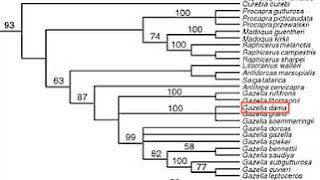 Pathogenic assault is what is happening to Saiga tatarica. It looks like the mortality among affected herds is close to 100% [like our own Ebola, hmmm?] and perhaps 50% of the documented 250,000 world population has died in the month of May. Epidemiological results aren't properly in yet but it looks like the lungs of the dead animals are fritzed and that symptom is putting the smart money on Pasteurellosis. The genetic diversity in Saiga has collapsed since the Pleistocene and this will not have helped the species as a whole fight off a pandemic. A similar epidemic swept through the Russian Saiga population in May 2010, but the numbers slowly recovered. Each time death comes swinging his scythe wholesale, the genetic diversity slumps, making the species more susceptible to the next pathogen. Despite its weird proboscis, the Saiga is closely related to the Springbok Antidorcas marsupialis [R for phylogeny]. There is no suggestion that A. marsupialis is particularly susceptible to Pasteurella spp.; that is what makes comparative immunology so interesting. You'll have to forgive me if I become an artiodactyl-bore over the Summer, it looks increasingly likely that I'm going to do my new 4th Yr course at The Institute by working through the cetartiodactyla.
On one of the trips up and down the lane, I noticed that H for Harriet [our flock is beginning to sound like a Squadron from Dambusters come in Red Leader] was a little limpy and when she made the trip two days later she was clearly favoring her right fore-foot. Accordingly we tipped her over, trimmed her hooves and gave her a generous spray of Footmaster which is bright violet in colour and seems to work as a cure-all for sheepy-feety problems. But on the way back to the field after treatment, she seemed to be quite weak-in-the-wind and had to stop to rest <pant pant> on the 100m journey. The foot-treatment seemed to have induced some improvement but we had Mike look at her anyway. He immediately concentrated on her other symptoms, noted the labored breathing, took her temperature (40.4oC, not good) and said "Pasteurellosis". That confidence of diagnosis, supported by decades of experience, is why we pay vets the big bucks. He gave her a whack of anti-biotic but a very poor prognosis because Pasteurella does irrecoverable damage to the lung tissue, so it no longer has a tennis-court of surface area for gas exchange - hence the labored breathing. We were advised to get her two lambs weaned asap and H for Harriet off to the factory because we were not going to get another year of breeding out of her despite her teeth being in working order ["full mouth"]. Dang!
We've lost the quagga Equus quagga quagga, a half-striped zebra from South Africa, the last example of which died in captivity in Artis Zoo in Amsterdam in 1883. That's a tragedy, but not a disaster because molecular evolutionists have extracted enough DNA from preserved Quagga skins to show that they are probably the same species as the plains zebra that used to be called Equus burchellii, but is now Equus quagga burchellii. It is another example on a tighter time scale of the whales-are-hippos story where the distinctive look of a species turns out to be caused by a very few, almost trivial, genetic changes. Like white folks, hmmm?
A little more worrying was the lost and found story of the Arabian Oryx Oryx leucoryx. This striking creature was put on the IUCN Red List in 1986 after too many poor little rich kids from Saudi started to amuse themselves by fitting machine guns to their jeeps and roaring over the dunes playing budda-budda-budda with the helpless antelopes. Oryx have now been re-introduced to the wild from an Omani captive breeding programme and number 1,000 individuals. That population, coupled with 6,000+ more in reserves, parks and zoos around the world allowed the IUCN to reclassify Oryx leucoryx as merely vulnerable. That's progress but the species has been forced through a serious genetic bottle-neck and its reduced diversity will make it more sensitive to the next pathogenic assault.

Friday, 6 December 2024
Clueless in Cloughjordan

I've never met Bruce, but a lot of our home-ed & rice-cakes, Birkenstocks & FloatySkirts pals have passed through the Eco Village, so I daresay I've washed the dishes [at the annual HEN gatherings] for the self same people, or their carefree childer, who can't be humped to keep plastic out of their compost bin. Bruce started believing that he was getting an asset for free, so of course he should add the labour needed to transform the gift into something garden-useful.
Poor bugger is now worn out with fetching uncompostable shite [mostly plastic] out of compost as he turns and sieves it. He's spent years cutting his co-composters some slack. Our small veg-peeling knife turned [lit.] up in the compost the year after Javi left: it must have gotten submerged in the potato peel. But the compost of others is no longer worth the candle. And so, earlier this year he stopped managing this community resource . . . but let everyone know that Compost Manager was available in sits.vac. Of course, nobody else stepped up the the plate, just as nobody else had offered to put in an afternoon compost turning in his garden.
Read the comments attached to the YT: they are an instructive collective confessional of other people's experience with compost, lost sink-plugs and community action. Bruce baulked at putting a DO NOT sign beside the bin because
- a) he worked as a design-wonk in a previous life and believes signage is only needed because the system is poorly designed
- b) the people who leave plastic cookie packets in their compost ain't a gonna read no sign
- c) it seems officious
But I did like his idea [see below] of creating a 'lost&found' board next to the compost intake bin on which were pinned a weird and wonderful selection of what The Community had mistakenly concluded was compostable. See my earlier rant about tea-bags and the difference between bio-degradable [years] and compostable [months].
"Having said that, I was thinking of setting up a big board beside the compost where I could hang all the stupid things that I found in the compost, almost like an art instillation. And label it 'Lost and Found' or 'Is this Yours?' or something like that, to make a joke about it, and so that people can see what does end up in there. I think that would be more interesting, effective and educational, than an instructional sign."
Sunday, 14 January 2024
Bawo = father etc.

- Comms: International signal flags [sample R]
- BT Young Scientist 2024
- ♩ ♬ ♫ ♪
- Ndikhokhele Bawo Just some school kids && Phila Mpofu
- Ndikhokhele Bawo U.Pretoria
- Nkosi Sikelela iAfrika
- Ashokan Farewell Jim Anon
- Phil Ochs - When I'm Gone
- Mark Knopfler - Miss You Blue
- Skinny Lister - Company Of The Bar
- Waterford named as 1/52 NYT places to go in 2024.
- with woeful want of imagination because ditto 2022 when it was an "Offbeat Destination". It is now mainstream - expect charabancs and land-cruisers and litter
- Alaska 1282 Door Failure. The missing plug door was recovered yesterday by a Portland school teacher identified only as "Bob" in the Cedar Hills neighborhood who found it in his backyard, NTSB Chair Jennifer Homendy said, saying she was "very relieved" it had been found.
- Other debris found on ground
- Juan Browne Blancolirio summarizes quite possibly TMI!
- Aloha Air 243 Bloboprev
- Alaska beachcombing = glass floats
- Reversing a B-double
- It’s all in the thumbs [simple trailer]
- Don’t drive above yer own ability and don’t be a goose
- Keep the rubber-side down
- IRL: This is the moment I knew it would work
- Metafilter offers comments
- Finnish Lumberjack
- 2 x 4s: modern is weaker
- The science of marbling
- Stuff: French couple sold cheap and have to lump it.
- History: my pal Dan looks for ancient DNA . . . in the library?
- Literature: Faber&Faber reluctantly take a chance
It's my Dad's anniversary tonight. He died "suddenly" in hospital in the wee hours of 15 Jan 2001. My mother waited until "it was decent" [0800 hrs] to call their children with the news. The hospital "lost his records" when his death seemed so unexpected as to warrant an enquiry. He knew Bannow Bay, Co Wexford rather well: his own father is buried just over the headland on the right of this picture. He used to paint views such as this: being rather better at clouds than at people.

Monday, 28 October 2024
AFOL LEGO BURP
How much information about the Tokio Express do you have capacity for? Tracey Williams doesn't think that a book's worth is TMI! On 13 Feb 1997, the container-ship Tokio Express was caught in a brutal storm between Land's End and the Scilly Isles and a freak wave carried away a number of TEUs which were washed overboard. Within a few weeks specific designs of Lego 'bricks' started to appear on Cornish beaches. Lego head-office supplied an inventory of the lost pieces and they are still being found nearly 28 years later. And not only in Cornwall.
Ironically, a good proportion of the lost pieces were nautical themed: octopus, life-raft, flippers, sea-grass, life-jacket. The available inventory tells how many pieces of each type were hoiked off on their journey in 1997, so finders can assess how rare their pieces are. Green Dragons are the Holy Grail in the field.
I'm a beachcomber, buoys and rope division. Dau.I is a librarian, Northside Dublin division. She correctly surmised that I would like to read Adrift: the curious tale of Lego lost at sea (2022) by Tracey Williams. When I became one of the earliest unDanish adopters of Lego, aged 7 in 1961, there were only red bricks. The spaceships, dragons, flowers and helmets all came later. I really wouldn't count as an AFOL [adult fan of Lego] although several of my family wear that badge. With my failing eyesight, I don't imagine I'll become an ABOL [adult beachcomber of Lego] because the search image is too small. a BURP is a big ugly rock piece, see also LURP.

My son the engineer put himself through Open University to get his first degree and is now designing signalling networks for British Rail. Make an error here and people will die. I like the idea that there are life-and-death averse B.Eng.s who are working for Lego tonking a concept brick 100x with a precisely weighted hammer and looking for cracks.
Wednesday, 14 December 2022
Vilket fräscht helvete är detta?
This time last year, by request, for her birthday, we went IKEA and bought Dau.I a wing-back chair. As a reader living a multi-function apartment, she liked the idea of limiting draughts round her ears while snuggled up with a book. This year she yearned for a matching foot-stool and so hey-ho hey-ho off to Ikea we went.
One of the themes in The Blob is to give tribs to people who are sufficiently flex to change their minds. Let that also include me! Browsing back through the archives you can detect childish delight that I could buy a serviceable book on Amazon for $0.01 . . . plus $3.99 p&p. But it looked like a better deal than $12.99 plus $3.99 p&p. But me getting suckered into the Bezos narrative has seen his empire drive local book-stores to the wall and treated their employees as expendable zero-hour contract-bots. So I don't do that any more: Kennys is my only man . . . and Borrowbox is better yet.
IKEA used to be my sort of place and we've bought a fair amount of clobber there - not to mention some bilious yellow upholstered furniture. What's not to like about Scandi-chic clean white delph? or a bright plastic and stainless cheese grater? Last year, in full chrimbo-mode, we bought cheese, rye-crackers, ginger biscuits and horse-radish sauce from their micro-deli. Walking into Ikea from the car-park I was talking up a storm of Svensk ost [no better really than LIDL's own-brand 'Maasdam' or 'Emmental']. So I was hacked off to find that cheese no longer featured in Ikea deli-inventory.
Then I got lost in Kitchenware, assumed the rest of the team was powering through to soft-furnishings and found myself in a sort of ware-house with aisle of ceiling-high shelves holding tonnes of flat-pack. In the near distance consumers were lining up for the checkouts with gurneys laden with boxes and lamp-stands. I didn't start whimpering like six-y.o. me when lost in Dingle's department store in 1960; I figured that I must have missed them in the Ikea-maze. How did folks manage before cell-phones? After some minutes and one missed call, I heard that the rest of my party were a) separated and b) still mullocking about in kitchenwares! I went through the check-outs to double-check about the absence of cheese and and settled down to wait. At least I was warm and dry and not homeless.
It occurs to me that it would help the Lost-in-Ikea syndrome for each family to come with an easily identifiable team hat [as L] and/or a distinctive coloured jacket. Especially the hat, I guess, so that you can find your quarry over the landscape of shoulder-height shelves. But actually, I suspect that is my last time in Ikea. I have a life-time supply of dishware [unless I get badly shook with the tremors] and enough cheese-graters to see me out. Thanks!Saturday, 2 July 2016
god-stabber

King Tut's dagger was a) an heirloom and b) an import. The quirks of history (so much gone for ever, the remaining evidence absurdly patchy) have left us with only 7 plays by Sophocles out of his known oeuvre of more than 100. On the other hand we know, or can infer, quite a lot about this dagger. Seemingly it was made as a diplomatic gift for Tushratta, King of Mitanni, to give to Pharaoh Amenhotep III. The Mitanni lived where Syria is now in bloody conflict and they were skilled metal workers - better than the Egyptians were at the time. The raw material must have been shipped to the workshops in the North and returned to the Pharoah with a neatly decorated gold sheath. It is possible / probable that this Amenhotep was young Tut's grandfather. The fact that meteors fell from the sky and arrived hot from heaven, was not lost on the ancient Egyptians. Iron was rare because they lacked the technology to raise a sufficient temperature to smelt iron from its abundant ores. Meteoric iron was thus very much a gift of the gods; and so an appropriate possession for one revered as a god on earth.
Friday, 8 November 2024
Darwin Glass
The Blob's Southern Correspondent TBSC aka the BiL in Kaapstad ZA sent me an enigmatic email:
>> Subject: Darwin . . . May be of mild interest to you.
but no attachment; to which I replied:
>> Subject: Re: Darwin . . . Missing link Darwin? or Oz City? or Uruguayan footballer? 1999 asteroid?lunar crater? All interesting.
But closer to home than the moon, there is Darwin Crater: a terrestrial geo-feature near Mt Darwin in Tasmania. This is a circular 1.2km ⌀ dimple in the landscape, about 15km South of the mining community Queenstown (pop ~1800). The peaks hereabouts: Mt Darwin [1030m] Mt Owen [1150m] Mt Lyell [920m] Mt Sedgwick [1150m], all named after 19thC Brit geologists, are 'mountains' in a cosy not very tall sense, such as we have outside our own back door in Mt Leinster [800m]. Although they look a bit more craggy than Mt Leinster.

There are strict criteria for deciding whether divots in the surface of the Earth are cause by extra-terrestrial impacts and none of these have been clocked for the Darwin Crater. But the smart money is on meteorite because a 20km x 20km area round about is rich in Darwin Glass [fragment R]. Geologists, like all good scientists, get narked by by the niggling unknown and so “[Dr. Ramsay J] Ford accompanied a team that bulldozed a path from the Franklin River Road into the centre of Darwin Crater in 1974. The team drilled cores up to 230m deep in search of diagnostic shock features. “
That quote is from an account by Brad Dare, as part of his project to map and visit all the known, and aspirational, impact craters in Australia. It looked straightforward on the map. All he needed to do was park on the Franklin River Road, find the bulldozer track, yomp in, take some pictures and yomp out - it's only 2 miles = 3 km. Not so fast puny mortal.
Mother Nature has had 50 years to return the rainforest to its pre-dozer state and soon Dare and his companion found themselves in Woozle status “After battling the swamp for some time, we noticed some footprints and, feeling elated that we must be closing in on the original track, followed them. Our hearts sank when we realised not too long after they were our own footprints, and we had inadvertently gone around in a circle. “ and later their 21stC equipment blinks out “The swamps’ humidity had allowed water to get inside the housing of our electronic equipment. With a flicker of the screen, both the GPS and compass went dead, and we were on our own. “
They did make it out, as do almost all folks who are lost in the woods, but it does put into perspective what a daunting task it is mount a search when folks get lost in wilderness national parks. See also when my neighbour lost his dog and his phone forever [last para] in a treeless (but fissured and scrub-covered) area a few dozen hectares in extent.
Turns out that Darwin Crystal is an asset, at least among the Woo: €31.16 Darwin Glass Healing Crystal ~28mm. Having physically transformed by the celestial slam-dunk “Close to 11,250 cubic metres of Darwin Glass was thrown into the air and scattered over a circular area totalling 400 square kilometres.”
Q: What would that be worth aliquotted as €30 = 30mm 🧊s?
A: There are ~30 x 30 x 30 = 30k such 🧊s in 1cu.m so about 300 million frags in total; valued retail at ~€9 billion. That's A Lot of sugar: enough to run all the schools in Ireland for a year.
Imagine! an asset that you just have to pick up from the ground on either side of the Franklin River Road! I've high-lighted the just because it's doing some heavy lifting. By happy coincidence the Darwin glass is spread over 400 million sq.m. or one chunk per sq.m. Since they were scattered far and wide 800,000 years ago, a good bit of a) jungle, b) swamp c) razor sharp grass d) leeches have moved in on top. There must be easier ways of earning $30.
Friday, 14 June 2024
Change Islands
My Parapals Rory and Alastair, for all that they mad-busy, are great readers altogether. I've taken on board a few of their book-recs out of respect to their sense of what's worth spending time on. The latest rec to be eased out of the library has been Radical Help: How we can remake the relationships between us and revolutionise the welfare state (2018) by "social engineer" Hilary Cottam.
Cottam's thesis is that William "Charterhouse, Balliol" Beveridge's 1942 vision for a Welfare State is no long fit for purpose in a post-industrial society top heavy with extractive plutocrats and ranks of declining Olds. And always the ♇!⊗king market, as if competition was always obvs better than community and cooperation. Maybe Capitalism = Koyaanisqatsi = "a state of life that calls for another way of living": Caring for each other is not about efficiency or units of production. It is about human connection, our development, and at the end our comfort and dignity.
In the UK, there are 100,000 neighbours-from-hell families, each of which is costing The State about £250,000 every year. One case study of a (single parent four offspring one preg) family in Swindon clocked 74 different professionals from 20 different agencies (tutors, counsellors, police, housing, health visitors, the social) involved in the family's care and attention. Cottam's people shadowed (with a time sheet) the eldest boy's social-worker and found that 74% of his time was spend on Admin (the forms, the forms); 12% on the phone haggling with other agencies; leaving 14% of the working week for actual work with the chap. But that social-worker's case load was much longer than one troubled teenager. 5½ hours a week spread across a dozen kids barely gives a social worker time to take off his coat, and in-fill another questionnaire before driving off to the next meeting. FFS don't use neighbours-from-hell and the like, it lacks compassion and smacks of hubris - the overweening complacency that it could never happen to me coupled with victim-blaming.
Cottam sets out the stall for the UK welfare state as it now stands. The Irish equivalent is not substantively different. When novel "obvious to all thinking people" good things are suggested, The State puts the kibosh on them double-quick:
- See the same doctor? Too expensive
- Help another person? Too risky
- Provide solutions through a known community group? Against the rules of competition
Manage need vs develop capabilities
The middle section of the book looks at left-field "Experiments" or pilot-studies with which Cottam has been involved; professing, if not actually solve, to ease the burden of problems in 5 areas where The State is only rearranging the deck-chairs and not delivering a lot. Well 1 million people are employed to help make things better for their fellow citizens - 1 million adults not collecting the dole, so there is that. For ten years, Cottam's NGO Participle did the state some service and demonstrated how agile, focused orgs might deliver more QALYs for less money.
- Family. Their Life programme set in place mentors / listeners who had time to listen to the manifold problems of the dispossessed; develop a holistic view rather than silo-thinking; engender self-respect by respecting the troubled rather than joining the line of comfortable people who want to beat on them
- Youth. Their Loop programme swept up lost youth and found them work-placements in the community - a bit like the best examples of Irish Transition Year work experience. The pilot study was going gang-busters with obvious benefirs accruing to The Yoof, The Community, The Employers. But when they held an open day for government agencies, the scheme was immediately closed down . . . because teens were developing a relationship with an adults who was neither a family member, nor a teacher. In the eyes of The State, all adults are potentially if not probably predators on the young.
- Employment. The first thing in Backr was to call out the complete failure of Job Centres to place the unemployed in work. They then created a network of MeetUps where job-seekers could network, commiserate, and even crowdfund money to get small businesses over the threshold for creating a new position.
- Health. Another problem, another daft label. Wellogram applies similar holistic views to health and well-being. It's normal now to refer people with unlabelled malaise deeper into the maws of the NHS. Maybe it's better to take them out of that mill altogether and treat their loneliness, stress, and feeling crap with kindness and a cup of tea. The GP has no time to listen and for some people some of the time, tea and chat is at least as effective as [and FFS cheaper than!] anti-depressants, anti-biotics or anti-inflammatories. Health education is the unsexy, unfunded, unseen part of the health service: but it doesn't have to be like that..
- Aging. The End is Circle. This experiment facilitated Elders getting together and telling each other that they could so do more for themselves rather than relying on the State or it's agents. Call me the complacent patriarchy but I've found that fixing stuff, making stuff, myself is empowering. It also frees me from dependence on someone else's timetable, engagement and priorities. And it saves money. I know, I know it's a short step from victim-blaming but making people do for themselves can be done with kindness, with panache, with respect.
There you have it. Dozens of ideas, thrashed out round a conference table, and rolled out into the local community. Some of the schemes are still chuntering along years after the initial funding dried up. Related to this is Samuel Smiles [prev] and his vision for the world in Self-Help (1859). But what do I know? I've returned Radical Help to the library. You can read it next. It might outrage you enough to do something different.
Change Islands? A decade ago The Blob wrote a neat 900 word essay about fishing on the North shore of Newfoundland, parcelled it up, tied it with a green white & pink ribbon and launched it into the blogosphere. The next day I butterflied off to write about Sellafield / Windscale about which I was marginally better qualified to express an opinion. That was then, this is now, and flitting about long ago and far away won't butter no parsnips.
Tuesday, 28 August 2018
Ogham Code

There are a finite number - maybe 400 dated and authenticated - of these inscriptions which have survived; they are almost all written in ancient Irish and almost all on the island of Ireland mostly in the SW. It is sometimes known as the Celtic Tree Language, because later scribes glossed each symbol with the name of a "tree", if you include shrubs like gorse, broom and fern. That gives letters and whole inscriptions some extra mystical power because each tree will have different medical, magical or practical properties.
HTML UniCode for Ogham goes from   to ᚏ and then ᚐ to ᚜
0 blank [ ]
ᚁ B beith birch Betula
ᚂ L Luis later rowan Sorbus
ᚃ F Fearn alder Alnus
ᚄ S Sail willow Salix
ᚅ N Nin later ash Fraxinus
ᚆ H Úath whitethorn Crataegus
ᚇ D Dair oak Quercus
ᚈ T Tinne holly Ilex
ᚉ C Coll hazel Corylus
ᚊ Q Cert apple Malus
ᚋ M Muin vine Vitis
ᚌ G Gort ivy Hedera
ᚍ N nGéadal broom ?Cytisus? or fern Pterdidium
ᚎ Z Straif blackthorn Prunus
ᚏ R Ruis elder Sambucus [ᚏ]
ᚐ A Ailm pine Pinus
ᚑ O Onn furze / whin / gorse Ulex
ᚒ U Ur heather Calluna
ᚓ E Eadhadh aspen Populus
ᚔ I Iodhadh yew Taxus
That's the 20 original letters:
ᚚ P peith was added later as were these diphthongs (presumably by a monk who was lost in a haze of hallucinogenic mushrooms):
ᚕ EA
ᚖ OI
ᚗ UI
ᚘ IA
ᚙ AE
᚛ beginning of text
᚜ end of text

᚛ᚁᚑᚁ ᚏᚑᚈᚓ ᚈᚆᚔᚄ᚜
Monday, 14 October 2024
Irvine's foot
Because things come in threes it is fortunate that we can now add Sandy Irvine's foot to Capitaine Legionaire Danjou's [wooden] hand and maybe Galileo's finger. But knock yourself out: Susie Dent has written a whole book on famous body parts Vital Organs . . . also on YT [45m].
Andrew Comyn Irvine was last seen on The Blob in 2021. . . or with George Mallory near the summit of Everest on 8th June 1924. They found Mallory's body in 1999. But Irvine had the camera which might retain the evidence that the intrepid Brits had made it to the highest point of the World a generation before Hillary and Tenzing. Now they've found Irvine's boot with what's left of his foot inside.
Q. How did they know that it was Irvine's boot?
A. Because the sock had his name tag on it!
They'll do a DNA test and compare it to his grand-niece Julie Summers who is also author of his biography Fearless on Everest The Quest for Sandy Irvine (2020, £20) But any reasonable person would consider it case closed. Sandy's sister Evelyn married his school-friend Dick Summers. It is claimed that Irvine had a fling with Marjory Summers the step-mum of Dick Summers; or something - I'm frankly Scarlett about illicit interwar bonking, given the reg'lar old-fashioned forensic evidence in this case.
That evidence [see L] gave me a frisson. Part of my very expensive education required me to leave home for about 3/4 of every year and go boot camp with hundreds of other chaps. Laundry still had to be done in those institutions and we were requested-and-required to supply the commissariat with 12 handkerchiefs [remember them?]; 12 shirts; 18 collars; 12 pantses; and 12 vests. WTF collars? Yup we had to attach the collar to each shirt with a pair of studs; also cuff-links. These had to come back to the correct locker, so each item was labelled with Cash's name tapes. As you see Irvine's [mother?] chose the default colour. In our family, for reasons lost in the mists of fading memory I was B.T.SCIENTIST in black, my brother's name tapes were blue and my sister's green. At about the same time (as Charles Windsor was playing The Pirate |King at Gordonstoun) Cash's won the right to say 'Manufacturers of Woven Name Tapes to Her Majesty the Queen.'
PS MeFi commentary on foot of the story. Interesting idea: check Mallory and Irvine's pockets for [top souvenir] rocks rather than cameras.
Thursday, 5 November 2015
Bones: what counts?
In the certainties of the limited world of Trivial Pursuit and pub quizzes there is one answer to any question. The QM's decision is final; because s/he got it out of the back of the Compendium of Table Quiz Questions and it must be true. It is bad form to argue at pub quizzes, it's meant to be fun as well as isn't-Bob-clever. and the money is going to a good cause. But questions with only one answer aren't very interesting and that's why QI, the thinking-person's game-show is in its 13th season. Although, if you see that clip you'll wonder that any of the QIstas have survived. An earlier stodgier version of the concept was a BBC production called The Brains Trust that ran through the 1940s and 50s on wireless and TV and Pathé News; there you could use a word like self-abnegation without blushing. One of the egg-heads was C.E.M Joad, who started many of his answers with "It depends what you mean by . . .". B'god that's a welcome introduction to almost anything that's worth investigating.
Q. How many bones in the human body?
A. 206!! they all cry with confidence.
 At The Institute we have up-graded the Counting Dem Bones practical from a stop gap to a written-in-the-manual item for all 1st Year cell biologists. We've also found Bob the Skeleton in a dusty cupboard and have that as a resource for the exercise. Most of the ribs on Bob's left side have been replaced with PVC tubing and he is festooned with gobs of ancient glue and crumbly sellotape which have long since ceased to hold him together. It was good fun, getting the folks to think a little and realise that it's quite hard to find where the '206' comes from or is comprised of. One of the key realisations was that, in 206-land, the sacrum and coccyx at the base of the spine are considered 2 bones not the 5 and 4 bones which a cursory examination [L above]reveals them to be. There is indeed a good bit of inter-personal variability here as to the amount of bone fusion and even as to how many bits are present.
 Contrast this with the skull which is treated as 22 bones out of 206 rather than two that Josie Public sees with her own two eyes: skull & jaw-bone. N=22 does not include the 3 teeny bones in each ear-hole: the stirrup stapes, [R at something approaching life size] hammer malleus and anvil incus, and N=206 does not include these ossicles either.
 If you're interested in your bones - and who isn't? - you should concentrate half your attention on the limbs because they comprise half of the bones: mostly in the hands and feet. Interestingly the front and back limbs have the same number of bones but in different places. Legs have a patella halfway up but there is no equivalent at the elbow joint. OTOH, the ankle has one fewer bone (tarsals=7) than the wrist (carpals=8) [R above]. Otherwise the structure of each limb is uncannily similar: down to the 3 phalanges in the little toe, the smallest of which could easily get lost if you dropped it in the rice. And the great toe and thumb both have only two phalanges.
 I was reading up on the wrist bones and the pisiform (pea-like) was referred to as a sesamoid bone. These are peculiar bones, named after sesame seeds, which develop entirely or partly enclosed in tendon. The patella is the largest of this class of bone and nobody from 206-ville considers excluding either patella or pisiform. But sesamoid bones are 'commonly' found at the toe-end of the metatarsals [L above as x-ray ghosts] and also at the base of the thumb. I say commonly, because the appearance and number of sesamoids is higher variable between people. Other examples of human osteo-polymorphism in my earlier piece. Why aren't they included in the 206? They are a lot bigger than the ear-bones. Indeed, there should be N=4 ear-bones as the lenticular process of the incus is a teeny-tiny sesamoid bone with a separate developmental origin. Sesamoid bones got a brief pulse of press in 1980 when an extension of the radial sesamoid got tribbed in Stephen J. Gould's [previously] famous essay The Panda's Thumb and the book of the same name.
The count of bones is thus arbitrary and capricious and very bad science until you get under the covers with Bob the Skeleton. When the Quiz-master asserts that N=206 you are well within your rights to cry "It depends what you mean by . . .".
Q. How many bones in the human body?
A. 206!! they all cry with confidence.

The count of bones is thus arbitrary and capricious and very bad science until you get under the covers with Bob the Skeleton. When the Quiz-master asserts that N=206 you are well within your rights to cry "It depends what you mean by . . .".
Sunday, 16 October 2016
Repatriation
For as long as I can remember, I've gone down to the sea-shore to scavenge. The idea of sitting on the beach soaking up the rays is a) only possible to achieve twice a year in Ireland b) causes melanoma so I don't do that. In England, when we lived there, it was wooden fish-boxes and rope. In Ireland, because things have moved on, it's plastic fish-boxes and rope . . . and buoys. We live a long way from the sea, so I tend re-purpose the buoys as Art. The Beloved and I spent pretty much the whole of last weekend down on the incomparable Waterford Coast. The weather was a blessing: dry enough to mow the lawn, warm enough to leave a coat behind and sunny enough to need a hat. Over a couple of days, I scoured the beaches between Stadbally and Annestown: Ballyvolane, Ballydwan, Templeverick, Knockmahon, Kilmurrin, Benvoy and Woodstown / Whitefield. No not the Woodstown, famous for its oyster farm and for having hosted Jacqueline Kennedy while her husband was on his Presidential visit to Ireland in 1963. There are four townlands called Woodstown in Co. Waterford.
It's been pretty calm at sea the last month, so there wasn't a lot to be found. But it was super-wonderful to be out in the fresh air, in the sun and have all day to spend loafing. For many of these beaches you don't ever get all day because they are only accessible at low-tide . . . unless you have a canoe.
 We are currently collecting sea-scoured drift-wood for another Art project which doesn't involve buoys but I can't leave buoys all lonely on the beach when they can meet lots of new buoy-friends in our orchard. Eeee, I were delighted to see a pink blob in the distance when I came round the headland from Annestown to Woodstown. It turned out to be a large buoy, such as used by lobstermen to tag the end of a string of pots. It also had JUEAST W245 printed in big letters on the side. When we got home to a nice cup of tea, I googled up the information that Jueast is:11 m long; 11.5 t gross tonnage; and her home port is Dunmore East. There are even pictures of the ship [R]. After talking large last month about how I would return a fish-box if the owner was nearby, I could hardly keep this buoy. Before we packed up to head home on Sunday afternoon, I snt a txt to the Harbourmaster at Dunmore East asking if the Jueast was in port because I had something to return to them.
Being a Sunday, I didn't expect a reply and headed in towards Dunmore aNNyway. It's more than 20 years since I was in Dunmore which is still one of Ireland's most attractive villages. My grandfather was harbour-master there from 1922-1947 and my father learned to sail out of that little port. Neatly, the Jueast was indeed in port, tied up to the quayside and unloading boxes of crabs. They were expecting me, because the ever-wakeful harbour-master had forw my txt-msg. They knew exactly where and when they'd lost their buoy, were delighted to have it back and curious to know where I'd found it. Then they went back to work and I went to find another cup of tea in the locality. Good day's work.
It's been pretty calm at sea the last month, so there wasn't a lot to be found. But it was super-wonderful to be out in the fresh air, in the sun and have all day to spend loafing. For many of these beaches you don't ever get all day because they are only accessible at low-tide . . . unless you have a canoe.
Being a Sunday, I didn't expect a reply and headed in towards Dunmore aNNyway. It's more than 20 years since I was in Dunmore which is still one of Ireland's most attractive villages. My grandfather was harbour-master there from 1922-1947 and my father learned to sail out of that little port. Neatly, the Jueast was indeed in port, tied up to the quayside and unloading boxes of crabs. They were expecting me, because the ever-wakeful harbour-master had forw my txt-msg. They knew exactly where and when they'd lost their buoy, were delighted to have it back and curious to know where I'd found it. Then they went back to work and I went to find another cup of tea in the locality. Good day's work.
Monday, 22 July 2024
Lost in Dublin
I guess I am a diasporan. In 1931 my father left Dunmore East at the age of 14 and more or less didn't come back: like Pat the Salt he ran away to sea; although The Da aka "Sir" didn't ship before the mast, but rather, in time, got to drive very big naval ships in quite exotic [and mundane] places. All his kids were born in England - Dover, because my mother was born there and went home to deliver the sprogs. But all my paternal rellies were in Ireland and, as kids, we returned every year to visit a diminishing store of agéd female relatives - Rosslare - Wexford - Tipperary - Wicklow - and home to wherever home was that year in England.
The year I turned 12 years old, we rang the changes on this round because my folks had business with the family lawyer in Dublin. It was also, coincidentally, the year we came with a 14ft touring caravan to save on hotels. The lawyer occupied fantastically dusty and decrepit chambers round the back of TCD - since demolished for the extension of the Mont Clare Hotel. Lest we die of boredom or from inhaling spores from long dead protestant dust, we three kids were deposited in the snug of Rice's Bar at the top of Grafton Street with minerals and bags of crisps. A peculiar choice? because Rice's, at least when I was a student a few years later, was The Dublin Gay Bar. But then again the whole othering anxiety balloon about The Gays (let alone The Zombies and The Kidnappers) hadn't gone up. So here we are in Rice's [◎pink blob] on the NW corner of Stephen's Green S; the parents are at the solicitor [▶blue arrow] on the NW corner of Merrion Square M. The car & caravan are parked extravagantly occupying several parking bays somewhere on Merrion Square.

As a Plan: so far, so good. But when I'd guzzled my mineral and the crisps were finished and I'd had enough being teased by my sibs, I announced that I was going to hang out in the caravan and stomped out of the pub. A while later, my parents returned to collect their family and head off towards the ferry port. Consternation! Contingency plan to leave one parent in Dublin to liaise with the Gardai and the Bureau of Missing Persons; while the other parent returned to England as scheduled with the rump of the family.
Meanwhile, I'd made two circuits of Stephen's green [we'd parked beside a large park with trees, here was a large park with trees] and found no caravan. I then started cutting through the Green to sneak up on the ephemeral caravan and catch it before it disappeared again. Eventually, I cut my losses and returned to Rice's to endure more [parched] abuse from my brother and sister. Let me tell you, the Prodigal son was in the ha'penny place compared to what I experienced in a torrent of relief-plus-annoyance. So it all ended happily ever after, as we all caught the ferry together that night. The mobile-phone generation cannot imagine the sketchiness of communication protocols in the 1960s.
We never toured in the caravan again and it was parked up on blocks in the field next to our house in Essex. I adopted it a tuthree years later as my atelier: banging out rubbish poetry on an old Olivetti portable typewriter.
A few years later, I was old enough to vote and old enough to leave home so I left Essex and turned up to try studenting in Trinity College Dublin. I was no longer answerable to my parents who were 400km and an Irish Sea away; so I could get lost in Dublin without causing an international incident.
I was still trying to locate people / things round the periphery of Stephen's Green though.
Sunday, 22 February 2015
Beriberi Eijkman

- make up a litre of MacConkey Broth (Enzymatic Digest of Gelatin 20g; Lactose 10 g; Oxbile 5 g; Bromocresol Purple 0.01 g) which because of the bromocresol starts off an agreeable royal purple in colour. Only a few organisms will grow happily on lactose (milk sugar), and the Ox bile inhibits the half of the bacterial world, some of which can handle lactose, that are blue after Gram-staining. The digest of gelatin (ox hooves, possibly from the same animals that contributed their gall-bladders for the bile) provides all the other nutrients - a bit of protein, some vitamins. There's a century of science behind this: originally the indicator was litmus, which was replaced by 'neutral' red, which in turn was found to inhibit a bunch of the bacteria that poor MacConkey was trying to grow.
- dole it out into 10ml test-tubes.
- sink an inverted Durham tube the liquid in each tube.
- sterilize them all.
- add your possibly contaminated sample (we use sheep shit and other likely sources)
- Incubate at 40oC for a day or two.

Eijkman was born in Nijkerk on the shores of the Zuider Zee in the Netherlands. He trained as a medical officer for the army and shipped out to the Dutch East Indies in 1883 at the age of 25. He caught a dose of malaria and within two years shipped back home sick. It was good timing because he was able to go back to college and studied for a time under the giant of the microbiological world, Robert "Postulates" Koch in Berlin. While there, he met Professors Pekelharing and Winkler who had been tasked to work out the causes of beri-beri: a devastating disease of the tropical East Indies which was a huge drain on the Dutch colonial economy. Eijkman joined their team and in short order found himself on a boat back to Batavia. When the Big Guns went back to Europe, Eijkman stayed on as the newly appointed director of the Medical Laboratory; having resigned from the army, he could devote his energies to scientific research.
I think he was a great scientist who looked to the evidence for his understanding and wasn't swayed by what Everybody Knew To Be True. He carried out some careful metabolic and physiological studies of Europeans and 'natives' and could find no significant difference. This put in the dustbin a lot of protocols for 'acclimatizing' white men to the tropics. Actually, it probably didn't - you may be sure that many people persisted in doing the same-old same-old in the face of scientific evidence that they were wasting their time. More importantly he cracked the puzzle of the cause of beriberi, a progressive and often fatal neurological disease which killed native soldiers and prisoners in disproportionate numbers even if they were young and fit. Everyone had a theory, including 'vapours', rotten fish, and excessive perspiration. The Pekelharing and Winkler Commission followed the "it must have been something I ate" theory and tentatively identified a bacterial coccus as probable cause before they went home. Eijkman more of less accepted this, evidence based, theory until he noticed that the hospitals chickens developed a condition that looked suspiciously like beri-beri after they were fed on rice which was used to feed the native soldiery. They recovered when some martinet in the army refused to allow military rations to feed civilian birds! That was Eijkman's cue and after further research (convenient lab 'rat' now available) he was able to show that brown rice had a beneficial active principal that was lost when the rice was 'polished' to remove the husk.

Eijkman was successful in his endeavours at least partly because he paid attention to what was happening around him and he wasn't prepared to accept what other people considered certain - because they were all too often wrong. He is recognised by the Indonesian Government in the Eijkman Institute for Molecular Biology in downtown Jakarta. The Eijkman-Oxford Clinical Research Unit (EOCRU) was created in 2007 as a collaboration between the EIMB and Oxford University. There is also an Eijkman-Winkler Institute for Clinical Microbiology attached to Universiteit Utrecht where he was working when he won the Nobel Prize. He died the following year in November 1930. Laten we ons petje te verwijderen.
Thursday, 30 July 2020
On the hillside
The Blackstairs Farming Futures BFF, Knockroe Division, are under starters orders to get out on the hill and start meithealing away together. Lockdown has put a damper on the project through to the end of June. It's all part of a cunning plan Pilot Study to see if we can't make a better fist of managing Ireland's uplands. Last Sunday 19th July, 6 of us went up the hill to find areas of heather "suitable for burning". In my book NO area is suitable for burning because by turning the above-ground parts of plants into carbon-dioxide you are sending irreplaceable micro-nutrients in a great black plume into the next county. But I am in a minority of One on that. So like Lyndon Johnson on the hideous Edgar Hoover, it seemed better to be inside the tent pissing out than outside the tent pissing in: boycotting the procedure will deprive me of agency in influencing the process.
 One sub-text of the BFF project is to promote community by incentivising neighbours to talk to each other and work together. That's been a roaring success, especially for blow-ins like us. I hope the neighbours have seen that, despite the funny accents and the Birkenstocks, we are within the normal range . . . and not above getting dirty and wet while cleaning out the drains. There we were following a sheep-path across the face of the hill when I saw a huge umber moth about 5cm across [R slightly less than life size]. I know nothing about lepidoptera beyond that butterflies have bobbles on the end of their antennae and moths don't. So I referred ID to Angus Tyner: tree-hugger; fell-runner; naturalist; mothista; but I heard nothing probably because my email records are, like me, old. And also to Des Higgins [bloboprevs]: who affirmed that it is an oak eggar Lasiocampa quercus or rather Northern eggar, the morph typically found in Ireland. The common name and the quercus is from the resemblance of its cocoon to an acorn. I was, of course, delighted to see the thing itself up close and to get a name; with a [Latin] name you can tap into the combined knowledge of hundreds of naturalists. And because I've got GPS coordinates on my camera, I can probably find the moth again.
On our expedition to identify areas of leggy heather of about half a hectare in extent, we were not communicating terribly well. The two who are real shepherds and spend a lot of time on the hill looking at, and for, sheep, yomped off up a sheep-path and the rest of us struggled after them. It was a 4-limb scramble in parts with the ever-present danger of a leg disappearing down a hole between two rocks. One of my neighbours, faced by another near-vertical obstacle, tossed her water-bottle to the ground to free up both hands. I could have offered to carry the bottle in my ruck-sack; I could have gone back the few feet and picked it up; I could have chid her for littering. But it didn't seem worth getting on a better-than-thou-sister hobby-horse over a plastic bottle. So we all went on . . . until we didn't. Eventually, the distance between the two shepherd-yompers and us 4 clompers extended beyond shouting distance and we paused [again] to admire the view. And after a short while, turned for home: we were two hours out; it was almost getting dark; and was that a rain-cloud incommming?

On our expedition to identify areas of leggy heather of about half a hectare in extent, we were not communicating terribly well. The two who are real shepherds and spend a lot of time on the hill looking at, and for, sheep, yomped off up a sheep-path and the rest of us struggled after them. It was a 4-limb scramble in parts with the ever-present danger of a leg disappearing down a hole between two rocks. One of my neighbours, faced by another near-vertical obstacle, tossed her water-bottle to the ground to free up both hands. I could have offered to carry the bottle in my ruck-sack; I could have gone back the few feet and picked it up; I could have chid her for littering. But it didn't seem worth getting on a better-than-thou-sister hobby-horse over a plastic bottle. So we all went on . . . until we didn't. Eventually, the distance between the two shepherd-yompers and us 4 clompers extended beyond shouting distance and we paused [again] to admire the view. And after a short while, turned for home: we were two hours out; it was almost getting dark; and was that a rain-cloud incommming?
Score. Lost 1 bottle : Found 1 Oak Eggar
Tuesday, 12 April 2016
Here come the elephants
Nearly 40 years ago, with no lire left to spend on food for The Boy, then an infant, we were escaping from Italy across an Alpine pass at night. Three years ago, I told the romantic tale of how we landed a lucky and sustaining bowl of soup at the last outpost on the Italian side of the border. It never occurred to us, being too hungry to think, to wonder whether we were mirroring the famous trek of Hannibal and his elephants as he marched to bring war to the Romans in 218 BCE. Πολύβιος Polybius, a historian who died 100 years later (although he interviewed some of the trek's survivors) said that the details of the route even then were lost to the mists of time.
First though, let's clear the elephant jokes out of the way:
Q. What's the difference between an elephant and a grape?
A. One's grey and the other is green.
Q. What did Hannibal say when he saw the elephants coming over the Alps?
A. Here come the grapes [he was colour-blind].
Eeee how we larfed when we were 8.
 Molecular archaeology has turned up some new evidence supporting a Hannibal route across the Col de la Traversette. This is now a rough bridle-path unpassable to motor vehicles about 20km N of where we got our Found Soup. Back 2234 years ago, Hannibal and his army had a cold coming of it, famously having to break through a recent rock-fall laying on top of an earlier rock-fall which was impassable for men and horses. let alone the elephants. They cracked the immovable rocks using fire and vinegar. JMW Turner captured their trials, with a liberal dose of pathetic fallacy, in his 1812 painting [L. Snow Storm: Hannibal And His Army Crossing The Alps] Back in the 1950s Gavin de Beer, a well regarded embryologist, pointed out how the Col de la Traversette matched the ancient descriptions much better than alternative paths which modern engineers had used for laying down tarmacadam.
This idea was seized on by Bill Mahaney, a polymathic scientist for hire, and he went trekking along the pass until he'd convinced himself that he agreed with de Beer. It's the rock-falls, stupid; none of the other options match Polybius's, and other early documenter's, descriptions of the terrain. Most recently,elephant horse shit has made a huge splash towards elucidating the controversy [BBC]. Queen's University Belfast <huzzah!> has also made a contribution to the analysis. In an ancient bog near to the summit of the pass they have found a layer of churned up soil, such as might result if 15,000 horses had bivouacked in the place. In the sediment they have turned up a disproportionate number of Clostridial spores and even some fossilised horse tapeworm eggs. As you know from The Blob, Clostridium is a natural component of the intestinal flora of mammals. Nearby undisturbed soil had no such spike of Clostridium spp. The story has been covered by the unfailingly erudite Philip Ball [prev] in the Grauniad.
First though, let's clear the elephant jokes out of the way:
Q. What's the difference between an elephant and a grape?
A. One's grey and the other is green.
Q. What did Hannibal say when he saw the elephants coming over the Alps?
A. Here come the grapes [he was colour-blind].
Eeee how we larfed when we were 8.
This idea was seized on by Bill Mahaney, a polymathic scientist for hire, and he went trekking along the pass until he'd convinced himself that he agreed with de Beer. It's the rock-falls, stupid; none of the other options match Polybius's, and other early documenter's, descriptions of the terrain. Most recently,
Subscribe to:
Posts (Atom)