Showing posts sorted by relevance for query Vincent's. Sort by date Show all posts

Friday, 10 February 2023

Joined up thunk

After three years of dental isolation, we booked back-to-back checks-up with Old Bill of the peach-coloured dental couch. We've been together now for 25 years and he looked after our girls from baby-teeth to leaving home. Now t'bugger is going to retire! Which is fair enough because he's of pensionable age, but it does cast us loose a bit. The Beloved asked if he'd contact all his clients to let them know but he looked pityingly at her and said "there are 20,000 names on my books, that's a lot of postage stamps". Anyway, I made a note-to-self to call in before the lease is up on his premises and come away with my dental records. Not my dental file - I'm not from the cannibal isles.

We're well into the 21stC but still, in Ireland, medical records may still be kept on 3 x 5 index cards in dusty cabinets as if they were the personal chattels of the medico who scratched them in their pharmacist-baffling crabbed hand. When we were home-educating in the 00s it transpired that home-ed registration [TUSLA & Dept Education] records were not cross-referenced against children's allowance [Dept Social Welfare] records. School-kids were still entitled to children's allowance over the age of 16 if in full time education; home eddies maybe not so much.

At the end of last month Health Research Charities Ireland, an NGO / umbrella-body / quango, issued their 2023 HRCI Position Paper calling on the government and its healthcare apparatus to embrace joined up thinking w.r.t. medical records. The Exec Summ:

  1. Progress the implementation of a national electronic health record 
  2. Build on momentum to support genetics and genomics research  
  3. Establish research support functions within the health service

When I was working in St Vincent's University Hospital 20 years ago they were talking large about how modern technology could present all a patient's data to those attending at the bedside. That would include allergies, biopsies, cardiology reports, drug-reactions . . . X-rays, yellow fever vax records, and zoonoses. For an elderly patient with medical history the physical records might be several kilos in weight scattered in a dozen different locations in SVUH and other hospitals, at their GP's surgery and maybe even in Germany or Australia because the Irish will go all diaspora. With tech otoh that crucial chest X-ray from last year would be on a screen at the nurse's station at the flick of a switch. But it was all talk and wistful aspiration. And here's HRCI calling for those same resources twenty years later. Jo Publick also wants Electronic Health Record EHRs. It's frustrating!

And who should be the CEO of HRCI be but Avril Kennan, who did me a huge favour many years ago by introducing me to her parents. Dr Kennan of HRCI is doing an important job making sure that those, who have drawn a challenging hand in life's genetic game of rummy, get the care and attention that we all deserve. HRCI claims to represent 1 million people [whoa that's 20%!] in Ireland because HRCI umbrellas 43 (!) separate charities from Adelaide Health Foundation to St. Vincent’s Anaesthesia Foundation. Cancer Research Ireland isn't in there because CRI is big enough to fight its own corner. Considering that 64,000 diagnosed with Alzheimer's and add all the impacted friends-and-relations, for that one condition; then 1 million people becomes credible. Kudos to Dr Kennan and HRCI's Advocacy Team for drafting this infrastructural policy document. 

According to this paper, the EHR should be designed to facilitate access of people's health data for medical research as if that was an unalloyed good. EHRs are A Good Thing for you or your aged parent: partial [in both senses] data in the hands of the the attending physicians may lead to faulty diagnosis, inappropriate treatment and poor outcomes for the patient. Ireland has a history of medical cock-ups and cover-ups which have generated understandable skepticism about scientific certainties uttered by the Minister of Health or the Chief Scientific Officer, let alone HRCI. Let's hope that the woo-folk in the Dáil won't diss EHRs out of fear about "genomic science" and cyber-breaches involving personal medical data.

More women in Science

Friday, 2 September 2016

How to run a meeting

At The Institute we take roll-call for every class, a practice which seems wildly disrespectful to someone from the university sector. But the management insists on a roll-call for the teaching staff on the 1st September each year: we all have to line up outside HR and sign a book to indicate that we are back from Barbados or Ballyhack and are available for work. The ritual reminds me of signing a condolence book, so it's a little bit like being present at your own funeral. But by asking for dispensation and pleading CPD [continuous personal development] and completing a green LOA [leave of absence] form, I was able to avoid that networking opportunity and go to Dublin for a much more valuable one. 1st September was the date fixed by the TCD lab of Aoife McLysaght [prev], a noted Woman in Science for the 2016 VIBE [2013 - 2014 - 2015] meeting.

VIBE is my annual family gathering, when the 200 or so people engaged in research in molecular evolution and genomics in Ireland get a chance to showcase their work and hang out over tea & biscuits or coffee & croissants as the host's budget allows. Actually, we have a tradition of showcasing the work of our students rather than hearing another highly polished talk from the principal investigators PIs who lead each lab. Last year, for example, I asked one of my final year undergraduate students to present her research on dolphin Tursiops truncatus immunity which triggered the most active discussion of the day - win! for her. This year, we heard the presentation of work by a second-year Summer intern who had turned up something interesting in the McLysaght lab - win! too. Nice also because I first met AMcL as a scorching Summer intern in 1996. This year, the whole meeting was organised by the post-graduate students in the McLysaght lab which was another nice example of empowering rather than infantilising the young.

I got up at 0500hrs to breakfast at leisure, do a little light bloggin' and catch the bus to Dublin. I had a great day, taking notes on all the talks (ever hunting ideas for new research projects for our final year cohort), nattering in the tea breaks and being asked to chair the last talks session of the day. 2014 was the second time I'd hosted the meeting. In ?2005?, when I was working in St. Vincent's Hospital, my graduate student and I organised the VIBE meeting.  It was easy, I asked Ger L-R, the amazingly competent executive administrator to book the room and call down tea & coffee. I mentioned sandwiches for lunch and she gave me a choice of two external companies: cheap&cheerful or pretentious&dear. St Vincent's was badly placed for getting lunch quickly and cheaply. A free lunch raised the bar for subsequent VIBEs. We also persuaded one of the speakers at a just prior genomics meeting up the road in UCD to hang out in Dublin for an extra day and give us a key-note talk. That was also a first for VIBE.

The key-note in 2016 was Prof Laurence Hurst from U. Bath in England. Back when I was working in a hot-shot SFI-funded lab at the turn of the century, Hurst was one of the rivals to watch. He could turn out papers that made you mutter "B'gad Whistler, I wish I'd said that" but I'm sure he felt the same about us. Hurst hasn't lost his touch and gave a stonking talk outlining a new layer of constraint on the sequence of protein coding genes. As Hurst said "if you retain one thing from my talk today, remember ESE" [exonic splicing enhancer] there's a lot of them about and they have to be accommodated.

What else did I learn about how to run a meeting?

  • let the the students chair the sessions
  • make sure that the wheel-chair access toilets are unlocked [shame]
    • it is not a disabled toilet!
  • make sure that family (youngsters from the host lab) circulate the biscuits
    • this makes things fatter easier for everyone and so good manners
    • gets the youth thanks & eye-contact with their potential next employer
  • how difficult is it to print legible name badges?
    • wear the goddam badge! not everyone can remember who you are
    • include affiliation
    • long-standing note to self: Bring Own Name Badge
  • apply oil to the doors / seats so that people can leave talks discretely
Next year VIBE is across town in UCD.  Time after that to go down the country again.

Monday, 28 March 2016

Love your worms

I think we all agreed, with President Jimmy 'Peanuts' Carter, that Guinea-worms are A Bad Thing. But is it fair to generalise that to all nematode worms are bad?  That's a helluva lot of badness, because there are probably 1 million different species in the phylum Nematoda; only outpaced by Arthropoda with 1.1 million species.  But let's just focus on the nematodes for which humans are host and hostess; are they always to be extirpated by medicine?  I've suggested that this kill-them-all policy is definitely dodgy w.r.t. bacteria.  Your flora might help you side-step liver cancer.  If we continue to ladle out antibiotics for trivial infections, we might go back to depending on our own 'good' bacteria to fight off the Black Hats.

Take Enterobius vermicularis the common pinworm, it is remarkably common, specially among children with infestation rates of, for example, 50% in England and 29% in Denmark.  When I lived in the Netherlands in the late 1970s, they said that the rate was as high as 70%.  The Dutch obsession with Schoonmaken [cleaning] helped the spread in a very direct way.  It was customary for householders to air the bedding every unrainy morning by stripping off the sheets and shaking them into the street.  Children walking to school and burgers heading for the office would progress through a snow-storm of pinworm eggs, some of which would land on lips or get inhaled.  And so the cycle continued.  When I trundled across to Boston for graduate school, I had several thousand Dutch Guilders to pay my fees but I also had several thousand pinworms aboard. My only visit to a doctor in the US was to get a script to deal with them.  This is part of the reason why Dutch toilets often have an 'inspection pan' incorporated into the design. Pinworms are not only nearly ubiqitous but they are 'mostly harmless'.

Hookworm Ancylostoma duodenale, on the other hand, may be mostly beneficial.  That's probably putting it too strong but we have increasing evidence that asthma and allergies are brought under control if you have a hookworm infection.  An epidemiological study in Ethiopia showed that being hookworm-free made you twice as likely to by awkwardly wheezy. Like pinworms, carrying loadsa hookworms is usually asymptomatic. Ten years ago this, potentially woolly, small-sample association between X and Y was put to a more direct scientific test.  A team from Nottingham deliberately infected themselves with hookworm larvae to ensure that nothing dramatically bad happened.  If this reminds you of young Barry Marshall giving himself an ulcer by chugging a mug of Helicobacter pylori, it must be the way I tell it.  The Nottingham group then went on to infect clients at an allergy and hay-fever clinic.  hmmmm: I can find a review by the lead author two years before the Guardian report, but nothing on PubMed afterwards: maybe all the talk about the mechanism didn't yield statistically significant results in a study in the UK. The supposed mechanism is that hookworms, as part of their survival strategy are able to damp down the immune response and that this damping carries over to the asthma etc. Maybe the report from Ethiopia should be rescrutinised to see if it was just a once-off coincidence? [previously irreproducible results] The other hookworm Necator americanus was used by the Notts folk in a 2010  N=32 study for reduction of allergic asthma symptoms: again no significant effect. It worked for one chap, but that's anecdote not data and your mileage may vary.

When I was running the academic journal club in St Vincent's University Hospital 10ish years ago, one of the clinicians presented a really nifty study in this area of medicine.  Instead of using a natural human helminth parasite/commensal as the experimental infective agent, the researchers used horse nematode eggs. This triggered the expected change in the activity of regulatory T-cells and/which reduced the effects of ulcerative colitis [another auto-immune inflammatory condition] but the eggs never reached adulthood because they were in the wrong species.  Nematodes, lice, and other small-small t'ings that hang about the person are often really fussy about where they can reach maturity. I've tried and tried to track down the original reference to that fascinating study but have turned up bupkes. Maybe it wasn't ulcerative colitis; maybe the paper was a preview that never got published?

The Go To source of authoritative medical research is the Cochrane Index.  The experts who review and re-analyse previous studies of  clinically interesting/important findings have hairs on their statistical chests. They consider that using pig whipworm Trichuris suis is ineffective as a cure for any of the bloody stool trio: ulcerative colitis UC, irritable bowel syndrome IBS or Crohn's Disease CD [previously associated with changes in the bacterial flora of the gut].  While we're about it, Cochrane reckons that worm-therapy for allergic rhinitis [that would be hayfever] is a) safe but b) useless.  Where does that leave us? Resolved to keep tricking about with the bacteria in the gut rather than putting hope in the worms.

Saturday, 18 November 2017

Science Week Table Quiz

Well Science Week is wrapping up now. At The Institute I've been at a parcel of events and not one was a sleeper. Thursday night, they scheduled a Pub Quiz in one of the local hotels. A round dozen of our science post-graduates stepped up to the plate and found €20 a table for a night out with the grown ups. Otherwise the demographic was really top heavy with crumblies. It is ever thus: our younger colleagues have family commitments with small and medium sized children. Me I do love a Pub Quiz - it is one of the few situations where my very expensive education can be run through its paces. The quiz was sponsored by Science Foundation Ireland SFI (finger food bring on the orange goujons and, weirdly, fireworks) but raising money for Camara a charity that takes old computers, reconditions them and recycles them out to the third world. Back in the day, when I worked in St Vincent's Hospital Dublin, the IT guy was from Uganda via Botswana. He was entirely and comprehensively dismissive of Camara at the time: "we may be black but we don't want or need your elderly tech kit; just like you we want the latest thing: antiques are clutter". My Pal Terry thinks otherwise and has done at least one stint out in the Horn of Africa training up the local kids on Camara computers.

Mais revenons a nos pub quizzes this one was 10 rounds of 10 questions to make the scoring easy.  As happens when you have such a Works do, you tend to lose autonomy about who you share the night with. Ideally, a team wants
  • one Me: good for what we facetiously called in skool JN - Jeneral Nollidge: South American capital cities; British generals and prime ministers of the 19thC; obscure weights and measures
  • one Hello Magazine subscriber for the celebrity photo round
  • one Sporty person who knows who won the Ryder Cup (nothing to do with horses, I gather); who is top of the Premier League in the soccer; how to spell sliotár or at least know that it doesn't take a fádá,
  • one youth who has head-phones tuned all day to pop and rock 
if you can't draft a dream team you have to pretend that you're only doing it for a bit of craic and don't care if you win. I spit on that sort of nonsense. I don't have very high standards but I try to do my best: lash out my pub-quiz knee-jerk answer but then have a bit of a think and a bit of discussion about it - keeping the grey cells warm y'know. And it is considered extremely bad form to dispute any answer with the Quiz Master even when it is a) wrong or b) ambiguous because of a sloppily worded question. I cannot remember more than a small fraction of the questions, which were the usual sort of forgettable thing. But one of them was "Which member of The Police has a degree in astrophysics" My knee-jerk was Brian May, but my team said that he was in Queen not Police and opted for Sting. That question was rather quickly withdrawn because the QM didn't know one authority-named 1980s band from another : silverbacks have their day . . . in the 1880s. But I kept the Dingbats sheet, filleted it and share them with you now:
They are a fair mix of the usual cannon-fodder and some which took a bit of time and a flash of insight. We collectively got the 011011010 and the circle below it wrong, wrong, almost right. Give it a go: answers below the fold

Saturday, 6 February 2021

Taking one for the team

For a few years in the 00s, I worked in SVUH St Vincent's University Hospital in their research wing. I met a lot of Junior Doctors on that corridor as they cobbled together some original research towards an MD or a BCh on top of their 6 year medical degree. getting some paper quals was vital to progression up the relentlessly steep professional ladder to the distant clouds of a Consultancy and a well deserved round of golf on Wednesday afternoons. Those young people worked so hard in circumstances which would have most of us reaching for a bucket to lose our lunch. About 25% of the entire national budget goes to "Health" and those doctors, and their along-side nursing colleagues, must have looked at their pay packet and wondered where all that money went. It's no wonder that doctors and nurses marry one another: people working 9-5 M-F find that dating medicos is hard work: so many broken promises and missed dates and cancelled weekends away - all in the exigencies of the service.

This flushing your social life down the t'ilet is brought front-and-centre in Adam Kay's This is Going to Hurt [R]; his retrospective of 6 years working the Ob & Gyn departments of several English hospitals in the 00s. That book is mostly wincingly hilarious: if you work for years doing far too many overtime hours you build up a lot of experience so there's plenty of copy if you keep a diary and have a dark sense of humour.

One example: after several times having to stand up his mother, he finally clears the decks to meet her for dinner immediately after his shift on the ward. After the starter, his mum settles into full Jewish Mother mode, licks her fingers, plucks a spot of spatter from Adam's face, pops it in her mouth and licks her fingers again. It all happens so quickly that it's too late for him to twig that the dark gobbet on his cheek came from work rather than the soup. 

Through the wonders of Borrowbox, I had the luxury of having Adam Kay read the book to me rather than me having to make the effort of turning the pages. It's distracting and engaging and it has encouraged me through several hours of routine tasks like cleaning drains, chopping wood and washing dishes. But in among the larfs, the strain on his relationship with his partner is a sustaining narrative thread. That and the systemic, institutionalised, carelessness about the human resources which hold the health care system together. The requirements of the service involve extra work and erratic shift scheduling which routinely cancel dates, birthdays, weddings, funerals, let alone getting the car serviced, a decent home-cooked meal down or good night's sleep. You'd really think that it would be sensible to manage the HR assets better. The schedule goes pear-shaped when one of the effectives falls asleep at the wheel after a 13 hr shift. Quite apart from the damage done to mothers and babies when exhausted doctors are making life-and-death decisions at the end of a busy shift. 

The commodification of health care dictates that there is no slack, no back-up in the system, no spare capacity beds, no grief counselling, no PTSD therapy. Doctors I know are, by definition, resourceful: only a subset of conditions fall within the neat chapters of medical text-books, they learn on the job and the best of them are decision-makers. They cannot stand aside and let things unfold but are impelled to act. Then they have to settle their conscience afterwards . . . without any formal help.

In the end [of the book] Adam Kay jacked in his scrubs. He had one terrible case too many, on Th 2nd December 2010 a routine caesarean turns nightmare with an undiagnosed placenta previa. The baby is stillborn, the mother loses horrendous quantities of blood that can only be staunched with a hysterectomy. While the mother is wheeled off to ICU between life and death, Adam goes to write up his clinical notes but can do nothing but weep hot bitter tears for an hour. He knows he did the best he can; that nobody in his position could have done better; that shit happens. But he's done; he's given medicine the best years of his life, he's given it socks, he's been brave and cheerful and supportive of his colleagues but someone's life has been ruined on his watch . . . and he's had enough.

Luckily, he didn't top himself. Luckily, he's got other talents. After several years coming to terms with his defeat, he could bear to look again at his journal and he wrote up his story in the book. It ends with an open letter to the Minister of Health; suggesting that the way the system treats front line staff in his empire is not only scandalous but self-defeating. The book was published in 2017, was favourably reviewed and sold a million copies. Nothing has changed! At the beginning of the pandemic these already working-at-max healthcare workers found quite unexpected inner resources in the crisis. The government's response? Let's encourage people to give a round of applause and/or deliver pizza and chicken korma to hospitals. Shame!

Friday, 22 November 2013

Not Dallas, Titchfield

http://goo.gl/maps/H39Zn
Where were you when . . .
Anyone who is now of voting age will be able to recall where they were on 9/11, and many of them will also recall their location when they heard about Princess Di.  Most of us in Europe woke up to the news about the Princess, and so were probably in the kitchen at home. For me, I honestly can't remember and definitely didn't send flowers to Buck House via Interflora. For 9/11 I was working in St Vincent's Hospital Dublin and was offsite for a couple of hours at the crucial time, so was spared from ever looking at the footage of people falling out of the real Towering Inferno.
You have to be over fifty to recall where you were when you heard about the assassination of JFK (today's the 50th anniverary).  I was a small chap in an English boarding school very close to the pointy tip of the red arrow on the left.  It was well after lights-out and we were all meant to be asleep, but one of my pals must have gone out for a pee and bumped into an adult, because he came back to the dorm and woke us all up to relate the news.  It was arresting but not too shocking to a 9 year old and afaik I was drifting back to Nod in short order, ready to hoover up information the following day.  I was at the start of my very expensive education which has put me in good stead winning table quizzes ever since.
Keywords: Dallas - grassy knoll - book-depository - Zapruder - Lee Harvey Oswald - Jack Ruby - Warren Commission - CIA - Cuber - Conspiracy - Moon-landings - LGM

Saturday, 21 July 2018

paracrumping

I was boasting the other day about my "prowess" in sports: which amounts to the fact that, in the course of my very expensive education, I was given the chance to try a number of different ways of striking a ball. In 2002, The Boy told me to pack my traps for a weekend on the Isle of Wight with him and his pal Eoin. "Y'have to come paragliding with me and Eoin, Dad, it will be a bonding experience". As an institutionalised kind of bloke, I can obey orders, so I flew to London and we left early early on Saturday to catch the ferry to IoW and onwards to the Paragliding School at Mellow. Saturday morning was fun, we were kitted out with a "canopy" appropriate to our weight, then taken to a sloping field and taught the elements of take-off and landing. To get airborne, you first have to lay out the nylon canopy in such a way that with controlled tugs you can get it to fill with breeze and start to lift. You then turn round and run like Bernoulli buggery downhill hoping that the the canopy will become a aerofoil generating a pressure differential that gives sufficient lift to take flight. It takes a bit of practice but soon enough one minute you'll be pounding downhill and the next your legs will be rotating in the air 2 or 3 metres off the ground and you can glide to the bottom of the hill.

After lunch, everyone was taken to the bottom of the chalk downs by LandRover and the morning lesson was repeated from the top of the downs maybe 30m up a steepish slope. This is where you get the chance to catch a thermal which means that you don't have to trudge up from the bottom at the end of each flight. You can rather get the rising warm air, the on-shore sea-breeze, and the aerofoil of your canopy to deliver you back to your start point for another go. After a couple of mildly amusing glides downhill parallel to the grass, on my third attempt, most of me was suddenly hoiked vertically upwards about 25m leaving my stomach behind. I was airborne but terrified that I'd be swept out to sea:
I have achieved what every budding paraglider aspires to; and I knew I wanted no part of the game. For the rest of the afternoon, I avoided my turn in the air: as a beginner's class only one person was allowed airborne at a time. But eventually, I stood up to the plate to give it another go - we'd paid a chunk of money for the privilege, after all. It all went wrong, a stiff breeze swept in from the sea dragging my canopy backwards, the instructor tried to pull me straight but suddenly one half of the canopy collapsed as the other side took off and my feet were whisked out from under me. The Boy caught it all on film until he dropped the camera diving forward trying to catch me. I finished up in a heap on the ground mumbling heroic things and looking for someone called Hardy to gie us a kiss:
My fore-arm had a huge bruise the size and shape of half a hen's egg and I assumed I'd broken my arm when it was crushed between the chalky soil and my descending rib-cage. I hadn't. But I had an excellent excuse to spend the Sunday session in spectator mode watching The Boy and Eoin and the others cruising about in the air, landing in shrubberies, and having a flyin' time altogether.

When I got back to work in St Vincent's Hospital, I asked one of the junior doctors to check if, rather than my arm, I'd broken some ribs. "Here Conor, crepitate my ribs to see if they're bust; it will be practice for when you're in an A&E rotation." Crepitation was a diagnostic practice back in Nelson's day: if your ribs were broken the doctor could hear the jagged ends creaking against each other when he pressed the place with his thumbs. Young Conor was having none of that, but he did give me a chit for the X-ray department and duly told me that two of my ribs were fractured but I wasn't going to puncture a lung so I'd just have to wait until the damage repaired itself. "Try not to laugh" he suggested.

Wednesday, 6 March 2019

A plate of beige

I for several years in the 90s, I was invited to teach a short course in molecular evolution in Oslo. It was good fun and I think we all learned a lot. I learned that Norwegians have lunch really early in the working day which meant having to tweak the schedule for the course. I also got to appreciate the very understated, laconic sense of Norwegian humour. Lunch and funny collide in an explanation of matpakke by Ronald Sagatun and Mads Nilsson. The idea is that the lunch-time sandwich is always made at home (to save money) in a really predictable and unadventurous way (to prevent surprises). "It should be a disappointment when you open it. You're not supposed to look forward to your lunch." Here are the boys on Kvikk Lunsj [bloboprev] it is not a Kit-Kat!

Way-hay that's my sort of lunch! I make a sandwich every morning with two slices of (home-made) bread and a smear of butter separated by some cheese. If the fridge happens to have grated carrot or a leaf of lettuce or some pickle, I might put that on top of the cheese. The other day I replaced >!frisson!< the cheese with a fragment of cooked salmon. Years ago in the 00s, I worked one day a week in St Vincent's Hospital and my postgraduate student and his undergraduate student insisted that I come down and eat lunch in the canteen "like a christian". Fortunately, the canteen always had a student special on offer: lamb curry and rice; pork and red pepper and rice; chicken supreme and rice. The youngsters used to tease me: "Bob and his bowl of beige" was how they characterised their dining companion. It was probably good for me to have that socialisation even if only one day a week. They met me half way by ensuring the lunch was at 1300 ± 5 minutes, a preference inherited wholemeal from my naval father.

I've had occasion to laugh at my old boss [when he was the age I am now] who used to let out an involuntary whimper of pleasure if his wife put a chocolate biscuit in this lunchbox. I would never countenance anyone making lunch for me: they'd be sure to put too much, or too fancy, cheese and I'd fall into a drooling sleep shortly thereafter when I should be working. The Boy, aged 11, was assumed to be capable of making his own lunch . . . which turned out to a little adrift of the reality. But it's got to be said that, although his empty lunch-box was a source of concern to his teachers, it was a long way from starvation he was r'ared.

My late lamented pal Barry worked for several years as a painter and decorator in California. When he was on the job, someone on the crew would set off for the nearest convenience store at lunchtime and offer to bring back a submarine sandwich à la Barry. It would cost about $7! Making his own sandwich at home saved him $30 a week or much more than $1,000 each year. The "convenience" of a store bought sandwich was too steep for that working man. Any Norwegian would have canaries at what went into the Sub: heaping spoonfuls of tuna salad, handfuls of iceberg lettuce; a show of tomato slices; some chopped bell-peppers; extra mayonnaise. No wonder American working men are bending the scales.

Monday, 16 July 2018

More worms are needed!

Early last Sunday morning, I was responding to an e-mail and needed a reference to The Blob to save me re-writing one of my well-worn anecdotes. As a by-product to that search I came across a Trib to The Boy, who helped me declutter about 50kg of scientific papers when he was 'resting' between jobs 12 years ago. My offspring have told me quite clearly that they will pour rancid milk on my grave if I leave them a mess of papers to go through after I pop my clogs. Because I love the kids, I thought I'd wade through one of my filing-cabinets to see if I could simplify their post-mortem paperwork.  An hour later, I'd culled a xerox-box full [~10kg] of discards: Win!  I also found a paper that I've been hankering after since I started The Blob. Win! Win!

It's like with trying to Google a remembered article at the intersect between Beirut and cooking oil without getting lost in a storm of recipes from Claudia Roden. Well like my recent triumph about eggs and Sarajevo, throwing out the dross has surfaced some evidence for the hygiene hypothesis: that we are beset with allergies, eczema, asthma, lupus, psoriatic arthritis and other autoimmune diseases because we never meet pathogens as kids. The immune system, having been crafted over millions of years to aggressively fight infection, is incapable of sitting on its thumbs if there is nothing left to fight. I remember the paper "Trichuris suis therapy in Crohn's disease." because it was one of the most interesting which was discussed that year at the Journal Club which I coordinated at St. Vincent's Hospital. But I got some key data wrong which meant my google-hunt and pubmed-search lurched quickly off the tracks on which I was running. Crohn's Disease is no fun: Diarrhea, Fever, Fatigue Abdominal cramps, Bloody stools, Mouth sores, Reduced appetite, Weight loss, Anal [not St Martin's] fistula, Inflammation of skin, eyes joints, liver or bile ducts, Delayed growth or sexual development.

Trichuris trichiura is the human whipworm a nematode about 50cm long which inhabits the large intestine of about 1 billion people. Not you and me, because we aren't poor and black and living in the tropics without proper sanitary facilities. The adult whipworms, with their heads embedded in the gut epitheium have their arse end hanging out into the lumen of the gut into which the females shed 5,000 fertilised eggs a day. Some of which get into the food supply or on the shitty fingers of the neighbours. Those dispossessed people in the tropical and sub-tropical Third World are notable, not only for their load of intestinal worms but also for the comparative absence of the Diseases of the West: asthma, IBS, MS, etceterzema. It didn't take long for someone to put these two observations together to suggest a causal relationship between them..

The paper which surfaced in my filing 'system' is a nifty advance on the hygiene hypothesis into a testable experiment. No Ethics Board is going to countenance deliberately infecting sick people with a known and debilitating human pathogen. Therefore the team from U Iowa Medical School deliberately infected patients living with the Crohn's Disease [see IBD link above] with 8 x 2400 eggs from Trichuris suis the pig whipworm. It has long been known that whipworms are quite species-specific and T. suis just can't get established in the human gut or vice versa. Part of the reason for that is because the human immune system gives it a damned good alien drubbing and stops the eggs from hatching or, if they hatch, from getting a toe-hold in the wall of the human gut. The immune response is necessarily systemic: anti T. suis agents are released into the blood-stream and find their way to the gut. OR the ongoing immune response to Crohn's is diverted to combat the whipworm eggs and leave the intestinal epithelium alone.

Excited as I was back in 2005 when the paper came out, I'm a bit more skeptical now.
  • It's an open label trial (everyone knows the treatment that is being administered).
  • There are no controls - where, say, half the participants get a teaspoon of baker's yeast instead of the eggs
  • The sample is small - only 29 participants with an initial CDAI (Crohn's Disease Activity Index) greater than 220. Hey, you can calculate your own: +20 for anal fistula, +2 for each extra loose stool. The cut off between 'normal' and Crohn's is CDAI= 150; so >220 is definitely clinical Crohn's
  • It is still being cited in the Wikipedia entry 13 years on
Nevertheless, after 24 weeks of getting a dose o' whipworm every 3 week 23/29 patients reported a significant reduction in their CDAI and 21/23 were effectively cured.  It might be a life-time commitment because the study doesn't claim that the treatment has reset the inflammatory clock but that it a small price to pay for such a dramatic reduction in symptoms. Then again, it could be that, without a reset of the clock, eventually the immune system will get used to the whipworm eggs and return its attention to hacking blood out of the bowel.

Saturday, 16 September 2017

The Ginger Man

I pretty green in 1973; but at least I had the gumption to leave home and country to go to college. Travel broadens the mind and I really needed to be exposed to different vistas after more than ten years being institutionalised by my very expensive education in England. On the ferry from Liverpool, I had brought a 20 lt volume box of volumes mostly Penguin paperbacks which I considered essential to civilised life. It turned out the at least two of these not particularly racy [for 1970s England] books were on the Index Librorum Probitorum and banned in Ireland. I had, for example a copy of La porte étroite by Andre Gide. I've written before about how another of these banned books, The Ginger Man by JP Donleavy, or rather my laughing at one of these, brought me and The Beloved together. It is accordingly with a certain sadness that I note the passing of Donleavy [L last year at his 90th bday with Glen "Once" Hansard] at the beginning of the week. There was a time when I read The Ginger Man ragged; riffling through it to find favorite passages and slapping the open book's face down on the kitchen table to acquire some accidental butter stains. I read a lot of his other books but they seemed a bit tired and derivative after Donleavy's first and most immediate book.  I will acknowledge that I cannot remember reading his Fairy Tale of New York but do rate The Pogues song of the same title.  The Ginger Man itself inspired Brian Cadd's song of that name.

I wrote him a letter in about 1974, offering to come out to his country mansion and interview him for the TCD student newspaper (with which I had absolutely no connexion or affiliation). Donleavy, quite sensibly, didn't reply to my letter.

Donleavy must have been an engaging chap, he was certainly a great boozer and intimate of Brendan Behan. You get a flavor of this listening to him on Desert Island's Discs DID in 2007. I've had occasion to mention DID as the ultimate tribute of respect from the British Establishment (=BBC): better than a medal, better than an honorary degree. I must ask The Brother, who has landed all three fish. Somewhere in his interview-with-music JPD offered the suggestion that some of the 45 million copies of the book have been so good for the morale of the sick that they have recovered "You don't die in bed if you have read The Ginger Man". That is likely to be confirmation bias, selective attention or cherry-picking. So many copies out there and everyone dies, most of us in hospital beds (or on mere trolleys in Ireland, there being insufficient beds). If every sick person receives ex officio a copy of The Ginger Man, some of them will recover and that connexion will wing its way back to head office at the publisher; the unmiraculous copies of the book won't be noticed under the hospital bed, let alone tallied up.

Nevertheless, I will share a nice story that was going the rounds when I started working in St Vincent's Hospital in 2001. In 1990, Ireland did surprisingly well in Italia 90, that year's World Cup soccer tournament. An elderly lady was occupying a hospital bed for her last journey surrounded by her anxious family. As the time for a crucial Ireland match approached, she told her sons and daughters to go off and watch the match in the common room "sure don't be worrying about me". After the game, her rellies trooped back somewhat sheepishly having had their priorities exposed. "How did we do?" murmured the old lady
"We won on penalties" they chorused
"I'm feeling much better, so; is there a cup of tea to be had?"
The restorative power of tea (and soccer) worked its magic, she was soon discharged and lived on for several more years.

It is strange and peculiar how sporting events can be so inspiring for people; even those whose nearest approach to a football is sitting on a sofa all Saturday afternoon working through a slab of tinnies and shouting at the ref. The case has been made many times that Ireland's somewhat limping progress through Italia 90 was the catalyst for the rise and roar of the Celtic Tiger.  On 3rd September this year Waterford and Galway met in the All Ireland Senior Hurling Final. Waterford, of all Ireland's cities, has had the roughest time through the recession and could do with a boost. Galway with a critical mass of IT companies is doing much better.  It was mental in Waterford in the run up to the key weekend: every house was dressed out in blue&white  Pat the Salt was compelled by his carers to buy a large flag although he has no time at all for GAA having grown up in Wales where Rugby is king. When Waterford went down GALWAY 0-26 WATERFORD 2-17, I wrote to my pal Paul who used to hurl all over Galway in his youth "Thanks a bunch Paul, you and yours have screwed over any chance of economic recovery in Waterford this decade"

Tuesday, 3 March 2020

Logistics

As you see from the above, I was in The Institute's aircraft maintenance hanger with a bunch of teenagers who were having a day of science and technology. Someone has donated a miscellany of aircraft, aircraft parts and aircraft extras which more or less fill the space. I like the warning sign [above], it is so retro: like the old films where the pilot calls "Contact" and a guy in overalls heaves at the propeller to start the engine. Normally the hanger is where our student aircraft-maintenance engineers get practical experience, but as it was half-term, no one was there to answer our [many] questions.
I did the best I could to satisfy their curiosity and interest. After I regaled them about bird strikes, one of them asked about a little triangular window in the side-windscreen of a Cessna 335 II light aircraft. It didn't really look like the one shown R but the function was the same.

When The Boy realised that he had no future working in Ryanair, he slung his hook to seek his fortune elsewhere in the airline industry. After a bit trouble and a bit of travel he secured a position in the logistics wing of British Airways, operating out of Heathrow. LHR is one of the busiest airports in the World shipping not just people but also stuff which needs to get somewhere else in a hurry. The company was in the process of transforming itself into a fully automated, containerised shipping service and before he left, he was well paid but very bored. On average in an 8 hour shift, he was actually working about 20 minutes. Unless you call scanning a series of progress monitors to make sure the robots were shifting the containers through a massive, multi-level hanger.  Before that it could be quite exciting: like the time 8 tonnes of fresh shrimp [from BKK to JFK vis LHR] missed its connexion and had to be <fizz, fizz> dumped. "Useless if delayed" indeed. That was a loss to someone or their insurance company of about $100,000. In those early days, sometimes the connexion would be so tight that someone (often The Boy) had to trot out onto the tarmac to hand deliver a small package to the crew of a departing plane. It may be a fantasy but I got the sense that the envelope was handed up to a triangular window in the cockpit.  As the cockpit of a 747 is 7.5 m high, I suppose they used a rather long cleft stick.

Less than a week after I was reflecting on the problems of getting stuff from one place to the other, I came across a related story of shipping human organs for transplant.  As ever, interesting and informed commentary on MeFi.  The journalistic point is made that dozens of kidneys a year get lost in transit or delayed in logistics centres or shipped to BOZ rather than BOS. You surely know someone, quite possibly yourself, whose checked bags got sent to the wrong airport and may or may not have been repatriated eventually. I bet everyone is happy to see their used underwear again, but if you had to take compo for the loss about buy this year's boxers, then it wouldn't be the end of the World. Not quite the same if it is a well-matched kidney that has travelled 3,000km to find a new home. But if you look at the numbers of AWOL organs as a percentage, it looks more exceptable

15 years ago, I was working in an immunology group in St. Vincent's Hospital. One strand of research (not really mine) was to study immune function of and in the liver. In those days, StVs was the Irish centre for liver transplants and our students were on 24/7 call to collect liver samples from donor or recipient when a match was made and the recipient was called in to obtain a new lease of life. I've forgotten much of the detail, but back in the day phrases like ischaemia or hypothermic machine re-perfusion would trip off me tongue. The transplant team used to have weekly meetings doing triage on the waiting list of people with liver-failure. They tried to apply rational, equable, criteria for the decisions about who would live and who would die.

Organ transplant is at the sexy pinnacle of the surgical hierarchy, perhaps over-shadowed by brain surgery but definitely a cut above tonsillectomies and removal of unfortunate tattoos. Part of the reason is because it is technically challenging and so only the steadiest hands and quickest reactions to adverse events need apply. But I think its éclat also hinges on the process being intrinsically more expensive than whipping out an appendix. One problem with the economics of health care and indeed the economics of government is that it is rarely expansive in its overview. The liver transplant team is making a hard choice between Hilda Doohickey, mother of six children vs Sean Masterman chairman of the local GAA Cumann. But they never think that they could disband the whole transplant unit and devote the money to
  • safe-sex education for teenagers
  • addiction centres
  • mental health support
  • a really good system of home help for the elderly
  • pelvic-floor surgery for urinary incontinence
  • speech therapy for kindergarteners
All of which are in the unsexy bin of caring for the least of our citizens. Does a just and fair society need heart transplants?

Saturday, 13 December 2014

Et in Arcadia, ego

When I worked in St. Vincent's University Hospital after the turn of this century, I used to take my lunch ('umble sandwich, cup of tea) downstairs to a round table where everyone else ate, gossiped and talked about telly: Big Brother had just been launched and everyone except me seemed to care who said what to whom about whom in that artificial melting pot. Everyone there had been to college and about half of us were working towards a higher degree or had already achieved that dubious honour; they were 'educated'. One day, our bright young research associate turned to me and asked where I came from (. . . with that distinct middle-class-southern British accent by implication).  I fobbed her off (and everyone else with radar-swivelling ears by implication) with my standard cocktail-party story about us being horse-riding protestants from King's County in the Irish Midlands.  But she brought me up all standing by inviting me to "go back where you came from": England by implication.  I was dumbfounded; my family had a paper trail showing that they had been living in Ireland since 1634 - I bet she couldn't be so sure about where her people came from.

I knew a little about displacement and exile because I had spent the early part of the 1980s immersed in the history and genetics of New England and the Canadian Maritime Provinces.  My PhD had sought genetic evidence of migration patterns in that broad region and I travelled all over New Brunswick and Nova Scotia in search of data.  The Francophone part of this bailiwick was known as Acadia which was a corruption of an Idyllic fantasy place called Arcadia which was mentioned in Virgil's ecologues "Et in Arcadia, ego" as a place of plenty and happiness . . . where yet death (ego, in one interpretation) was inevitable. 
The phrase is most famously represented by Nicolas Poussin's didactic painting Les Bergers d'Arcadie [L for Louvre] in which three half-clad bucolic "shepherds" ponder the inscription on a tomb and Art explains that her works will transcend death. Deep? If you want deeper meaning you must read Holy Blood, Holy Grail which was ripped off by Dan Browne's Da Vinci Code and is a better book entirely.
In one of those weird language "coincidences" that would please my distant cousin Trevor, -acadie is a suffix in the language of the local Micmaqs which means place of abundance.  Acadia can date its origins back to the foundation of Port Royal on the South Shore of the Bay of Fundy, by the French in 1605.  They lived there minding their own idyllic business until they got caught up among the trampling feet of two geo-political elephants England and France who were crashing about in conflict for prestige and the cod fishery.  Acadia central (New Brunswick, Nova Scotia and Maine) was lost to the British at the Treaty of Utrecht in 1713, while the French retained Île Royale [Cape Breton] and Île Saint-Jean [Prince Edward Island] for another generation. Many of the Acadians left for these havens when-and-if they felt that their religion [RC] or their customs or their daughters or their livestock were in danger of being violated by the British local government. Among these emigrants was the patriarch Noël Doiron who had lived with his extensive extended family in Pisiquid further up on the South Shore of the Bay of Fundy.  He upped-stakes and brought his family to Île Saint-Jean in 1750 where they endured a succession of Little House on the Prairie hardships - locusts, famine, subsisting on shellfish.

In 1756, the summering tensions broke out again in the Seven Years War aka the French and Indian War and the French were trounced on all fronts: India, Caribbean, Europe, North America. London decided that the Catholic Francophone population was a source of support to French ambitions in the area and issued a diktat that these people would be rounded up and "repatriated" to a country which their ancestors had left 150 years before.  In late 1758 after the fall of the French bastion at Louisburg on Île Royale, the deportation order was signed and a fleet of thirteen transports appeared off the coast of Île Saint-Jean. Noël Doiron and his family were among 3000 Acadians embarked on the Duke William which finally set sail in convoy during a lull in the storms in late November. They had a rough crossing and after days at the pumps, on 13th December the ship foundered 20 leagues from France. There were three small boats aboard and Doiron, knowing that not everyone could be saved, told Captain William Nichols to save his crew in the two largest boats and allow the passengers to rather commend their souls to god.

Nichols agreed to this strange bargain (and why not?) and eventually made landfall in England. Noël Doiron [74] his aged wife, five sons, their wives and thirty grandchildren were among the 360 Acadians who perished on that one ship. Two other vessels in the original flotilla the Ruby and the Violet also went down with all hands in the storms. In all, only about 50% of the Acadian v'yageurs made it 'home' to a strange and alien France. I've written about other shipwrecks and the fate of women and children before.  Usually, these members of a ship's company have really poor chances of survival in the undignified scramble of an emergency; on the Duke William they met their fate holding hands. We may weep now.

Tuesday, 9 May 2017

Nightmare superbug

You will have heard of MRSA [multibloboprev], it's the bacterial infection that killed your beloved Auntie May when she went to hospital for that hip replacement. You may be hazy about the long words represented by the acronym. I believe even in France 'MRSA' is used rather than SARM Staphylococcus aureus résistant à la méticilline. When I worked in St Vincent's University Hospital 10+ years ago, they were getting a new case of MRSA diagnosed by the path lab every day. The hospital has a little over 500 beds [and a helluva a lot of trolleys for the overflow].

When I set off across the Irish sea last week there was a whippy Nor'Easter raising waves, so I left the car deck with a sleeping bag, a rug and a pillow case in which to stuff my fleecy. I found a quiet corner - not under one of the many large TVs; away from the play-area; away from the smell of frying fish [it was Friday, near Catholic Ireland] - and got horizontal for the crossing. Ten minutes later a handful of loud American voices settled in the next bay and 5 minutes later another Yankee-voice piped up "Aha, I've found my fellow nurses, do you mind if we talk shop?". It transpired from the transcript (my eyes were firmly closed) that an enterprising tour-company had filled a coach with nurses and paramedics, active and retired, from all over North Carolina and as far down as Greenville S.C. They were on a whistle-stop "If it's Tuesday, it must be Kilkenny" of Ireland and the cherry on the cake was a night in Cardiff [it's the castle] before heading on to Heathrow and home. Would they stop talking? No, they would not!

The shop-talker quickly brought the chat round directly to "Do you have CRE in your hospital?" to which everyone answered in the affirmative. Not having much truck with hospitals since Auntie May succumbed, I had to look it up: CRE is Carbapenem-resistant Enterobacteriaceae  aka carbapenemase-producing Enterobacteriaceae (CPE) because the key enzyme carbapenemase is what what makes food out of the antibiotics called carbapenems. They are the drugs of last resort for nosocomial hospital acquired infections. Enterobacteriaceae  are E.coli and their many and varied relatives.  Carbapenems are drugs of last-resort because these bacteria are already resistant to penicillins and cephalosporins. All three classes of drug contain a beta-lactam ring which looks sufficiently like components of the bacterial cell wall, that they get incorporated by the wall-building machinery like faulty bricks. This compromises the cell-wall integrity and the bacteria die.  But they don't die if they can treat the antibiotics like so many calories.

Unless you are having this Blob read to you in a hospital bed as you toss your fevered brow about, you have nothing to fear from CRE. Our immune system is quite capable of knocking the stuffing out of rogue Enterobacteriaceae and Staph. aureus.  To the nearest whole number 100% of cases of CRE are acquired in hospitals because the management has allowed sketchy cleaning practice to develop: the medicine cabinets are not blitzed often enough, the hand-washing is irregular, the staff spend too much of their shift filling in forms and reports. These hospitals will have all the million-dollar kit: the CAT-scans and MRI instruments, colonoscopy cameras and half-million dollar managers but the grunts on the wards are having to do too much on too little pay to care.  It must seem ironic when your Auntie May [mine has gone to her rest] is shipped 100km to a big teaching hospital where all the experts and equipment are, by modern medical philosophy, corralled (but which is too far from home to allow easy visiting)  and then dies in a bloody flux from MRSA or CRE.  When your immune system is compromised because of whatever brought you to hospital, then you are much more likely to get one of these antibiotic-resistant infections. If every surface, every bed-frame, every hand and every food tray is cleaned to within an inch of its life then there are no bacteria to get above their station in life. Cleaning is hard work, desperately unsexy, and cannot be carried out if you are wearing a tie and have a stethoscope draped round your neck to prove that you've done 4 years in Med School.  Basic hygiene and cleanliness, especially clean water, have saved more lives this century than all the CAT scans put together.

Saturday, 23 March 2019

Reproducing the code

Yesterday, Friday, I got up, tea'd up, spruced up because I was Countryboy Going To Dublin for the 'annual' VIBE symposium. I, wearing my 2014 VIBE organiser hat,  had sent out a call to everyone to remember their name badge, so I had a chance of remembering who they were:
Goodo, looking forward. No registration means no name-badges so could everyone remember to bring one? from their last conference?  Just as a courtesy to confused old buffers and total newbies.
Thanks, Bob
The previous (2016) organiser added a note:
And/or a roll of blank stickers that people can just write their name onto. 
To which the the 2019 organiser replied.
Great; please bring one.
Clearly some people are more invested in the Science than interpersonal signalling. And IMO, a roll of stickers is A Bad Idea because they are not designed to stick to jumpers and it invites useless contributions as shown [R]: Bubba? Who he? Who his boss? Which is his poster? What group is he affiliated with? Should I get concerned when he brings out a banjo?

The presentations were wide-ranging and all interesting, even those that were whoof totally over my head. Molecular sequence analysis is amazingly ambitious, seeming to keep up the precipitous drop in the cost of generating the primary sequence data. My report of VIBE 2013 noted that analytical throughput increased 4000x-fold in a decade while the co$t per DNA base had fallen by a factor of 10 million in 20 years. In the early 00s, I was tasked with determining if certain classes of genes [those switched on in the cells of the heart, liver and lights] were clustered in the human genome, which had just been released into the public domain. I learned to program in Perl, robbed code from my fellow workers at the genomics, hacked it to do my bidding, learned how to display data graphically using the GD add-in and presented my progress regularly at the lab-meetings. It was a challenge, it was hard work, it was great fun and eventually my mates started robbing my GD code to use for their own projects. A small part of my work-flow was getting a program to work - my first binfo boss used to say "that's just a simple Fortran program, take you ten minutes" which was orders-of-magnitude true: it took maybe 90 minutes. But it took the rest of the day, and sometimes the rest of the week to be confident that the results spat out were true and meaningful. I won't say I was a programming god, but I could do the work even if I still don't feel comfortable with associative arrays.

The first talk on Friday was an over-my-head job: Research and Clinical Applications of Fully Reproducible Containerised Workflow Architecture. Dang, but that could mean anything at all to an old code-kludger like me. Even though I didn't recognise the names of any of the software tools - they having been developed over the last 7 or 8 years since I fell away from the coal-face of science and went back to teaching down the country - I followed with admiration the aspiration. Reproducibility is the key!  It's like using Latin names to talk to Hungarian ornithologists. IF you build a pipeline to integrate a wild variety of disparate but relevant data so that you can develop predictors or therapies or a cure for colon cancer THEN you really need it to be reproducible in Hungary or next year. 

I've been there, and I've been caught with my pants down. Maybe 15 years ago, I was working in St. Vincent's before it became SVUH the University Hospital. The colon cancer people had generated a noisy multivariate dataset and asked me to see if there was any signal there. I had a word with my pal Aedin [prev] before she went all ad Astra and to Harvard on us. She was the local ADE-4 guru and with her help I beat the colon cancer data into submission. I was skeptical about the results I'd generated; not because they were wrong, but because they explained so little of the variation in the data. I sent the analysis up the line, with my skeptical warning, and Team Colon were delighted because TOP2A, a known actor in the development of colon cancer, bobbed to the top of the roiling mess of data, you could see it there, barely visible, awash with statistical noise, but top of the heap of over expressed genes. The project wasn't written up immediately: the bloke who'd done the original analysis finished his rotation, his boss moved to a different hospital and her boss was too busy saving lives. I moved to a different institution too. Four years later, I got a call to redo the analysis because the paper was finally ready for launch and they were checking through their pipeline; and the graphics I'd generated were kinda ugly.

Well it was a freaking nightmare. The computer on which I'd done the original analysis had been left in StVs as obsolete. ADE-4 had been totally re-written, and was reluctant to install on the new computer. I couldn't remember how to get it to work and Aedin was 5,000km away in Harvard rather than up the road in UCD. I knuckled down and did what I was asked but that's when my hair-loss started. TOP2A was still tops, which was a relief, and the paper was published. If it was left to me, it would have been written off  rather than written up - but then my scientific publication record is woeful. Even with the same people and precisely the same data, reproducibility was a hard slog.

The small world connection here is that the presenter of the Containerised Workflow Architecture talk yesterday answers to the same boss as the boss-boss-boss I was serving in 2005 and 2009. In the intervening years, the quality and esp. the quantity of the data has gone up and up. By using containers in your workflow you can let collaborators and rivals replicate your findings and run precisely comparable analyses of their own. The science will be reproducible and we'll be nearer to eliminating colon cancer.  All good until a senior scientist at Friday's VIBE asked - what happens if there is a mistake in your code; will everyone be replicating that error?

Hmmmm! As Osric has it: A hit, a very palpable hit. Later in the day, I was talking to a handful of MSc students who'd come up from Galway for the meeting but missed the first talk. They are a useful mix of biologists and coders and I said that I'd been part of a similar group when their boss had moved from mathematical physics to biological sequence analysis and helped me with my Perl scripting. I hoped they were sharing their expertise and propping each other up. And I gave them an executive summary of the first (Containerised Workflow Architecture) talk of the day which they'd missed and emphasised the critical replicating that error question. Don't do what we used to do, I said, if you are all robbing each other's code there's a good chance that errors will propagate through the lab. If we use computers [and especially fancy pipelines of interconnected software] to find out something new, nifty and important then someone else should rewrite as much of the code as possible from scratch. There are a hundred different ways of computing any reasonably complicated analysis, if you have two independently generated solutions and they agree then your confidence in the result is more than doubled.  Ain't gonna happen though, everyone wants their own apple to polish.

Wednesday, 3 January 2018

Non-invasive

Abdominal surgery can be dangerous even in modern times under a well-practiced surgeon. Quite apart from leaving a sponge or a clamp behind when they sew up, nobody can supervise the healing of the internal sutures.  If you're unlucky, you can get adhesions in the wrong places as the tissue remodels across the gap. So when Pat the Salt went all yellow on his 90th birthday 2.5 years ago, we were concerned that the removal of the gall stones blocking his common pancreatic duct would lead to trouble. The immune / inflammatory /healing system [it's essentially the same machine] tends to run down and get crotchety in old chaps like Pat and me. We were delighted, therefore, when the problem could be solved with a tube down his gullet and a brief pulse of ultra-sound to fragment the stones. At least, even if surgery was indicated, Pat could have signed an informed consent form having been apprised of the risks and potential benefits.

About 15 years ago, I was discovering and characterising immune genes while working in St Vincent's Hospital. The human genome was available and we were trawling through the chromosomal sequences looking for anti-microbial peptides. As evolutionary biologists, we asked whether these genes and their protein products might be present in chimpanzees, Pan troglodytes, our nearest relative. It turned out that a big cheese in Dublin Zoo was the son of our family lawyer and I approached him as a fellow member of the Protestant Mafia. "Next time you take a blood sample from one of the chimps, can we have 1ml to help push the frontiers of science?". Phlebotomists always take 10ml from sufficiently large animals [less for mice!] and there's always some to spare after the vet has carried out all the necessary tests. Well really, you would have thought I'd proposed to vivisect his daughter! We certainly could not have any blood for any purpose except to service the well-being of the bled chimp. The point being that our primate relatives cannot do informed consent, but effectively deserve the same consideration as humans, which rights are vindicated by the appropriate ethics committee. IF we filled in the appropriate forms, submitted an application, secured approval from StVs Ethics Committee and the Zoo's Ethics Committee then maybe we could get a chimpanzee turd to analyse. With PCR, and the fact that intestinal epithelial cells are continually being shed into the fecal matter, that would have been enough for our purposes. But the required bureaucracy put a stop to our gallop and we drifted off to chase down easier prey on the prairies of science.

These reflections on the recent past came to mind because of a paper published this year by Dan Bradley's [prev as Samaritan] group in TCD. They went back 1000 years to analyze the provenance of The York Gospels [R title page], a beautiful and exceeding rare Anglo-Saxon illuminated manuscript. Over the last 20 years, Bradley has built up an expertise in Ancient DNA - making sense of the signal that remains after the DNA of the originally living thing has degraded to wisps and fragments. They have to be super careful to avoid modern contamination because there is more, and better preserved, human DNA on a pair of unwashed hands than in a whole neolithic femur. Needless to say, librarians, archivists and curators have been unwilling to let scientists go at their inventory with a hole-punch . . . no matter what the scientific question. What they were prepared to do was allow Bradley's people to have [part of] the sweepings from a restoration project where the pages had been cleaned up with judicious use of a rubber eraser. The pages of the Gospels were made of parchment (cleaned, cured artiodactyl skins) which is pretty robust but even so, enough sheep and goat cells were present in the rubbings for Bradley to identify the species. Most of the pages were calf Bos taurus but some of them, maybe later infills for missing or damaged pages, were sheep Ovis aries skin. The original scientific paper [1Mb PDF] with details of methods and results. One of those details is the phrase ". . .large volumes of eraser waste (150-250μl)" that's about equivalent to the eraser on top of your pencil, which is a bucketful in nanotech speak.

Bradley and Co have to be circumspect and cautious in their reading of the data but The Blob can throw some of that caution to the wind. One of the sampled pages had sufficient material of sufficient quality to call the breed of cow which contributed it: it looks N European / Norwegian Red / Holstein-Friesan. [Norwegian Blue is a sort of parrot] Two other pages may fall outside that range, which may suggest a provenance from much further afield. That provokes an intriguing image of trading animal skins across the continent in the Dark Ages, like the stone axe unearthed near Canterbury with provenance from the Apennines in Italy [bloboprev].  They also found differences in the amount of human contamination of the artiodactyl traces. This is supposed to be either from more or less handling / reading on pages or more recent handling during restoration.

If you can find human DNA on the folios, you can also find traces of the human microbiome if you look for them. That's a whole other level of complexity because we are all toting about maybe 10,000 different species of bacteria and each one will have a characteristic DNA signature. The most informative way of approaching these data is a multivariate statistical analysis, comparing the Gospel traces with the known human microflora. We know that our different crevices and orifices harbour quite different communities. The bugs on the York pages fall decisively in the midst of the bacteria which inhabit our noses and skin and quite different from oral or fecal samples. This suggests that medieval scribes and readers sneezed a good bit but that they washed their hands between bathroom and lectern. Good thing too, it's The Gospel after all. The Muslim attitude to hand-washing has always been more proscriptive,

Wednesday, 1 July 2015

beaten to death for being right

Yes, you read the title correctly, not beaten to death for being white or the far more common beaten to death for being black.  That's one interpretation of how Ignaz Semmelweis [L] met his untimely end at the age of 47.  But we'll start at the beginning because he was born Semmelweis Ignác Fülöp on 1st July 1818 in Buda on the West bank of the Danube - y'know: opposite Pest.  Although his family was of German ancestry, his early life was spent in Magyar-speaking Hungary [or "in Hungary speaking Magyar"] where they follow the same patronym-first "Eastern"convention as they do in Kerala where my put-upon colleague comes from.

A bit of modern context.  When I was working in St Vincent's Hospital more than ten years ago. someone on the wireless [Minister? Head of the Health Service?] suggested that it might not be a good idea for doctors to wear ties on duty because they were an obvious source of patient-to-patient transmission: getting dunked in some yeuch bodily fluid by accident and then dripping away through the rest of ward-rounds.  That afternoon, I happened to overtake a couple of young doctors on the corridor and asked them if they planned to discard the old [school] tie any time soon.  They looked at me like I was mad and instinctively reached for their stethoscopes; the tie and stethoscope are key identifying symbols of a doctor's status.  No tie is a reason why women still don't rise as far or as fast in the medical profession.

Semmelweis was onto this [doctors being a vector for disease as dangerous in context as anopheles mosquitos [malaria] or badgers [TB]) 170 years ago.  He obtained his medical doctorate in 1844 choosing to specialise in obstetrics and obtained a prestigious position in Vienna as assistant to Geburtshilfe-Professor Johann Klein. In those days mortality from childbed fever was frighteningly common. We know now that this is due to infection, frequently by Streptococcus pyogenes; but 1846 was long before Pasteur had rubbished the theory of spontaneous generation and forced acceptance of his germ theory of disease. So Semmelweis's guess as to the cause of  perinatal infection was as good as anyone else's, but not better.  But he was notable in approaching the problem through the gathering of data rather than by reading what Galen or Aristotle had to say on the matter.

First off he noted that he and Klein were responsible for two clinics which had significantly different rates of mortality: 

and he racked his brain as to what could be the cause.  It was a great, if unintended, controlled experiment because the clinics admitted women to the two clinics on alternate days, so each patient population appeared to be a random selection of poor women who were unable to afford having the doctor or midwife come to them for a home birth.  But by listening to the women, Semmelweis learned that they were well aware of the survival chances in the first clinic and would back off and prefer the risks of a delivery "on the street" rather than be taken in care by the deadlier clinic.  Semmelweis noted that these street-deliveries had a better record than the hospital and after some faffing around with other explanations decided that the key variable was that one clinic trained doctors and the other trained midwives and that the doctors did courses in anatomy on fresh cadavers when they were available but the midwives didn't. The anecdote which convinced Semmelweis that cadavers were the principal cause was the death of a medical colleague after he was stabbed across the autopsy table by a clumsy student: the doctor's final symptoms looked suspiciously like childbed fever.

Convinced that he was right, from 1847 he compelled the students and doctors under his direction to wash their hands with a powerful disinfectant [chlorinated lime, we use it to sanitise swimming pools] between autopsy and delivery and within a month the rate of mortality in the first clinic fell to 10% of its previous high.  He didn't know what the agent of death was precisely but knew that chlorinated lime dealt effectively with the smell of death  . . . and the results of this simple intervention were compelling.

The response from the medical profession was either a) indifference or b) to reject his theory or c) say that this was already known and so wholly unoriginal. The following year, when his two-year contract ended, it was not renewed and he was forced to return to Budapest. Not before he got into a number of unseemly slanging matches with the medical establishment in Vienna. From Budapest he continued to enforce his hand-washing regime with conspicuous positive effect. But he also continued to barrack his medical colleagues for not seeing things as he saw them. He wrote up his findings and published them 12 years later in 1861 as Die Ätiologie, der Begriff und die Prophylaxis des Kindbettfiebers [The etiology, meaning and avoidance of childbed fevers]. He used this also as a vehicle to criticise his critics and so didn't win over anyone who wasn't already convinced. Several unfavorable reviews resulted and Semmelweis responded with a number of intemperate open letters re-asserting his position and insulting his critics in unparliamentary language.

He gradually went off the rails entirely and there has been a lot of post-hoc speculation about the nature of his madness - early-onset Alzheimer's and GPI [general paralysis of the insane = syphilis] from intimate handling of hundreds of prostitutes at work are the front-runners.  But let's consider an alternative hypothesis: not mad [bonkers] at all but mad [furious]. Suppose today that you believed in the rights of animals not to be casually consumed in scientific experiments or on the dinner-plate.  Suppose you knew you were on the high moral ground on this but that everyone around you considered animals to be unworthy of consideration equal to what was accorded to men. Suppose that this iniquity ate into your soul and you had a tendency to anger. Suppose that nobody would listen to you, especially after you had been insulting about their own professional practice. Wouldn't you be fighting mad?

Eventually his tiresome behaviour got too much for everyone and, at the end of July 1865, he was committed to a Vienna Insane Asylum by János Balassa, a highly respected medical professor from Budapest. Ferdinand Ritter von Hebra, another respectable doctor [Ritter von is "Sir"] agreed to take Semmelweis "to visit a new von Hebra clinic". Semmelweis, in his professional suit and tie, objected most strongly when he realised where he was being delivered and was beaten into submission by the guards, confined in a straitjacket, doused in cold water and purged with castor oil. He died of gangrenous septicaemia two weeks later. Twenty years later, Semmelweis's ideas fell into place as Louis Pasteur made clear that bacteria were the key to most of the contagious diseases which beset us.  We're very sorry that we didn't listen to Semmelweis and we've put him on postage stamps, but we're not as sorry as the thousands of women who died in the years between his discovery and its implementation.

Sunday, 23 April 2017

A quiet riot

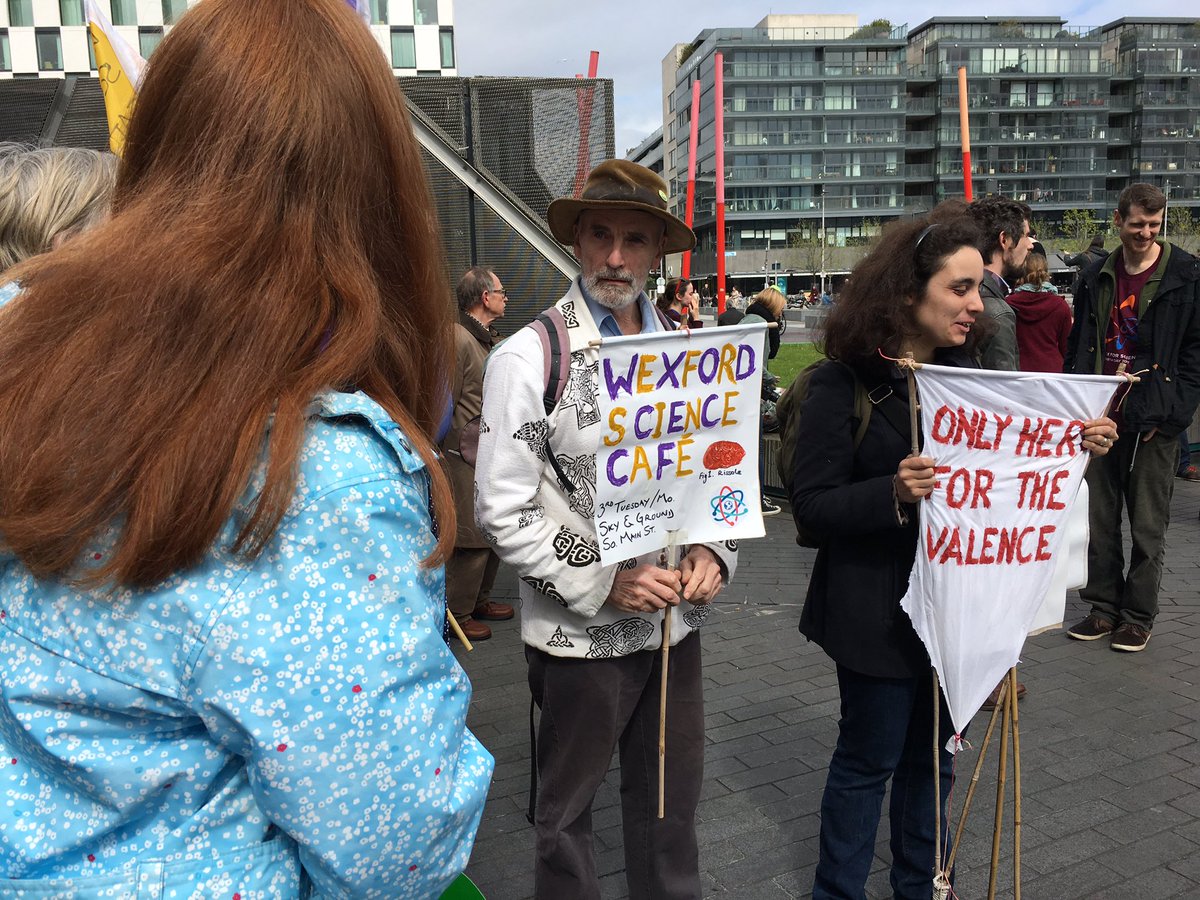
March for Science rounding into Westland Row

We had a nice airing, Dau.I and I, on the March for Science yesterday. Our poster only works if a) you are aware of the ironic rally slogan “I’m only here for the violence” and b) you have sufficienct chemistry to know that valency refers to the number electrons available to an atom for chemical reactions. I had to explain part a) to two of my scientific friends, one of whom invited me to make a Venn diagram to show the intersect between the violence-meme-gettit people and qualified chemists, hmmmm N << 10 he suggested. Another ironic poster which made an appearance (not for the first time!) yesterday was “Up with this sort of thing” to suggest that anyone who attends a rally or protest is a member of Rent-A-Crowd. At least our “Only here for the valence” was original if not universally comprehensible. Dau.II told her sister that "the march will be top-heavy with people who think they are as clever as Dad thinks he is clever".  If you have call-and-response to promote internal solidarity then:
What do we want?
Evidence-based policy.
When do we want it?
After peer review.
works well enough. But if the purpose is to push out a message to passers-by, or the fuming folk on the top deck of a bus delayed by your science-solidarity rally then 'evidence-based policy' is not terribly helpful instantly forgettable mouthful and 'peer-review' is mere jargon. In the Irish Times, the Provost of Trinity College, a bio-engineer, is quoted as advocating policy-based science. That's bonkers got lost in translation. No scientist I know is willing to be told what to research by some policy-wonk.

Depending on whom you ask, either 600 or 1,000 people were on the March. That count was surely enough to allay my concern that only three handfuls of moaners would turn up to inconvenience the traffic. The March was originally conceived as a show of solidarity with our brethren in the benighted USA where they seem to be parking 60 years of scientific progress in medicine, agriculture, space and genomics and going back to witchcraft and blood-letting. Whatever about solidarity with my pals for the US [two of whom were out in Boston], I was delighted to bump into lots of old friends from this side of the pond; people whom I haven’t seen for a decade. I bodged up a prototype travelling placard consisting of two bamboos, string, duct-tape and a roll of plastic. Because the prototype worked, in short order I had 4 placards (and only two hands)
  • Only here for the valence
  • No such thing as a fish on one side and Skeptical About Science on the back
  • Wexford Science Cafe
  • Blank
I handed off the Wex Sci Caf  poster on someone who was willing to carry it and never saw it again but Twitter did [L]. A handle on the other slogans can also be had through Twitter. I had a blank/spare in case my wingman, Dau.I, had a creative dove descend upon her. Someone had suggested on the wireless that every scientist at the rally should bring a non-scientist with them. That's important because otherwise the whole thing looks like a Me Me Me demand for more support and recognition - eliciting "they would say that, wouldn't they?" It turned out that there was another rally / protest in town starting about an hour after the March for Science. That was to express concern that the new 21stC National Maternity Hospital would be built by the tax-payer but administered by the Sisters of Charity, a religious order that owns St Vincent's Hospital. We went over there to see what was going down after the science stuff finished up. "We'll have Nun of that" was the level of sloganism.

The juxtaposition of the two rallies presses the button for a worry of mine which I has trying to articulate with my Skeptical About Science slogan. I talked to a young chap at the science rally who was carrying around a "more science | less religion | in our schools": look at my slogan, kidder, you want to be careful about those scientists who believe in evolution . . . but couldn't marshal the evidence for that belief. I know, I've been there.