Monday, 29 November 2021

Obsession

"I wish was as certain if anything
as Tom Macaulay is of everything"
maybe Lord Melbourne

I've been listening to "Don't die in Autumn" by Eric Dempsey, one of Ireland's champion birders and twitchers. As a Dubliner who left school without doing his Leaving Cert, he'd be uncomfortable with "ornithologist". The title is from an injunction on his parents to stay out of harm's way at the time of year when Ireland is, hopefully, storm-spattered by rare vagrants from North America and Southern Europe. Fifteen years after leaving school to work for P&T, he presented his parents with the first copy of his first book The Complete Guide To Ireland's Birds with "There! that's me Leaving Cert!". They were most extraordinary parents for 1960s Ireland: not afraid of The Church . . . or child-thumping teachers; proud to be trade unionists; proud to be working class; interested, interesting, supportive, literate and generous.

Young Eric was interested in wildlife, particularly birds, from an early age but he was able to build up his "tick list" of species seen during the Post Office Workers strike of Feb-Jun 1979, when the young chap was turning 18. After a bit of picketing in the morning, all the strikers had the day off, and Eric hitched lifts further and further afield from The Bull Island slobs and the Tolka River in Dublin. It's a strange community - birders - intensely competitive but also generous with information and mentoring. Nowadays rare finds are announced on Twitter . . . down to the very field or hedgerow or dune where t'bugger is lurking. In the 1980s, domestic phones were rare as hen's teeth and news would arrive from Cape Clear by letter [except during the post-strike, of course].

In 1990, Dempsey set up a premium rate phone line Birds of Ireland News Service or BINS - a clever play on binoculars - the birder's essential tool. News was collated of any interesting observations from all over the country and updated at 2130 hours every night . . . for 20 years. That nightly report was sorted "by rarity", so that real obsessives could drop the phone after "the emu seen last week in Cork is now behind the schoolhouse in Ballycotton . . ." and set off into the night in the hope of catching a glimpse before sunrise the next day. Like everyone who reads content on the internet today and complains about paywalls, in the 90s, there were plenty of begrudgers who complained that information used to be free before BINS came along. Free maybe, but neither time-sensitive nor reliable.

Dempsey is clear evidence in favour of Universal Basic Income, so he could spend all waking hours pursuing his passion, building his skills and sharing his knowledge rather than shifting the burden of supporting him onto an employer who was heedlessly short-changed with a rota of sick-days, leave-days, personal development days, "training days" in a remote location. I don't think he ever ran out of grandparents that he had to bury because, in Ireland, funeral attendance is expected for aunts, cousins, old teachers, employer's collateral relatives, and anyone from the GAA team at the home-place.

After several decades of mitching off  work to go a-twitching, Dempsey reckoned he could go free-lance and make a living sharing his expertise by writing books, giving lectures and guiding enthusiasts less knowledgeable than himself. In one telling incident, he brought a group of 20 absolute beginners to Cape Clear to see what they could see. It turned out that a Baltimore Oriole Icterus galbula [L] was "showing" in a garden on the island. But a score of well-known twitchers refused to let the tyros see this rare vagrant . . . and even cold-shouldered Eric when he returned alone. It's hard to view this as anything less than begrudgery and passive aggressive indignation at . . . something? That was his Road to Damascus: he abruptly stopped competitive twitching and started to celebrate the ordinary: bullfinch in the grass; choughs on the cliffs; dunlins on the beach.

I was in the yard the other day and heard a raucous cackle from our little woodland. I wish I could, from the sound alone, recognise the species. I wish I was better at sorting out hawks, buzzards and falcons in flight. I delight in the colours of bullfinch and kingfisher. But I'm not going to turn my life upside down to sort out the LBJs [little brown jobs] of which Ireland has a confusingly large number. I'll leave that to Dempsey and my friend Des. Here's a task for you:

identify the species which feature above as thumbnails above
Over the years, several readers have complained about the quality of the bloblistrations: it being true that I do try to save bandwidth electrons. But don't use that as an excuse to disengage from the task. Dempsey and Des could recognise each of them at 100m, half obscured by shrubbery, with the last photons of eventide.

Sunday, 28 November 2021

Bunyan Bday 1628

Saturday, 27 November 2021

Arwen Incommming

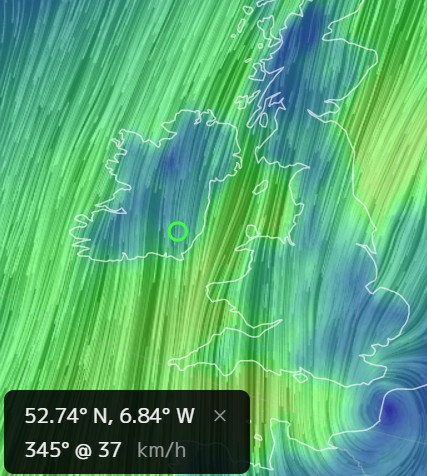
You may remember my piece-to-camera in September about the naming of 2021-22's storms: Arwen; Barra; Corrie; Dudley; Eunice; Franklin; Gladys; . . . It will be hard to take seriously a boy called Sue a storm named Dudley; but Storm Arwen is on us since yesterday:


For us, the circle marks the spot and 37km/h is pretty mild on the scale of storms. We are protected to a certain extend by a looming Mt Leinster to our immediate North. But the Northern coast is taking a pounding and an unfortunate driver in Antrim has been killed by a falling tree. While over on the bigger island, it is gusting 150km/h; trees are down; railways are blocked in Scotland; and sleety snow is adding to everyone's misery. Meanwhile, much further South Gdau.I reports snow in [the] Bath. Winter has begun.

Friday, 26 November 2021

How to be An Old

More than a year ago, in the middle of the Summer lockdown, by virtue of my aged bones, I became eligible for a Free Travel Pass. I characterised this as the start of my Lunch in Longford Years. With Coronarama blazing through the country, I wasn't in a tearing hurry to vindicate my entitlements. But in the last week of November 2021, I was induced to take the train to Dublin to inch forward a venture which had been started as a WFH research project when scientific labs across the country were closed in a vain attempt to contain the spread of SARS-CoV2. 

[It is not without irony that I spent a chunk of the morning in the very building where one of the earliest cases of "Skiing in Italy" covid made the news in early March 2020. At the time, TCD thought that sanitizing the lift to the 4th Floor would be sufficient response . . . hollow larf, lads!]

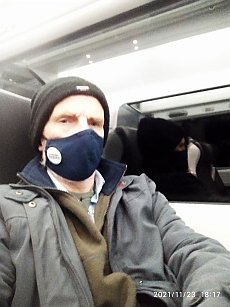
I'll also note that between booking the meeting in early November and actually being in the meeting, the daily covid cases doubled from 3K to 6K and the government started to tighten the screws on containment.  I tend to mild travel anxiety, especially when venturing into unknown territory, which includes public transport during a plague year. But it turned out to be super easy because Irish Rail - a notoriously feather-bedded and inefficient quango - has made pre-booking and ticketing super easy and intuitive. There is a clear [travel pass] button which sets all the costs to €0 instead of €28. Having selected seats in both directions, you are delivered an 11 digit reservation number. The fancy new touch-screen ticket machines have a truly enormous key-pad that could be operated with the stump of a severed arm and the numbers are echoed of a size and contrast sufficient for all but the most severely vision-impaired. Those 11 digits, sufficient to count every human that has ever lived, is also enough to print a unique creditcard-sized paper ticket. Masks are obligatory as are selfies [R at the end of a 12 hour day in town].

Did someone say in Town? Might projects are afoot in the Capital. The scheduled meeting was held in the EM Forster Seminar Room With A View on in the 6th floor of Trinity's TBSI. This is what you see looking NE over Docklands and Dublin Port - count the T-cranes! - it's like the Celtic Tiger all over again . . . but no accommodation for the homeless.


Wednesday, 24 November 2021

Svalbard Пирами́да

Uma - jointly captained by Kika and Dan [prev] - sailed into Longyearbyen earlier this year and then they sailed 80km across the sound in their personal dorm-mobile to Пирами́да Pyramiden the Russian coal mining centre which shut up shop in 1998 when extraction of coal became uneconomic and/or the Russians felt they no longer needed / could afford their presence in the area.

Pyramiden is Episode 284 in Dan & Kika's world-ranging voyage in a little hi-tech yacht which the bought cheap and fitted out themselves after they met in Architecture School in Canada and then decided they didn't want to design workaday hospitals and apartments while they still had fire in their bellies and two pairs of knees to transport themselves when they arrive in port. It's an internet thing, like Leo Sampson's Tally Ho project, whereby couch-spuds like me sit on the sofa and watch creatives doing there thing Out There. A thousand coal-miners and dependents / managers / ancillaries used to work in the area before King Coal played out. When the company pulled out they left heaps of extracted but unexported coal locally and 20+ years later this is still being used to keep the lights on in the diminishing collection of buildings that haven't fallen into ruin or been filled up by landslides. Tour-ships come to visit and allow the top-dollar punters one hour in town to tick their bucket lists and boast to their neighbours when they return to Peoria or Osaka.

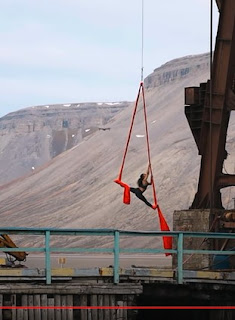
Dan and Kika get to hang around in midnight-daylight after all the visitors have buggered off back to Longyearbyen: having a couple of beers at $7 a bottle. Which is not insanely expensive compared to Oslo. Uma groupies will know the Kika does Aerial Silk acrobatics for fun and that why they had drone footage [R] of aetherial against a post-industrial backdrop against a polar desert backdrop. 

Spitzbergen prev more recent

Monday, 22 November 2021

Solnit

I've complimented Rebecca Solnit on the quality of her semicolons but tbh her status as a public intellectual has been on the periphery of my attention. Which is silly because I've been content to be [a bit skeptically] washed over by the certainties of, say, Malcolm Gladwell or Steven Pinker.  Not Richard Dawkins, though, he can go preen himself.

Solnit is perhaps most famous for getting her article The Uses of Disaster: Notes on Bad Weather and Good Government on postapoc kindness published in Harper's on the very day in 2005 that Hurricane Katrina whacked New Orleans and the delta. She paid attention to the unfolding drama of the Cajun Navy of little ships rescuing strangers from rooftops to eventually write that up as A Paradise Built in Hell: The Extraordinary Communities that Arise in Disaster [2009]. Contrary to what social [nature red in tooth and claw] Darwinists believe, it is not always a dog-eat-dog world when disaster strikes.

I'm now turning pages on Hope in the Dark: Untold Histories, Wild Possibilities [2004]. Or rather a later [2015] edition with a long forward and some extra chapters to flesh out her theme. Grim as the world was when Bush&Blair sexed-up their data and invaded Iraq in 2003, a lot more shit passed under the bridge through the next ten years: polarizing political discourse and degrading the planet.

One point Solnit notes is the distressing tendency for us to identify The Other and then assume that they are the opposition. It doesn't have to be thus as she discovers when her fellow leftie tree-huggers from San Francisco are on an environmental workshop in a remote Nevada village and have to share the bar with <frisson> ranchers. Because ranchers and ramblers are uneasy bed-fellows in the wilderness. But over a couple of beers and a bit of listening, it turns out that the livelihood, the patrimony, of ranchers depends on keeping the landscape undegraded and they've been achieving this for several generations. The real enemy are real-estate developers and the military-industrial complex.

Sunday, 21 November 2021

Rare ould times

Different strokes

endnote