Friday, 12 November 2021

And now I'm easy

Wot's it all about, then? John Green, youtube person, was reflecting on being grateful for having enough [4mins] and thankful that he was side-stepping the precarity [technical term] which besets that half of the world which exists on $2-a-day. It was flagged on MetaFilter where some wag put up the alternative Key Largo view of wanting more and more.


I had the huge [unintended consequences] advantage of having a brilliant older brother. At some early stage I reckoned that I'd never match that, so I stepped off the merry-go-round. I tell my kids that my ambition genes were shot off in the war.  [soccer]I was much better as Left Back than Centre Forward[/soccer]. When you're 7, a 10 y.o. brother may have seemingly unattainable skills; when you're 67 the playing field is pretty much levelled. But those early pressures and choices do set the clock. 

It's always been easy for me to achieve good enough. And indulge myself in a little subversive piss-taking directed at The Man. That's substantially because I was born white &  into a professional home in 1954: in 1986 we bought a home that cost 1.4x my then humble govt salary. A starter home for Dau.I is as near as dammit 14x her govt salary. That makes her living much more precarious than mine ever was. I was talking to my elderly [older even than me!] neighbour at the time of 2008 crash and bail-out. She remembered life being pretty hard chaw as a farmer in the 1980s recession. But she said brightly "At least, poor as we were, we had no debt". The bill of goods which our society has been sold [have now, pay later; have more now; everyone in the office has more] means that balancing the books is way harder.

I never got tenure at . . . Anywhere U; indeed I never secured a permanent job and my pension is shot full of holes; but I had 40 years in science and now I'm easy

Wednesday, 10 November 2021

Re-evaluating certainties

 It's Science Week from Sunday 07 to Sunday 14 Nov 2021. This national festival of STEM has been formally funded in the 2nd week of November for the last tuthree years.  2020 -- 2019 -- 2018 -- 2017. Wexford Science Café has been there, trying to boost our numbers and spread the Joys of STEM. I unloaded the responsibility of convening the WxScCaff this year and so all I have to do is rock up.

There is a bit of money sloshing about to support Science week down in the provinces and this year it was enough to commission a film by local Film Company Crannog Media. We cast about for a couple of handfuls of science-folk who'd go in front of the camera and decided that the topic would be

"What have you changed your mind about?"
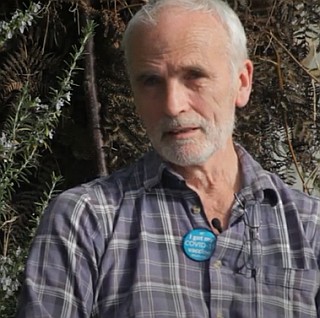
or Has any evidence cut across your bows since SARS-CoV2 started pirating about the planet which made you stop and think: I might have been wrong about that. I'd already written about my contribution to this show-and-tell so I had my script already written when Chris and Alan, with Lydon as Best Boy and Key Grip, wired me up and made me talk to camera. I carefully set the backdrop to feature a huge sheaf of bracken Pteridium aquilinum and the scythe used to cut it; but tat was lost in the zoom. They pulled on 9 other lapels whose owners could translate STEM into Yola and edited all that material down to a sharp 20 minutes of mind altering substance. No, no, not Psilocybin this time!

At the Cafésession last night, we watched the film and then opened the floor to discussion. A couple of people remarked that very few of the contributions actually described an evidence-based change of mind since Feb 2020. Whoa! lads. I've had three good ideas during 45 years of science which might be equivalent to a seismic shift in my thought patterns. So the chances that one of these events will have occurred in the last 20 months is zero to the nearest whole number. But it's hard to shake lose the idea that scientists are no more prone to having creative insights than poets or chartered accountants . . . and we do cherish our hypotheses rather than really go at them with the 🪓hatchet of skepticism. Always, always treasure your exceptions with Wm Bateson.

Monday, 8 November 2021

Outposts

Q. What would you do if your father, an artist and explorer, returned from Svalbard just a month before your birth smelling of pemmican and bringing a polar bear pelvis found detached on the open ice? 
A. Why, of course, you'd grow up to become an artist and explorer yourself.

Of course it doesn't always work out like that: I didn't join the navy and was never in charge of anything, let alone a crew of 600 and 200m of warship. Travel, of which I have been a keen consumer, has involved far more turning the pages of a book than turning over vegetation to reveal leeches and snakes. The genre was given its modern timbre by a pair of books - Brazilian Adventure and One's Company - published in the 1930s by Peter Fleming: older brother of Ian "007" Fleming. Fleming is the quintessence of British stoic aplomb. Maybe not quite dressing for dinner in the jungle but having an unassailable gift for wry humour and intrepid pushing on because going back is really not quite the thing a chap does. After WWII, this mode of travel was carried forward, with some hilarity by Eric Newby and Redmond O'Halloran; and much later by Bill Bryson.

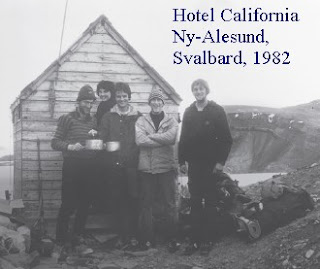
The picture at the top shows Tim Richards père and others outside their Arctic accommodation which is as big as the garden shed behind our house. That was the pot of nostalgic gold which defined the arc of Dan Richards fils trajectory. The thesis of his book Outposts is that striving for distant and inaccessible places can turn a spot-light on a pilgrim's mettle. Sometimes things only qualify as "fun" in the recall but if you never go near the edge you'll die anyway eventually; perhaps without having lived. The outpost-hopping starts repairing sæluhús with/for Ferðafélag Íslands - the Icelandic equivalent of Scotland's Mountain Bothy Association MBA. Sæluhús translates literally as joy-houses because that's what you feel when one of these primitive shelters is espied from afar through a break in roiling ground-level clouds; the alternative being either a) a bleak night's sleep or b) death by exposure. Later, he persuades a Scots pal to join him on a 150km ramble through the Cairngorms sampling the delights of the MBA's rough hospitality.

In between Dan tunes into Le Phare du Cordouan which features as a refuge in the film Diva. This is not inaccessible to anyone who can muster €44 and 4 hours for the jaunt from the coast of Aquitaine. But getting to the top gives a sense of achievement and allows the mind to reflect on what it must have been like when the West coast of Europe was the end of the world.

It takes a little longer to get to Desolation Peak in Washington state where Beatnik Jack Kerouac spent two month lord of all he surveyed as a fire-watcher in 1956. Kerouac parlayed that brief and somewhat unsatisfying experience into a string of best-selling books which dangled like a carrot in front of the next two generations of wilderness wannabees.  Most of us cannot bear our own company for longer than a weekend and would go bonkers to be exposed to the social deprivation of solitary exfinement for weeks at a stretch. While there Dan gets to hang with Jim Henterley [prev].

After several other contrived adventures, the final chapter takes Dan to Svalbard but not as remote on that remote enough place to match his dad's furthest North at Hotel California. Here, after actually seeing a polar bear with two cubs, in their native habitat he reflects, not without introspection, on humanity's place in Nature. WTF is he doing hauling fat-arsed carbon footprint to the distant Arctic when the creatures he comes to see are done-for because the ice is melting from the collective carbon footprint. It's not "fine" but it is trite to make the connexion between flying and snow-mobiling to view the goddamn bears too direct. Bitcoin and FAANG is nixxing the ice far more effectively than all the destination tourists who have ever been to Svalbard.  And you, yes you me, who are virtuously Friendfaceless and compost the carrot-tops . . . you'll have to give up the chest-freezer, the central-heating and the car before you can chid Dan for going to the World's End.

The adventures are "contrived" because this is Richards' fourth book and his idea needed a deal of research and forward planning to come off. It's an [ad] venture to invest so many weeks at a desk thinking what can be done with a finite budget and working out when and where is possible. And when all the travelling is done, many more weeks are required at the desk putting the pieces into a coherent order. But the jokes are not, cannot be, contrived: they spring spontaneously from the self-deprecating adversity in which The Plan has dumped The Author. I laughed: the baton has been passed from Fleming and Newby to another writer who uses travel as a way to explore what it is to be human and alive.

Sunday, 7 November 2021

Friday, 5 November 2021

Mad or misinformed

 Last [2020] Summer, for the first time in 25 years the windows of our home became a holocaust for thrushes Turdus philomena and other birds. In noticeable numbers these creatures would fly into the glass at speed and kiill themselves.  After a number of these collisions we covered the windows with bright post-its to lessen the chance of them reflecting, and looking like, the sky. It may have worked - or all the birds flying under this misapprehension had offed themselves - but eventually we stopped hearing these fatal thunks. And this year 2021, the geomagnetic anomaly has shifted to Wexford and we didn't get a repeat performance of the tragedy.

However, round about Hallowe'en, we started to hear fluttery thumps on three of the windows which all seemed to be caused by a blackbird Turdus merula which was jumping up from the sill and making repeated, aggressive, flapping attacks on the window-pane. If we knocked on the window, or even appeared close to the glass, the perp would fly quickly away chattering. This is really too late in the year to be mating or nesting, but maybe it's never too late to assert your dominance and see off a rival bird of the same species.

The major consequence for us, is that in his excitement the bird is shitting purple poos on our white[ish] window-sills. I begin to see why Linnaeus named this genus Turdus.

Wednesday, 3 November 2021

In the field

Research is quite fractal, science can reveal 

  • width of the known Universe [= 46.5 billion light years this week, more next month]
  • the length of human chromosome 21 [= 48 million bases]
  • life the Universe and everything [=42]
Biblical scholars have a rather finite universe: 588,258 words, according the the KJV. This is about a quarter of the content of The Blob and so makes an easier specialist topic on Mastermind. In the best of all possible worlds, scholars should be free to devote their cogitations and experiments to whatever they think is an appropriate use of their time . . . not what Boris Johnson, Senator Bill Langer, Dick Cheney or Willie Whitelaw believes is the best use of a government pay-cheque.

What's not to love about a paper entitled "No time to die: An in-depth analysis of James Bond's exposure to infectious agents", published this year in Travel Medicine and Infectious Disease. The three authors, all expert epidemiologists from Nijmegen and London,  watched 25 Eon-produced films released between 1962 and 2021 (∼3113 min of evening hours per author that were not-spent on more pressing societal issues or forms of relaxation that are more acceptable in academic circles). From these data they abstracted 86 James Bond 007 adventures that involved foreign travel.

The lowlights of these escapades include: "Food safety also appears to take a backseat to Bond's appetites. He regularly eats unwashed fruit . . . fails to wash his hands, neglecting both the risk of bacterial infection and the lack of toilet facilities during the ensuing boat chase . . . unhealthy when it comes to his level of alcohol consumption . . . drinking straight from a field-drain in Egypt". 

They conclude that Bond's death-wish risk-taking is consistent with infection by Toxoplasma gondii caught from Blofeld's cat. Toxoplasma has been associated with changes in behaviour in mice and humans which make it more like that the carrier will be gobbled up by a predator and complete the life-cycle of the parasite. 

I imply that those lowlights are clipped from the original paper, and they are, except for the last one. I made that one up from the sagas of another friend of mine who, as a PhD student in the early 1990s, was sent out to the Developing World to bleed cattle, sheep and goats, capture their DNA and discover previously uncertain evidence about the process of domestication. This is the same bloke who blagged the elderly Treasurer of Prestigious University to sign off a wodge of folding money from a government grant as cash under the line-item 6.3.1 Bribes. Tales came back of what this chap was prepared to eat and where he was prepared to sleep, which boggled the mind of us bacon-and-cabbage stay-at-homes. A couple of times, a few days after returning home, he was checked into the Cherry Orchard Fever Hospital in Ballyfermot for observation and flush-through of a wild variety of bacterial and protozoan parasites. As they say, what kills not, fattens and he's now MD of a biotech company valued last year at €50 million. So the risk of setting up and growing a small campus company paid off!

 eeee, y'have to larf.  

Monday, 1 November 2021

Optimization

Metafilter flagged up for me a youtube project a bit like Leo Sampson's project to rebuild the Tally-Ho, a 110 year old sailing boat. Julius and Dylan, two 20-something cousins, started building an iron-age round house in Ireland on Mayday last year and just finished in the middle of October 2021.

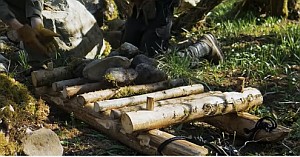
That first, foundation, episode is an interesting exercise it optimization: what is the most efficient way of transporting fist-to-skull-sized stones from the river to the building site? Clearly carrying them one at a time is not it. While carrying too many at once invites a hernia. 

When I was 10 or 11, the school decided to build a new science block . . . on the cheap. In those ununionized times it seemed reasonable to have the fit, young, male teachers do a certain amount of the labour in the Summer evenings preparing for the next day's work by the actual builders. They hadn't invented Health&Safety or PPE in those far off days and we schoolboys were encouraged to lark about on the site and even bear a hand  in the tasks. I remember me and palomino loading two wheelbarrows with a single concrete block each and racing from the block pile to the scaffolding. I also remember thinking about whether it was better to plod across the site with a lot of blocks or fly them across one-a-time. Somewhere in between, for sure. Apart from efficiency, a few years ago, my second best, second-hand wheelbarrow collapsed when I loaded it with too much spoil from the drain. 

Dylan and Jules start off by loading an iron-ago wicker basket with stones and carrying that load suspended from a pole between their two shoulders. There is some discussion of the tare and nett weight when load-bearing apparatus is involved. 25 years ago, when we bought our old farm; languishing in one of the sheds was an exact pre-Massey-Ferguson replica [but with milled timber and nails] of the solution D & J come to [see R]. In episode 2, they acquire a horse! to do the heavy dragging.

And they have let the river do a lot of work in cleaning and grading the stones. Wave-washed Chesil Beach on the South coast of England does this sorting on a grand 30km scale. At the Iron Age hill fort of Maiden Castle 20km inland, archaeologists found caches of even-sized sling-stones clearly mined from this section of the beach. Or maybe that bit was made up by archaeologist Mortimer Wheeler in the 1930s - the sling-shots having been fetched from the beach in his Model-T Ford.