Showing posts sorted by relevance for query forensic. Sort by date Show all posts

Friday, 20 November 2015

Following footprints

Nobody would claim that The Institute is at the centre of things.  So when we get a visiting speaker, I do my level best to turn up and also encourage any students who are under my wing within earshot to come along too. What the visitor has to say is surely going to be more interesting than the same-old-same-old drone from the likes of me. Partly that's because the visitors are not a random selection of the community; they are people who have a reputation for being articulate. They also get to be invited by someone on the staff who thinks their material is relevant and interesting to one or more of our student cohorts. We've had
This week we had a talk from Niamh nic Daéid, newly appointed Professor of Forensic Science at the Centre for Anatomy & Human Identification [CAHID] in U Dundee. She came from a 20 year posting in U Strathclyde where she became the first woman in that venerable institution's history to be awarded a personal professorship. She wanted to be an archaeologist when she left school but didn't get good enough grades, so went to read chemistry, maths and physics at an Institute like ours. Her grades may have been unstellar but her determination was mighty and she went on to get a PhD from the Royal College of Surgeons . . . and later a BA in Psychology from Open University! Hat's Off!! We are exposed to a raft of forensic scientists on the TV, in which strikingly symmetrical young women sort through the crime scene with unbelievably sophisticated instruments and wrap up the case within an hour including 12 minutes for ad-breaks. We know that it's not really like that but that sort of nonsense gets a great press, and persuades the gullible to sign up for 'forensics' courses at college. The other side of the forensic coin less so.  Who now remembers Dr Frank Skuse, whose " . . . conclusion was wrong, and demonstrably wrong, judged even by the state of forensic science in 1974" but whose tendentious interpretation of a Greiss test helped convict the Birmingham Six?  Who but The Blob remembers Lucia de Berk and Sally Clark being convicted of murder on the basis of dodgy statistical analysis?

Like any profession there will be a range of abilities between Dr Skuse and the perfect competence of TV fiction.  Prof nic Daéid pointed out that, in her profession it matters . . . rather more than if, say, your HR department cannot get contracts out on time and then sends them to the wrong people. Sending the wrong people to a lifetime is gaol is clearly a more serious issue. One of the skills you need as a top-gun forensic scientist is the ability to explain your findings and their scientific basis to ordinary people, and the pace and presentation of 'our' talk was right on the button: accessible to a raw 1st Year and informative to a professional biologist. FSs can be experts not only in blood-splatter, DNA identification and the chemistry of illicit drugs but also in the chemistry of combustible materials. This last is interesting because identifying how/where a fire started could be the basis for a criminal conviction but seeing how the fire spread is more about building regulations, health&Safety and public good.

Good FSs continue the traditions of Sherlock Holmes in having a technical expertise in written materials. But 70% of their work in this field is puzzling out what was written on the sheet of paper above the one which has been retained as evidence.  That doesn't require any sophisticated instruments, nor does matching a footprint in two different locations, but both can be useful in cracking a case.  At the techie end of the tool-box, there are 8 different protocols for making methamphetamine, each of which will leave a characteristic trace among the impurities that come down with the drug. To those in the trade, this chemical signature is almost as a good as a finger-print for identifying the lab where the drug was made.  How do they know this?  They make serial batches of the drug using each protocol and then run the results through analytical instruments and keep pictures of the output as 'standards'. Using similar standards, you can determine whether a fire was caused by unleaded petrol or kerosene or LPG which will tell a lot about whether arson is likely. That's criminal, but nic Daéid's people carried out research to show that 100% of boys and 80% of girls failed to wake up when a fire-alarm went off in their bedroom! That's a vital piece of data to inform public policy, parental behaviour and fire-alarm manufacture.

But perhaps the most worrying aspect of forensic chemistry is not identifying known substances - MDMA, gasoline, cocaine, haemoglobin, semen - at crime scenes but the ballooning number of chemicals which are new to the experience of the scientists involved.  If there are no standards and no standard protocols it is really difficult to stand up in court and stand over your findings. 350 new psycho-active substances NSPs have come on the market in the last few years and people in clubs and pubs are putting them in their mouths or up their noses without knowing how they act, where they are made or what they are cut with. That's a worry on many levels.
You can hear Niamh nic Daéid talking about similar material in a BBC interview. And she tweets. I particularly like her frequent use of the CEM Joad phrasing "It all depends on what you mean by . . .": until we know what we're talking about, there is very little real science going down.

Friday, 12 January 2024

Murder Most Florid

Let's hear it for diatoms! They are microscopic, unicellular algae fantastically abundant in wet places across the world. Not a patch on Prochlorococcus abundant, mind, but that's a prokaryote. One interesting thing about diatoms is that they have silica, rather than calcium carbonate, shells. This material is rather more resistant to degradation; perhaps because everyone else is avid for calcium. The other diatom 'fact' is their remarkable diversity of form - as sampled above from the Nat Hist Museum in London.

With their diversity, you can imagine that diatoms might be useful in forensics but TIL that they are particularly useful in cases of drowning. The smaller members of the tribe can be forced across the alveolar membrane when water under pressure floods the lungs and finish up embedded in various tissues including the liver. One standard forensic technique is to "ash" a necropsy sample from such tissues and then wash out the impervious-to-fire silica skeletons to determine if the drowning occurred at sea or in a lake or in a bathtub. Each of those habitats hosting different varieties of diatoms.

This is not all I learned from reading Murder Most Florid: Inside the Mind of a Forensic Botanist (2019) by Dr Mark Spencer. I won't link to the publisher because, a) the book is basically out of print because Quadrille under-estimated the take-up b) the book has been published with two missing pages. Check your library, though, because it's worth a leaf through (see wot I did there?). Spencer's work is adjacent to that of Patricia Wiltshire, who works in the same arena as a forensic palynologist (pollen-boffin). They have both been free-lancing = scrabbling for work on zero hours non contracts from police-services across the UK. Between 1991 and 2012, there was a UK state-owned FSS Forensic Science Service. It was available as a service to the several police forces . . . but also coroners, the Revenue, prosecutors. Then it was shuttered because it was costing money and half the staff went free-lance. I'm sure that the created competition is great for Das Kapital.

Most crime (Forensics:the application of scientific methods and techniques to the investigation of crime) happens in houses, or on the mean streets. Forensics in this world is about glass fragments, gunshot residues, blood-spatter, exit wounds. Most coppers never get out in the countryside and are a bit at a loss when scene-of-crime hinges on bending of grass-stems, the length of bramble arches, leaf-frags in trouser-cuffs. They are more inclined to call up a boys-toys back-hoe, than a fastidious botanist in wellies. A back-hoe will dig up the body if it's there, Yes,  but with a lot of extra metal-on-bone marks to bamboozle the forensic pathologist like Richard Shepherd. Cripes, I've been reading too much about dead-body science.

Who knew that a really experienced botanist can name a plant species from a 1cm2 fragment of leaf stuck to a muddy boot-heel? For most of us, beyond ash Fraxinus excelsior and daisies Bellis perennis, we'd be hard-put to dredge up common name, let alone a Linnaean binomer, for a whole in situ random plant from the neighbourhood - even if it was in flower. Quiz-time [L]: under what species of tree was the bludgeoned Together For Yes activist having a picnic? A: at page bottom.

It's true that police services have long ago given up on the ideal of solving all crime. They probably won't bother to call by if you phone-in a burglary: "Just call your insurance, Sir". They have a budget and a set of priorities and nailing a perp to a particular place through botanical trace-work is a) alien e) expensive, so it's not done. Drs Spencer, Shepherd and Wiltshire think that justice is a missing a trick there; but perhaps everything looks like a nail to a hammer and they would say that wouldn't they? If you read either of the forensic botanist memoirs, you'll be in a better position to judge whether "we" need that expertise. Nobody has made a convincing case that "we" need synonymous codon usage analysis, however much fun I had working in that field for a decade.

Mark Spencer addresses the Linnaean Society on his book and work.
A: Acer pseudoplatanus, sycamore Seicmar

Monday, 28 December 2020

Dusty Death

. . . and all our yesterdays have lighted fools the way to dusty death. [Macbeth]

A hit, a very palpable hit! [Late Hamlet] I'm a great believer in reading outside my echo-chamber: random books have done me proud in the past. I was scanning the severely limited inventory on Borrowbox to land some audio-book fish for the holidays: nothing nothing nothing nothing nothing . . . Trace by Prof Patricia Wiltshire. My female relatives read a lot of bodice-rippers body-rippers murder mysteries; many of them far too challenging for me. The genre has come a ways since Sherlock Holmes solved the problem by taking a rattling train to Dartmoor and smoking a couple of pipes. Patricia Cornwell, for one example, tends towards grizzly details of bodies in bin-bags . . . the flies, the flies. I started one of her books and could not finish it.

Patricia Wiltshire, contrariwise, is strictly non-fiction; but works in the same arena as a forensic palynologist. Palynology is the study of scattering παλύνω ultimately from dust πάλη [aaarggh not the dreadful Gwyneth Paltrow's shameful concoctions]; and forensic is the application of science to crime. Wiltshire used to be a lot of things including a botanical archaeologist, but her core bailiwick now is collecting and characterising plant pollen and fungal spores from dead bodies, brake-pedals and bin-bags;
 and matching those data to a location. Making that connexion in a way that will convince a jury and outsmart a defense attorney requires an encyclopedic knowledge built up from 40 adult years of staring down a microscope with the fingers of one hand marking several different pages in a weighty Victorian botanical memoir. The internet has a been a boon to her because she can rapidly get a second opinion or pull on a distant colleague's coat for their niche expertise.

She was over 50 years old before [the out-of-box thinking branch of] the police networked themselves up against her by telephone . . . because Kew Botanic Gardens couldn't help them progress their case. She's in her late 70s now, but still in the saddle and widely respected for her dedication and professionalism. She was early on able to suppress her gag reflex by resolutely affirming her belief that dead bodies are no longer people. Although this needed some effort when she was presented with cauliflower cheese in the police canteen after working in the morgue. The smell of sulphur from the brassica and butyric off-milk from the cheese is just what the intestinal flora produce in their post-mortem work.

I know that Trace is a Jo Public version of the forensic process rather than a scientific article, but I'd be more confident of the results if the evidence was treated double-blind. Bias will creep in if the analyst knows whence the sample originates. Nevertheless there are many stories of uncanny precision in describing a locating crime-scenes from the quantitative and qualitative analysis of microscope slides. In one case, Wiltshire is driven out to the site after she has analyzed the pollen profile from the perps' shoe scrapings. She walks along a field-boundary hedge until she stops where a blackthorn and a whitethorn-with-ivy rear up over a little clump of dead-nettle . . . "Here!" she announces [correctly] to the trailing policemen. No other location along the 300m hedge would deliver the unique combination of pollens. For her, "a lawn is a lawn is a lawn" is simply not true: if you get down on your knees and look it is infinitely variable. Although that lawn is very different in its palynological profile to a wooded glade, despite being probably dominated by the same three species of grass.

Verdict: this is a book worth reading as an antidote to Agatha Christie or CSI on the telly. It shows that results that come from hard work are rewarding and useful while results that come quickly might be suspect because superficial. Forensic palynology, and indeed archaeological palynology, requires the mastery of many different disciplines - botany, parasitology, geology and statistics for starters - and weaves many threads of disparate evidence into a coherent tapest[o]ry. Hear it on BBC from the horse's mouth?

Monday, 26 July 2021

The Good at his job Shepherd

I'm not knocking fiction; it's an effective way of laying bare life as she is lived to better understand how humanity ticks - even if all the characters are talking rabbits. But I don't read much of it, preferring "true" stories. My latest download from borrowbox is Unnatural Causes by Richard Shepherd. Shepherd is the last of the old style forensic pathologists: trained in an era of pipes and tweed-jackets and very dark humour over the mortuary slab. He's retired a couple of times but his experience and expertise are still valued by the small community of those who tidy up the dead. Not so much morticians with a deft needle, formalin and a touch of blusher; more those who come before, tidying up the loose end-of-life ends. Shepherd's position is that we-the-people owe it to the dead to discover and publish the cause of death, even if that task is messy, time-consuming and [therefore] expensive.

One of Shepherd's gripes is that when every aspect of life was privatized and cost-centred under Thatcher and Blair, there was often insufficient money to pay for a decent path report and so death certs were signed off without the cause of death being adequately investigated. Subsequent enquiries, for example, revealed that police and prosecutors didn't give-a-damn about how Stephen Lawrence was murdered in 1993 because the kid was black. You'll get a better post-mortem if you get offed at the beginning of the financial year! In the old days, forensic pathologists could do experiments and develop particular expertise through experience because they got their salaries on the regular. Today forensic pathologists are all independent contractors, so any spare time between cases is spent hustling for more business rather than stabbing pig livers and documenting the damage.

Shepherd started forensic work in the late 80s when a tumult of tragedies delighted the tabloids: Hillsborough, Zeebrugge, Marchioness, King's Cross, Lockerbie, Piper Alpha, Clapham Junction, Hungerford, East Midlands Airport. Not only was he Point Pathologist for several of these events, he was instrumental in setting up the infrastructure for better handling of such things in the future. Cost-centers really don't like investing in future Maybes, but infrastructural failure means a shameful response when, say, pandemic happens.

Unnatural Causes is, rather stiffly, confessional. Shepherd acknowledges that he could have done better with the optics of his messy profession because blunted affect [and a really sharp PM-40 see R] is necessary to do post-mortem efficiently. One ghoulish detail was caused outrage was the decision to remove the hands from some of the long-submerged bodies of the Marchioness so that the finger-prints could be properly identified with large specialist equipment that couldn't be transported to the mortuary. And the poor man could have done better flipping between his day job and his suburban family life. Helping the kids with their home-work and making together time with his wife 40 minutes after showering the smell of decay out of his hair at work. He couldn't square that circle and his first marriage wrapped up in divorce after the kids had left home.

Keeping the image and smell of death and dismemberment at arm's length for 4 decades and 23,000 autopsies eventually came to unbend his mind with PTSD, depression and panic attacks. If we cared about mental health of front-line workers, we'd budget for therapeutic help: £100 a week for a discrete ear isn't much money and it leverages better product at work. The adversarial nature of the law as it is practiced in their islands is damaging to justice and fairness. Senior council will not be nice about distinguishing between the professional competence and personal integrity of pathologists, police constables, or doctors. It's little wonder that these people hit the bottle [or, god forbid, the family] after a mauling by some toff in a wig at court.

Another insight is that a lot of tea is consumed in mortuaries. It is a necessary professional and social lubricant among those whose work requires them to be present but whose interests often conflict. The pathologist's call can mean more, or less, work for the police. Unnatural Causes may not be your cup of tea but I found it interesting and not gratuitously gruesome.


Wednesday, 25 September 2024

Deputy State Pathologist

The Blob has been running for nearly 12 years; recently cranked down from daily to MoWeFr[Su]. Now that I R retire, it is no longer an everyday story of Institute folks and I must poke elsewhere for copy. Most days, before breakfast, instead of a cold bath [so Protestant, so Yesterday], I glance at the RTE front-page to check that I haven't missed something important. We've come a long way from the BBC dressing a chap in evening clothes for 9 o'clock to solemnly announce "There is no news tonight". RTE will fill their page with stuff regardless of whether there is any news. But it would take a momentous recent upheaval elsewhere to stop RTE giving headlines to an Irish murder or a multi-victim car-crash. 

For 20 years 1998-2018, the reports on Irish mayhem would mention the presence of Dr Marie Cassidy, the [Deputy] State Pathologist. Before she was appointed DSP in 1998, one man carried the can, now there are seven pathologists on pay-roll (currently all women for what that's worth). Jack Harbison, Cassidy's mentor and predecessor, wasn't camera-shy and State Pathologists have become celebs in Ireland. This is not the norm in other jurisdictions.

When Cassidy retired in 2018, as well as the Dancing with the Stars gig and a part on Cold Case Collins [nodding sagely R], she also sat down to write her memoir Beyond the Tape which was published in 2020. It required big font and 1.5pt line-spacing to get it to fill 300 pages and justify the £16 sticker price. Not knocking it for being short; it does the job. The gruesome is presented but not lingered over and the books spares us the smell and the flies, so we can get a sense of how grim-but-necessary tasks are carried out professionally. One thing that helps front-line workers get through is gallows humour and a good bit of that leaks into the pages of the book. 

One aspect of the professional demeanour of Marie Cassidy is that she tries very hard to be non-judgmental and dispassionate. It's not helping grieving relatives if the forensic pathologist goes all weepy on them but neither is pretending to be a robot. Also (by her own account) while Cassidy works hard and meticulously to bring decades of experience to bear on resolving the cause of death, she is not prone to over-egging the pudding. She will stand up in court to say that the evidence is equivocal or insufficient. And I also detect a degree of compassion for the perps. It's not helpful to anyone if state professionals are judge and jury and St-Peter-At-The-Gate for The Accused. Humility and a l o n g list of wrongful convictions require uncertainty about The Facts.

This is the 4th forensic biography I've reviewed after Mark Spenser's Murder Most Florid, Patricia Wiltshire's Trace, and Unnatural Causes by Richard Shepherd. The last has the greatest overlap with the Cassidy book. Shepherd eventually unravelled. It's probably true that gallow's humor isn't enough to secure the mental health of all workers at the forensic coal-face. I only read Beyond the Tape because The Beloved browsed it off the library shelves especially for me. I won't be reading Marie Cassidy's first essay into fiction with The Body of Truth (2024) but I daresay the whodunnit members of my family - who are legion - will give it a go.

Saturday, 28 September 2013

Ulster fries the data

On dit que the last signature on the Ulster Covenant was obtained on 28 September 1912 and the project was declared closed .  .  . or open for business.  If you don't live in The North you may be forgiven for knowing nothing and caring less about a document that was signed just over a hundred years ago to protest the idea that Ireland-the-island would be accorded a measure of Home Rule.  Frederick Crawford, Firearms Liaison Officer of the UVF and successful gun-runner, claimed to have signed the Covenant in blood.  Forensic analysis 100 years later showed that, while his signature is definitely red it a) has not faded and b) has no trace of iron and so it is very unlikely that Crawford was telling the truth.  It's a bit like Oscar Wilde's Canterville Ghost borrowing Virginia E Otis's paint-set to keep the "terrible stain of blood" on the floor and using up all her crimson, magenta, scarlet and finally resorting to purple and blue.

The most recent General Election before the Covenant started circulating was held in 1910 and the Census of the Western European Archipelago says that there were 17,448,476 males on the islands (women hadn't been enfranchised yet, so we can ignore them in matter electoral), of which 38% were too young to vote.  So the eligible voters comes out at 10,818,000.  But in the December 1910 Election, only 4,875,000 votes were cast: a turn out of 45% which seems about the right amount of interest in the normal democratic process.

As well as the ink, I think that the accepted numbers could do with a skeptical forensic analysis as well.  It is claimed 471,414 adult men and women signed the Covenant (for those with a Y chromosome) or the Declaration (XX people only).  According to the 1911 census, there were 1,582,000 people in the province of Ulster (9 counties) at the time.  That breaks down as 674,000 Roman Catholics; 838,000 'Protestants' and 70,000 'other'.  The Census at the CSO also says that of those 38% were under the age of 18 and so technically ineligible. That means that of the 0.38 x 838,000 = 519,000 who were a) eligible and b) at all likely to sign (Protestants) such a document, 471,000 (91%) did so.

I suggest that is as credible as the claim that 93% of Albanians voted for Enver Hoxha in the elections of 1945 that gave him a mandate to set up his Maoist-Marxist Paradise on the Adriatic. The signatories have all be digistised and you can search for names or addresses, agents, electoral divisions.  So there are definitely nearly 500,000 signatures on nearly 50,000 pieces of paper:
Here is one of  210 Bobs, for example.  When you look at the database, it turns out that the constituency is much wider than Ulster, with batches of sign-ups from many counties in the rest of Ireland, many areas of The Mainland (including "Plymouth, Cornwall" N=9 which wrong wrong nearly right), Canada (N=56), Australia (N=39), At Sea (N=39), China (N=9).  So that puts a wee hole in my maths but only puts a wee dent my skepticism. 

Friday, 20 October 2023

Scar tissue

Note for furriners: courgette is zucchini is calabacín is κολοκυθάκιCucurbita pepo 

If were proper scientists, rather than woo-wits gardeners and courgette fryers, we'd keep records of what-all we take from garden to kitchen. But we aren't and so we don't. It was therefore up to me to carry out a forensic post-mortem on the courgette stalks after we grubbed them up [as Lwth secateurs for scale] at the end of the 2023 season. Counting the harvest is not (solely) obsessive behaviour: it helps to plan for subsequent years. Nobody wants to be part of the annual August courgette glut when  you cannot give them away; but having one a week as a special treat is not ideal either.

On 12 Oct 23, we grubbed up all 5 of the courgette plants because a) the leaves were dusting with white fungus b) many of the courgettes which were still coming rapidly developed a squishy distal end before they were big enough to eat. Anyone who's ever grown courgettes knows that sinking feeling when, two days after a  comprehensive harvest, a full-grown marrow the size of a child's leg is discovered under a big leaf. The ideal is to have a handy couple of courgettes every day through the Summer. 

  • Sliced, fried in butter and olive oil with a bit or bread and more butter makes a fine lunch
  • Grated into a paste of spiced besan = gram-flour and water; and fried
  • Courgette fritters: with eggs, feta cheese, flour, chopped scallions, dill, parsley
  • Substituted for carrots in any recipe for carrot cake.
  • Sliced thin, served raw in a green salad

The flowers, and later the courgette, sprout from the axil of [most of] the leaves along the stalk of the growing plant. At some stage sensible people start trimming off the bigger leaves because they are attracting mould . . . and hiding those monster marrows. For forensic inventory I sat down and counted  30 + 11 + 47 + 24 +17 = 129 ± 2 from the five plants which survived to adulthood. I think we lost a couple to slugs or cut-worm when they were small. That is, and has been, about right for 3 people over the Summer: about 1-a-day since 01 Jul 23.

Did I mention 3 people? The only reason we have any courgettes this year is because Dau.II took ownership of the polytunnel and the out-door veg-beds this Spring. Starting some plants from seed, buying some plants and being gifted others. 2022, Spring planting was on me and it was an unaccountable disaster: nothing sprouted, fungus sprouted everywhere and it was highly disheartening. I have minimal resilience about such things and resolved to rely on ALDIDL for my veg. Having someone else to move things along in 2023 was just grrrrreat.

Saturday, 22 November 2014

Griess

Peter Greiß was a mid-19th century organic chemist from Germany who left for England to work with Hofmann at the (UK) Royal College of Chemistry.  He married an Engländerin, chamnged his name to Griess, refused a good offer to return to the fatherland with a position BASF and worked for the Allsopp's brewery until he died. He's buried in Burton-on-Trent, England's brewing Mecca. BASF BLOB BOOM.  His lifetime's work with nitrites, diazonium salts and other nitrogen rich organic compounds made it inevitable that he would contribute to our understanding of nitroglycerine and TNT trinitrotoluene. Those years were exciting for chemists and in the course of that century science went from knowing very little to knowing a lot about how chemicals interact and how we can tilt reaction processes to favour desirable outcomes.

The Griess test for the presence of nitrates and nitrites is named for him because he invented it in 1858. The previous paragraph and a previous Blob shows that nitro-containing compounds lean towards flammability, not to say explosiveness, because of the excess oxygens that are embedded in the molecule and so don't need to be found from the surrounding air when things blow up.  If you use caustic soda - NaOH - you can strip off the nitro parts of unexploded TNT or nitroglycerine (the active part of dynamite) and then carry out the following two reactions.  First add sulphonamide to make a diazonium salt with a rather reactive N=N side-chain.
If you then add N-alpha-naphthyl-ethylenediamine and it turns pink, then you must have had some nitro groups in the original sample . . . and those nitro groups must have come from an explosive material.
All this stuff about nitroglycerine and the Griess test is because sometime in the small hours of 22 November 1974, a government appointed forensic scientist was swabbing the hands and fingernails of six Irishmen who had just been arrested in the port of Heysham.  The police were certain-sure that they had nabbed the fleeing perpetrators of the Birmingham pub bombings which had ripped through some scores of people the night before and killed 21 of them. While the boffin was taking the swabs and analysing them to produce one plank of the evidence, the police were extracting confessions from the arrested men. One problem with the Griess test is one of false positives: nitroglycerine will give a pink colour but so will a raft of other common-or-garden substances including detergents used to wash the vials for carrying out the test and lots of stuff (shoe-polish, cleaners) you probably have under your kitchen sink. The analysis hinges critically on the strength of the NaOH used at the very beginning of the test: too weak and it cannot possibly strip off nitro groups; too strong and it will find them everywhere - there is no middle ground, and the Griess test is only useful as an preliminary indicator rather then evidence in itself.

At the trial the following year the judge summed up the evidence thus ". . . if Dr Black [the defense counsel] is right, the Griess test was not worth carrying out... Do you think that Dr Skuse [the govt forensic scientist] has been wasting most of his professional time? It is a matter entirely for you".  As is enshrined in the justice system in these islands, the judge will have made up his mind at this stage in the trial and can phrase his summing up in such a way as to tilt the opinion of the jurors so that - surprise! - they come to agree with the judge.  At the appeal years later the judges had this to say "if the trial judge had known what we know, he would have excluded Dr Skuse's evidence as valueless".  I'm not going to beat up on Dr Skuse here, having had a go at him five months ago, but before you make up your mind you could, with advantage read Beverley Schurr's long essay summarising and dissecting the whole sorry story.  Of course, it's not the whole story, but it's more comprehensive and balanced than the original convictions.

Saturday, 27 June 2015

Little Miss STEMshine

At The Institute we offer a degree called something like Biowonders with Bioforensics.  Every year some students sign up to this because they have grown up with CSI on the TV and think they can handle the blood-splatter and skeletons found in the woods. They wait a helluva long time for any of this on the curriculum and eventually pass out with a degree that is more or less useless for getting a job in forensics in Ireland: of which there are about three openings every decade. We are spending next academic year having a strategic review of our courses and one thing we are all determined to do is scotch the 'forensic' lie and call the course Biotechnology for Superheroes for the generation raised on Spiderman movies. Elsewhere you can complete a BSc in Forensic Science and get a job as an autopsy technician [they call it medical examiner and medical technologist]. Presumably the Faculty at U. Vermont devoted some time and effort to developing their course in Forensics - Blood-splatter 101; Advanced Entomology; Handgun Caliber Analysis - rather than merely stapling the word 'forensics' into the Prospectus as a dishonest after-thought.

I know all this because Alayna Westcom, a rather symmetrical female autopsy technician, secured the title Miss Vermont 2015 this Spring. You can't see much of her symmetrical face because she has been raised on the Little Miss Sunshine school of how to respond when you win a beauty pageant. You put both hands up to the mouth, give a little at the knees and shriek "OMG, OMG", while last year's winner drapes your sash and pins a plastic tiara to your hair. Now you could getting snitty about the elements of popular culture than Ms Westcom has chosen to embrace: how parading fit young women in near-nakedness is demeaning gives a rather one-dimensional view of their talents. She contributed to the distractinglysexy twitterfeed, so she has a sense of humor. Although Only confirmed followers have access to @AlaynaWestcom's Tweets and complete profile, which suggests that Miss Dingbat competitors attract a lot of unwanted attention from lurkers, stalkers and oglers. But you could turn it around and say: here is a successful young scientist who has a peculiar hobby.  No more peculiar than going to Samba school or doing a little light book-binding in the evening after a heavy day pushing the frontiers.

It may seem that some of the contestants in these competitions are as thick as pig-dribble but then so are a proportion of any profession including college professors. With hindsight, the responses to the question "Should evolution be taught in schools?" by Miss USA contestants are a) varied and b) not unreasonable; although we all snickered contemptuously at the time (2011). Is it just me but do a disconcerting number of these women have sort of up-slanty eyes? What's that all about? Most of these women are white, or 'round-eyes' as the Chinese used to refer to Westerners, but the ideal physiognomy now seems to be going East - is it all the Kung-Fu movies on the TV?

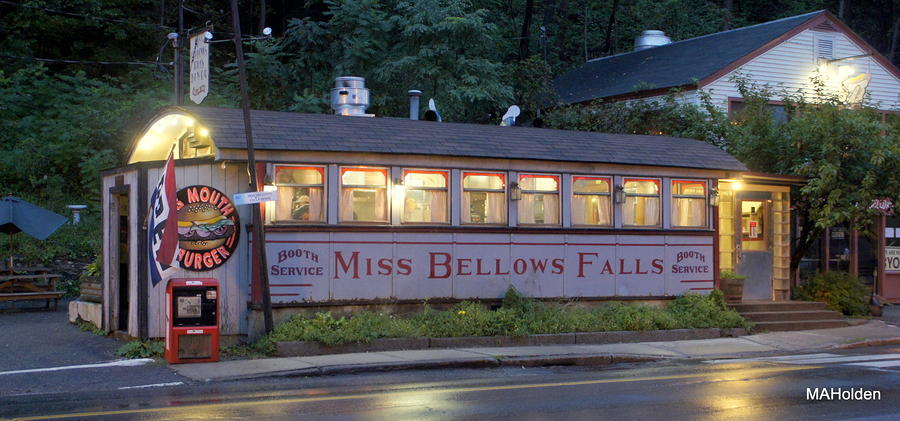
Mais revenons a nos agnelles Ms Westcom has been changing her strategy over her years of competing for the titles of Miss Bellows Falls . . . Miss Vermont . . . Miss America. Over the years, the contestants have been asked to demonstrate that they are not one-dimensional ciphers to be ogled at; but are young women who are worth something in their community. She is still raising wodges of folding money for a worthy charity, and she visits old folks homes. Ms Westcom used to offer a [same-old, same-old] dance routine as her way of showing that Vermont Has Talent.  This year however, she has ditched that and her 'extra' is Platform:  Success through STEM.  That's great, like Harry Potter and Nobel Prizewinners, people listen disproportionately to celebrities.  Can't be bad if girls see Alayna Westcom's demo of 'science' and say "that's cool, I'll have some of that" and put an extra effort into their maths homework. The fact that her science demo [L and micro-youtube] is reduced to a 40sec sound-byte is not her fault but integral to the whole superficial nature of these events.

Thursday, 8 August 2019

Patient Null

Patient Zero was long believed to be Gaëtan Dugas [R], an air steward, who a) Canadian b) gay c) flamboyant d) attractive and e) promiscuous. All the gays I know well are really monogamous, in long-term, cohabiting, monogamous relationships, if not actually availing of the right to get married. Dugas was one of those who helped solidify the cliché that gay men were mad for sex, with as many different men as possible. Think Warren Beatty for the heterosexual equivalent: he reportedly had sex with 13,000 different women. Whoa!? That's one-a-day for 35 years. Promiscuity tsk tsk  was part of the trope that enabled the bourgoisie to be smugly judgemental when HIV/AIDS burst out of Africa and started to infect people who matter - white, male, middle class - in the early 1980s. The CDC in Atlanta and clinicians, esp in New York and California, were caught on the hop because the symptoms were so diverse and so invasively shocking and it took a while to see what were the epidemiological connexions. It didn't help that, even in NY and Haight-Ashbury, men were understandably reticent about admitting to active homosexuality.

At the time it wasn't clear who gave and who received the virus, not least because there was a quite poor fit between the time of infection and the first manifestation of symptoms about 9 months later. Until they could identify the cause, there was no possibility of a cure, and one of the techniques was to do a forensic audit of who had sex with whom and when. Dugas was particularly helpful in identifying his previous partners of which he'd had hundreds and hundreds. By mirror, his name came up frequently in other interviews because a) he wasn't shy b) he was strikingly beautiful and c) he had a peculiar name. The scientists would be at nothing if events had unfolded in Cork where half the men in the city are called Mick or Pat Murphy. In their efforts to keep a semblance of discretion and anonymity, a clinician in Los Angeles flagged Dugas as Patient O-for-Outsider. If he'd got E for Exotique his subsequent reputation wouldn't have been quite so damned because O soon came to be mis-copied as 0 and Patient Zero became A Thing to the  media. Dugas died in 1984 as his kidneys collapsed from multiple immune-deficient assaults including Karposi's sarcoma. This diagram from 1984 has Dugas front and centre [as 0 = Index patient] based on interviews and the time-line of symptoms:
It wasn't until 30 years later that a careful analysis of HIV sequences from old tissue and blood samples definitively put poor Dugas back in the ranks of victims rather than as a sort of cheer-leader. 
The lead PI on that study was the same Michael Worobey, whom we met more recently tracking HIV samples back to 1966 in Kinshasa. Forensic HIV work is particularly delicate because it is an RNA virus; RNA is much less robust that double-stranded DNA and tend so get degraded. Especially if subjected to multiple freeze-thaw cycles as samples are taken out of freezers, analysed and then put back in the cold. Worobey's people used a technique called RNA jack-hammering which assumed the molecular quality would be marginal and worked to reliably reassemble the fragments after sequencing. That analysis [Quartz QZ summary, original paywalled] showed that, w.r.t. the New World at least, Patient Zero likely came from Haiti to New York about 10 years before Gaëtan Dugas burst on the gay scene and died from having too much fun.

Sunday, 22 June 2014

Estoppel

21st June has been a good day for injustice. On top of the Old Bailey, the Central Criminal  Court in London, stands this statue of Justice, who is usually represented blindfold but willing to defend (sword), fairly (scales), the administration of justice. The British have agreed to discard the ould blindfold from their symbol because tired old men in full-bottomed wigs feel they have such clarity of vision that they can see the rights and wrongs of a case and instruct the jury accordingly. Do you have jury trials in Ukraine?  They are a mixed blessing, because juries tend to do what feels right to them even when it is not strictly in accordance with the law or the evidence or the judge's summing up.  Two events occurred yesterday that made the news only within their own parish because the injustice happened long, long ago and we've moved on and we think we're more civilised now.

Gerry Conlon died last night aged sixty. He spent 15 years (that's 25%!) on his life in jail. On 5th October 1974, the IRA bombed a couple of pubs in Guildford in Southern England because they were known to be frequented by members of the British military.  Four soldiers and an innocent plasterer were killed.  A few weeks later, the Metropolitan Police, incapable to identifying the perpetrators of these crimes, had themselves a razzia and rounded up four Irish people (the Guildford Four: Gerry Conlon, Paul Hill, Patrick Armstrong, Carole Richardson) living in England. A few days after that they identified another parcel of seven friends-and-relations of Gerry Conlon (the Maguire Seven) and accused them of running the bomb factory that made the gelignite. On the way home last night, I listened to an interview of Daniel Day-Lewis who played Conlon in In the Name of the Father the film of Gerry Conlon's book.  He was asked if it was true if he had slept in prison while filming.  It's a reasonable question because Day-Lewis really gets into his parts: he learned Czech while filming Unbearable Lightness of Being, and carried a long-rifle all the time while shooting The Last of the Mohicans as well as learning how to skin a deer and build a canoe. DD-L's reply was a bit round the houses about how he found it really difficult to get into the mind of a man who, totally innocent, would confess to a murder he didn't commit.  But then he came to the point: no he didn't sleep in prison because every ten minutes for three consecutive night someone banged on the door of his cell with a tin cup and then he was interviewed by two ex-Special Branch policemen for 8 hours.  He then felt he understood, even if all his experiences were play-acting, why Conlon and the others would sign confessions to a string of suggestions put to them by their interrogators. You don't need to waterboard, or pistol-whip people to get them to condemn themselves.  You can achieve what you want by depriving them of sleep and threatening to shoot their family back home in Belfast.

The British Government in their response to the deadly assaults of the IRA suspended Habeus Corpus and allowed The Man, under the Prevention of Terrorism Act, to hold people for seven days without access to a telephone or a lawyer while He convinced himself that the Perp had been identified. Conlon said afterwards that he could, and did, resist the pressure for 48 hours (the previous limit); so clearly the new limit 'worked'.  The Guildford Four promptly retracted their confessions but they nevertheless served as the basis for their conviction a year after the bombings. Interestingly a fifth accused, Brian Anderson, was worn down to a frazzle by his grilling and would have confessed but for the fact that his interrogator was called away for a telephone call and the respite enabled Anderson to brace up enough to resist for the whole seven days. Guildford Five sounds as reasonable as Guildford Four. no?

In parallel, another pair of pub bombings allowed the police to collar the Birmingham Six at the ferryport to Belfast and these men too were given life sentences after they confessed to whatever their interrogators wanted to believe was true.  Two days after those bombings a Marxist splinter group the Manchester Brigade of Red Flag 74 claimed responsibility but the police knew they had their men. In 1977, the Six brought a civil suit against the West Midlands Police for damages; holding that they had been assaulted while in custody.  The suit was struck out on Appeal on the principal of Issue Estoppel.  The fact that British justice chooses to dress up their law with jargon derived from Medieval French as they dress up their judges in the fashion of 1720 indicates how out of touch with modern realities the whole system can be. Lord Diplock estoppled the legitimacy of their claim because it "would otherwise bring the administration of justice into disrepute among right-thinking people".  The implication is that once the law has decided something, you can't question its correctness.  It's probably true that right-thinking people in those days were prepared to believe all sorts of demonising nonsense about all the Irish, so Diplock was weasily correct in his application of Estoppel in that case.  We lived in England in the 1980s and came home regularly to Ireland.  Our neighbours were routinely unable to distinguish between Northern Ireland where The Troubles were in full swing and the Republic where it was all Kerrygold butter and dancing at the cross-roads.  Anyway, they thought the whole island was essentially part of Her Majesty's demesne and would be incredulously annoyed that Sterling wasn't accepted to shops in Limerick.

In the early 1990s,  the Four, the Six and the Seven finally had their convictions quashed and they were set free. One of their lawyers had found evidence in police files that the confessions were drafted, sexed-up in a typescript (all full of copy-editor's amendments and re-writes) and then transcribed back into a handwritten document that looked like it was a verbatim transcript of what the accused was spilling from his bruised kidneys.  They also looked at the evidence of Dr Frank Skuse, the Crown's forensic "expert" and found "Dr Skuse's conclusion was wrong, and demonstrably wrong, judged even by the state of forensic science in 1974."  In other words, any of my final year environmental chemists could have carried out a quantitative test for nitrites more effectively than this salaryman. Skuse later sued a Granada TV programme about his contribution to the deprivation of liberty of his Irish neighbours on the grounds that a chap like him could be wrong without being negligent, as if that somehow made him innocent.

Many people in the UK are still convinced that the de-conviction was all about legal technicalities and that they know that Paddywhack carried out the original crimes. But this knowledge is almost certainly in inverse proportion to the amount of effort the opinionators are prepared to put into reading the evidence.  Regardless, there is a well-nobody-died sense of complacency about the whole sorry story: desperate times require desperate remedies and so on.  And it's just not true, because Gerry's father Guiseppe Conlon died while still banged up in chokey on the day the British Home Secretary signed an order releasing the poor old desperately sick man 'on compassionate grounds'.

Perhaps the most annoying aspect of the whole sorry saga occurred in 2000 when the Prime Minister Tony Blair formally apologised to the Paul Hill's wife for "a matter for the greatest regret when anyone suffers punishment as a result of a miscarriage of justice".  As with exonerating Alan Turing years after his death, there is a gross and grotesque smugness in apologising for what other people did in times past because it implies the we wouldn't have done the same in the same circumstances. While I was over in England, I bought a copy of Are We All Nazis? by Hans Askenasy.  It's an echo of Hannah Arendt's more widely known Eichmann in Jerusalem: A Report on the Banality of Evil. I know that if I'd been a railway-worker in Bohemia in 1943, I'd have continued switching the points or filing the bills of lading as the cattle-wagons rumbled inexorably East. What about you?

I said at the top that 21st June is the anniversary of another failure of Justice, but I'm too depressed now to take my hat off to James Chaney, Andrew Goodman, and Mickey Schwerner who were murdered 50 years ago and buried in a swamp in Mississippi.

Tuesday, 1 October 2013

The comet falls to earth

A few days ago, I was on about metal-fatigue in early Liberty Ships.  The hogging and sagging that ships go through out upon the ocean requires material of extraordinary strength and flexibility.  One of the things that engineers understand is that structures that flex are often much stronger than those which are completely rigid.  Often the problem comes down to a compromise between flexi-strong buildings and inhabitants feeling too sea-sick to work in them.
The few catastrophic failures in the Liberty Ship fleet were due to metal fatigue propagating from stress points like hatch corners. The SS John P Gaines, for example, broke in half in 1943 and the stern section (containing the bridge, the crew's accommodation and 90% of the people aboard) stayed afloat for 33 hours which is a huge tribute to good design, redundant engineering, water-tight doors and excellent discipline.

Ten years after the end of WWII, there was a notorious spate of cases of fatal metal-fatigue, in a different medium - the atmosphere.  The plane involved was the de Havilland Comet which had a habit of breaking up in mid-air and coming rapidly to earth - or in the case of BOAC Flight 781, rapidly to the Mediterranean Sea in January 1954. Like the SS John P Gaines, which eventually finished on the ocean floor off the Aleutian Islands, there wasn't a lot material from the 781 crash for forensic engineers to work on. It took several crashes, including another one leaving Rome 3 months later, and several dozens of deaths before it was realised that metal fatigue was the common factor in all the Comet disasters.  The engineers had designed these rather swish square windows for the passengers to look out of.  The de Havilland engineers, not completely ignorant about metal fatigue, had designed all windows to be glued into place, but they were riveted into place by the manufacturing arm of the company. Another killer example of communication failure between different wings of the same project. The normal heaves, bends and shifts of the air-frame in flight propagated cracks from the rivets in the window frames until they reached the sharp corners of the windows whence they unzipped the whole aluminum skin. Instant depressurisation ruptured the lungs of everyone aboard and killed them before impact. That's why all modern aircraft windows have rounded corners.  The Comet also put the nail in the coffin of British commercial passenger aircraft design for 20 years until they took a half share in Concorde.

And while we are on plane safety, why do the seats on aeroplanes all face forward so that you can whiplash your head forward to contact the seat on front?  Survival through front-end impacts (very few aeroplanes get rear-ended) would be much greater if everyone sat with their backs to the engine – to use a railway metaphor.  Indeed why do they have windows in aeroplanes at all if they so weaken the airframe.
And while we're on railways, how come a) they don't fit seat-belts and b) allow people to travel standing up and sitting on suitcases in the corridor.  Is the railway company's face red when these standing passengers are killed when the train leaves the ails by accident?

I started down this rabbit-hole because I had been bloggin' about how Werner Herzog missed a flight which fell out of the sky.  It reminded me of a story about my father missing a flight from Rome when I was tiny and thus providentially escaping death.  Being a trained researcher, I Googled off to see what flight he might have missed and BOAC 781 is by far the most likely.  It would have made a big difference to the family dynamic if me and my twin sister had been born posthumous. So then I asked my mother again about something that happened when I was in short pants and she had no memory of anything like that happening to her husband. Neither did it ring any bells with my sister.

It's a funny thing is memory.  Next you'll be telling me that my clear memory of learning naked woodwork from my Uncle Jim in the workshop at the bottom of his garden never happened either!

Sunday, 11 June 2017

Sunday sundae 110617

There I was trying to define a short ton - a measure of weight used only in the US - and I found myself at the National Institute of Standard and Technology NIST, Fossicking about there I found a recruitment screen for CSI:
That's quite enough work for an over-taxed brain on the weekend. There follows some light relief.

Wednesday, 17 November 2021

Pharmaaaaaargh

I am being battered by Pharma, Gerard Posner's [RR with wife Trisha the power behind the throne] 2020 800+ page hatchet-job on Big Farmer Pharma: the subtitle is Greed, Lies, and the Poisoning of America. which more or less says it all - S&S publisher's summary. Posner is a diligent investigative journalist who has written similarly chunky anti-conspiracy books on the JFK and MLK assassinations; so this sorry tale about price-fixing cartels, evidence fudging, bribery and patriarchy across the industry is a volte face in approach.

MegaPharm has seen the serial consolidation of thousands of competing pharmaceutical firms into a couple of handfuls of huge, rich, multinational conglomerates with turnover greater than most countries [there are 228 countries]. Ireland ranks 35th with a revenue of $93billion, but is disconcertingly pwned by the pharmaceutical industry with thousands of voter's wages dependent on pharma production lines across the country.

Pharma Revenue Country Revenue Rank
J&J $56bnUkraine $56bn 51
Pfizer $52bnQatar $52bn 53
Roche           $49bn Chile $51bn 54
Novartis $47bn Slovakia $43bn 55
Merck $47bn Pakistan $43bn 56
GSK $44bn Algeria $41bn 57
Sanofi $40bn Peru $35bn 58
AbbVie $33bn Kazakhst. $30bn 59
Takeda $31bn Luxemb. $28bn 63
上海PH $27bn Morocco $27bn 64

GSK Started small in 1830 as Smith & Gilbert . . . & Kline [1870] & French & Richards [1891] & Nathan [1947] & Horlicks [1969] & Beecham [1990] & Glaxo Burroughs Wellcome [2000]. There are, of course, economies of scale: big facilities are more efficient than small. But those big facilities demand more sales so that the [capital intensive] production lines are never idle. MegaCorp can reduce the wage bill on the manufacturing side by off-shoring production to Indonesia or Ireland but the herds of "detail-men" coursing about the country talking to prescribers in their surgeries are mostly white, mostly men and all on delivery bonus. Their salaries, and those copy-editting in the advertising department, are part of the reason for the handsome retail mark-up over production costs.

The other reason is the claim that developing novel therapies is intrinsically expensive . . . because novel - so many bright ideas scattered on the floor of Reality Station: failed at one of the many stages where the creative spark is walked up the hill to a safe drug that actually works to alleviate suffering. Doesn't work in a Petri dish; doesn't work in mice; doesn't work women; does work in some women but kills a disconcerting number of other women. Not to worry about that though, if the FDA prevents sales in the USA, there is a vast market in South & Central America.

It didn't have to be like this. Posner's thesis is that the growth and development of the American Pharmaceutical industry went in a particular direction because of Arthur Sackler:  a charmer who had a way with words and a relentless entrepreneurialism: so many companies, so many wholly-owned subsidiaries so many inter-dependencies. Posner had to become a forensic accountant to shovel through a mountain of documentation to determine that Sackler (or his brothers or his wives or his cronies) was the beneficial owner a named $$$ company with a registered address somewhere in America or Europe. He realised that doctors were the key nexus in the distribution of drugs: if you could get your product front-and-centre with a GP then there were potentially hundreds of sales to the doctor's patients. Direct mailing of promotional copy, often masquerading as objective impartial science, helped as did free samples to try on vulnerable patients. Side-effects? Contra-indications? there was nothing to be gained by emphasising those! And the detail-men who appeared, all smiles, in person: they were trained more in empathy than in evidence. 

The competitive marketing which Sackler started and was taken up by everyone else in the industry - except The Losers - meant that far more scripts were filled than was strictly necessary. This worked serially for

  • A for antibiotics - penicillin, tetracyclin, etc. each in turn developed anti-biotic resistant strains like MRSA and CRE. As we blame the Chinese for Covid-19, so we should blame the USA as the breeding ground of untreatable pathogens through the 1950s and 1960s
    • 80% of US antibiotic pharma goes to farmers! 140,000 tonnes annually mostly as growth promoters and/or prophylaxis against overcrowding in feedlots
  • Psychotropics: Valium, Librium, Adderall, Prozac, Xanax . . . 600 million scripts in the USA in 2018 costing $30 billion. That's only $50 a pop: huge numbers of sales means the price is low for each. Contrast with orphan diseases with only a few punters: Vimizim costs 10,000x more per dose.
  • Oral contraceptives and hormone analogs. Diethylstilbestrol was widely prescribed for a variety of real and imaginary ailments. Alan Turing was chemically castrated with this estrogen-like chemical before he committed suicide. Estrogens have a wide variety of physiological functions beyond regulating the menstrual cycle and the side-effects of oral contraceptives indicate the extent of that empire: blood-clots, cancer, stroke. It didn't help that decades of women were give 10x more estrogen than was needed for preventing pregnancy.
  • Orphan drugs - meant to help folks suffering from minority diseases - is being flim-flammed into an excuse to charge $whatever+50% because The feds will pick up the tab
The narrative proposed by Big Pharma is that only entrepreneurs can discover and develop new therapies and that profits from sales are ploughed back into the drug-discovery program. But actually, it's more profitable to develop a me-too drug as a slight variant of a successful product and fight that through the patent courts; rather than sit back and think real hard about a truly innovative therapy. I  recommend Pharma to anyone with a tendency to utter cries of rage and despair at the lives and treasure consumed on the altar of this Moloch. Don't come at this book for scientific explanations, however, as these are often sketchy: Posner went to Law School and didn't see the need to learn a PhD's worth of biochemistry under the cosh of publication deadlines.

Monday, 14 October 2024

Irvine's foot

Because things come in threes it is fortunate that we can now add Sandy Irvine's foot to Capitaine Legionaire Danjou's [wooden] hand and maybe Galileo's finger. But knock yourself out: Susie Dent has written a whole book on famous body parts Vital Organs . . . also on YT [45m].

Andrew Comyn Irvine was last seen on The Blob in 2021. . . or with George Mallory near the summit of Everest on 8th June 1924. They found Mallory's body in 1999. But Irvine had the camera which might retain the evidence that the intrepid Brits had made it to the highest point of the World a generation before Hillary and Tenzing. Now they've found Irvine's boot with what's left of his foot inside.
Q. How did they know that it was Irvine's boot?
A. Because the sock had his name tag on it!
They'll do a DNA test and compare it to his grand-niece Julie Summers who is also author of his biography Fearless on Everest The Quest for Sandy Irvine (2020, £20) But any reasonable person would consider it case closed. Sandy's sister Evelyn married his school-friend Dick Summers. It is claimed that Irvine had a fling with Marjory Summers the step-mum of Dick Summers; or something - I'm frankly Scarlett about illicit interwar bonking, given the reg'lar old-fashioned forensic evidence in this case.

That evidence [see L] gave me a frisson. Part of my very expensive education required me to leave home for about 3/4 of every year and go boot camp with hundreds of other chaps. Laundry still had to be done in those institutions and we were requested-and-required to supply the commissariat with 12 handkerchiefs [remember them?]; 12 shirts; 18 collars; 12 pantses; and 12 vests. WTF collars? Yup we had to attach the collar to each shirt with a pair of studs; also cuff-links. These had to come back to the correct locker, so each item was labelled with Cash's name tapes. As you see Irvine's [mother?] chose the default colour. In our family, for reasons lost in the mists of fading memory I was B.T.SCIENTIST in black, my brother's name tapes were blue and my sister's green. At about the same time (as Charles Windsor was playing The Pirate |King at Gordonstoun) Cash's won the right to say 'Manufacturers of Woven Name Tapes to Her Majesty the Queen.' 

PS MeFi commentary on foot of the story. Interesting idea: check Mallory and Irvine's pockets for [top souvenir] rocks rather than cameras.

Tuesday, 5 May 2020

Dinner in the forensic canteen

I had a most peculiar dream the other morning. Actually, of course, all dreams are damned peculiar but I never remember them because I am primed to spring from bed at first light or 0600 hrs whichever is earlier. Dozing in the morning is the way to bump up your dream quotient and maybe, with no 9 o'clock classes, I may do that more often. And why not - dreams are thought provoking and may be the source of new ideas. Kekulé famously had the structure of benzene delivered to him in a dream. Some really smart people, before and after Carl "Memories dreams & Reflections" Jung have pondered on wtf is going in in our heads at night. But it's not necessary to know why or how something works; to know that it works and thereby get some benefit may be good enough.

The dream, Bob, the dream, let's get this over. Relax, mate, it's going to be an anti-climax for you as it is for everyone involved. The monumental and frankly weird tumble of images and irrational rationalistions which leaves us breathless upon waking, looks slight and inconsequential on the page. Soooo . . .

I'm about to sit down at a table where two of my pals are finishing their lunch: one is my roomie Θ and the other is a blend of my pal Tim, now in Gaillimh, and Hugh "House" Laurie. The setting is clearly informed by my credit where salad is due experience in March as is the story as it develops. As I look at my scoff, Tim/House is waxing erudite about his slab of peach cobbler and saying that the chef (probably Margaret) almost forgot to put the sugar in with the peaches because he can tell it was added later. I'm about to call cobbler's awls to this, but zip my lip because I realise that Tim/House is not me but pays attention to his chop. Even if it's a slab cut from a catering tray of generic institutional food.

I put this out there for three reasons
  • As a reminder (which we're all much better about since Coronarama) to give tribs, or better formal thanks, to the guys n gals in infrastructure, whom we tend to take for granted until they make a minor cock-up and we rip strips off them because our latté is the wrong shade of beige.
  • Tim's deep knowledge about how the order in which ingredients are added will affect the final product tells us
    • Something we all know: you cannot make a white sauce from milk and flour and adding a dobbit of butter at the end
    • Expertise is built from deliberate practice and paying attention to details [like twitchers]
      • Jakers the day after I clocked a bullfinch eating dandelion seeds; I saw a goldfinch Carduelis carduelis doing the same thing: so handsome!
    • But whoa! your admiration. Some experts, like wine-tasters, are ignorant blaggarts who are no better than random
  • Because someone creative might want to riff on the theme to create next year's Hit TV series as a cross between Great British Bake-Off and CSI.

Tuesday, 18 February 2020

Does he take sugar?

Sing!: Yer toe-bone's connected to yer foot-bone; yer foot bone's connected to yer ankle bone . . . dem bones dem bones gonna walk around,. The deeper I get into genetics, development and human physiology the more peculiar the connexions become. Take vasopressin: a hormone distributed from the posterior pituitary which, as it says on the tin, compresses blood vessels to keep up blood pressure. The same hormone has an alias - anti-diuretic hormone - which promotes water retention in the kidney . . . which keeps up blood pressure. I'm covering this next week in Hum Phys as a classic case of homeostasis (and redundancy). Lecturing to pharmacy technicians on Hum Phys mentions a lot of drugs; most of which have a quite extraordinary range of side-effects. Take infliximab for example; or rather don't! unless you're real sick. What that tells us is that the normal function of the drug-target is remarkably varied and wide-spread.

What about TAR syndrome? That's Thrombocytopaenia with Absent Radius. It's a genetic disease caused by mutations in a gene RBM8A or deletion of the portion of chromosome 1 which houses that gene. Thrombocytopaenia is the absence of platelets, which brings its own clatter of problems, but it seems absurdly specific that the same lesion should absent the radius but not the ulna; the other bone in the fore-arm. Because the radius, which could be considered the foundation of the thumb, is absent the thumb is opposable but often smaller than optimal function requires. And the hand, lacking half of its supports is canted at right-angles to normal. Your thumbs are one of your most under-appreciated assets: try opening a jam-jar, writing a thank-you letter or whacking a home-run into the crowd without 'em!

Why do I know so much about this rare [1:200,000 live births] disease? Because yesterday I met one of the bus-load of Irish people with the condition. Nice young chap, doing his Leaving Certificate next year and wanting to be a forensic scientist: must have been binge-watching CSI on the telly, like far too many youngsters. His parents asked if they could bring him round to The Institute to test the waters and see just how hard, or easy, studenting in science might be for a young chap with plenty of determination and ambition but a bit short in the arms. Is that an unsurmountable deficit? I would have preferred, if having brought him from home, the parents had buggered off for a coffee rather than hanging around being useful.

In first year science, students typically will take physics, chemistry and biology. I did 50 years ago and we're still in those parallel-and-never-meet ruts in the 21stC. That because we bin science in that way and have done for about 200 years. "Keats and Shelley were the last two poets who were at all up to date with the chemical knowledge." Because in their day, a chap could be expected to know all the science that anyone knew. Since then, the amount we know collectively has ballooned into a monster that not even Wikipedia can fully cover; hence the specialisation.

As we're starting first year microbiology next week, we have a bunch of already poured Petri dishes and some stock strains of bacteria to play with - E.coli, Pseudomonas, the usual suspects. I suggested that I could get the chap to streak some plates and see how they grow. It's no more difficult than writing your name: the other hand its important for holding the Petri dish or paper steady while the dominant hand scribbles. Well he made a total hames of it the first time, but that's okay. He tried a tuthree more times and seemed to be making different mistakes each time, but that's okay too. If his life depended on it, I'm pretty sure he could learn to streak plates efficiently and reliably. But I don't think we'll have, or make available, the extra resources of time and consumables to get him where he needs to be. That's not discriminatory because we don't give any of our students time and consumables and practice to get to do anything really well - because we are obsessed with content and getting through a demanding syllabus of repeating dead white men's experiments.

But ya know what was the most depressing aspect of the morning? Everyone talked for him (parents) or over his head at the parents (us) or at him but nobody found time to listen to him. But at least I had one positive idea to share. There is more to forensics than swatting flies off body parts found in a bin-bag in a shallow grave. It is routine now to get DNA sequenced: to identify the sex, race and relations of that bin-bag-body; to identify the bacteria in a sputum sample; to check for HIV status. Someone has to be the whizz who knows what to do with DNA data. But DNA data is just data. You don't need to know how to streak a Petri dish; or dissect a dogfish; or operate a microscope - data is data and on a computer science degree you're good to go so long as you can hunt-and-peck across a keyboard - one finger ,or a toe, or a pencil in your mouth will do good enough. I spent 20 of the last 30 years doing little more than writing code to analyse genomes; it was good fun and they paid me to do this - what's not to like about that for a career?

Tuesday, 15 October 2019

Forensic plate pouring

At almost the last minute, I got to teach one lab section of Yr3 Food & Fermentation Microbiology. That was because a couple of last minute registrations pushed the numbers in the year just over the magic number of 36 (= 18 x 2;  18 being the health & safety limit to the number of bodies in the room. I think that, if surplus hadn't appeared, I would have had nothing to do on Thursday afternoons and had short hours for my last year teaching at The Institute; that would have been okay also!

I've had two weeks with these 12 students, about half of whom I had for QM [remedial math] 2 years ago. As in recent years, I'm going to appoint each pair in rotation to the rank of Autoclave Liaison Officer ALO. At least some of our students will be confident and comfortable with this potentially lethal scalding instrument when they move into their final year. They also need to be confident, comfortable and reliable when pouring Petri dishes if they want a career at the microbiology end of biology.  reliable here means: can you pour 20 plates from 500ml of agar so that they are all the same weight / depth? You only get to be able to do that by deliberate practice and it's important to get some feedback on how you're progressing towards the goal. Accordingly, last Friday while putting away the previous day's plates for use next week, I recorded the weight of each one.

Each pair of students had poured a wildly different number of plates: in general those who had poured light plates got more out them out of the bottle. That's not necessarily a good thing: the empty plates cost about €1/dozen so it's better to pour fewer plates so long as you have enough. Also thin plates dry out and blow away more readily, so don't last as long waiting to be used. Again, the shelf life needs to be enough - either one week or two weeks usually. Fat / thick plates otoh aren't getting as many functional plates from each run through the autoclave. In the table [L] I've recorded
1) the number of each type of Petri dish
2) the weight of just the plastic - count x 13.15g
3) the total weight of all the plates less the plastic
4) the average weight of each filled plate
5) the standard deviation of each batch
I've highlighted the lowest Standard Deviation [in the 3rd data column] because those boys were clearly in the zone when they were pouring - each plate the same as the last. But they still have things to learn. Expecting to pour 20 plates, they had labelled 20 empties before pouring because they poured a little mean, they only used 401g of their half litre of agar. That's enough to make 4 or 5 extra plates from the batch. But the lazy arses decided not to label the extra plates; preferring to throw away the surplus agar. If we have enough starch agar plates for the class next week, that was a good call. If not then someone will have to go sort in their investigations at the frontier of science. In the interests of nerdnik completeness here is the analysis of variance which shows clearly that there is a significant difference in the average weight of Petri dishes poured last Thursday - tsk on the quality control, lads.

Tuesday, 15 November 2016

Food Ferm 2017

The Friday before last we gave out a couple of hundred certs, diplomas and degrees. Some of us even dressed up in medieval costumes with floppy hats and pointy shoes. In her address to The Faithful (parents, students and teaching staff who must believe that a fine "parchment" and a quality education has been exchanged for several thousand €€€s), the President alluded to the fact that we have students from 90 different countries.  But we don't seem to make a dent in the education of the plain young people of counties Limerick, Dublin, Clare or Louth. It's like we know more about the far side of the moon than we know about the biological make up of the ocean or our own guts.

There are 12 Institutes of Technology ITs in the country and they all aspire to have a global or at least National reach. But that is hardly true if every one of them is offering generic and indistinguishable courses in accounting, biology, and chemistry. Why would you go to the other end of the country when you can get the same deal and live at home?  After the success of CSI on the telly, a number of ITs cynically inserted "Forensic" into the title of their degree courses without troubling the staff to change their delivery to include Blood-splatter 101, Introductory Remains in a Bin-bag, or Semen Stains in the Merchant Marine.  Most years I have a straw pool among our students as to how many a) admit to washing up in The Institute because of the "F" word and b) regret their decision. The answers are a) a lot b) none. We have many virtues at The Institute, it seems, despite the hypocrisy of The Management.

At the beginning of the Summer, The Institute launched its new BSc in Brewing & Distilling. It is an idea whose time has come, we are the first out of the traps, and it may be the saving of the college in the internecine InstTech wars. As this band-waggon started to lumber forward, I leaped aboard crying "Avanti Food Fermentation" and spent a couple of days designing a module on that topic with Learning Outcomes; Deliverables; Assessment Methods; Recommended Text-books and all the other nonsense that bean-counters and brochure-writers require of us. But the substantive content will be:
  • Role of chemical preservation in the food industry: cheap soy sauce, pickled onions, Chorleywood process.
  • Carcinogens as possible downside of food transformation.  
  • Lactic Acid Bacteria LABs and fungi used to transform grains and milk into digestible food such as sourdough. yoghurt, quark, koumiss, kefir, cheese.  
  • Foreign: 
    • fermented vegetable products (sauerkraut and kimchi)
    • dry fermented meat products (chorizo, pepperoni)
    • filamentous fungi fermented beans (tofu, tempeh, soy sauce, miso).
    • I didn't then know about Faeroese ferments like skerpikjøt or turrur fiskur
    • marketing these exotica in Ireland   
  • Production of acetic acid, ethanol, citrate, lactate and glutamate as industrial fermented food products.  
  • Create a delicious fermented food product and eat it.
A few days later, we had the annual Open Day, when prospective students and occasionally their parents come and mooch around the campus to see if it might suit them for the next two, three or four years.  Mostly the kids come in a bus from one or other of the local secondary schools to get a day out of class to stare at their smart-phones in a different place.

Last year, I was in my authentico white lab coat manning the science stand handing out brochures and enthusiasm when a girl and her Dad came by wondering whether to sign up to The Institute or Another Institute. Basically I was given an opening for an elevator pitch. With Food Ferm on my mind, I said that signing with us would open the girl's mind to a world of food that was different from anything she'd experienced. I fantasised that she'd do a research project on making soy sauce and become so intrigued with the process that she'd continue doing it after college. With luck, a garage and some venture capital she'd start Killeshin Soy at a secret location in the Irish Midlands with quirky proprietal Irish! strains of Aspergillus oryzae. Five years later she'd be selling soy sauce to the Japanese. 15 years after that she'd be retired on her money.  Irish soy sauce becoming as hip and sexy as Manga is to us.  It's the 2016 Open Day this week, I'll see what fantasy I can lay on the unsuspecting teen-public this year.