On Saturday three weeks ago, I was up early and made a slab of flapjacks. I used the last crumb of oats in the house to do so. After breakfast, I divvied the cookies into 3 packets and set off to give thanks for the sheep. First I went off to Paddy the Shear. He lives so far up a really long crap-surfaced road on the other side of the mountain that a fit person could probably run there over the hill quicker than I could drive down and round and back and up in a car. He was out working, as he does every day of the year, but his daughter graciously accepted the flapjacks and gave me directions to the Mike who scraped up two of our three lost sheep and brought them home. I was glad I made the effort, because that sort of thing is a little out of the ordinary and it's no bad thing to be a little disconcerting in a rural community. If folks are uncertain as to how you'll react, they might pause before they poke you in the eye with a stick. But when I shared the good news that the final missing sheep had been returned to us by Neighbour Martin the night before, Mike replied "Yes, I heard that". You want to be really careful what you do, in the privacy of your own home-place, minding your own business: the least bit of strangeness or [mis]fortune will be broadcast across the parish before you next sit down to tea. Although, as I suggested last week, sometimes the bush-telegraph operates in your favour.
Now I'll tell you about a really peculiar encounter I had with my feuding neighbour, who cleaned up his shite out of respect for Dau.I's lungs. At the back end of 2009, Ireland was blanketed with snow from before Christmas until well into the New Year and we were besieged 300m from the county road for about two weeks. Then on 15th January 2010 it warmed up a little, we escaped in the car and drove to Dublin to visit people, deliver late Christmas presents and collect a crate of Seville oranges for marmalade. We got back late, unloaded the car, opened a bottle of celebratory escape plonk, had dinner and fell into bed. We must have slept soundly because when I woke the next morning to look the day, I found that the lane had been swept to buggery and was criss-crossed with knee-deep gullies. In the wee hours, a dump of warm rain had fallen on the equivalent weight of drifted snow above us on the mountain. That was like 10% of the annual rainfall falling to earth in about 4 hours. The drains were quite unable to cope with this tropical deluge and the raging water spilled out into the roadway carrying all before it.
That was unfortunate, especially because our car was in the yard; 300m up our impassably ruined lane from the county road. We called John-the-Digger and he said that he might come by that (Saturday) evening but it looked more likely Monday or Tuesday. I wasn't too surprised, therefore, to hear machinery in the lane well after nightfall. I walked down the lane to meet and greet but couldn't see much because of the headlights. I was amazed to find that it was Neighbour Gruff with his tractor and front-loader: "I'm just pushing the crown of the road into the dykes so that you can drive the car down". I thanked him, shook his hand, and walked away. The trial by silence was back on track the following day. There's nowt so queer as folk.
Tuesday, 11 December 2018

Monday, 10 December 2018
Hucked a lunger
My late lamented mentor Neil "NBT" Todd taught me a lot about how to live. His ethics were summarised by "your rights end where my nose begins" and I've applied that to the back of an infant's head, the uterus, the lungs, retirement etc. I was having dinner with them one night and his wife, who worked in the local police station for 40 years, mentioned that she'd been insulted [again - it went with the territory] by a member of the public. Neil suggested "Ya shudda hucked a lunger and stuck it on his nose". ie you should have spat in his face. As a USAF-brat Neil had travelled widely and picked up, distilled and adopted some colourful vernacular. It was impossible to imagine his wife Joyce, the kindest and most compassionate person you'd meet in a month of sundays, doing anything so vulgar as to follow his advice.
Hucking a lunger is mild compared to hucking a lung, or rather the trace-fossil of a lung. But the latter event has just happened as recorded in the NEJM. You can see a larger picture of the right bronchial tree at the link. As well as a description of the process: During an extreme bout of coughing, the patient spontaneously expectorated an intact cast of the right bronchial tree. What's also interesting is the list of fabulously expensive high-tech interventions to combat his chronic heart failure and keep this relatively young chap alive. He died a couple of weeks later, despite many additional interventions. via MeFi, where, as often, the comments are informed and often hilarious: "Fucking rad. Shared with all my nursing mates.". After Le jour des morves in October, it must nowbe International Snot Week because MeFi also has another post pointing to another nightmare worry from LiveScience: "Young Seals Keep Getting Eels Stuck Up Their Noses, and Nobody Knows Why".
And that led me [International Snot Week after all] to an another LiveScience story about a fatal nasal abnormality. Poor Seattle woman dies from brain-eating amoeba Balamuthia mandrillaris she foolishly introduced through her nose. Her doctor recommended that his patient use a neti pot to help relieve a persistent clogged sinus. Doc neglected to emphasise (perhaps because it was obvious to all thinking people?) that the neti pot should be filled with sterile water - boiled in a kettle and cooled will probably do. Neti pot? you ask: it's a little tea-pot that some folks use to flush through their noses when reaming the nostrils out with a finger just isn't effective. You may be forgiven for thinking that "neti" is the Sanskrit for priapic phallus. Mayo Clinic recommends clean water. In the Seattle amoeba case, the doctors were first baffled and then at a loss because such protozoan infections - "granulomatous amebic encephalitis (GAE)" in CDC-speak - are extremely rare and there are no good meds against. You won't be re-assured to hear that Naegleria fowleri is a more likely suspect for inducing GAE. CDC knows more about that boyo. Should you be worried? Naaa, not at all, there are about 3 cases a year, 97% if which are fatal, in the USA, most from swimming in warm fresh-water but 10% from using these neti pots. Here's all you need to know about brain-eating amoebic infections from LiveScience. You are far, far more likely to die driving to the swimming hole than contracting GAE from the immersion. Or more relevantly there are 1000x more deaths by drowning [bloboprev] than from amoebae. At least with drowning, onlookers can do something to prevent it, rather than wringing their hands and watching folk die.
Hucking a lunger is mild compared to hucking a lung, or rather the trace-fossil of a lung. But the latter event has just happened as recorded in the NEJM. You can see a larger picture of the right bronchial tree at the link. As well as a description of the process: During an extreme bout of coughing, the patient spontaneously expectorated an intact cast of the right bronchial tree. What's also interesting is the list of fabulously expensive high-tech interventions to combat his chronic heart failure and keep this relatively young chap alive. He died a couple of weeks later, despite many additional interventions. via MeFi, where, as often, the comments are informed and often hilarious: "Fucking rad. Shared with all my nursing mates.". After Le jour des morves in October, it must nowbe International Snot Week because MeFi also has another post pointing to another nightmare worry from LiveScience: "Young Seals Keep Getting Eels Stuck Up Their Noses, and Nobody Knows Why".
And that led me [International Snot Week after all] to an another LiveScience story about a fatal nasal abnormality. Poor Seattle woman dies from brain-eating amoeba Balamuthia mandrillaris she foolishly introduced through her nose. Her doctor recommended that his patient use a neti pot to help relieve a persistent clogged sinus. Doc neglected to emphasise (perhaps because it was obvious to all thinking people?) that the neti pot should be filled with sterile water - boiled in a kettle and cooled will probably do. Neti pot? you ask: it's a little tea-pot that some folks use to flush through their noses when reaming the nostrils out with a finger just isn't effective. You may be forgiven for thinking that "neti" is the Sanskrit for priapic phallus. Mayo Clinic recommends clean water. In the Seattle amoeba case, the doctors were first baffled and then at a loss because such protozoan infections - "granulomatous amebic encephalitis (GAE)" in CDC-speak - are extremely rare and there are no good meds against. You won't be re-assured to hear that Naegleria fowleri is a more likely suspect for inducing GAE. CDC knows more about that boyo. Should you be worried? Naaa, not at all, there are about 3 cases a year, 97% if which are fatal, in the USA, most from swimming in warm fresh-water but 10% from using these neti pots. Here's all you need to know about brain-eating amoebic infections from LiveScience. You are far, far more likely to die driving to the swimming hole than contracting GAE from the immersion. Or more relevantly there are 1000x more deaths by drowning [bloboprev] than from amoebae. At least with drowning, onlookers can do something to prevent it, rather than wringing their hands and watching folk die.
Sunday, 9 December 2018
G for Gneiss
Golly me, gold dust in the Gs
- Gas. How the Norwegian Government controls Global capital.
- Grzegorz Kazmierczak - xylophone plays Danse Macabre
- Gustav Holst: In the bleak midwinter
- Gymnopédie No 1: Eric Satie in Paris
- G string, air on a, by JS Bach, violin by Анастасія Петришак
- Groucho Marx - Romance on a canoe
- Gounod: Sanctus belted out by Jessye Norman
- Gordon Bok: Turning toward the Morning
- Gordon Lightfoot: Canadian railroad trilogy
- Gordon Highlanders: Cock o' the North
- Geology meets velocity Stone skipping records and physics. Skimming prev.
- Guy Martin - the 200km/h TT guy.
- Guinness - the physics.
Post early for Christmas
It's wellinto December. I'm beginning to get twinges of festivitis.
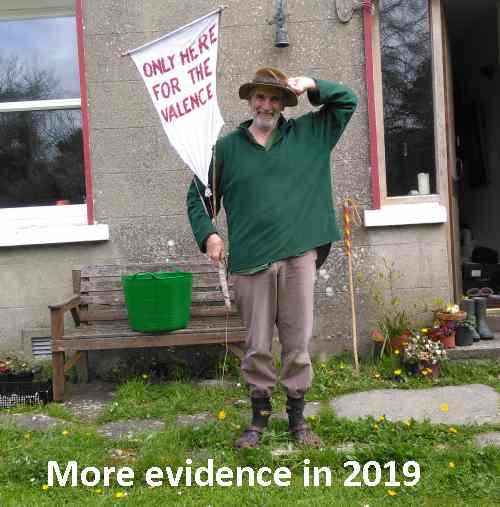
- Finished the teaching term on Friday
- and have no exams set for next week
- made the Christmas cake
- can begin to think about eating it
- Should post Holiday Greetings to TYWKIWDBI
- source of much blobcopy over the years
- Time to reflect on the past.
- Here's me in battle fatigues for the Spring 2017 March for Science
- Better to look to The Future.
- Bring on 2019!
Saturday, 8 December 2018
Christmas 2018 cake
It's not every year we make a Christmas cake, but it's prolly A Good Thing that we have a recipe. Nobody shd be coursing across the interweb or riffling through a dozen cook-books for Other Men's Flours [prev on Montaigne] - all slightly different. Just get yourself a recipe that suits that cake-tin which is in the rarely-used cupboard of your kitchen. Here's mine written, unaccountably in green ink in the mid 1980s:
 Dau.II, aka Cookie, was home for the first weekend in December and that served as a catalyst to make a 2018 Xmas cake. The top right corner of the recipe page has been immersed in a solvent so it is not clear what to soak the dried fruit in: matter-a-damn, though, you're going to use what's available anyway:
 One year we made such a cake in late October and then a neighbour gave us one in the run-up to Christmas. We parked ours in a tin until the following year: it was fine. They say that, like wine and pheasant, fruit cake improves with age.
- Wet things soaked over night:
- 2 lb (900g) dried fruit: this year = (½ sultanas; ¼ glacé cherries; ¼ chopped dried mixed fruit = 30%apricots+30%dates+20%figs+20% pears with added SO2; potassium sorbate; malic acid, citric acid (Alesto from Lidl)
- slug
brandywhiskey + juice of 1 lemon - Dry things
- 8 oz (225g) self-raising flour
- ½ tsp cinnamon
- ½ tsp mixed spice
- pinch nutmeg
- grated zest of lemon
- 3 oz (80g) ground almonds
- 4 oz (110g) flaked almonds
- Fat things
- 8 oz (225g) butter, creamed with
- 6 oz (175g) dark brown sugar beat till fluffy
- 5 large eggs
Friday, 7 December 2018
Local Hero
One of the themes which threads The Blob together is that, in science as everywhere else, women have to work twice as hard to get half as far as their twin brothers. For Science week last month, my first draft of an Eponymous Alphabet was so thin on female scientists as to make them barely visible. That is a reflection of historical certainties that science was an exclusive straight white patriarchy during those times when things were discovered and given names. But also a reflection that I am part of that same patriarchy and only see scientists who have silvery whiskers about their chops. I was brought up all standing and sent back to the drawing-board to make a second draft by those who were younger fitter and XXier. That was decisively more female and more European . . . and a good thing too. As the project manager, I was left, at short notice, with a number of gaps to fill. But early on in the process, I had owned V is for Virus to give credit to Yvonne Barr, a then young Irish post-Graduate student who, with her boss Michael Epstein, isolated Epstein-Barr Virus EBV aka human herpesvirus 4 (HHV-4) in 1963. I've given her a hat-tip in my piece on Denis "Lymphoma" Burkitt. Here's her 50 year retrospective on the discovery. [Forensic videologists will note <green-screen alert> that the "waves" in the background never reach shore]. In researching my snippet on Barr, I found [Wikipedia] that she was born in Ireland in the 1930s:
 Curiosity drove me forward to see if I could discover where in Ireland this doggedly persistent good pair of hands had been born. Accordingly, I went to ancestry.com, and discovered that she was born in Laois/Carlow on 11th March 1932 and that her mother's name was Norris. I'm not going to make a habit of this sort of thing, so I was unwilling to take out a sub to Ancestry.com's full archival database. I was, however, able to justify €4 to get a 'research only' copy of the entry in the Register of Births. Last Monday, I went to the other side of town, coughed up my €4 and got:
 From which I deduce that Yvonne Margaret Barr [F] was born in Pembroke, Carlow Urban District; at home because her father Robert Barr lived at the same address. Her mother Gertrude Eileen's unmarried name was Norris and the birth was reported by AF Slater, present at birth, Tullow St Carlow. I'm guessing he was the local doctor but it's just possible it was the local midwife. Pembroke is just off Burrin Street and about 1km from my office. Tullow Street is a short walk in the opposite direction. I was quite delilah to make this discovery, it was almost as exciting as discovering a new human gene, and I got closure on this project a lot quicker. And I've solved a small dilemma for The Institute's Suits: the new Science Building should surely be named the Yvonne Barr Memorial.
Thursday, 6 December 2018
The Hook: when anecdote trumps data
We've been living on a farrrrm up a rough dirt-track in deepest rural Ireland for more than 20 years. We met our neighbour below before we even bought the place and he seemed helpful and accommodating. He was also within a year of my age and as interested in the outside world as I was in the local microcosm in which we were wedged. For a couple of years we often found time to lean on a gate and chat about home-and-away. Then we fell out; there was a dispute about the land, boundaries, and grazing and he abruptly ceased speaking to us at all - wouldn't even acknowledge us as we passed on the road. It was a bit awkward at times, but he was much more anxious to stoke the feud than me and we all moved on while occupying the same ground. Then, partly through carelessness and possibly by design he caused a huge heap of farm-yard manure [shite to city-folk try the revenge of the angered farrrrmer] to fall across the bottom of the lane, so it got difficult to get traction going up, or even down. It was really annoying and I used to fantasise about filling a trailer by hand and dumping it by night outside his kitchen door. Weeks passed. Then I was talking to another [neutral, obviously] neighbour and I mentioned being worried that Dau.I would have a nocturnal asthmatic crisis like her brother and we'd be unable to get her to hospital. Within 24 hours the problem heap was all tidied away. Within a week, I heard back that, in this locality, feuds were for adults only and not carried on down the generations. Which was as near as I ever got to an apology. I reckon it was the image of a small sick <coff> <coff> child dying because from a surfeit of spitefulness that was too much to bear.
That was last century, this is last month: Dear parents of children who do not have cancer: a casual measles exposure in a grocery store caused the following things to happen when my child was in chemotherapy: a horse-shoe [*] story by Nicole O'Donnell widely disseminated on Twitter in November. We are given to believe that measles is so rare nowadays in America, and the surveillance of US citizens is so comprehensive that the movements of each child with measles can be tracked back for the entire period when the kid was contagious but not symptomatic. That Big Data can be cross-reference with all the immunocompromised people for whom a touch of measles might be fatally devastating. That would be a) all the adults with HIV-AIDS who are on anti-retroviral therapy to stay upright and walking in the community or b) people under-going chemotherapy or radiotherapy because of cancer.
[*] a story with cascading consequences . . . for want of a nail, the shoe was lost; for want of a shoe, the horse was lost; for want of a horse, the king was lost; for want of a king, the land was lost; all for want of a nail.
Encourage any anti-vaxxers to read the fall-out of that contact between two children: one unvaccinated and coughing measles virus about her as a miasma and another innocent who must avoid viruses of all sorts until her cancer is in remission. It's not just about the hazards gambled upon by the parents of the unvaccinated child; it's not even just that one cancer-girl; it's all the kids who funnel through the Oncology clinic that week. That story, not really data-driven, a mere anecdote, is going to be a much more powerful vehicle for change than all the epidemiological data in the world. Data is just numbers, often big numbers, which few of us are equipped to process. Indeed, I suspect that as many anti-vaxxers are embedded in their certainties as immunologists are wedded to theirs. If we attempt to snow them with numbers, they may just set their teeth fold their arms, call conspiracy or sell-out to big Pharma and settle back to their prior beliefs. A small child with cancer is an image. If epidemiologists and virologists want to win hearts-and-minds, they may ironically have to dump the science and appeal to the emotions.
That was last century, this is last month: Dear parents of children who do not have cancer: a casual measles exposure in a grocery store caused the following things to happen when my child was in chemotherapy: a horse-shoe [*] story by Nicole O'Donnell widely disseminated on Twitter in November. We are given to believe that measles is so rare nowadays in America, and the surveillance of US citizens is so comprehensive that the movements of each child with measles can be tracked back for the entire period when the kid was contagious but not symptomatic. That Big Data can be cross-reference with all the immunocompromised people for whom a touch of measles might be fatally devastating. That would be a) all the adults with HIV-AIDS who are on anti-retroviral therapy to stay upright and walking in the community or b) people under-going chemotherapy or radiotherapy because of cancer.
[*] a story with cascading consequences . . . for want of a nail, the shoe was lost; for want of a shoe, the horse was lost; for want of a horse, the king was lost; for want of a king, the land was lost; all for want of a nail.
Encourage any anti-vaxxers to read the fall-out of that contact between two children: one unvaccinated and coughing measles virus about her as a miasma and another innocent who must avoid viruses of all sorts until her cancer is in remission. It's not just about the hazards gambled upon by the parents of the unvaccinated child; it's not even just that one cancer-girl; it's all the kids who funnel through the Oncology clinic that week. That story, not really data-driven, a mere anecdote, is going to be a much more powerful vehicle for change than all the epidemiological data in the world. Data is just numbers, often big numbers, which few of us are equipped to process. Indeed, I suspect that as many anti-vaxxers are embedded in their certainties as immunologists are wedded to theirs. If we attempt to snow them with numbers, they may just set their teeth fold their arms, call conspiracy or sell-out to big Pharma and settle back to their prior beliefs. A small child with cancer is an image. If epidemiologists and virologists want to win hearts-and-minds, they may ironically have to dump the science and appeal to the emotions.
Subscribe to:
Posts (Atom)