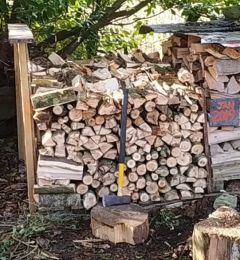
This above is moh2o's cord of firewood, three different species in a well-built self-supporting pile. Well, I've finished Lars Mytting's Norwegian Wood and I feel like a failure. I wrote in the New Year about reading an early paragraph and rushing out to split some wood. I have a dreadful feeling that I was waaay too late. What I have failed to grasp is the separation of two stages in the life of fire-wood: a) drying and b) storage. It is much better if your get the wood dried down quickly to <20% moisture in a process of evaporation before the wood succumbs to the necrosis of fungal infection. Even invisible fungi can block the water-filled tubes of the wood, so that water cannot easily escape.
One of the last things Tadek, our wooffing Pole, did during his second winter with us was thin out a dense dark stand of laurel Prunus laurocerasus, which was sharing the bottom of our yard with the 6 tree apple orchard. The apples were probably heirloom species but were almost useless to us because the fruit was +5m up in the air at the end of wispy twigs. There was nothing near against which to lean a ladder. The reason for this was that the laurel and apple trees had been fighting for the light. It was so dark in the orchard that no grass grew. Tadek went mad with the chain-saw and cut down a LOT of laurel and then cut it into lengths about 30 cm long, and then returned to Poland. I started to stack the small-enough logs into a pile at the edge of the orchard. The bigger pieces, which were easy to split, I split. Then my competent friend René came up and said my pile would be at nothing unless I raised it off the dirt floor. So I threw down what I'd started, found a number of beat-up pallets and, with the help of a 12 y.o. Dau.II, stacked them all up again so that they were clear of the worms. It filled out at 1m x 1m x 5m and I covered the top with election posters weighted down with the gnarly unsplittable lumps. I opened one end of the stack last winter and am working through the rest now.
Stacking the wood in situ was a good idea because it meant less barrowing the stuff about, but tucked in a corner of the orchard; up against the dry-stone wall; covered with plastic was not exactly encouraging of water loss. It would have been better to stack them more openly where the sun and especially the Summer wind could whistle through to carry away the moisture THEN after a significant weight loss move t'buggers somewhere dry and convenient to the stove. It's been the same with all my other wood stacks around the farm: too dark; not enough air-circulation. And especially, I have failed mea culpa mea maxima culpa to strip off the bark from the unsplit logs to expose more water-loss area. The bark is, by design, waterproof - if it wasn't trees would weep bitter tears down their trunks.
Lars Mytting and his compatriots actively go out into wood-lots and cut down trees - huge debate about the optimum time for felling. Or they get firewood delivered by authorized dealers - who guarantee them as less than a maximum moisture content. They get to choose their species and to some extent the individual tree (nice and straight, please, minimal knots]. We on the other hand have been able to rely / subsist on what has fallen out of the ditches (usually rowan / mountain ash Sorbus aucuparia) or come crashing down from the crown (ash - Fraxinus excelsior & Scot's pine Pinus sylvetsris). This bounty tends to become available during winter storms and I try to cut them up there, then. When the fields are dry in the summer is the time to load up the Yaris and bring them to the yard. Since we had Young Bolivar working with us, we've had a nice airy wood-shed with hit-and-miss walls and a well-high roof but I should nevertheless dry the wood first in the breeze.
You should check out "artistic woodstacks" on Google Images: despite firewood being essentially ephemeral, some people prefer to make something beautiful as well as functional. "Have nothing in your houses that you do not know to be useful, or believe to be beautiful" Wm Morris.
Showing posts sorted by relevance for query tadek. Sort by date Show all posts
Showing posts sorted by relevance for query tadek. Sort by date Show all posts
Friday, 5 January 2018

Friday, 8 April 2022
ласкаво просимо до Ірландії
Transliterated: laskavo prosymo do Irlandiyi or, being translated, Welcome to Ireland !
Back at the birth of The Blob, I was bemused and tickled that a large chunk of my readership seemed to have Ukrainian IP numbers. I had some harmless fun with myself greeting them specifically and making inclusive jokes about Europe and the Viking Kingdom of Kiev. These japes were met with the deafening silence they deserved. But I did wonder if Blogger's measuring robots needed adjustment - perhaps confusing Kiev with Killarney. And that sent me down a rabbit hole of superficial "research" about this almost mythical country at the other end of Europe.
It might be time to reprise my 2013 UkrEire post which riffed on a vague shape-similarity by twinning Irish counties [N = 26] with Ukrainian Oblasts [N = 25] - ya couldn't make this up. The executive summary is this handy map for pairing the administrative districts:

As our tea-time guests came into the yard, I launched into " ласкаво просимо до Ірландії " at which one of them teared up. Quite emotional these Easterners. Indeed, Easterner is true because this family escaped from Суми = Sumy which is East of the R Dnieper (and only 50km from the border with Russia). Strictly, according to my realpolitik twinning scheme [above], coming from Суми, they should be in Kildare not Carlow but there is already a place in our hearts for them in the valley.
Thursday, 25 June 2015
How to milk a cow.
Several years ago, just before the Celtic Tiger rolled over and died, we had a Polak to stay for six weeks in the middle of Winter. He came from the far North East up near the Lithuanian border. Tadek was even older than me and his farmlet was smaller than ours but he was a good deal more productive . . . except in the Winter when the permafrost precluded pretty much all out-door work. Coming to work with/for us in milder Ireland was better than sitting inside at home eating pork-fat and slugging down the wódka. We paid him a trifle over the minimum wage and he took home more actual folding money than he'd earn in the rest of the year from his hectare of strawberries. The following Summer I went, at his earnest request, to visit with his family. It was interesting. They were cash-poor but close to self-sufficient for food. Every day, twice a day, Pani Tadek would go out into the field with two buckets: one to sit on and one to milk the cow into. It was a protocol familiar to many rural families in Ireland up until they joined the EEC in 1973. There were no economies of scale but the milk was good and you knew where it had been. You also knew your cow(s) intimately. A couple of weeks ago, I was talking to a dairying neighbour, and he said I could have a a few litres of milk at the price he got from Megacorp = 28c/lt just about 1/3 of what we pay in the shops. Eating your own produce has leverage.
 Yesterday I went to deepest South Kilkenny to see the future. The owner, in Owning, of a Lely Astronaut A4 robotic milking machine was having an open day demonstration. You don't need to get your cheek up against the flank of your cows any more. You don't need to get up at 0500hrs either. You train your cows - takes from two days to two weeks - to form an orderly queue and amble into the machine's crush. The front part has a trough with a taste of feed. The other end has all the mad-robot machinery that you'd expect: little rotary brushes like in a car-wash to clean the udder, which is fairly likely to have been lying in a cow pat at some stage during the previous 12 hours and steam cleaners for the milking machinery. You can watch the udder being played over by a criss-cross of lasers such as you might get in a shop's bar code-reader in order to get a 3-D image of the teat locations. Then one by one the teat-cups orientate correctly >!whirr crrrk!< and engage each teat in turn >!ferloop!< and the machine starts to suck. When the milk is stripped from the udder, the pump switches off, the teat-cups release and get steam cleaned, the front gates of the crush slap open and Daisy walks out and back to the field for more grass. The robot knows it's Daisy (or more likely A0245-01723) because she has a transponder on her collar. She can't leave the shed through the electronic doors for fresh grass unless she has been recently milked.
There is a dairy-man, but he doesn't get chapped hands or cowpox. His tool kit is more for cleaning the lines if they get blocked and cleaning the optical sensors so they read correctly and phoning the company when the machine goes wrong. This scales up. Once the computer knows which cow is in the A4, it can respond to the individual cow and to each quarter of her udder. It's normal for the rear quarters to milk slower and less than the front quarters, and if the rear-left has been giving little over the previous seven milkings, that tells the machine to go easy there. Each of the four lines stops at what it senses is the right time. In the past you had to attach the milking device by hand but it would drop off at the end of the process . . . but drop off all together even though one teat might still be giving and another might be raw from dry-sucking.
If the cows are allowed to choose when to get milked they don't go twice a day anymore, they go, on average 2.5x - 3x a day. This means that the milk is left at blood temperature for a shorter period and so potential mastitis pathogens like Staphylococcus aureus get flushed out before they can get a grip and so the somatic cell count SCC is lower. If the SCC (mainly white blood cells for fighting infection) is above a certain threshold, the milk will get rejected by the creamery as not fit for purpose. But there are indications that SCC is in fact higher in automatic milking systems perhaps because continual use doesn't allow the milking lines to be really thoroughly cleaned as they used to be after the morning and evening milking sessions. A lot of other milk qualities are measured in-flow & on-site: temperature, conductivity and colour for starters; and these, theoretically at least, allow some milk [colostrum, high SCC etc.] to be diverted from the bulk cold storage vessel. They also allow, theoretically at least, some diagnostics to be done on the herd - who is getting mastitis, who is yielding the most.
There are questions
Q1. Why do cows have four teats when they generally give birth to a single calf?
Q2. If let alone, will a cow settle into a routine to be milked at the same time each day?
Q3. Will those preferred milking times be scattered through 24 hours or are there peaks driven by, say, the hormone melatonin which has a daily cycle in concentration.
And the economics: statistics for Ireland 2014:
Cows: 1.14million
Dairy farmers: 17,000
Average herd size: 60 cows
Milk yield per cow 5,000 litres
Payment: 28c/lt
Gross payment: 60 x 5000 x 0.28 = €84,000
From the promotional material that was available yesterday it seems that a Lely A4 can had for €45/day or €16,000+ /year. That's a chunk off the bottom line before even the electricity is switched on. Clearly it looks more profitable if your herd is bigger: the A4 and the shed to hold it is a fixed cost. But you can't have an infinitely big herd because it takes 5 minutes for a cow to release all its milk. If this is happening 3 times each cow is occupying the milking machine for 15min each day which says that the capacity for the machine is a little under 100 cows if they spread their occupancy evenly though the day.
Final question. If we are driving the dairy industry forward talking about efficiency, what are we keeping cows for at all at all? Wouldn't it be better for the planet if we grew wheat and maize and lentils and ate them direct instead of feeding all those good things to cows for milk which the Chinese government doesn't want any more. The PRC has just introduced a breast-feeding directive to all their mothers which threatens to collapse the global market in powdered milk.
There is a dairy-man, but he doesn't get chapped hands or cowpox. His tool kit is more for cleaning the lines if they get blocked and cleaning the optical sensors so they read correctly and phoning the company when the machine goes wrong. This scales up. Once the computer knows which cow is in the A4, it can respond to the individual cow and to each quarter of her udder. It's normal for the rear quarters to milk slower and less than the front quarters, and if the rear-left has been giving little over the previous seven milkings, that tells the machine to go easy there. Each of the four lines stops at what it senses is the right time. In the past you had to attach the milking device by hand but it would drop off at the end of the process . . . but drop off all together even though one teat might still be giving and another might be raw from dry-sucking.
If the cows are allowed to choose when to get milked they don't go twice a day anymore, they go, on average 2.5x - 3x a day. This means that the milk is left at blood temperature for a shorter period and so potential mastitis pathogens like Staphylococcus aureus get flushed out before they can get a grip and so the somatic cell count SCC is lower. If the SCC (mainly white blood cells for fighting infection) is above a certain threshold, the milk will get rejected by the creamery as not fit for purpose. But there are indications that SCC is in fact higher in automatic milking systems perhaps because continual use doesn't allow the milking lines to be really thoroughly cleaned as they used to be after the morning and evening milking sessions. A lot of other milk qualities are measured in-flow & on-site: temperature, conductivity and colour for starters; and these, theoretically at least, allow some milk [colostrum, high SCC etc.] to be diverted from the bulk cold storage vessel. They also allow, theoretically at least, some diagnostics to be done on the herd - who is getting mastitis, who is yielding the most.
There are questions
Q1. Why do cows have four teats when they generally give birth to a single calf?
Q2. If let alone, will a cow settle into a routine to be milked at the same time each day?
Q3. Will those preferred milking times be scattered through 24 hours or are there peaks driven by, say, the hormone melatonin which has a daily cycle in concentration.
And the economics: statistics for Ireland 2014:
Cows: 1.14million
Dairy farmers: 17,000
Average herd size: 60 cows
Milk yield per cow 5,000 litres
Payment: 28c/lt
Gross payment: 60 x 5000 x 0.28 = €84,000
From the promotional material that was available yesterday it seems that a Lely A4 can had for €45/day or €16,000+ /year. That's a chunk off the bottom line before even the electricity is switched on. Clearly it looks more profitable if your herd is bigger: the A4 and the shed to hold it is a fixed cost. But you can't have an infinitely big herd because it takes 5 minutes for a cow to release all its milk. If this is happening 3 times each cow is occupying the milking machine for 15min each day which says that the capacity for the machine is a little under 100 cows if they spread their occupancy evenly though the day.
Final question. If we are driving the dairy industry forward talking about efficiency, what are we keeping cows for at all at all? Wouldn't it be better for the planet if we grew wheat and maize and lentils and ate them direct instead of feeding all those good things to cows for milk which the Chinese government doesn't want any more. The PRC has just introduced a breast-feeding directive to all their mothers which threatens to collapse the global market in powdered milk.
Wednesday, 2 March 2022
Sturm und drang
Did I mention that Storm Eunice delivered a source of firewood 12 days ago? I did. It took all of the following week to put manners on the mess, so I could see the wood for the trees, rocks; branches-under-tension; branches under compression; wire fences and the other manifold hazards of chain-saw land. I've delivered so many ivy branches to to the sheep that they stopped eating the stuff. It may not be toxic but it could sure get boring, I guess.
Tuesday St David's day, I clocked our first flowering daffodils [much later than those of the flatlands NWES of here] in passing. Then I loaded my current audio book and finished loading the ash into its stack. The final tally [see L] is 2/5ths of a cord = 1.4 stere [see how to measure firewood] ignoring the trunk which has a volume of about 0.75 cu.m. solid or another ~1 stere stacked - because cordwood is about 25-35% air-space. In addition, I salvaged about 10 cu ft = 0.25 cu.m. of laurel logs and loglettes. These are chock full o' prussic acid HCN and need a hella long time to dry out before burning. The last holocaust of laurel went up the chimney a full 12 years after being cut in 2008 by Tadek the Polish wwoofer [multibloboprevs]. To speed up the process I have, after several sleepless nights, contrived a cunning [patent pending] wall-rack just one log thick and oriented at right angles to the prevailing Westerly wind. Breeze is at least as important as temperature for drying logs.
At the far end of Europe, a little beyond Tadek's homeplace, while I was dragging around the aftermath of Sturm Eunice, the Russians decided to up the sturm und drang ante on neighbouring Ukraine. Ireland has not been slow about ethnic cleansing in my lifetime if you can credit that two people called McGuinness and sporting a similar shock of red hair could treat each other as, like, Other . . . and then decide to burn down their houses and spit on their infant-school children. Still, it's nothing like Breslau or Srebrenica. I am sure you have made up your mind about Ukraine, Russia, The Great Patriotic War and the breakup of the USSR. Not me. But I am surely fed up with Othering especially if it is weaponized by violent patriots and mendacious rhetoric. Dau.II realises more than most of us that a lot of the world's ills could be solved with some decent home-cooking and a cup of tea. She didn't need to push very hard for me to join her in sending some money to WCK World Central Kitchen which has become a little like MSF Médecins Sans Frontières except with soup not tourniquets. Here they are serving food just across the Polish border:
Thursday, 28 September 2017
Whacaccino
Doctor doctor I get a pain in my eye every time I drink tea.
Have you tried taking the spoon out?
I was remind of this watching this instructional video for making the latest elixir to appear in our beverage closet. Cripes, how difficult can it be to spoon a dark powder into a cup and add water that it needs a video?
Me I'm a simple chap, because of the culture in which I grew up, Like George Orwell, I like a nice cup of tea [R credits]. When I was a teenager, and knew no better, I would put a spoonful of loose tea into a cup, stir, add sugar and milk, drink it down hot-and-strong. Often enough, on a no-waste jag, I'd scoop out the soggy tea-leaves and eat them too: rrrrroughage! Now, however, . . .
On Saturday, at home, if it's going, I'll have a cappuccino. This caused much amusement to our Polish friend Tadek when he spent the Winter with us in 2006 & 2007 "Hej Bobek, soboda, kawa har har har".
Every so often, coffee and milk will go off menu and replaced with various substitutes. I don't feel happy with the term chamomile or rooibos tea, because I'm with Wikipedia: "Tea is an aromatic beverage commonly prepared by pouring hot or boiling water over cured leaves of the Camellia sinensis, an evergreen shrub native to Asia" Likewise, I deprecate chemical emulsions like Oat Milk; Soya Milk; and Almond Milk. And I certainly don't drink them: far too complex. Compare:
 Here's the breakdown Macaccino amino acids which is interesting because it seems that none of the three species in the mix has detectable quantities of cysteine one of the 20 amino acids that are found in all proteins. It also rings true that there is no asparagine [Asn, N] or glutamine [Gln, Q] in the report, that's because all these amides get broken down in the process of protein hydrolysis: so Asn becomes aspartic acid [Asp, D] while Gln becomes glutamic acid [Glu, Q]. And the proportional concentrations of amino acids in macaccino look normal enough compared [see chart R] to the ratios found in UniProt the protein sequence database, A bit more arginine and glutamate/glutamine than average expectations and a little less proline, threonine and alanine. I cannot believe that anyone, however deluded, would consume Macaccino for its protein content. I'm surprised that the Macaccino marketeers haven't checked out my graph because Glu = glutamic acid is a natural human neurotransmitter and Macacccino is loaded with the stuff.
I'm guessing its benefits, if any, are no better than placebo. No worse than tea, indeed, but considerably more expensive. Remember Michael Pollan's advice for food "Eat food; not too much; mostly plants"? Here's Bob on beverage "Keep it simple, stupid"
Have you tried taking the spoon out?
I was remind of this watching this instructional video for making the latest elixir to appear in our beverage closet. Cripes, how difficult can it be to spoon a dark powder into a cup and add water that it needs a video?
Me I'm a simple chap, because of the culture in which I grew up, Like George Orwell, I like a nice cup of tea [R credits]. When I was a teenager, and knew no better, I would put a spoonful of loose tea into a cup, stir, add sugar and milk, drink it down hot-and-strong. Often enough, on a no-waste jag, I'd scoop out the soggy tea-leaves and eat them too: rrrrroughage! Now, however, . . .
The sixth age shifts
Into the lean and slippered pantaloon,
With spectacles on nose and pouch on side;
His youthful hose, well saved, a world too wide
For his shrunk shank; and his big manly voice,
Turning again toward childish treble, pipes
And whistles in his sound.
. . . I drink my tea so weak that making a pot is more like making mystical passes over the water than infusing anything. I don't do Infusions - chamomile; fennel; bedtime; rooibos; wuggawugga root; lemongrass; honeybush - I know enough about the diverse pharmacopoeia of secondary compounds that plants produce to deter herbivores. I won't trouble to give you the Latin names of these ingredients because I don't believe the package contains, to sufficient purity, what the label asserts.On Saturday, at home, if it's going, I'll have a cappuccino. This caused much amusement to our Polish friend Tadek when he spent the Winter with us in 2006 & 2007 "Hej Bobek, soboda, kawa har har har".
Every so often, coffee and milk will go off menu and replaced with various substitutes. I don't feel happy with the term chamomile or rooibos tea, because I'm with Wikipedia: "Tea is an aromatic beverage commonly prepared by pouring hot or boiling water over cured leaves of the Camellia sinensis, an evergreen shrub native to Asia" Likewise, I deprecate chemical emulsions like Oat Milk; Soya Milk; and Almond Milk. And I certainly don't drink them: far too complex. Compare:
- Soymilk
- Filtered Water, Whole Soybeans, Cane Sugar, Sea Salt, Carrageenan, Natural Flavor, Calcium Carbonate, Vitamin A Palmitate, Vitamin D2, Riboflavin (B2), Vitamin B12
- Milk
- Milk
- Carob is the seed of the tree Ceratonia siliqua, the seeds grow in long drooping pods that betray its membership of Order Fabales, the legumes: beans, peas and the locust tree.
- Maca comes from the roots of Lepidium meyenii a member of Order Brassicales which includes turnip, cabbage, mustard, capers and nasturtium.
- Lucuma derives from the fruits of Pouteria lucuma a tree that grows in Andean valleys. It is in the same Order Ericales as tea, blueberry, persimmon, kiwi fruit and cranberry.
- alkaloids [would that be atropine, caffeine, cocaine, psilocine? all of which are alkaloids],
- ecdysone [an insect developmental hormone],
- saponins [used as fish poisons and include solanine from deadly nightshade],
- tannins [in wine and tea, sure, but tannins also denature animal skins to leather]

I'm guessing its benefits, if any, are no better than placebo. No worse than tea, indeed, but considerably more expensive. Remember Michael Pollan's advice for food "Eat food; not too much; mostly plants"? Here's Bob on beverage "Keep it simple, stupid"
Thursday, 26 May 2016
It's a Javi problem
Jakers! you'd think our eSpanish was better: we've had a lot of opportunity to practice it. Currently we have Bolivar, a wwoofer from Venezuela, staying with us for the Spring/Summer. Two years ago it was O'Manch' a young chap from La Mancha who could prune vines and play the piano. The first instar was Javier, from suburban Madrid, who spent nearly a year with us in the mid 1990s. We haven't been exclusively espagnolophile: for a couple of Winters we hosted Tadek a self-sufficient strawberry farmer from NE Poland.
Mais revenons a nos Javis. He was living with us to help with the children and the logistics of running the farm; in return he was clocking up social welfare credits back home in Spain which he could parlay into a year's unemployment benefit when he returned . . . and getting help with his English. Every Saturday morning when I returned from a working week in Dublin, he was hopping from one foot to the other to do blokey things with me rather than doing Lego with two small girls. One such day, early in our relationship, I suggested that he clear out the drain than runs beside the lane which bisects our property. This task is important because a clogged drain will fail to carry water, which will spill out into the roadway and sweep it all to buggery. I know: it's happened to us twice in the last 20 years. Javi's response was an incredulous "But Bob, that is one hundred metres!" . . . of head-high brambles, small saplings, enormous rocks and invisible quantities of other problems. Not being one to ask something that I was unwilling to undertake myself, I replied "Okay, Javi, let's do it together. We'll start at the bottom and see how far we get.".
40 minutes later, we had not only cleared the drain with slash-hook and sprong, rake and secateurs, but we had piled the mountain of brash onto a large plastic sheet and dragged it down to the haggard for burning. Five minutes after that we were settling down to a nice, and well-deserved, cup of tea. Seemingly insurmountable problems that yield to solution if you start pecking away at them somewhere became known in our family as Javi Problems. Not so difficult in the execution as anxiety makes them feel when you fail to grasp the nettle. We both learned something that day.
Javi's other problem was that he lacked any personal space, he had a bedroom but the girls were still quite likely to be roaring in the night and would occasionally wake him up, far too early, to finish last-night's Lego project. We had cleared out one of the ruined granite sheds to live in while the house itself was being stripped to its bare-bones and essential services / luxuries installed like running water; a front door that kept out mice; electrical sockets in all rooms; under-floor heating and windows that you could see through. In order to live in the shed we had created a timber box inside the granite shell and dry-lined it with sheet-rock [walls and ceiling] and tongue&groove pine boards [floor]. That plan was roughly shaken when we were evicted from our home in Dublin before the house on the farrrm was finished. So the shed was filled with furniture and boxes & boxes & boxes of accumulated possessions. Javi knew we had all the necessities for comfortable life in the house - he was sharing them on a daily basis. The material in the shed must, he reasoned, be surplus to requirements; not least because it had not been used for nearly two years.
One Friday at dinner, he tentatively raised the idea that IF we sorted through the clutter in the shed THEN he could shift his much smaller parcel of stuff and himself into the vacated space. We were willing, the next day was sunny and we sorted through 40 cu.m. of material before tea-time. The nicer furniture was shifted to the local auction-room where it was converted into cash. The much-loved but moth-eaten, wretched, touch-only-with-rubber-gloves sofa was put on top of a pile of empty card-board boxes and burned. We didn't know about carbon-footprint in those far-off simple days. It was a wrench, but Javi's Socratic method worked "This sofa: are you ever going to sit on it again? You have a nice sofa from Habitat in your living room, which is too small to accommodate two sofas. Can you imagine anyone buying such a sofa? [apart from us, by implication] Shall we just burn it?". Javi won his own place, which was for years know as Casa Javi, now simply The Casa, because it has housed a number of other inhabitants. But it lightened the load on our souls by the mammoth decluttering that he instigated.
Mais revenons a nos Javis. He was living with us to help with the children and the logistics of running the farm; in return he was clocking up social welfare credits back home in Spain which he could parlay into a year's unemployment benefit when he returned . . . and getting help with his English. Every Saturday morning when I returned from a working week in Dublin, he was hopping from one foot to the other to do blokey things with me rather than doing Lego with two small girls. One such day, early in our relationship, I suggested that he clear out the drain than runs beside the lane which bisects our property. This task is important because a clogged drain will fail to carry water, which will spill out into the roadway and sweep it all to buggery. I know: it's happened to us twice in the last 20 years. Javi's response was an incredulous "But Bob, that is one hundred metres!" . . . of head-high brambles, small saplings, enormous rocks and invisible quantities of other problems. Not being one to ask something that I was unwilling to undertake myself, I replied "Okay, Javi, let's do it together. We'll start at the bottom and see how far we get.".
40 minutes later, we had not only cleared the drain with slash-hook and sprong, rake and secateurs, but we had piled the mountain of brash onto a large plastic sheet and dragged it down to the haggard for burning. Five minutes after that we were settling down to a nice, and well-deserved, cup of tea. Seemingly insurmountable problems that yield to solution if you start pecking away at them somewhere became known in our family as Javi Problems. Not so difficult in the execution as anxiety makes them feel when you fail to grasp the nettle. We both learned something that day.
Javi's other problem was that he lacked any personal space, he had a bedroom but the girls were still quite likely to be roaring in the night and would occasionally wake him up, far too early, to finish last-night's Lego project. We had cleared out one of the ruined granite sheds to live in while the house itself was being stripped to its bare-bones and essential services / luxuries installed like running water; a front door that kept out mice; electrical sockets in all rooms; under-floor heating and windows that you could see through. In order to live in the shed we had created a timber box inside the granite shell and dry-lined it with sheet-rock [walls and ceiling] and tongue&groove pine boards [floor]. That plan was roughly shaken when we were evicted from our home in Dublin before the house on the farrrm was finished. So the shed was filled with furniture and boxes & boxes & boxes of accumulated possessions. Javi knew we had all the necessities for comfortable life in the house - he was sharing them on a daily basis. The material in the shed must, he reasoned, be surplus to requirements; not least because it had not been used for nearly two years.
One Friday at dinner, he tentatively raised the idea that IF we sorted through the clutter in the shed THEN he could shift his much smaller parcel of stuff and himself into the vacated space. We were willing, the next day was sunny and we sorted through 40 cu.m. of material before tea-time. The nicer furniture was shifted to the local auction-room where it was converted into cash. The much-loved but moth-eaten, wretched, touch-only-with-rubber-gloves sofa was put on top of a pile of empty card-board boxes and burned. We didn't know about carbon-footprint in those far-off simple days. It was a wrench, but Javi's Socratic method worked "This sofa: are you ever going to sit on it again? You have a nice sofa from Habitat in your living room, which is too small to accommodate two sofas. Can you imagine anyone buying such a sofa? [apart from us, by implication] Shall we just burn it?". Javi won his own place, which was for years know as Casa Javi, now simply The Casa, because it has housed a number of other inhabitants. But it lightened the load on our souls by the mammoth decluttering that he instigated.
Friday, 29 November 2019
Running the rails

One reason for a sense of empathy was that years ago I did some exploration of railway heritage which, looking back, was demonstrably reckless and ill-considered. At the time, of course, it seemed a bit of a jape in the sense of Five Down a Sardine Sandwich rather than One Goes Down a Tunnel . . . without a torch, PPE, or letting anyone known about the plan. The difference between 15 and 65 is 50 years and the development of functional imagination to replace a sense of immortality. In the very earliest days of railway mania, some entrepreneurs surveyed a built a 6 mile = 10 km branch railway line from the city of Canterbury to the seaside resort of Whitstable in SE England. Opened in 1826, C&WR [soon to be nicknamed the Crab & Winkle Line] predated the Liverpool and Manchester Railway but was initially operated by horses and pulleys because the gradients were too steep for the feeble steam locomotives of the time. One of the insuperable gradients was Tyler Hill, but the 19thC engineers solved this problem by driving a tunnel through the hill that was nearly half a mile = 700 m long. The railway chuntered along for 100 years until the passenger service was closed in 1931, while freights ceased to be economic in 1953.

In 1974, the tunnel collapsed, more or less where I had tripped over the pile of bricks, and part of the Cornwallis Building of the University of Kent at Canterbury was destroyed in a dramatic subsidence event. When I grew some sense (it comes with imagining your own children coming to harm) I reflected on what a dip-shit I was as a teenager. If I'd tonked my head in the tunnel, it would have been a long time before anyone found my recumbent body and likely the rats would have gotten there first. The Tyler Hill Tunnel, what's left of it, is a listed building. In retrospect my tunnel experience was nothing on the adventures of Buttercup the cow.
I didn't learn much, really. In 2008, I went to spend a week with my pal Tadek in NE Poland up near the Lithuanian border. Indeed we went on a mushroom hunting trip and looked down on the armed guards manning the nearest border post. At one point on the road-trip we paused in a lay-by very close to a concrete WWII pill-box and I went up a dirty embankment to explore. About 3m in, before my eyes had acclimated to the dark, I pitched into a huge hole in the passage floor that was filled with a variety of tinnies and other detritus. When I emerged nursing my bruises and scrapes, my 'friends' explained that, when in active use, that hole was a man-stopping feature optionally covered with a wooden draw-bridge. They hadn't thought to stop me from entering the bunker, though.
Sunday, 8 October 2017
Whacaccino go again
[You're getting this because of a weird blogspot glitch. I wrote an earlier version of this piece but when I pressed the [publish] button the thing disappeared from 'drafts' but failed to appear on the website. So I sat down to recreate the post while it was still fresh in my 'memory'. An hour and a half later, I recd an e-mail from one of the handful of folks who get Blobs delivered, at their request, by e-mail a) saying thanks and b) attaching the whole text of the lost ms. Turns out that the recreated rewrite was pretty close [see alignment at bottom]. So apologies if you've seen something very similar to this before. Further investigation showed that the post, launched on 7th October was somehow published with a date of 28th September; probably because I messed up on 'scheduling']
Mais revenons a nos breuvages!
What do you call a dentist who doesn't like tea?
Denis.
Why do Communists only drink infusions?
Because proper tea is theft.
I've been having a fare amount of tea anxiety recently. Me, like George Orwell, I'm a simple chap, and because of the culture in which I was brought up, I like a nice cup of tea [R source] When I was young and full of vim, I made tea by spooning leaves into a mug and brewing the stuff hot and strong. When the restoring cuppa was finished, I'd often spoon out the soggy tea-leaves and eat them too - rrrrroughage! Now, however . . .
The sixth age shifts
Into the lean and slippered pantaloon,
With spectacles on nose and pouch on side;
His youthful hose, well saved, a world too wide
For his shrunk shank; and his big manly voice,
Turning again toward childish treble, pipes
And whistles in his sound
. . . I make my tea weak. So weak indeed that it is more like making mystical passes with a tea-bag over the cup than actually brewing tea.
I have no time at all for 'infusions' of chamomile, rooibos, ginger&goatsblood, bedtime, woowah-lift, fennel. These are not tea. I am with Wikipedia for the definition: Tea is an aromatic beverage commonly prepared by pouring hot or boiling water over cured leaves of the Camellia sinensis, an evergreen shrub native to Asia. I'd even make a, not really strongly argued, case that these infusions are potentially hazardous because, while tea and coffee have been extensively investigated by biochemists and medical science, we know much less about the chemical contents of random herbs and bushes that you find behind the potting shed. While I'm moaning about misnamed beverages, I'll have a swipe at almond, soya, oat milk. I'm sorry but these are not milk any more than chamomile is tea. What evolution has developed as a miracle elixir for raising mammal-pups, the food engineer has to imitate with chemistical emulsion. Compare:
Occasionally, coffee will be off-menu and the current replacement is Macaccino which is a combination of three completely different plant-products:
But we haven't time to be drinking hot beverages all morning when there are data to analyse. Aaron has employed some real biochemists to digest the proteins in his cocktail to their component amino acids and reports their concentration in mg/10g powder. This is has the ring of truth because two of the twenty protein-constituent amino acids are missing. The amides Asparagine Asn N and Glutamine Gln Q aren't in the list because when you do a proteolytic digestion you destroy the amide bonds as well as the peptide bonds and convert these amides to their equivalent acid: Aspartic acid Asp D and Glutamic acid Glu E. I give the three-letter and 1-letter abbreviations [prev] in all cases. What's troubling is that Cysteine Cys C is nowhere to be found in Macaccino. That cannot to be true and must be a piece of slack-bob editting. Elsewhere on the site, an infographic of the benefits of particular amino acids appears. Cysteine appears there <whoop whoop internal inconsistency alert>; but Serine Ser S is missing and they've invented a 21st amino acid called maganese. Thinking from those errors and inconsistencies that the whole list of ingredients might be a bill-of-goods,, I compared the relative concentrations to the proportions found in UniProt the database of protein sequences. The graph of that analysis [R], show that the proportions are 'within the normal range' and that Arginine and Glutamic acid are higher in Macaccino than you might expect. As well as being an essential component of all proteins, Glutamic acid, serves us as a neurotransmitter. If the marketeers at Macaccino were scientifically literate <harrumph!> they might seize this information and add it to the miracle-grow benefits of their product.
Mais revenons a nos breuvages!
What do you call a dentist who doesn't like tea?
Denis.
Why do Communists only drink infusions?
Because proper tea is theft.
I've been having a fare amount of tea anxiety recently. Me, like George Orwell, I'm a simple chap, and because of the culture in which I was brought up, I like a nice cup of tea [R source] When I was young and full of vim, I made tea by spooning leaves into a mug and brewing the stuff hot and strong. When the restoring cuppa was finished, I'd often spoon out the soggy tea-leaves and eat them too - rrrrroughage! Now, however . . .
The sixth age shifts
Into the lean and slippered pantaloon,
With spectacles on nose and pouch on side;
His youthful hose, well saved, a world too wide
For his shrunk shank; and his big manly voice,
Turning again toward childish treble, pipes
And whistles in his sound
. . . I make my tea weak. So weak indeed that it is more like making mystical passes with a tea-bag over the cup than actually brewing tea.
I have no time at all for 'infusions' of chamomile, rooibos, ginger&goatsblood, bedtime, woowah-lift, fennel. These are not tea. I am with Wikipedia for the definition: Tea is an aromatic beverage commonly prepared by pouring hot or boiling water over cured leaves of the Camellia sinensis, an evergreen shrub native to Asia. I'd even make a, not really strongly argued, case that these infusions are potentially hazardous because, while tea and coffee have been extensively investigated by biochemists and medical science, we know much less about the chemical contents of random herbs and bushes that you find behind the potting shed. While I'm moaning about misnamed beverages, I'll have a swipe at almond, soya, oat milk. I'm sorry but these are not milk any more than chamomile is tea. What evolution has developed as a miracle elixir for raising mammal-pups, the food engineer has to imitate with chemistical emulsion. Compare:
- Soy milk
- Filtered Water, Whole Soybeans, Cane Sugar, Sea Salt, Carrageenan, Natural Flavor, Calcium Carbonate, Vitamin A Palmitate, Vitamin D2, Riboflavin (B2), Vitamin B12.
- Milk
- Milk
Occasionally, coffee will be off-menu and the current replacement is Macaccino which is a combination of three completely different plant-products:
- Carob is the bean from the carob tree Ceratonia siliqua which in Order Fabales included with peas, beans and the locust tree.
- Maca from the root of Lepidium meyenii a member of the Order Brassica / Crucifer which includes mustard, kale, radish and cabbage.
- Lucuma is from the fruit of an Andean tree Pouteria lucuma, Order Ericales, the heathers, but also including tea, persimmon, azalea and blueberry.

You will have seen Michael Pollan's advice about food "Eat food; mostly plants, not too much" [multiprev]. Here is The Blob's recommendation for beverages "Keep it simple, stupid".
Data of reproducibility: In my day job I often have to align two protein sequences. I use Clustal [here] designed and created by Des Higgins [multiprev] and others or T-Coffee ditto by Des and Cedric Notredame [Prev].The Blob has used clustal to align text [pledge allegiance] before.
CLUSTAL O(1.2.4) multiple sequence alignment
WhacI MeImasimplechapbecauseofthecultureinwhichIgrewupLikeGeorgeOr
WhacII MeImasimplechapbecauseofthecultureinwhichIgrewupLikeGeorgeOr
************************************************************
WhacI wellIlikeanicecupofteaRcreditsWhenIwasateenagerandknewnobet
WhacII wellIlikeanicecupofteaRcreditsWhenIwasateenagerandknewnobet
***********************************************************
WhacI terIwouldputaspoonfuloflooseteaintoacupstiraddsugarandmilkdr
WhacII terIwouldputaspoonfuloflooseteaintoacupstiraddsugarandmilkdr
************************************************************
WhacI inkitdownhot-and-strong-Oftenenoughonano-wastejagIdscoopoutt
WhacII inkitdownhot-and-strong-Oftenenoughonano-wastejagIdscoopoutt
************************************************************
WhacI hesoggytea-leavesandeatthemtoorrrrroughageNowhoweverIdrinkmy
WhacII hesoggytea-leavesandeatthemtoorrrrroughageNowhoweverImak-emy
***************************************************** :**
WhacI teasoweakthatmaking-----apotismorelikemakingmysticalpassesov
WhacII tea--weak-Soweakindeedthatitismorelikemakingmysticalpasseswi
*** **** **** * ******************************* :
WhacI erthewate----rthaninfusinga------nything---
WhacII thatea-bagoverthecupth-anactuallybrewingtea
:: * *** *.. ***
Data of reproducibility: In my day job I often have to align two protein sequences. I use Clustal [here] designed and created by Des Higgins [multiprev] and others or T-Coffee ditto by Des and Cedric Notredame [Prev].The Blob has used clustal to align text [pledge allegiance] before.
CLUSTAL O(1.2.4) multiple sequence alignment
WhacI MeImasimplechapbecauseofthecultureinwhichIgrewupLikeGeorgeOr
WhacII MeImasimplechapbecauseofthecultureinwhichIgrewupLikeGeorgeOr
************************************************************
WhacI wellIlikeanicecupofteaRcreditsWhenIwasateenagerandknewnobet
WhacII wellIlikeanicecupofteaRcreditsWhenIwasateenagerandknewnobet
***********************************************************
WhacI terIwouldputaspoonfuloflooseteaintoacupstiraddsugarandmilkdr
WhacII terIwouldputaspoonfuloflooseteaintoacupstiraddsugarandmilkdr
************************************************************
WhacI inkitdownhot-and-strong-Oftenenoughonano-wastejagIdscoopoutt
WhacII inkitdownhot-and-strong-Oftenenoughonano-wastejagIdscoopoutt
************************************************************
WhacI hesoggytea-leavesandeatthemtoorrrrroughageNowhoweverIdrinkmy
WhacII hesoggytea-leavesandeatthemtoorrrrroughageNowhoweverImak-emy
***************************************************** :**
WhacI teasoweakthatmaking-----apotismorelikemakingmysticalpassesov
WhacII tea--weak-Soweakindeedthatitismorelikemakingmysticalpasseswi
*** **** **** * ******************************* :
WhacI erthewate----rthaninfusinga------nything---
WhacII thatea-bagoverthecupth-anactuallybrewingtea
:: * *** *.. ***
Subscribe to:
Posts (Atom)