Showing posts sorted by relevance for query roy plumber. Sort by date Show all posts

Friday, 19 April 2024

New for Old

Roy the Plumber came as promised on Wednesday: third time lucky because Mon and Tuesday were giving stormy weather and he prioritized indoor jobs elsewhere. The forecast for Weds was not manifestly better, but he came anyway at 08:50hrs with all the kit to replace a) the submersible pump b) the old topside pressure cylinder c) the grit-filter d) most of the brass fittings e) the 28 years submersed electric cable. We were allowed to keep the ¾" = 20mm water pipe (L laid out on the grass, taped to a new ½" = 12mm polypropylene rope). 

Roy set to the outdoor work first, which was an astute move because, within minutes of finishing that half of the game, the drizzle drifted in from the North. But not before I was able to rummage up an old tarpaulin to cover the matériel which had been spilled across the grass out of the back of the plumber's van. It you think my desk-drawers  or my tool-shed is a mess, you should check out the vans of anyone of our five sequential plumbers. There is some organization in the hape because they always seem to be able to find whatever unexpected tool or fitting that the job requires. First thing obvs is to haul up the old pump and pipework. When the bore hole was clear of clobber, it was possible / necessary to plumb the depths. 

When it was drilled in 1996, water started to flow from the orifice at about 15m, but the drillers kept going down and down because "the flow isn't sufficient". They finally stopped at 34m or 113ft in old money. The drill sections came in 10ft lengths; except for the first which had 3ft of working bit on the business end. Drillers adopt a "I've started so I'll finish" protocol: if they've gone through the faff of hauling the rig up to install a new section, then they go down the full length of that pipe. Wells are thus . . . 73ft or 113ft or 173ft  . . . deep. The bore-hole cost, old money, £4.00 a foot.

In 2024, the well is 99½ ft deep. In 1996, the pump was suspended 76½ ft down. For reasons not entirely clear, 5 ft = 150 cm was trimmed off the pipe on Weds, so the pump is now suspended 28 ft = 8½ m above the sediment. Which, after nearly 30 years is a geological ~4 m thick. We're all guessing that sedimentation is not linear: most of the grit / sand /sludge was washed out of the rock-fissures in the late 1990s and things have reached a steady state by now. Interestingly whenever were have the cover off to look into the bore-hole [as R] you can see the water surface glinting an arm's length down. As in 2019 when we had the water tested for free.

The electrical cable is not taped to the rope. Which was interesting because heretofore I've thought that the rope was a bit redundant: y' could surely lower the pump down (and haul it up using the power cable and/or the water pipe. That was until I got to play with the old pump and the new one [guess which is which? L]. Those lads are heavy: at least 15 kg. It is entirely possible that the connexions would rip out under the weight. If not immediately then over time. Like with sinking the drill bit, getting the pump up and down is work and you want to have as much as possible of the workings topside where they can be diagnosed, fixed or replaced - capacitor for example.

We're back to 21stC normal now. Water comes gushing at the turn of several available taps, both t'ilets fill their cisterns without a thought.So little heed have been paying to the inestimably wonderful resource - and for all my life - that I thoughtlessly flushed the t'ilet twice before I re[s]trained myself. I was alone in the house of 8 of those tap-waterless days, so I was able to lower the standards on generating dishes and pans for washing. And putting socks over the faucets to stop me being thoughtless. Still-and-all, I doubt I've acquired Giardia, SchistosomaOnchocerca or Fasciola from drinking crystal clear rain water from a bucket. Which is not the case in Somalia hmmm.

Wednesday, 1 January 2020

Toolkit

I know you want to know if our plumbing woes got sorted on the Eve of Christmas Eve. The answer is yes. As Roy the Plumb had diagnosed with his remote Ouija Board, the internal acid corrosion had eaten through the copper sheathing of the electric immersion heater, shorted out the heating element within and then winkled its way through the metal parts and connexions until at last the water reached fresh air and started to dribble down the outside of the hot water cylinder . . . and thence to the kitchen ceiling. If the house was run with a bucket economy, as it had from 1941-1996, - shit in a bucket, wash in the rain-butt, only drink tea (against the coliforms in the spring) - then we'd never have had a litany of water woes over the last 20 years. Jaysus, at least once a year I've been up in the attic or out in the pump-house fixing the small-small t'ing that I am capable of fixing and/or calling out a succession of professionals who will really fix the problem for folding money. It's a thought; and there won't be any choice about the matter when The End of Days comes round to us all.

The Eve of Christmas Eve was providentially dry and warm, because I spend much of the afternoon running in and out from house to various sheds looking for step-ladders, inspection lamps, screw-drivers and many gauges of spanner. Eventually Roy the Plumb strode up the yard with his bucket of tools . . . and a new electric immersion heater. As t'bugger had talked long and hard about the stupidity of leaving immersion-heaters in water-tanks I was surprised to see one in his hand. But, he said metaphorically tapping his nose, this is INCOLOY, an excellent match with your stainless steel cylinder; last for ever. Having managed without an immersion for at least 10 years, it didn't seem worth €100 to install one. But at least it would plug the 8 cm ⌀ hole in the top of the water tank. But I tell ya, lads, getting the old corroded instrument out of its seating was a job of work! Oxidative corrosion makes holes, yes, but it also effectively welds parts together; especially where different metals have come together with heat and water to exchange electrons and make exotic chemical fusions.

First he applied his 86mm immersion heater spanner, then he tried mine. Then he tried striking the spanner-handle with his hammer: If I can just get it started. I couldn't bear the thought of his palms pushing with full strength against the edge of the spanner so I went outside a scavenged a 30cm section of rusted scaffolding pipe. That would a) be easier on the hands b) get a bit of extra torque . . . but it didn't work. Have you got a club-hammer? I had, two even, if I could ever remember where. baDONG baDONG but still no movement. Then he went to his van and came back with a gas blowtorch to heat things up . . . without setting fire to the tank insulation. Open the windows there, it will smell a bit. Then back to clanging with the hammer, then striking the accessible corners of the octagonal flange with a cold-chisel; then applying more whooomph heat. Me, all the while, trying to help by holding lights over his shoulder and scouting various sheds for tools that might help. With all the traffic up the stairs from outside, it was a real blessing that the ground was dry. Eventually, Roy asked for towels because the wretched immersion nut was just starting to move. More hot water more towels made it sound like a domicilary midwife-led delivery.

Because it never rains but it pours [metaphor! it wasn't really raining] it transpired that the stop-cock between the cold-water header tank and the hot-water cylinder was corroded to buggery and needed to be replaced. I asked if it would help if I put my thumb on the header-tank outflow to staunch the flow during a live stop-cock swap out. Have you got a cork? That fits nicely in a ¾ in pipe. I had, but it also meant that I needed the loft-ladder and an inspection lamp. And the trip-switch for the immersion heater was done for and that needed to be swapped out. Eventually the plumber departed with his bucket of tools and we could get back on track with rissoles, sausinges, roast potatoes and family.

Unexpected tools used by plumbers: club-hammer; cork; scaffolding pole; cold-chisel;  evolutionary biologist.

Wednesday, 11 March 2026

wet wet wet

Last week I was recalling my adventures on [someone else's] rural laneways and on Monday riffing on potholes. Storm Chandra (26/27 Jan 2026) was just the low-point of high-water for us this really soggy late Winter. For once, peculiarities in the jet-stream and push-back from anti-cyclones meant that Ireland's Ancient East has been much more rain-sodden than The West. On average Galway West gets about twice the rainfall compared to Dublin Central. The MetEireann yellow rainfall warning was for Monday 27Jan, but it was dry on the Saturday, so I trudged uphill to clean out the drains in anticipation. But clearly not enough because, while I sat out Sunday in the warm and dry, steady rain accumulated on the hill [already saturated from a month of every day some ppt] and washed out A Lot of the 100 tonnes of gravel we spread for walkers in 2022. " And nobody NOBODY would listen to me about fixing the drains before dressing the surface!" This time last year I intercepted 200kg of this downhill travelling gravel before it piled up on the county road 300m downhill. That was largely consumed for infrastructure during the installation of our solar array which went live in April 2025.

Same again with Chandra. My uphill gravel catcher filled to brimming and the overspill trundled downhill to block the drain at the county road spilling water and debris across the surface. Prime pothole conditions esp coupled with imbeciles who plough through puddles at 60km/h like it was a fairground splashworld ride. Two never-seen-this-before consequences of the never-ending wet:

  1. On Mon 28 Jan the electric RCD [residual current detector] tripped OFF. With some advice from Roy the Plumber I a) unplugged everything then b) tripped off all the circuits and brought them back live one-a-time. That isolated the problem to the "Shed" circuit which was reasonably good news: none of the appliances were tripping, the broadband was working. But, the "Shed" circuit services a) the water pump and b) the freezer. So I scared up a couple of extension cords plugged them into sockets in  the nearest upstairs bedroom and looped them down the yard and in through the shed velux. Bingo and like fiat aqua
  2. Springs sprung in the lane where they never sprong before [as R] the warning flag is when the yellow clay (a compacted granite and quartz sand / sandstone) starts to blurf up through the road bed. and gravel. If you press these seeps with your boot it feels punky and a little bouncy like a quaking bog. The one shown was new but only 1 sq.m. in extent. Fortunately quickly remediated with a bucket full of fist-sized stones heeled into the soft bits. But not before our postie had driven through the surface failure at speed to start it weeping.
    Further down the lane where it narrows to 2.5m another new spring developed in the drain-side wheel-rut that was 10m long. I could not find that much stone easily and my bucket isn't strong enough.

I called our neighbourly friend John the Digger for a consult. He was optimistic - "the lane will dry out as Winter ebbs" and also cautious about starting work while the problem was still active. "Of course, if you can't drive up to your house, I can come and do something drastic . . . two Saturdays from now". Accordingly we parked the car ½km away in another neighbour's yard and installed a postbox on a stick at the bottom of the lane. I also marked the extent of the long weep with blue tags on the adjacent fence.

And sure enough, the long weep dried out enough for traffic about 2 weeks later. It's exercise to trot 300m down the lane to check the post but even the old need exercise. And it spares the grass verges near the house from being wet-ploughed several times a week by postie in the current version of enormous electric delivery van. It's carbon footprint might be low but its footprint footprint is extensive.

And we found Shane the Sparks through a strong rec by another neighbour. He came 4 weeks after the RCD flipped OFF [and two weeks after I'd tried making it go again] it flipped-and-stayed ON. Isn't it always the way? But while he was still within his call-out window, he did some investigation and disconnected the shed-circuit to the shed with the sketchiest roof. Now we know which wire goes to each of three sheds and we have both well-pump and freezer back on the mains. Later, Shane will come back to tidy the outside wiring and give each part its own RCD rather than one RCD-to-rule-them-all at the main fuse board for the steading. As I said to Shane "This could be the beginning of a beautiful friendship"

Wednesday, 22 January 2025

Damp damper

Our washing-machine went phut the day after we returned from our house-swap in Dublin. Luckily I was first up and had successfully run a load on the 30' superquick cycle that I always use on stuff that isn't dripping with mud or bolognese. We weren't tempted therefore to blame The Yoof who had the run of the house for the previous 3 days.

The LED console was showing a flashing faucet to indicate "low water pressure". I forthwith cleaned the grit-filter at the well-head and convinced myself that water was flowing goodo up to the back of the machine. It was therefore not Roy the Plumber territory but rather a job for Joe the Wash, who rocked up [asap] two days later. His multimeter said that a transponder [there are two] on the water inlet valve was broken and wash-machine central-command read this as insufficient water incommming. Joe didn't have the spare part in the van [dang!] but did have one at head-office and his Effective came along first thing on Friday to swap out the old and plug in the new.

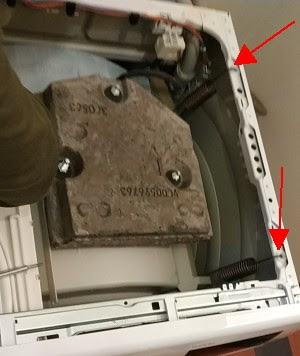
While the lid was off I noted a couple of engineering essentials. The first is that the business core of the machine is suspended from two enormous bed-springs indicated by [] and also a huge lump of concrete - cast and serial-numbered to fit Bosch wash-drums. It must be a damper [prev] to provide some inertia to the system. A load of socks or knickers is not a problem because they are granular and can distribute themselves evenly round the drum for the spin cycle. A great wet floor mat not so much? 

When spinning things are unbalanced they can get into a resonance cycle and rock back and forth until the whole caboodle busts off its spindle. As happened in an ex-place-of-work with a steel ultra-centrifuge bucket going through the casing and a 10cm solid concrete wall beyond. The concrete block in the machine overwhelms any trifling wet-blanket unbalance.

Whatevs, I am delighted that [as with the central-heating oil-burner at Christmas] we don't have to trek into DID electrical to buy a new appliance because this one is beyond economic repair. Inside dope note to self: NEFF are the same as Bosch; assembled from the same parts in the same factory but twice the price. I heard it from a chap who is in the trade.

Oddly enough the two meanings of "damper" come from the same etymological root [M.E. dampen, like German dampf]. The reduce-amplitude concept indirectly through soggy → gloomy → depressed → less volatile. All the gases that displace oxygen in mines are also -damp.

Wednesday, 17 April 2024

Our bucket economy

25 years ago Lilliput Press published Lives Less Ordinary 32 Irish Portraits by Peter Morgan and Judy Kravis (1999). It's still in print but you can get 2nd hand copies for £5 or thereabouts. It's an amazing record of alternative folk living their own peculiar dream in the later 20thC. I've mentioned the book before especially wrt the chapter about Judith Hoad who lived in a remote cottage without indoor plumbing.

We have, so, indoor plumbing; although Old Ray, who died out of the house in 1994, managed without those amenities for 50 years. When we came with our modern ways and two small children we had a bore-hole drilled and sunk a submersible pump 100 ft =30m below grade. From that central heating was installed so we had hot&cold running water, not only in the house but also in two sheds - and a stand-pipe in the yard for watering walkers and sheep. On Sunday 7th Apr, the water stopped running. Even after I cleaned out the sclerotic pressure valve, the pump would switch off a couple of minutes after reset.

I called Roy the plumber and he came (in the drizzle) the next day for a scoping visit. He has promised to come today to sink the new submersible pump and connect it up.

We are not strangers to waterlessness because, like, the submersible pump runs on electricity and maintenance- or storm-scheduled power cuts stop all taps. It's all do-able for a few days so long as fore-thought has provided some back-up drinking water in bottles. It's disconcertingly convenient to have a 'lec'kettle that works next to a tap that don't. During our bucket week we instituted a parallel system for kettles on the wood-burning stove: 1) for drinking and cooking water 2) for washing and hottle bottles. But it's been well soggy this weather and we're getting hectolitres of clean clear rain water captured by 150 sq.m. of polytunnel roof -  I'd have no compunction about drinking that . . . ignoring the leaves. It is comical to imagine over-educated, over-aged me tottering down the steps from the tunnel with a bucket in each claw.

All good fun until, like a bucket-economy friend of ours in The West, who on the morning To The Compost trip, went all literal and tripped dropping >!kaPLOOSH!< the brimming family pee-bucket at the head of the stairs. Mercifully 'e didn't follow the bucket on down.

Wednesday, 29 November 2023

Plumbing

When I was, say, 9 y.o., I was able to pee twice as high as my head [prev]. I was reflecting on this because it was the 60th anniversary of the assassination of President Kennedy last Wednesday 22 Nov 2023. My contribution to the MeFi debate about Conspiracy was "On 22 Nov 1963, 4700mi ENE of Dallas, 9½ y.o. me had just gone to bed but was re-woken with the news that President Kennedy had been shot. I started to internalize 3 letter acronyms TLA the next day JFK LBJ CIA FBI . . . RFK MLK." The reason we got the hot press news within an hour of the event at a country boarding school on a different continent is because one of the chaps went for a leak after lights-out and must have encountered a news-appraised teacher in the hallway.

We had more plumbing adventures a fortnight ago. There was a puddle on the floor beside the downstairs jacks - because the ballcock was not completely shutting off the inlet valve. I called Roy the Plumber and described the issue / discharge / problem. He took a quick look and then said "You need a new t'ilet; this one is 25 years old; we / I could replace the ball-cock and valve; but that cistern is too small to take the modern version; if I replace the cistern there is bound to be a leak between it and the toilet . . . it only works to my guarantee If we replace the whole caboodle". So I agreed and put a bucket under the leak; resolving to empty it every other day. But in the interim between nting the leak and buying the preferred toilet set things got A Lot worse. The ball-cock dislocated itself at the shoulder, floated free and we had a macro-leak. The washing-machine was in mid-cycle, so I preferred not to cut off the water at the mains. I flushed to reduce the water-level and rushed to the tool-shed for a replacement pin to reconnect the arm with the valve. After a predictable amount of splashy-splashy, I punched out the last fragment of [plastic!] pin and whanged in my replacement.

. . . and it worked! Not only to stem the current gush but also to stop the previous drip-drip leak. Seems that the crappy plastic pin which had held the system together for +25 years had fractured so that the ball-cock pressed on the shut-off button at an oblique angle and therefore could . not . get . it . completely . SHUT. Things had to get worse to get better in this case. I can afford to buy a new toilet if I need to but I'd rather keep the existing one out of land-fill if possible.

Back to meeeee! I am not always 100% on top of the plumbing sphincters but I can, for example, reliably wake up at night and get to the bathroom. Yes there are two - internal IUS and external EUS - urethral sphincters [L]: one up one down of the prostate. [much more information on the anatomy than you need] The external lad is skeletal = voluntary muscle, while the internal one is standard smooth muscle under the unconscious autonomic nervous system. Occasionally, acting on internal signals, my conscious self get the "need to pee" message and head out through the drizzle for the compost heap. On arrival, the goddam internal sphincter, which has been holding on manfully, will announce "arrived at destination!" let go before the rest of the apparatus is out of the fly ready to fly. It's where Free Will meets free willy! Emergency clench by the external sphincter is often not quick enough: so tinkle leakage. 

I guess it's why they let lecturers retire in their 60s. It's all very well for Leopold Bloom "Most of all he liked grilled mutton kidneys which gave to his palate a fine tang of faintly scented urine" to have a whiff of pee about him. But no fair on 20-somethings having to get up close and personal with a leaky lecturer during a physics lab? In a 9 y.o. that detrusor muscle is a powerful thing hence the pee to a great height Olympics in school bathrooms . . . in an old chap, no so much.