Showing posts sorted by relevance for query ken wolfe. Sort by date Show all posts

Tuesday, 22 October 2019

Secondary structure

Part I.
When they started to sequence The Genome Era with baker's yeast Saccharomyces cerevisiae 25+ years ago, I noticed something peculiar about the structure of chr III, the first ever eukaryotic chromosome to be sequenced. It was one of my three [3] big ideas in a life-time of science; and turned out to be probably not true. But it was nevertheless a contribution to the debate which opened up a novel way of thinking about constraints on the sequence of genes and their equivalent proteins. As more chromosomal sequences came on stream, Ken Wolfe, in the office next door, but not yet my boss, also noticed something peculiar about the order of genes. In particular he found evidence of shadowy patterns of duplicated segments. They were "shadowy" because the component genes were a) often only distantly related b) frequently missing. Thus on one chromosome you'd have 12 genes
A - B - C - D - E - J - K - P - Q - R - S - T
and elsewhere you'd find
a - b - e - f - g - h - j - l - m - n - p - q - t

What normal people saw, if they even bothered to think in gene order terms, was that a pair of neighbouring genes A,B were distantly related to another adjacent pair a,b. somewhere else in the genome. And a little further along on the same two chromosomes P,Q were sort of similar to p,q.  . . .  probably a coincidence, nothing to see here. What Ken saw was [hypothesis to test!] that a chunk of the genome had been duplicated, and that most of the duplicated genes had been surplus to requirements and had mutated away to pseudogene, and then to nothing-to-see-here. He was able to see the present pattern through the spectacles of evolutionary time. If you aligned the genes themselves rather than their sequences, then the signal from the pairs was boosted by the similar intervening singletons Ee Jj and Tt:
ABCDE---JK---PQRST
ab--efghj-lmnpq--t
**  *   *    **  *
Ken bounced the idea off Denis Shields, another absurdly smart friend of mine,  and they published Molecular evidence for an ancient duplication of the entire yeast genome in Nature in 1997. That paper documented the existence of 55 duplicated regions incorporating 13% of the total gene complement. That paper included Fig.2. [part shown left] which could claim a prize for the prettiest, most data-rich and informative visual display of quantitative information [Tufte] ever to come out of Ireland. It showed commendable bottle to keep digging in the gene-duplication pit  when 87% of the genome was saying something else entirely.

People like me would have taken the gong from Nature and moved on to the next project. Ken kept shaking the tree, looking for, and at, these patterns in the gene order of Saccharomyces cerevisiae. Some more focused [boring, pedestrian, ordinary] scientists started shaking their heads wondering if 'poor Ken' would soon be found crouched in a corner of the senior common room muttering to himself while blocking off imaginary fragments the yeast genome with extravagant hand-gestures. Partly on the back of his Nature paper, he landed one of the first mega +mi££ion grants when SFI Science Foundation Ireland was founded at the very end of the last century. One of the first tasks he set one of the Effectives of his dream-team was to create YGOB the Yeast Gene Order Browser. I remember him trying to explain his vision to Kevin Byrne, the recently recruited Quant who was assigned this task. Kevin could spell DNA but not desoxyribonucleicacid because he was trained as a mathematical astrophysicist . . . but ygob could that boy code! The result of that collaboration was like Fig2 above but with moving parts and incorporating not one but 2 dozen species [see the paper for more details] I always thought it looked like a mighty train marshalling yard for assembling genes into their most functional order:
Like the London Tube Map, the YGOB browser distills from the noise all the relevant data into a clear graphical roadmap with all the evidence (protein sequence, gene sequence, annotation] only a click away. Bri'nt!
With this infrastructural support, Ken then got to know pretty much all the 5,500 genes that kept Saccharomyces cerevisiae ticking: who neighboured whom; which genes contributed to biochemical pathway X; which protein was the receptor for which ligand. It was an extraordinary feat of memory and deep knowledge and a lot more useful than retaining the first 5,500 digits of π. As a teacher when you know everyone in the class you know who's missing. Ken started to notice a few cases of missing data: where every species in YGOB had genes ABCDE but Candida glabrata had only ABC-E [as L]. It turned out that in a number of such cases there was a gene in the expected position but it had evolved so fast that it retained no sequence similarity to any other gene on the planet in the databases. Nevertheless, the turned-up novel protein had the right secondary structure which, coupled with the compelling synteny / genomic location data, made him confident that he could ascribe a function in these peculiar cases. These functional annotations are vital to convert (ATCG) into making sense of what genes and organisms do. He wrote it up in a (rare nowadays) single author paper for Current Biology: Evolutionary Genomics: Yeasts Accelerate beyond BLAST. A few years later he set one of his students to make a comprehensive search of all the YGOB species looking for similar cases. They were able to annotate a number of other proteins which had fallen through the generic gene-finding sieve when each species was sequenced and annotated. Deep knowledge and a synteny Way of Seeing was able to tidy up a number of peculiaries in the biochemical capabilities of particular species.

I was started down this recent-history rabbit hole because I read a report in Chemistry World about the discovery of a 'missing gene' in Trypanosomes [prev] which are responsible for sleeping sickness one of the most scything neglected tropical diseases. Richard Rachubinski of U Alberta was looking for novel targets to kill the parasites before they could kill their human hosts and was surprisingly unable to find a homologue of PEX3 in the lists of trypanosome proteins. PEX is a family of proteins associated with the development and maintenance of peroxisomes - sub-cellular organelles which are vital for the processing of long chain fatty acids and reactive oxygen species. PEX3 remained elusive until Rachubinski went to a research presentation outside his own field and learned about a bioinformatic tool called HHPred which can infer function based on secondary structure [which is comprised of the intermediate building blocks or structural elements: α-helices; β-sheets; turns; ω-loops] even when the protein sequence is completely different from other members of a gene family.  They are a long way from an effective therapeutic but the first step of identification and annotation has put them on the right path. More shadows firming up into a hard reality!

Monday, 6 July 2026

Beechdrops

I was writing about hay-rattle Rhinanthus minor a peculiarly desirable meadow flower parasitic on grasses. Digging a bit revealed that it was part of  Family Orobanchaceae. Dang! that rings a bell I thought . . . but a distant one. The family name derives from the Greek ὄροβος (vetch, a legume) + ἄγχω (strangler). And that's the key to the family's success. Their roots invade the roots of grasses and legumes to dine off the products of their host's photosynthesis - collapse of grass, which allows other meadow species to thrive in the gaps. Orobanchs all engage in parasitism but some, like hay-rattle, do not inhale and retain the ability to photosynthesize. 

When we came back to Ireland in 1990, the TCD lab in which I started to work had just emptied of a clatter of exceptionally smart scientists who all, eventually, became Full Professors at UCD, the Other University.

One of them, Ken Wolfe, signed up as a PostDoc in Jeff Palmer's Bloomington Indiana lab; tasked to investigate what happens to the photosynthetic apparatus when a plant is no longer required to capture energy from the sun because it's gone full-metal parasite on its neighbours. This required Ken to learn which end of an eppendorf would open and how to extract and process DNA from a homogenate of tissue. He was notably more successful than me in his temporary sojourn as a real [white coat, safety glasses] scientist. In those couple of years, he mastered a whole new toolkit and sequenced the chloroplast genome of Epifagus virginiana [L in Arkansas pic by Eric Hunt] an Orobanch which is an obligate parasite on the roots of Fagus grandifolia the American beech: no other species will do.

If you are adept in the language of molecular biology you can read the whole PNAS paper. Function and evolution of a minimal plastid genome from a nonphotosynthetic parasitic planttl;dr chloroplasts, originally free-living bacteria, have their own reduced genome consisting of a) a bunch of genes to make energy-capture proteins b) another bunch of genes to switch on the 'business' genes. Epifagus, no longer bothered about photosynthesis, has lost about 2/3s of the normal chloroplast genome. This suggests that chloroplasts do something else as well as energy capture. But the plant could also be still in the process of shedding baggage. That's a neat story about the pattern and process of evolution, all tied up from a standing start in two years.

Wolfe returned to our alma mater after his been-to years in the USA and played to his strengths as a computational evolutionary biologist, leaving the generation of primary data to others. Through the rest of the 90s he did World-class beautifully illustrated work on the yeast Saccharomyces cerevisiae genome. and also contributed to The Paper delivering the human genome.

At the turn of this century he became my direct boss which permitted me fly-on-the-wall status as another generation of brilliant people chipped away at the coal-face of science while I watched. I think I earned my salt; but not really in a tangible papers-and-grants way. None of my three good ideas in science happened during that gig. But I really learned a lot and continue to be grateful for being giving a seat at the table.

Saturday, 8 September 2018

Life and death in science

I've just surfed through a busy week without falling off the board. At The Institute, I attended two (!) PhD vivas, for one of which I had skin in the game. I think I am with the dinosaurs in holding that an Institute of Technology should not be awarding higher degrees (MSc, PhD, MBA) but should concentrate on moulding technically competent, reliable, numerate, technicians [it's what it says on the IT tin]. But I know I'm against the tide of history and the imperatives of ambition on this one.  Nevertheless, these two now-Doctors fully deserve the award and I look forward to ribbing them when they put on medieval costume for Conferring in November. I've seen weaker students with thinner theses get the PhD in Universities.

I have many qualities, some admirable; but I wouldn't include resilience in the list. This deficit is clear from the fact that my career is littered with unfinished projects. There is no point in pushing the frontiers of science and finding out the peculiarities of how the world ticks if you keep the answer to yourself. A key part of science is publishing the results and putting them up to public scrutiny and robust testing. You can't get things published unless you submit them to 'peer review' aka searching scrutiny by other scientists qualified in the field. My problem [butterfly me] is that having solved the problem to my own satisfaction I flit off the the next bright flower to investigate . . . without writing it up. I have submitted papers to journals and some of them have been published. But lots of others have been submitted, gotten some adverse criticism, put in the To Do pile and effectively forgotten. If I had better Finish, I'd now be approaching retirement in some prestigious University rather than working in The Institute where teaching is privileged over research. But actually, butterfly me is happier where I am - I've found my unspecialised, general science, level.

Success in top-flight science requires focus and specialisation. The day after Lar's successful defense I was up in TCD at a requiem for an amazing scientist. Mario Fares, my friend and colleague, died in Spain at the end of last year. Pegging out awkwardly in the middle of the teaching term meant that many of his Irish colleagues, friends and admirers were unable to attend the funeral, so a memorial was arranged for this week and his Spanish family came, like Mohammed, to the mountain to meet los amigos del amado. The main eulogy was given by Ken Wolfe, the man who brought Mario to Ireland and with whom he published 4 solid error-correcting scientific papers. In that talk, Mario was named 'A Diamond' and I was referred to as 'the infrastructure'. That is exactly right, my main contribution to the Wolfe lab 2001-2004 was keeping things rolling. Indeed, my wholly passive presence allowed Mario Fares to tease out a tangle of ideas and mental dead-ends into a coherent and publishable story. Indeed Bob the Scientist [similar to L] was essentially created by Mario early one morning 16 years ago. Whatever help I gave Mario that day was repaid when I coat-tailed on a paper to get a Fares number of 1; it's like an Erdös or Bacon number. It is in the nature of funerals and memorial services that everyone reflects on the fact that you can't take it with you. But at least Mario's teenage daughter was brought to realise that her Daddy had made something of himself and been loved by so many strangers-to-her. His toddler daughter will absorb the same message as she grows.

The other success story that bobbed up in the news this week was that Jocelyn Bell Burnell had been awarded a stonking $3 million Breakthough Prize. Along with everyone-and-his-dog, I've written about JBB's brush with a Nobel prize because she paid attention to a bit of scruff on a paper print-out and discovered pulsars. She is the poster-girl for all the over-looked, under-rated, glass-ceilinged women in science. And she never allowed herself to be rankled by the fact that her supervisor won the Nobel for something he tried quite hard to stop her working on. I suggested that she has had far more impact on science in her work at home with Open University than her contributions at the farthest ends of the Universe. “I feel I’ve done very well out of not getting a Nobel prize,” she said. “If you get a Nobel prize you have this fantastic week and then nobody gives you anything else. If you don’t get a Nobel prize you get everything that moves. Almost every year there’s been some sort of party because I’ve got another award. That’s much more fun.”  That's a nice sentiment. It may also be satisfying to not share this prize with her old boss Tony Hewish. Martin Ryle, his boss, died in 1984 so he has no use at all at all for the money or the accolade.

In strictly financial terms the Breakthrough Prize is a far better deal. Hewish & Ryle split SEK550,000 between them in 1974, the year of the No-Bell physics prize.  That is worth about €300,000 in today's money, of which JBB would have gotten a third. €100,000 is, of course, a substantial chunk of change if all you want to do is throw a massive party. It won't even buy a box-room in a 3-bed semi-detached house in suburban Dublin. In is entirely consonant with her heroic infrastructural character that JBB is donating the windfall to fund PhD scholarships for groups which are under-represented in Physics.

Friday, 3 January 2025

The Infrastructure Guy

tl;dr: there are plenty enough farmers, rentiers,
publicans and teachers in the Oireachtas. We need
more scientists! A proper gander at the Seanad elections

We can't all be centre-forward. Someone else has to hoof the ball up-field or make the final cross for Messi to walk-it-in. But the culture we endure privileges the one over the other to a quite absurd degree. CEOs award themselves 20x the wages of the janitor; the surgeon is getting 5x more than the scrub nurse. 

25 years ago, I had a candid talk with Ken Wolfe = then just the fellow in the office next door; rather than Fellow of the Royal Society. He was almost always the smartest person in the room [MultiBloboPrev]. Whereas I was a second-rate [but not fifth rate!] kinda guy. I didn't want to win prizes but I was rather good at setting things up so that others could be their Best Selves. I was, I believed, a good post-doc: given a task I'd plug away at it creatively and with diligence until it was done. Six months later - scutter me pink, lads - Wolfe landed one of the first monster grants from Science Foundation Ireland and, taking me at my own estimation, offered me a seat at the table. Some really smart people [from Spain, France, Canada, USA & Ireland] landed posts as they were advertised under that grant.

One of the New Hires was a rocket scientist theoretical physicist called Kevin Byrne [R] who was ear-marked to be SYS$OP, managing the hardware for us all, as well as pushing the frontiers on his own project. The Boss had an arm-waving vision for a graphical tool for comparing complete genomes: both an archive and a tool for studying the evolution of related organisms. Over the next couple of years, from not knowing how to spell DNA, young Kevin implemented that idea, adding bells and whistles and extra features if they seemed to have utility. Or if The Boss had woken up screaming at 0300hrs with another of his brilliant insights. 

That lab was a wonderful experience. A dozen people from widely different backgrounds [hmmm, maybe a bit whiter than the global average; maybe a bit more spectral], with different tool-kits, all working on separate but related projects making sense of the fresh minted human genome [other genomes were available]. Kevin was present - always ready to pause and listen; suggest a solution; share a fragment of code; ready to say I've no idea . . . but also leave it with me, I'll find out. He could no more blag a bullshit answer than he could refuse to offer a helping hand.

The following May, the whole lab decamped for Cork to present our stuff at the 2002 VIBE meeting. That's when everyone in the molecular evolution / computational biology community in Ireland gets together to compare notes, set up collaborations and eat pizza. A block booking was made for the early morning train to Cork. There was a mild commotion when Kevin bailed out at Port Laoise and went back to Dublin. It turned out that he was moon-lighting for Fianna Fáil developing and maintaining one of the first effective political web-sites. The country was three weeks out from the 2002 General Election, the party web-server had blown a gasket and nobody at FF central office was able to make it go again. With their website fixed, Fianna Fáil went on to comprehensively win the election! And Kevin came down to Cork the following day to make his prez for VIBE.

Some time later I was in the pub with Kevin and asked him "Politics can be a worthy [and often thankless] task; but why [for heaven's sake] Fianna Fáil ?". Kevin was quite open: "When I was at school and then college, I really believed in Europe and all the positive, inclusive, diversity-affirming, opportunity-providing aspirations of the EU". Taking the long view, he asked himself which was the most effective political star to which he could hitch his wagon. FF was the answer, and Kevin signed up to make the tea, knock on doors and create the website. I've been teasing him since as the next Taoiseach but three because I knew him to be pragmatic, honest, loyal and clever. We need all those qualities in our leaders.

At last, Kevin Byrne has made his move! After three decades of crunching numbers in academia, and briefly in in dot.com business, and always always in the engine-room of politics [what do people want? what makes them tick? how best to achieve that?] my friend is running for the Seanad to take & hold one of the three seats allocated to The University of Dublin aka Trinity College, our shared Alma Mater. #1 No better man! Vote early and vote often. My ballot and some poll puffs have arrived at Caislean Blob:


Monday, 9 October 2017

A sad loss for science

In science you can't cover everything, you just have to pitch in to an area where you believe you can make a difference. Because of increasing specialisation, after a couple of years of contributing and reading the literature; and a couple of conferences presenting your results and listening to what your rivals are up to, you know all the Effectives in your field. You also identify the make-weights who, however diligent and worthy, are not going to set the world alight anytime soon. Just after the turn of the century, I got a seat in one of the first labs funded by Science Foundation Ireland SFI to give the frontiers of biological science a really good shove.  I recently wrote about those exciting times as a way of giving tribs to a very smart woman, then a graduate student, now CSO of a biotech company. That lab worked (and worked damned hard) because of the intra-group chemistry. Including the boss, there were about a dozen really clever people, half Irish half Other, rocking up to work each day. If you hit a wall or had half an idea, you could always find someone to help you to a solution.

I'm really sorry to report that one of that band of brothers and sisters! is no longer available to help us thrash out the big questions. Mario Fares [R] died, far too young, over the weekend and will be buried tomorrow evening. It is a  huge loss to science: he was only 45. If we had in biosciences the equivalent of Erdős numbers, then I'd be particularly proud to have a Fares number of 1. That paper, which was published after our days together in the crucible of SFI, came about because Mario was extremely generous with his time in mentoring our graduate student in the the correct way to approach the analysis of positive selection in populations. The standard tool for carrying out such analyses was/is called PAML, invented, maintained and distributed by Ziheng Yang from UCL. I quietly boast that I am one of a select [N=384!] group who has found a bug in PHYLIP, another key software suite in the field of molecular evolution. Mario, de lo contrario, during his PhD in Spain took his data through PAML, stress-testing it against every option and parameter in the program. At the end of that journey, he understood PAML better that anyone on the planet except, maybe, Ziheng Yang. You couldn't ask for a more authoritative source for the down-and-dirty on this sort of analysis.

I met Mario the day he stepped off the boat plane in Ireland. He'd signed up to Ken Wolfe's SFI lab but flew in on the Saturday before he was due to start work. It was a drizzly, stormy, soggy, Irish day. One of his new colleagues picked him up from the airport and said there was a garden party down the country and asked Mario if he'd like to drive for 2 hours into the wilderness for his dinner. Back in those days we had a Summer Solstice cook-out up on our mountain and invited everyone down from the city. When Karsten and Mario rocked up at 3 pm, they were the only people to arrive. Everyone else had decided to stay warm and dry at home. We fed and watered the boys, played petanque à la irlandaise in the drizzle and then they drove back to Dublin - a bit of a wash-out.

I wrote a few years ago about a brief 25 minutes when I gave back to Mario by acting as a sounding board for his latest Big Idea. A couple of years after we met, in the drizzle, Mario applied for a job at one of the other Irish Universities. Everyone encouraged him to do so because he was a great explainer and a really rigorous scientific researcher . . . and a walking genius! He applied believing it was a forlorn hope because, back home in Spain you only get places by being the protégé of a much bigger cheese. If you play your cards right and keep your nose clean, your mentor will secure you a suitable place. Mavericks need not apply. We have nepotism in Ireland, sure, but also an official level of transparency that often allows the best candidate to win through, regardless of who is his uncle. In that case, Mario was that best candidate and he went off to Maynooth for a couple of years. Before he left, I gave him some avuncular advice: in setting up his lab he shouldn't necessarily go for the cleverest candidates; successful scientists can be a bit driven and may be a a little too ambitious and such people can be a) a little wearing b) not the best pick for the greater good. If Mario were to pick one person who was good enough at the science, but had also coached a teenage football team or showed some other element of social competence then that might provide the social lubrication for really superlative science. That's the sort of group we had in the Wolfe SFI lab, which had eased Mario into the scientific establishment of a foreign country.

In any case, Mario was back in a couple of years with the offer of a permanent post in the Genetics Department in TCD; which Trinity people would regard as a step up. A short while after that he secured another job back home in CSIC-UPV in Valencia. Since then he appears to have juggled his commitments between both countries and getting paid by both institutions. The fact that the administrative burden of such a peculiar arrangement was taken on board suggests that he was really indispensable to both places. And now he's gone; several big holes, one in my heart, need to be filled.

Thursday, 27 July 2017

You are wot you eat

Back at the turn of the 21stC I found myself polishing the cutting edge of science. For a chunk of the 1990s I had the office next door to Ken Wolfe, now FRS, who is almost always the smartest bloke in the room; certainly when I am the only other person there. His contributions to science are many [pubcrawler] and varied [human genome and a Nature paper] and go back to his first Nature paper which predated his PhD. In 2000 Science Foundation Ireland SFI was set up with a brief (and a ton of money) to kick-start Irish scientific research. They solicited applications for grants of several millions of IR£s [soon to become €1.27] in biotech and infotech. Ken secured one of five SFI biotech grants to investigate the human and other genomes which were coming on stream. For reasons that I still find hard to fathom I was given a seat in the new lab along with some super-smart young researchers about half Irish and half foreign. I think I was a net contributor but I had an uneasy sense of Imposter Syndrome [it's not only women] for the 3 years I worked there.

Just as I was preparing to leave (retiring again!) Nora Khaldi a new PhD candidate arrived from Provence. She was young and fit and an asset to the nation of geeks with whom she was going to work. The Celtic Tiger was only starting to growl and the SFI salaries were generous [had to be to attract brilliant minds to an intellectual backwater on the edge of Europe]. Someone decided that all work (and we all worked really hard) and no play made dullards of genius and instituted a series of cultural events for the lab. We were each requested-and-required to book something and everyone else agreed to row in with the suggestion. I brought everyone off the see [subtitles! love 'em] a Belgian film Le Roi Danse about Louis XIV and his favorite composer Jean-Baptiste de Lully. I may also claim credit for suggesting The Burial at Thebes Seamus Heaney's brilliant version of Antigone at the Abbey Theatre. I admit that sounds consciously and pretentiously highbrow but The Lads loyally came out for those events. Nora au contraire decided that the best fun was to pile everyone into a Zodiac inflatable boat and roar off at 30 knots in a tooth-crunching cruise to nowhere round Dublin Bay. I for one left a puddle behind on my thwart which wasn't only from the spray. During her PhD Nora knocked off a bunch of seminal papers about genomic evolution in filamentous fungi which have garnered about 1,000 citations which is definitely above average.

After TCD, Nora went to America - everyone who wants credibility in science has to Go America for a spell - and worked at NCSU on mycotoxins. She developed a pipeline SMURF to analyse fungal genomes for their capabilities in producing secondary metabolites. Secondary metabolites are the bits and piece of biochemistry that don't have direct use in energy metabolism and reproduction.  They are often useful in minimising competition and/or deterring predation. Fungal secondary metabolites have, for example, given us the majority of the current available battery of of antibiotics. In due course, Nora returned to The Other University UCD and in short order dreamed up a company Nuritas which mobilised her computational biology skills and her appreciation that genomes produce a rich array of proteins and peptides whose function is not always obvious.

If oral antibiotics can survive the maelstrom of acid destruction that is the human stomach and go onwards, downwards and then around-and-aroundwards to cure a Staph infection in a child's ear, then what about other microbial products? As CSO [Chief Scientic Officer] Nora [L.L] is talking up the benefits of the Nuritas pipeline of discovering new bio-active peptides. Although she is the founder and the brains behind it, they have hired a Chairman from MegaCorp Novartis to steer the good ship Nuritas through the choppy waters of an unforgiving financial world [I bitterly use a nautical metaphor because of the Zodiac ordeal to which I subjected in 2004]. The nascent company had already appointed a CEO [L.R] from MegaCorp Pfizer in 2015 That's a common strategy in tech startups: you may be a mathematical genius and a dab hand at Python but chances are you will do something dopey like forget to add employer's PRSI contribution when you estimate the burn-rate of your wage-bill.  You start to talk about burn-rate when you secure your first €3.2m tranche of Venture Capital.

Nuritas has pipelines in anti-inflammatories [diabetes, heart-disease] and anti-microbials [pathogens] which will finish up as targetted additives in your breakfast smoothie. Here she is again, a) talking up the company but b) for the last tuthree minutes talking up solidarity among women in tech. As a metaphor she points out the women are expected to wear different shoes for every meeting where her male CEO just wears shoes. Going foodiceutical is a canny choice; the development pipeline for novel food products is much shorter, cheaper and less challenged by required FDA trials than the development of new drugs. And the market is calling for novel ways to make people well or better still prevent them from getting sick in the first place. In January this year, Nora Khaldi won  the Woman of the Decade in Business and Leadership award. You need bottle to persevere against a tide of know-it-all nay-sayers. “I was told this was impossible and I decided not to listen" attagurl Nora!  Feckin' Bri'nt!  You can talk like that with Nora because she now talks just like a Dub. You'd think she's been raised entirely on bacon-and-cabbage rather than Salade niçoise and bouillabaisse. There we go again: another bloke laying his truc on an entrepreneur and visionary just because she's a woman. But I'd do exactly the same to my pal Cedric Notredame, another escapee from Le Midi, if he was able to speak Dublinese half as well. He can't: all he can do is imitate a genuine Dub [Des Higgins] imitating a Frenchman [Cedric]: very funny but you have to be there. Because I only have two pair of shoes [one for work and one for funerals], I don't have a leg to stand on in footwear politics.
But enough of blokes, in science or otherwise:
here's a lot more Women in Science

Monday, 22 July 2013

The race is not to the swift

Round about Xmas 2011, I got an unsolicited mail from Nature - the premier European science journal.  If you publish in Nature, as Irish evolutionary geneticists Ken Wolfe, Aoife McLysaght and Karsten Hokamp did to deliver the Human Genome Sequence in 2001, you have arrived.  Even if you share your epic paper with 252 other authors (yes, I counted: must_have_data).  For a micro-second I imagined that they wanted me to write up my discovery of (well, strictly speaking my unconfirmed prediction of) a novel human gene on chromosome 19.  But they were actually making me a rather good offer: for £50 they would ship me a copy of Nature every week for a year.  It took a while to get the subscription delivered to the correct address (one of their keypunchers had riffle-shuffled my home and work address into a postal conundrum) but I got to look forward to its arrival every week.  And as I was working part-time through 2012, I got to read it, and then pass it on to a palomino who is/was a retired hydro-geologist.  Excellent value.

Then I got the job at The Institute in January and I didn't have time to read my pay-slip let alone a fascinating gallimaufry of science and commentary.  Nature tried to persuade me to continue my sub for €138 pa but I despise bait-and-switch marketing and won't accede to it on principle  . . . and I knew I'd not have time to read it.  Nevertheless the issues came in for another couple of months and I sat down today to open them up and read through the backlog from what was going down in science in the early Spring.

So I've just read a nice feature in the 21Mar13 issue by Brian Owens, a freelance writer from Canada, called Slow Science.  Owens extols the value of gathering data over a very long time.  So much of science, as so much of everything nowadays, is conceived, executed, analysed and written up (or tweeted) in an eye-blink. Funders want their reports back before the next general election at latest. So it takes bottle to carry on plotting data year after year, knowing it won't be analysable, let alone meaningful, for a generation. One of the cases cited by Owens has been running for 85 years in a cupboard at the University of Queensland in Brisbane. The researchers there have been monitoring the viscosity of pitch by watching for ing the drops to fall from a funnel full of the black near-solid goo.  Since 1928 they have accumulated just 8 data-points.  Well just last week, this Slow Science hotted up when a parallel experiment, set up in the TCD School of Physics in 1944, recorded on video the fall of a n o t h e r  S L O W d a t a  p o i n t.  It was big news in Trinity College and it too was written up in Nature.  Props for Irish science, cue Amhrán na bhFiann.

Tuesday, 28 January 2020

Backup but Checkup

I was writing about the necessity / virtue of keeping copies of things in case one of them "makes like a wheel and rolls away".  This only becomes real when you are caught with your pants down and suffer a painful sting on the ass because you neglected this chore. Last week in class I was critiquing and correcting a Literature Review for one of my students. I am a strong advocate of using keyboard shortcuts in MS-Word: far quicker than piffling about with a mouse, let alone with a mousepad on a laptop. I was on the 3rd page when abruptly Word disappeared off the screen along with all my edits. Dang! But I'd only been at it about 10 minutes and could remember most of my suggested changes. Probably my fault: working on an unfamiliar keyboard I must have typed ctrl-S, ctrl+N or ctrl+Q. It took me 8 minutes to restore the status quo ante.

Back in the noughties, I was hired to work in one of the very first labs wholly funded by the new SFI - Science Foundation Ireland. Instead of piffling about with dribs and drabs of science funding the government decided to invest a Lot of money in cutting-edge scientific research. As a pilot study in how to spend the $pond$,, SFI solicited applications for five [5!] biotech research projects and five [5!] IT ditto. Ken Wolfe secured one of these prizes, was given some millions of €€€s and told he could hire the smartest people in the world who were happy to work in Ireland. Even with an unconstrained budget it was quite hard to get the money allocated in a way that would satisfy a government audit.
  • Personnel: The salaries were pitched very high, even for post-graduate students, but there was a limit to the number of seats that could be filled. Even a walking genius can't supervise 50 people working on 10 different sub-projects and there was a physical room with a finite number of electrical sockets. Those hired were indeed all super-smart but super-nice as well and it was a really productive fizzing place to be. I never figured out why I was hired but my imposter-syndrome died away as I started to get to grips with my tasks. Those who didn't die, did really well afterwards. And I think it's fair to claim that some amazing work was carried out.
  • Kit: everyone in the group was given a brand new high-end desktop dual-boot linux/windows PC . . . and a ditto laptop, so we could be productive on the bus. After 3 years we all got newer slimmer more gutsy laptops.
  • Expenses: one of the hires worked part-time as Office Manager and dealt with all the invoices, room bookings, petty cash and biros . . . as well as churning out a couple of papers a year with the boss.
  • Common core: part of the ancient Victorian office suite was partitioned off as a machine room, where a couple of the techy hires built the lab's own massive parallel server cluster out of Intel chip boxes [no I don't really know what that means, either]. There were layers of redundancy built into it so that, if one of the components failed, no data would be lost. 
  • Infrastructure: All these planet-sized brains, generating eye-wateringly large datasets, couldn't be expected to back up the day's work on a CD or USB key. No no, all the computers were backed up every Friday on a rotating set of DAT tapes and incrementally backed-up [all new changes that week] every night.
  • SYS$OP: one of the two techies, as well as churning out a couple of papers a year with the boss, was the designated Technical Manager fixing and advising on all the hardware issues and responsible for care maintenance and back-ups
Everything went along fine until two components failed in the server cluster and a chunk of data was lost. Not mine, praise De Lawd, but two of the post-grads lost weeks of data accumulation and analysis - >!poof!< gone without even a noticeable puff of smoke. But it's okay, said the Sys$op when he rocked up mid-morning [owls and larks were both tolerated], I'll restore everything from tape. But when he got there, the tape-cupboard was bare. All the tapes were there, but somehow an assumption had been made that they were all being written to each night. Indeed they had been  so written when the system was set up and checked but somewhere with the passage of time the current data hadn't been caught. I never wanted to find out the details of what went wrong, there were enough red faces without having to account to me. The corrupted cluster components were sent, at vast SFI expense, to a commercial data recovery services. But the discs were so badly corrupted that nobody wanted to trust the fragments of recovered code and those affected more or less started again from scratch. Quis custodiet ipsos custodes? - Who backs-up the back-ups?

Saturday, 9 March 2013

The Real and the Ideal

I guess I could have called this post The Possible and the Actual in tribute to Francois Jacob's brilliant short book about bricolage, but I'll hold that back for later.  I'm coming to end of my lecture course on Human Physiology and have to cover 'digestion' soon.  You can't do that without a nod to the epidemic of obesity which is ballooning from America to Ireland.  One of the key ideas in the science of obesity is that our evolutionary heritage encourages us to fill up and fill out at any and every opportunity.  We've spent 95% of the time since we came down from the trees leading an austere and literally hand-to-mouth existence as hunter-gatherers, so when a glut presents we eat and eat and hope to convert as much as possible of the surplus calories to fat.  Sub-cutaneous fat has all kinds of advantages over other forms of food storage - it's portable, doesn't go off and retails at 9Kcal per gram.  Killing a wildebeest was a rare event in those days, when most of the calories came from mongongo nuts, witchety grubs and roots.  The problem for us now is that wildebeest fill every aisle of the supermarket and wildebeest cutlets are available in our domestic fridges.  The genetic program is strong, sugar and fat are delicious and it's hard to stop glomming down another spoonful.  Yes, yes it's more complicated than that and Paranoid Me is rather taken with the idea that the plastification of our world has led to the widespread availability of hormone analogues which are also helping to pump the balloon.

I particularly liked a graphic, which I found on a presentation by Leslie Liebermann from the University of Central Florida and I've rejigged her idea in the picture above.  The ideal in each case is on the left!

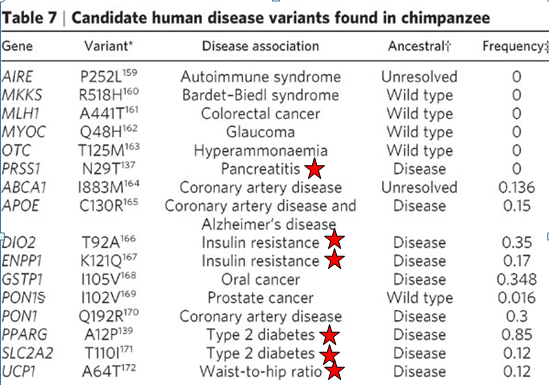
Now here's another interesting insight.  The human genome was delivered into the public domain in June 2000 by Bill Clinton and Tony Blair (thanks, lads, good job on the sequencing) and published by the real scientists, including three Irish analysts Ken Wolfe, Aoife McLysaght and Karsten Hokamp, the following February.  Five and a half years later, the Chimpanzee genome was completed (Nature 437:69-87 01 Sep 2005).  Another Clint was more modestly in the background of that second project as the adult male chimpanzee who contributed his DNA.   Everybody knows that the two species are remarkably similar genetically (98%, 99% identical depending on the details of what you measure).  But an interesting table in the Chimp genome paper reports the differences where the normal variant in chimps is the cause of a disease in humans.  Nearly half of these reverting candidate genes (you can hypothesize that the ancestral human condition was the same as chimps but mutated to accommodate the different lifestyle of the walking ape) are related to digestion and diabetes.

Monday, 13 May 2013

100-up

100-up is much better than Bib-Label Lithiated Lemon-Lime Soda which was the first incarnation of 7-up - less fizz but more substance.  This is my hundredth post and I'll indulge myself in a tiny Retrospective.  It turns out, as near as dammit, that I've dropped about 100 names in those hundred posts.  I've sorted them by first name because we now seem like old friends and the good people at blogspot/blogger provide a search function for Science Matters that will satisfy your curiosity about "What could Bob possibly have to say about Gene Wilder?".  In many cases the answer will be not very much! Sorry.
Abraham Lincoln; Ada Lovelace; Alexander Bell; Amedeo Avogadro; Andre Lwoff; Andrew Harrington; Aoife McLysaght; Barry Dalby; Benjamin Disraeli; Bill Clinton; Charles Babbage; Charles Darwin; Charles-I Stuart; Chris Hayes; Christian Goldbach; Craig Venter; Daniel Day-Lewis; David Attenborough; David Fahey; David Haussler; Dionysius Exiguus; Edsger Dijkstra; Edward MacNeil; Emil Zatopek; Eugene Cernan; Ewan Birney; Francis Coppola; Francois Jacob; Frank Ramsey; Gene Wilder; George Dawson; George McClellan; Gerd Gigerenzer; Jacques Monod; James Gleick; James Joyce; James Lovelock; James Murray; James Ussher; James Watson; Jan Jansky; JBS Haldane;Jean Danjou; Jim Kent; Jim Peters; Jocelyn Bell-Burnell; Johan Kjeldahl; John Hinde; John Keats; John Lonergan; John Seymour; Joseph Conrad; JS Haldane; Karl Landsteiner; Karsten Hokamp; Ken Wolfe; Leslie Liebermann; Lynn Margulis; Malcolm Gladwell; Mary Mulvihill; Matt Groening; Matthew Broderick; Maximillian I of Mexico; MC Escher; Michael Ramsey; Michel Thomas; Michelangelo  Buonarotti; Nan Doyle; Neil Armstrong; Paddy Lydon; Patricia Arquette; Paul Crutzen; Paul McCartney; Percy Shelley; Peter Medawar; Pope PiusX; Ralph Leighton; Raj Padam; Richard Chamberlain; Richard Feynman; Richard Haldane; Ronald Graham; Saint Cunigunde; Sian Croose; Sinead O’Brien; Skip Lovelady; Sophocles; Stanislav Jungwirth; Stephen Fry; Sukiyabashi Jiro; Tony Blair; Varro Raetinus; Walter Bagehot; Widukind Lenz; Wilkinson, Mr; William Hurt; William McBride; William Shakespeare; 

Clearly these may be gathered into bins or made to form themes (several Haldanes, many geneticists, some film-stars, a surprising number of Jims).  But several of them appear to be, in the tradition of "googlewhacks", un-met by google-light:

Your search - "Amedeo Avogadro" "Sukiyabashi Jiro" - did not match any documents.
Your search - "Johan Kjeldahl" "Emil Zatopek" - did not match any documents.
Your search - "Lynn Margulis" "Varro Raetinus" - did not match any documents.
But it is the destiny of googlewhacks to fade as soon as the spiders of Google find the site that reports them, so there will be soon at least one site on Google that reports the meeting of these unlikely couples.
 

Sunday, 28 July 2013

100K

A couple of months ago, I put up my 100th post on this blog.  I thought that was an achievement - I was never able to keep my Letts Schoolboy Diary going even to the end of January.  So I trawled through the back-catalogue and abstracted all the people who had merited a mention.  I thought that several pairs of people in that list wouldn't appear in the googleverse, and it was so . . . then.  Because Google scrapes the very bottom of the barrel, my abstruse connexions have now become googlechapwhacks (rather than googlewhacks):
Your search - "Lynn Margulis" "Varro Raetinus" - did not match any documents.
now has two hits: both from The Blob.
I now find that I've written more than 100,000 words here since January, so thought I'd put up another summary list.  It's getting rather long (N > 300), so I won't be doing this ever again.  There are more saints than astronauts, more Jims than Bills, the sex ratio is shamefully (41F:267M) skewed and for a republican there are rather too many monarchs.

Abraham Lincoln; Ada Lovelace; Adi Roche; Aeschylus; Al Bean ; Alan Shepard ; Alexander Bell; Alexander Friedmann; Alexis St.Martin; Allen Gardner; Amedeo Avogadro; Andre Lwoff; Andreas Ioannides; Andrew Harrington; Anne Boleyn; Anne-Marie Pétrequin; Aoife McLysaght; Aristotle; Arjumand Banu; Aurangzeb; Barbara McClintock; Barry Dalby; Beatrice Gardner; Benjamin Disraeli; Bert Vaux; Bibb Latané; Bill Bryson; Bill Clinton; Bill Liao; Bill Watterson; Brian Owens; Leopold I Belgians; Buzz Aldrin ; Calvin Klein; Carole Lartigue; Cathal Daly; Catherine Aragon; Richard Rich; Charles Babbage; Charles Burnham; Charles Darwin; Charles Dickens; Charles Duke ; Charles Weingartner; Charles-I Stuart; Charlton Heston; Chris Burnett; Chris Corlett; Chris Hayes; Christian Goldbach; Christophe Irmscher ; Christopher H. Calvey; Chuck Merryman; Clyde A. Hutchison III; Craig Venter; Cuchulainn; Cynthia Andrews-Pfannkoch; Dalai Lama; Dan White; Daniel Day-Lewis; Daniel G. Gibson; Dave Brubek; Dave Bruno; Dave Scott ; David Attenborough; David Fahey; David Haussler; David Hockney; David Lean; Debarghya Das; Dermott MacMorrough; DH Lawrence; Dionysius Exiguus; Dorian Pritchard; Edgar Mitchell ; Edmund Burke; Edsger Dijkstra; Edward MacNeil; Elizabeth Marshall Thomas; Elizabeth Windsor; Emil Zatopek; Enda Keane; Enver Hoxha; Ernest Walton; Ernst Röhm; Esmond Harmsworth; Eugene Cernan; Euripides; Evelyn Fox Keller; Evgeniya A. Denisova; Ewan Birney; Francis Coppola; Francois Jacob; Frank Ramsey; Garret Mullooly; Gene Wilder; Georg Wittig; George Beadle; George Dawson; George Gaylord Simpson; George III Hanover; George McClellan; Gerd Gigerenzer; Gordon Ramsey; Gregor Mendel; Gregor Strasser; Gretchen Rubin; Gustav Ritter von Kahr; Gwynedd A. Benders; Hamilton O. Smith; Harold Macmillan; Harold McGee; Harold Wilson; Harvey Milk; HDF Kitto; Heinrich Matthaei; Herbert Terrace; Iain M Banks; Iizuka Sh?kansai; Jack Hawkins; Jack Schmitt ; Jacob Bronowski; Jacob Lewis Bourjaily; Jacques Monod; James Gleick; James Irwin ; James Joyce; James Lovelock; James Murray; James Ussher; James VI/I Stuart; James Watson; James Whelton; Jan Jansky; Jane Goodall; JBS Haldane; JD Salinger; JD Salinger; Jean Anouilh; Jean Danjou; Jim Jones; Jim Kent; Jim Peters; Jocelyn Bell-Burnell; Johan Kjeldahl; Johann Charpentier; Johann Goethe; John Charles McQuaid; John Darley; John Glenn; John Henry; John Hinde; John I. Glass; John Keats; John Lonergan; John McCarthy; John Napier; John Seymour; John Tukey; John W. Drape; John Young ; Jonathan McCrea; Joseph Conrad; Joseph Stalin; Joshua Foer; Joshua Katz; Joshua Slocum; JS Haldane; Julie Christie; Julie Powell; JW Nijman; Karl Landsteiner; Karl Schimper; Karsten Hokamp; Ken Wolfe; Kevin Byrne; Kevin Mitchell; Kitty Genovese; Lambros Lambrou; Laurens van der Post; Lei Young; Leonard Mlodnick; Leslie Liebermann; Li Ma; Louis Agassiz; Lucy Ferris; Lynn Margulis; Malcolm Gladwell; Marcus Rhoades; Marius L. Jøhnda; Marjorie Shostak; Mark Boyle; Marshall Nirenberg; Martin Luther; Martin Ryle; Mary Mulvihill; Matt Groening; Matthew Broderick; Maximillian I of Mexico; MC Escher; Melvin Konner; Michael G. Montague; Michael Pollan; Michael Ramsey; Michael Young; Michel Thomas; Michelangelo Buonarotti; Mikkel A. Algire; Monzia M. Moodie; Nacyra Assad-Garcia; Nan Doyle; Neil Armstrong; Neil Gaiman; Neil MacGregor; Neil Postman; Nigel Slater; Nils Bohr; Nisa !Xun; Oscar Wilde; Paddy Lydon; Padraig Pearse; Patricia Arquette; Paul Crutzen; Paul McCartney; Percy Shelley; Pete Conrad ; Peter Donnelly; Peter Medawar; Philippe II Belgians; Phineas Gage; Pierre Pétrequin; Pope PiusX; Prashanth P. Parmar; Primo Levi; RAB Butler; Rachel Hewitt; Radha Krishnakumar; Raj Padam; Ralph Leighton; Rami Ismail; Ray-Yuan Chuang; Richard Chamberlain; Richard Doll; Richard Feynman; Richard Haldane; Rollins Emerson; Ronald Graham; Ruggero Boscovich; Saddam Hussein; St Agatha; St Aidan; St Barbara; St Cunigunde; St Cyr; St Edan; St Francis; St George; St James the Great; St Lucy; St Martin de Porres; St Martin de Tours; St Mary ; St Patrick; St Thomas Apostle; St Thomas More; Sally Clark; Sally Hemmings; Samuel Wilberforce; Sanjay Vashee; Shah Jahan; Sian Croose; Siddhartha Gautama ; Simon Perry; Sinead O’Brien; Skip Lovelady; Sophocles; Stanislav Jungwirth; Stanley Adrianus; Stephen Fry; Stephen Jay Gould; Steven Brams; Sukiyabashi Jiro; Suzanne Leenhoff; Sydney Brenner ; Terentius Afer; Thomas H. Segall-Shapiro; Thomas Hunt Morgan; Thomas Huxley; Thomas Jefferson; Thomas More; Tony Blair; Tony Hewish; Varro Raetinus; Victorine Meurent; Vladimir N. Noskov; Walter Bagehot; Widukind Lenz; Wilkinson, Mr; Willam Cobbett; William Beaumont; William Hurt; William Marshall; William McBride; William Rowan Hamilton; William Shakespeare; William Wordsworth; Zeve Sanderson; Zhi-Qing Qi

Monday, 21 October 2019

Similar proteins

Proteins are made of amino acids stuck together in long chains which come curling out of ribosomes in an order dictated ultimately by the DNA in the genes on the chromosomes in the nucleus of every cell which makes new proteins -- which is all cells that
are still alive. I've spent the last 30 years trying to make sense of those sequences: usually comparing them by alignment. Here's part of the sequence of insulin for pigs and humans:
SP|P01315|INS_PIG   PQAGAVELGGGL--GGLQALALEGPPQKRGIVEQCCTSICSLYQLENYCN 108 SP|P01308|INS_HUMAN LQVGQVELGGGPGAGSLQPLALEGSLQKRGIVEQCCTSICSLYQLENYCN 110
                     *.* ******   *.** *****  ************************
Notes:
[Each of the 20 amino acids found in proteins has a unique 1-letter code. And a more readable 3-letter code too]
{For the first half of the 20thC, diabetics were injected with insulin extracted from thousands of pig pancreases and it worked just fine.}

You can see that the sequences, and therefore by inference, their 3-D structures, are very similar but with several significant differences: the human version has two extra amino acids GA for starters.  If the final functioning protein is in 3 dimensions, then the linear sequence, as it appears from the ribosomes, or as represented on paper and on screen as above, can be thought of as a 1-D object. In between, biochemists talk about the secondary structure, which is comprised of the intermediate building blocks or structural elements: α-helices; β-sheets; turns; ω-loops.

How similar do protein sequences have to be for us to believe that a) they have a common ancestor and b) they therefore have a similar structure and function? If you line up any pair of sequences, some of the letters will match because there are only 20 amino acids to play with. Like when I align the opening words of the first two paragraphs above:
Proteins are made of aminoacids
You can see that the sequences
3/30 = 10% of the letters appear in the same position in these random unrelated sequences. Molecular evolutionists talk about the twilight zone when ~15-20% of the amino acids are identical between two sequences. More than 20% identity and you can be reasonably confident is assigning similar function and inferring the same 3-dimensional structure. In the twilight zone you really need some independent information to make that call. You might naively think that the random probability is 5% = 1/20 because there are 20 amino acids to play with. But because you're allowed to insert gaps in one sequence [to accommodate the extra GA in the insulin above, for example] and because some amino acids eg LAG and more common than others eg HWC:
the biologically meaningful / statistically significant cut-off (and the Twilight Zone) are pitched higher than 5% at just under 20%. To be continued . . . as gene location becomes the added value independent information to match barely detectable similarities between genes in two different species.

Years ago, in the late 90s, I wrote some code to deconstruct protein sequences as if they had been hydrolysed by 1M NaOH [that's caustic soda to cooks] into a soup of their component amino acids. This might be though of as a protein's 0-dimensional structure. My program also tallied up and counted the frequency of each of the 20 amino acids. Tricking about with a test dataset, I noticed that this string of 20 numbers had quite high predictive value: the AA frequencies of Bacillus subtilis recA could predictably fish out the recA in Escherichia coli etc. I got sufficiently excited about this that I presented it as my contribution to the weekly internal lunchtime research seminar. Ken Wolfe, not yet my boss, but usually the smartest chap in the room, said he'd noticed this several years earlier but hadn't though it worth publishing. My abiding problem as a scientist is that I lack the stamina to get results, even interesting results, down on paper and through the publication process. I am thus glad to be able to publish this executive summary in The Journal of Blob Studies - they will take anything.
  Part II.

Friday, 25 November 2022

The farmer's friend

Like all farmers, Peter Whatling of Hoxne, Suffolk was possessed or a gurt big lump-hammer . . . until he wasn't. Lump-hammers are the Great Persuader of rural life: if the tines of your bale-lift get bent out of shape; or a bolt just won't fit in the hole then a tuthree mighty tonks with a lump-hammer will sort it out. In November 1992, Whatling had been using his hammer [R on show in the British Museum] down the field and when he got home his hammer was missing. After a while of fruitless searching, he called on his neighbour Eric Lawes to make a few passes with his metal-detector. They did eventually find the hammer, but on the way Eric turned up the largest treasure trove of Roman gold and silver ever discovered in Britain. You can listen to Eric Lawes trying to remember the sequence of events. And here's his famous for 15 days obit. The story has been recorded when Roger Bland of the BM came down to talk to the Hoxne Heritage Group.

They grassed themselves up to Suffolk County Council, who sent their archaeological swat team the following day to painstakingly excavate the hoard maintaining as much archaeological context as possible; including lifting large blocks of frozen soil [did I say it was mid-November?]. Peter kindly created a wall of straw-bales to protect the archaeologists and their police escort against the whipping wind. The 1993 coroner's inquest in Lowestoft determined that the hoard was treasure trove and therefore the property of the state. But, by long-standing convention, the value of the artifacts was paid over to Eric Lawes as the sole finder. The boodle was valued at £1.75million, and Eric shared it with the tenant farmer Peter Whatling. In this case the owner of the freehold Suffolk County Council didn't get nuffink; and was put to some expense saving and cataloguing all the pieces.

They thought they'd revealed all the Roman material in the immediate vicinity but subsequent passes in 1993 and 1994 turned up even more, if less spectacular, historical artefacts. Analysis of the 569 gold coins (solidi):14,272 silver coins (mostly siliquae) was able to date the horde as the very end of Roman Britain because it includes coins minted for Emperor Honorius (393-423). Other details and and cross-referencing suggests a terminus ad quem [earliest possible date] of 408 CE.

In 409, Constantine III stripped all the legions from  Britain to deal with barbarian hordes closer to the Roman heartlands and in 410, 411 Emperor Honorius sent his Rescript to the plain people of Britain inviting them to look to their own defenses. The first Saxon raids occurred at about the same time and it is probable that a wealthy family, probably including one Aurelius Ursicinus, packed their portable property into an oaken chest and buried it somewhere safe. Clearly they never returned - unless you prefer to imagine a bloke in a toga fruitlessly casting about in the area after the above-ground ID had been disturbed.

It's also interesting that the gold coins had identifiable mint-marks from all over the Roman Empire from Trier in Gaul to Antioch in Syria. 85% of the silver coins have been clipped to retain the value of the coin while also salvaging some silver bullion; this defacement has removed most of the mint-mark information. The value of coins to us moderns is definitely more in the provenance and archaeological context rather than the silver. Hoxne bling!

When we joined the Euro-zone in January 2002, each country was invited to strike its own coins to its own design. Ireland struck 135 million €1s in 2002, compared to 300m in France and 2,000 from Vatican City. I thought it would be interesting to get 200 €1 coins from the bank every quarter and tally up the provenance. Presumably on day 0 all the coins from Allied Irish Bank would have a harp on the obverse. But as German, Greek and French tourists piled in to buy pints of Guinness with their small change, the All-Irish flavour of the coinage would get diluted. Something could be learned from the circulation of Euro-people from taking snapshots of Euro-coins. I was super busy in 2002 pushing the frontiers of human genome analysis with Ken Wolfe - and creating the persona of BobTheScientist - so that project never flew.

Footnote. The Hoxne Hoard, and subsequent rogue metal-detecting in the area, precipitated a new law "An Act to abolish treasure trove and to make fresh provision in relation to treasure (1996)". Treasure trove was the term used in British Common Law (dating back to Edward the Confessor 1,000 years ago) to cover valuables which had been hidden, buried or secreted, with the intention of recovery, for which no owner or heirs could be identified. Famously Sutton Hoo was deemed by the coroner to be finders-keepers because nobody intended to come back for the Great Man's helmet [L]! The 1996 act defined what exactly constitutes treasure.

Thursday, 29 June 2017

Metameasuring

At The Institute there are several exit strategies. We offer one and two year Diplomas and Certificates, a three year Degree and a 4 year Honours Degree. The difference between the last two options is a research project. Here each student is given a pick and shovel and a section of the Frontier of Knowledge and is invited to hew at the coal-face of science for a few weeks.  It has to be original science - no point in re-inventing the wheel - so the first task is to do a literature survey. Our students' attempts at this task range from poor to appalling. Back in the day, this meant going to the library and finding a recent review of the field and reading that; and reading the references there cited and then going down a recursive rabbit-hole until you're reading manuscripts by Isaac Newton [portrait] or Antoine-Laurent de Lavoisier. In other words it was all retrospective.

I wrote about the process of reading the literature rather than just photocopying papers in February: "Have you tried neuroxing those papers?". There I cited Eugene Garfield for inventing Current Contents and Science Citation Index SCI in the 1960s which made The Literature much more easily accessible. I regret to report that Dr Garfield [See L being enthusiastic] died 26 Feb 2017 two weeks after I wrote that piece; he was 91. Obits: The Scientist - Nature. The Blob is not the place to get The News!

Current Currents was an indexing/abstracting service which allowed you to scan through this week's reports from the Cutting Edge looking for keywords related to your project. Saved having to scan the Table of Contents ToC of 20 key journals each week. More importantly, it allowed you to scan the contents of journals which your institute couldn't afford and send out a reprint request card [prev] to get the one paper in that week's Journal of Molecular Biology that was of interest. The great thing about SCI was that a ramble through the literature could, after its invention, go in both directions: by recording who cited a key earlier paper you could work forward along another branch of research that was developing parallel to, or diverging from, your own interests. It changed the metaphor of a paper from a leaf on a static twig on a branchlet on a branch on a limb on the trunk of science to a more bushy, interconnected and recursive way of viewing the process.

SCI had unintended consequences: as well as making it easier to read the literature, it also allowed data-wonks to treat the citations as meta-data and analyse them. You could count the number of times your own papers were cited [my track record is fair to middling] and be often bemused at which had gone viral and which jewels were languishing unpolished. And prospective employers could tally up your citations to see whether your contributions had made a bigger dent in science-space than Dr Aziz's or Dr Zabriski's.  Garfield's people also invented the Impact Factor for a journal, initially as an internal metric to help them decide which publications to index. Impact Factor is essentially the average citation count for a paper in that journal. That allowed persuaded scientists to try for a pub in a journal with high impact factor in the hope that more clued-in scientists would read it . . . and cite it . . . and boost your employment prospects.

These objective metrics are fine as aids to the decision-making process or the progress of science but too often became the tail wagging the dog. If you hire by algorithm you mustn't be surprised if you acquire colleagues who are selfish. sexist, specialist and sententious shit-heads. Impact Factor is a generic metric which generates winner-takes-all harrypotterism; if you follow IF you may edge away from the subset of scientists who work in your [minority] field. If you really want a lot of cites, you should develop a new method rather than discover new primary data. Methods papers get widely cited. Garfield himself despaired at the misuse of his tools, castigating “bibliographic negligence” “citation amnesia” because scientists were too lazy to read the literature that they were citing. Have you ever cited a paper which was cited in a paper you have scanned for the figures without reading the original . . . because you were under pressure to get your own stuff out? If you haven't then the chap in the office next door has. It is partly because life itself is not long enough to read all the relevant papers every working day in 2016, six new papers on TLR4 were published. If you're a TLR4 groupie you wouldn't have time to both read this leaf-storm (ignoring TLR3 and TLR5 papers) and do your own work.

I will here gives tribs to Ken Wolfe, a walking genius and my one-time boss at TCD, who was overwhelmed with the task of separating the literature wheat from the chaff. He invented Pubcrawler to scan the daily updates to PubMed for key-words to the areas of science in which he was interested, and send him the abstracts. This super-useful tool was developed by Karsten Hokamp as a free public subscription service. Try it? - " It goes to the library - you go to the pub(TM)"

Our plagiarism policy document at The Institute is called Credit Where Credit is Due, which is what Garfield wanted us all to take on board. I've reflected on that issue as well. PageRank the Google algorithm also acknowledge a debt of gratitude to Eugene 'Serial Pioneer' Garfield. Really interesting and informative interview with Garfield from 2000.