- I've been following the Tally Ho Project for at least 3 years.
- Leo was hosted initially by Raul & Darlene fellow boat-builders and sailors
- Sorry to report Darlene recently pegged out
- "Fair winds and following seas"
- Labneh & Za'atar via MeFi
- DifferentDrummer the Penguin by Werner Herzog
- Inside a Japanese mallet factory
- ♬ ♪ ♫ ♩
- Poker Joker paradox
- Drone: chimney stack inspection for demolition [spalling R]
- The 15 Minute city "explained" by Jago Hazzard
- Now, I have been cross about people walking up our lane through sheep country, with leash-less dogs.
- some children need a leash also
- and of course there's Fenton "Jesus Christ" FenTon!
Sunday, 10 December 2023
Sun Ten Dec Bit Bob
Wednesday, 20 July 2022
Built by association
At heart we are stick-shaking primitives under a veneer of rational thought. Thousands turned out for the relics of Saint Thérèse of Lisieux when they arrived here on tour in 2001. Is a book which was owned by {insert big cheese here} or signed by the author really more interesting / valuable than an almost identical book without these inside-cover scribblings?
I've mentioned before that I've been following Leo "Shipwright" Goolden's quixotic quest to rebuild an Edwardian sailing yacht called Tally Ho. Quixotic because everyone agrees that it would be cheaper and simpler and much quicker to build a new yacht than to try to replace pretty much every artifact which makes up the boat and/or try to salvage more than the anchor from the original build. All this is going down in Port Townsend, Washington - just across Puget Sound from Seattle. And the reason for that is because Port T. has one of the highest concentrations of grizzled and experienced shipwrights in the USA, maybe the World. Every couple of weeks Leo pushes out a ~30m video about the project and about the Effectives in his team. The first vid for July made no mention of Tally Ho. It was rather to celebrate the launch of another quixotic Port Townsend project: to rebuild a purse seiner called Western Flyer - this:
It's not [even?] a sailing boat! And it was launched only 85 years ago. And it's been sunk three times. It is not obvious why, in 2015, the wreck of the Western Flyer should have been worth $1,000,000 dollars to a marine engineer and entrepreneur called John Gregg. That's just the hulk, a king's ransom has also been splashed on the material and highly skilled labour for the rebuild. Part of skill is appreciating where your work fits into the greater project and making life easier, and more efficient, for those who come after you in the process. It is autonomy with interaction: boat-building, the the best science, isn't boss driven it is internal-standards and deep knowledge driven.The answer to the million dollar riddle is that the Western Flyer was chartered by John Steinbeck in March 1940 for a collecting trip in the Gulf of California with his pal, marine biologist and fount of compassion, Ed Ricketts [whom prev].
That six week trip was written up as The Log from the Sea of Cortez [1951] a rollicking, inspiring tale of salt, fish, invertebrates and drink. Nobody died, anyway. The same cannot be said for the inter-tidal invertebrates, however, 500 different species, 50 of them new to science, of which were collected and bottled and brought back to Monterey for scrutiny and analysis. An international expert of Phylum Cnidaria, Oskar Carlgren, named three of the novel species of anemone Palythoa rickettsii, Isometridium rickettsi, and Phialoba steinbecki [L], after the principal investigators. Too bad that current taxonomy reckons that Isometridium rickettsi is a synonym for Metridium farcimen which was described more than 100 years before the crew of the Western Flyer lifted their specimen from the fore-shore.
Nicely, neatly, John Gregg's plan for the Flyer is to abstract her six-weeks' experience as a marine biology station in 1940 and make that her 100% future. Being small and nimble, the hope is that the Flyer will go where larger government- and foundation-funded fear to tread: inshore and round the coast to document the status of this crucial ecosystem. Crucial because the shore is the interface between humans and the ocean so its health has a disproportionate impact on ordinary people - wild-swimmers; beach-combers; kids with shrimp nets; poets; surf fishers. But also because edges are always more diverse and interesting.
Wednesday, 24 November 2021
Svalbard Пирами́да
Pyramiden is Episode 284 in Dan & Kika's world-ranging voyage in a little hi-tech yacht which the bought cheap and fitted out themselves after they met in Architecture School in Canada and then decided they didn't want to design workaday hospitals and apartments while they still had fire in their bellies and two pairs of knees to transport themselves when they arrive in port. It's an internet thing, like Leo Sampson's Tally Ho project, whereby couch-spuds like me sit on the sofa and watch creatives doing there thing Out There. A thousand coal-miners and dependents / managers / ancillaries used to work in the area before King Coal played out. When the company pulled out they left heaps of extracted but unexported coal locally and 20+ years later this is still being used to keep the lights on in the diminishing collection of buildings that haven't fallen into ruin or been filled up by landslides. Tour-ships come to visit and allow the top-dollar punters one hour in town to tick their bucket lists and boast to their neighbours when they return to Peoria or Osaka.
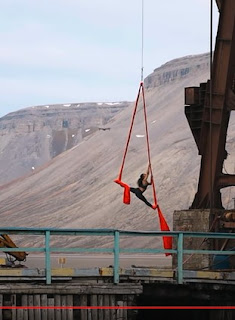
Dan and Kika get to hang around in midnight-daylight after all the visitors have buggered off back to Longyearbyen: having a couple of beers at $7 a bottle. Which is not insanely expensive compared to Oslo. Uma groupies will know the Kika does Aerial Silk acrobatics for fun and that why they had drone footage [R] of aetherial against a post-industrial backdrop against a polar desert backdrop.
Monday, 1 November 2021
Optimization
Metafilter flagged up for me a youtube project a bit like Leo Sampson's project to rebuild the Tally-Ho, a 110 year old sailing boat. Julius and Dylan, two 20-something cousins, started building an iron-age round house in Ireland on Mayday last year and just finished in the middle of October 2021.
That first, foundation, episode is an interesting exercise it optimization: what is the most efficient way of transporting fist-to-skull-sized stones from the river to the building site? Clearly carrying them one at a time is not it. While carrying too many at once invites a hernia.
When I was 10 or 11, the school decided to build a new science block . . . on the cheap. In those ununionized times it seemed reasonable to have the fit, young, male teachers do a certain amount of the labour in the Summer evenings preparing for the next day's work by the actual builders. They hadn't invented Health&Safety or PPE in those far off days and we schoolboys were encouraged to lark about on the site and even bear a hand in the tasks. I remember me and palomino loading two wheelbarrows with a single concrete block each and racing from the block pile to the scaffolding. I also remember thinking about whether it was better to plod across the site with a lot of blocks or fly them across one-a-time. Somewhere in between, for sure. Apart from efficiency, a few years ago, my second best, second-hand wheelbarrow collapsed when I loaded it with too much spoil from the drain.
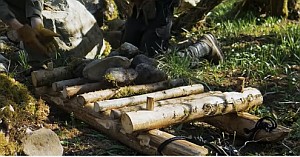
Dylan and Jules start off by loading an iron-ago wicker basket with stones and carrying that load suspended from a pole between their two shoulders. There is some discussion of the tare and nett weight when load-bearing apparatus is involved. 25 years ago, when we bought our old farm; languishing in one of the sheds was an exact pre-Massey-Ferguson replica [but with milled timber and nails] of the solution D & J come to [see R]. In episode 2, they acquire a horse! to do the heavy dragging.And they have let the river do a lot of work in cleaning and grading the stones. Wave-washed Chesil Beach on the South coast of England does this sorting on a grand 30km scale. At the Iron Age hill fort of Maiden Castle 20km inland, archaeologists found caches of even-sized sling-stones clearly mined from this section of the beach. Or maybe that bit was made up by archaeologist Mortimer Wheeler in the 1930s - the sling-shots having been fetched from the beach in his Model-T Ford.
Wednesday, 12 May 2021
Ringing true
As the Guardian of the Ringstone, I've had many occasions to talk about the technique of splitting stone with an elegant lack of effort by understanding the crystalline structure of the rock and using the mechanical advantage of [a hammer and] wedges. A wedge being a form of lever where a long easy travel in one direction is complemented by a small powerful force at right angles. As Archimedes said, you can in theory move the very earth with a long enough lever and a place to stand. I've been a teensy bit obsessive about this craft on The Blob. One of the keys is to practice until you don't have to look at your hands, With a hammer and cold chisel, you must have faith in the hammer; if you check up on it, t'bugger will hit your chisel hand out of spite. I think it's probably true that, like Zatoichi, a blind rock-splitter would be as good as their sighted peers . . . not least because they will listen / hear better to know which wedge needs to♬k-to♬k rather than to♬k.
If the ringing in the stone conveys important information about the invisible progress inside, the same is, Tally Ho apparently, true of the sounds made by hammer on caulking iron. You can hear whether the oakum is tight in the seam. As the caulking progresses - best carried out with a meitheal - the hull gets drum-tight and sounds it. If the hull isn't drum-tight, the ship will take in water and the mariners will have to pump instead of dancing horn-pipes in the off watch. As we saw in February and in contrast to Gertrude Stein's "a rose is a rose is a rose", hammers is a broad church to comprehend very large differences in purpose. Caulking hammer's head is made of a hard heavy wood the business end of which is bound by a metal band. The head is split along it's length to better absorb the shock of each blow and protect the user from white-finger and other repetitive-shock injuries. A by-product of the design is that it acts like a tuning fork and the pitch of the hammer will change as the working face gets worn away and the peculiar g=head gets shorter.In the cited video, Leo makes the case that the caulkers mallet is not retro hang-over from by-gone times. It is an exquisite tool designed by insight, trial and error over many centuries: each part works synergistically not only with the other parts but also with the operators hand. That was my experience when I was using a tradesman's hammer in a peculiar craft. The binding of an old book is a thing of beauty even if you can't read. What I learned over 4 years of Tuesday evenings in the bindery of the university library is that each aspect on the binding enhances the function of the whole. The book opens to be read; but stands upright on a shelf; it can be packed tight; a single index finger can pull it from the shelf without destroying the spine. Leather, acid-free paper, cotton-thread and a bodkin, cardboard and cloth if engineered together properly [a hammer helps!] will be fit-for-function for 1,000 years. You can't say that about your iPad or my Yaris.
Sunday, 2 August 2020
Caesar Augustus
- Lego Zulu
- S♩♫g So♫g
- Everyday - Allison Young
- Pomme - Tous les garçons et les filles
- Politics The Fog of War 90mins
- Far too long? The Value of Empathy 5mins Kennedy scopes Хрущёв
- Tonkin? - we were wrong
- Oliver Stone was there
- So was David Christian
- Fitness
- Know your limits on the W Highland Way
- Running against the train timetable
- Rescue at sea (happy ending)
- Materials
- Land surveying at home
- Mallets for Leo's Tally Ho
- Swordsmithing is woman's work.
- AliBaba Car for €3K
- Presque Isle bulk carrier (300m x 30m capacity +50,000 tonnes) has a pier-tonk
- Calibrating the yard / foot / inch [preVol - lengths - weights]
- hj