Saturday, 22 January 2022

Thích Nhất Hạnh 11Oct1926 - 22Jan2022

Regret to report that Thầy [teacher: R teaching a thing or three] Thích Nhất Hạnh passed on to his next adventure today on the stroke of midnight Vietnam time. In 1975, with the Fall of Saigon, TNH was exiled in France and not allowed to return home. His community purchased land in the Dordogne intending to support themselves growing and selling plums and plum jam. Le Village des Pruniers Plum Village was founded in 1982. His early book The Miracle of Mindfulness: An Introduction to the Practice of Meditation [1975] struck a chord among those of the Lost Generation whose spiritual and affective lives had been shaken loose from their own tradition. An increasing income stream flowed into Plum Village from running retreats and workshops for those who were seeking a better inner life.  

In 2006, The Beloved and I went with Dau.I and Dau.II for a week-long Retreat For Workers in the Neurosciences. A certain amount of hilarity ensued. But it was also extraordinarily affecting: the monastics devote a good bit of time to their music and it's hard to be Dr Skeptic-Face when everyone comes together in harmony to sing namo avalokiteshvara . . . Now you know everything

Thầy was a great believer in walking meditation. This happened most days on the Retreat and with 700 questers and seekers on site there was a certain amount of discrete jockeying for a position near the centre of karma. Call me cynical but all that angst & neurosis seemed to put a damper on TNH's equanimity and his standard practice was to seize the hands of the two nearest children to keep the needy adults at bay. I reflected at the time that, when Dau.II [L,L] and Dau.I [L,R] are the age that Thầy was then, they would be able to tell their own grandchilder that they had been Present at the birth of a movement which now bigger than Islam and Xianity combined - they had walked with god.

Five years later a whole team of monastics led by TNH came to spread the word in Ireland. The Beloved was centrally instrumental in getting the ducks convention centres in a row to make that happen. Further hilarity ensued when I became the chauffeur of the rented people carrier which was to transport Thầy and his cabinet from the Airport to Dublin to Killarney to Dublin to Belfast to Airport.The old chap would doubtless have preferred to be driven by a child but a) that's not legal in Ireland b) I knew enough to speak only when spoken to.

He suffered an incapacitating stroke in 2014, received the best medical care available in the USA but left the West for good in late 2018, returning to Vietnam after half a lifetime in exile.

Hail and farewell and Bon Voyage!

Friday, 21 January 2022

Stampai Mullarnai

It's more than 20 years since we were co-instrumental in the launch of HEN, the Irish Home Education Network. Two things glued the disorganisation together: an annual 'gathering' and a ~quarterly newsletter. One of the early invitees to address the gathering was Máire Mullarney who was old enough to be my mother and had raised a family of 11 kids with very little formal schooling. And written a book Anything school can do you can do better documenting the wide range of interest her very different children had in school-school. The following year we asked Máire back again as part of a panel of Old Hands to field questions from anxious newbie home edders. Well that was a bust! Like Linus Pauling going off the rails about vitamin C, by that stage, Mullarney had gone Full Metal Esperanto and every question was framed by Zamenhoffery

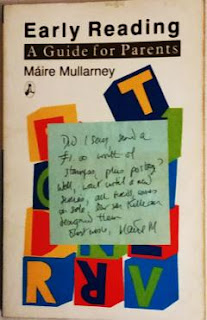
When we started editing the HEN newsletter, I was always casting around for people to interview, and on that button-hole list was Killian Mullarney, who'd spent his entire life observing, drawing and painting birds. But, while a number of people in my Wexford orbit claimed to know Killian, the word was that he was all grown-up and didn't want to be defined as the offspring of a home ed guru / activist / Esperantist. So that interview never happened. I was therefore looking for our copy of  Anything school can do you can do better but could only locate Mullarney's guide for Early Reading [as L]. Which contained a remarkably timely autograph book-mark [also L] "Did I say send a £1.00 worth of stamps plus postage? Well, wait until a new series, all birds, comes on sale. Our son Killian designed them. Best wishes, Máire M".

The new convener of the Wexford Science Cafe is much better networked than me and last Tuesday Killian Mullarney was our guest speaker - even though we are not yet meeting face-to-face. Here is a man who has invented himself; now making a living from the his researches into the life and times of birds. There is another ornitho-earner in Eric Dempsey, whose memoir Don't Die in Autumn [bloboprev] is worth digging out of the stacks in your library . . . or Borrowboxing! Neither of these blokes went to college or even finished school, yet they have become respected experts in their field. 

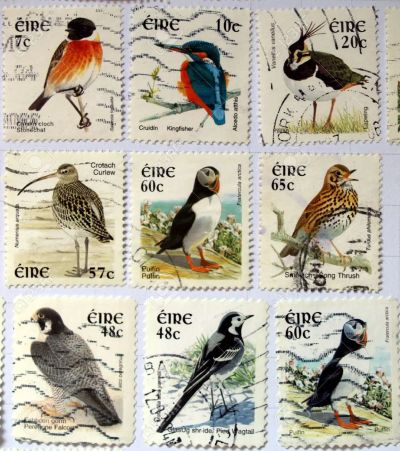
At WSC we heard the epic saga of getting the definitive Birds of Europe into print. Actually, of course, "definitive" because, as the kit gets better and the patient telescope-hours accumulate, revision of certainty is a constant in ornithology. Most of the birds you see out there do not have the perfect crisp plumage of alpha males which appear in bird books - most of the flock are scruffy looking juveniles and less blinged-up females. The book was initially commissioned in the last century by Collins. Their corresponding editor died suddenly, Collins was taken up into a publishing MegaCorp which wanted a quick return.The other illustrator Peter Grant also took ill and died. Eventually the Swedish [junior] publishing house owned the project and the 1st edition was launched 15 years after the initial commission. A 3rd edition is to hit the shelves this Spring 2022.  Mullarney is one of the leads on The Sound Approach which encourages the use of a final front-ear to assist the eyes in bird ID. Interesting riff on sounding out of birds on MeFi. As his Mother mentioned above, Killian Mullarney created the gorgeous set of birdy definitives for An Post:

Peter Grant the ornithological illustrator is not the same as Peter [and Rosemary] Grant, experts on the evolution of Darwin's Galapagos finches. At least the 2019 An Post Europa bird stamps painted by Mullarney have their Latin names.


Wednesday, 19 January 2022

Ed Wilson gone

With great prescience at the beginning of December, I put a hold on the Borrowbox ebook of Scientist: Edward O. Wilson: A Life in Nature by Richard Rhodes. He died, in the fullness of his years, on 26 Dec 2021, so I was ahead of the herd who wanted to read this recent biography.  The book arrived in my feed on 12Jan22 and I raced through the tale within the week: partly because I was familiar with the science and the broad brush of Wilson's contribution. But I guess also because the writing was good to great. Richard Rhodes is a Pulitzer Prize [The Making of the Atomic Bomb 1986 in re me prev] winning historian, biographer and journalist. We've covered some of the same ground: Hedy's Folly is about coded broadcasting and  Hedy Lamarr; Deadly Feasts about BSE and Carleton Gadjusek but I see a rich seam of future reading for me.

Mais revenons nous a nos formis - because ants is what engaged EO Wilson's attention for  the best part of 8 decades - he started early and stayed the long course: fit and lucid into his 90s despite having lost the sight of one eye as a teenage angler. It is not inappropriate to compare Wilson's contribution to 20thC biology to Darwin's in the 19thC. Darwin's 8 year obsession with barnacle growth and development is matched by Wilson's love affair with the genus Pheidole - a widespread and diverse genus of ants [Pheidole dentata's distinguishing features drawn L]. His comprehensive 800 page, 625 species, 650 illustrations Pheidole in the New World A Dominant, Hyperdiverse Ant Genus came out in 2003 and you can't afford it at €190.

It's not clear why Rhodes picked Wilson as his next project because his previous oeuvre was more about physics. It may have been that both men had grimmo absent-father childhoods that forged a dogged determinism. Anther connexion is that Rhodes was on the committee [with Annie Dillard] which decided that a zoology textbook The Ants is  by Bert Hölldobler and E. O. Wilson, should win the Pulitzer Prize for General Non-Fiction in 1991. It was Wilson's second Pulitzer - his first for On Human Nature [1979] which was Wilson's response to the internecine shit-storm conjured up in Dick Lewontin's tea-cup after the publication of Sociobiology [1975].

Sociobiology was the making of me as an independent scientific thinker when I read it (in preference to, like, the actual course material) while an undergraduate in 1976. It was also a long chunky book mostly about "animals" but the final chapter looked at humanity through the lens of what Wilson had learned about social behaviour in other animals. The idea that any part of human character was determined by genetics was counter to the [Marxist] dogma that anyone could become the General Secretary of the Communist Party of the Soviet Union if they learned how in a true Soviet school - regardless of whom their Papa was. Of course there were traces of patriarchal certainty in everything that Wilson wrote - he was born white in Jim Crow Alabama - but it is/was just lazy-arsed polemic to characterise the man himself as racist and misogynist. For the latter, he was notably generous, kind and respectful for two of my closest female friends. I'll also note that he found common ground canopy with Meg Lowman - both recognising the vital importance of biodiversity up there in that of part tropical forests which you can't see from the forest floor.

We - you and me - could do worse than make a contribution to EO Wilson's Half-Earth Project which has the conceit that humanity has shit-the-bed, yes, but is prepared to ring-fence the other half of the planet for all the beetles, bats, bees and begonias which we haven't already driven to extinction.

Monday, 17 January 2022

Processing: alnus to twigs

 Two Fridays back, I wrote about the forcible transmigration of a handful of our riverine trees [alder Alnus glutinosa and willow Salix spp.] to the opposite Wexford <ptui ptui> bank of the wee stream which marks the end of our demesne and then county borrder. 


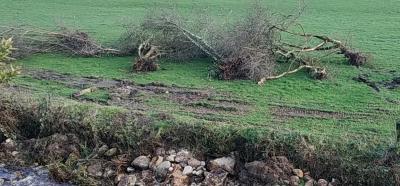
These things happen even if one could wish otherwise. asap, I planted about 20 Salix whips to help hold the bank together during the periodic floods. Last week, the weather being unseasonably sunny and dry, we descended on the field where the tree corpses had been laid out: self with the mighty Zomax ch.saw & The Beloved with loppers and a hatchet. I R old, so I resolved to work a shift equivalent to a tankful of gas in the ch.saw. The willows especially were quite gnarly and twisted; and I could see length suitable firewood through a veil of twigs. Removing the layers of occluding brash was not dissimilar to a surgeon peeling back the epidermis, dermis, adipose, muscle and mesentry to reach the patient's pancreas. 

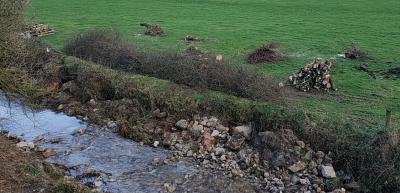
I stopped the engine every little while a) to spare the arm-muscles b) to get some work out of the others: pulling brash out of the way, so it wasn't a trip-hazard [I R old: it goes with the territory] but also stacking the logs into tidily convenient piles. TB did more work pulling all the small stuff into a long bank along the edge of the field. This stop-start meant about two hours of work and two trees dismembered for each tankful of gas. Three shifts over Thursday and Friday saw our part of the task finished.


I am confident that, some time soon, the log piles will be delivered to our yard in the front bucket of our neighbour's tractor. The stumps, which are too fibre-tangled to split and too stone- and sand-included to cut, will disappear into a hollow - for habitat, like. Twigs also.

Sunday, 16 January 2022

Than longen folk to goon on pilgrimages

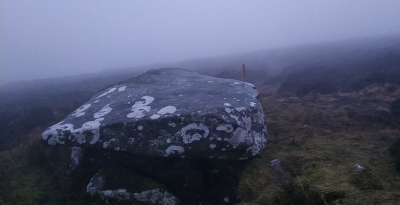
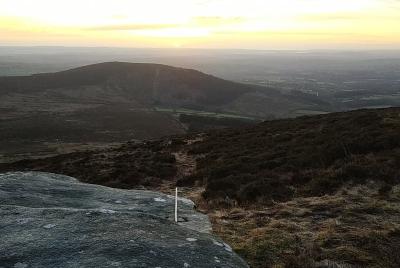
It is the Feast of St Fursey Lá Feile Fursa, an Irish saint, born in  Galway (where he became abbot of Killursa) but travelled across Europe to teach and preach in East Anglia and Picardy - where he is more widely venerated than in the home-place.  A train of events last year has induced me to make an annual pilgrimage to a certain glacial erratic on the North-East shoulder of our hill. Has to be for sunrise; has to be January; so there is small expectation of "success" - defined as catching the sun actually breaking the horizon. But that hasn't stopped a rolling roiling circus around Solstice Sunrise in Newgrange each year. On Weds 12 Jan 22 I made a wee recce aka feasibility study and captured the moment. On Lá Feile however it was a mizzling whiteout:

Leaning up against the altar, you can catch the top of the pilgrimme's staff made by my friend and fellow seeker Sally a few years ago.

I was, so, there! As I came down across the face of the hill I could hear the first weekend walkers chattering on the path far below but they couldn't see me, nor I them. Make a note in your diary for next year: staff, sandals, sanctity all optional.

Tis St Fursey's day

Sunrise is the local thing on this day
this pic taken at 0830 12Jan2022; because you just can't guarantee clear skies in Ireland on any particular day and time in January.

Notes on the pic above: sun rises at 125 today; the stick is pointing at 127 because it's four days ago. Onwards! Avanti! Ar aghaidh! En avant!

Friday, 14 January 2022

Plumbing the depths

 Since we moved into the farrrm, we've had <counts> five [5] different plumbers on the payroll. The first installed a) copper pipes throughout: in an area known to have copper-eating acid water b) a truly byzantine heating and hot water system c) the grit filter on a sideline of the water system that didn't go to the house. Grit from the newly sunk well accordingly washed into the house . . . to embed like fossils in all the tap washers so they ground out their seatings . . . to block the inlet jet to the header tank . . . and fill the header tank with an inch of fine sand. The first copper hot-water cylinder lasted 15 months the second 2 years until replaced by stainless-steel. The copper pipes lasted about ten years and failed sequentially over the next five to be replaced by qualpex plastic piping. So many drips through the kitchen ceiling!

The current plumber answered an emergency call two years ago. In the chat afterwards, he refused to change the washers on the kitchen taps because he reckoned the corrosion hereabouts would be near terminal, but did offer to replace the mixer tap unit in the kitchen if we found one which suited [the decor?!]. I operate on an if it ain't broke don't fix it basis. If the t'ilet doesn't flush easily, I'll happily fill a bucket. This Christmas we had a house full of family though, and they all needed to be instructed in how to flush the upstairs jacks. This was quite the ritual for house-guests of my father's generation "you need give the chain a half pull and then heave like buggery". Something clearly needed to be done and at the beginning on this week Current Plumber said he'd time free if we could source the parts.

The kitchen tap unit [R, with lever-taps and height enough for a hot-water bottle] was replaced soon enough but the upstairs toilet cylinder proved to be of sterner stuff. The thing is that toilets are designed so that the workings are invisible - users must not be frightened by the sight of a ball-cock or a rusty bolt. Plumber decided that the problem was only obviously to do with the flush-handle: the fact that was banjaxed through strain hinted that the siphon was probably defective as well. Toilet fittings are fixed together with threaded steel bolts and wingnuts but these inevitably get corroded unless the householder [that would be me] routinely keeps them oiled, greased and undone and re-tightened. At some stage in the derusting process, Plumber asked if there is a vice-grips in the house. Fakk! There is; but that tool could be in one of 3 places, two of which are outside in the dark beyond the reach of electric light. After 10 minutes of fruitlessly turning stuff over by torch-light, the vice-grips manifest itself in a 4th place [with the spanners, duh] and I rushed them upstairs.

"Every man needs a vice-grips"
"Maybe so, I'm not a proper man clearly: I have vice-grips but I don't know where they are"

I also have a selection of spare hack-saw blades which was handy, because the wing-nuts clamping the cistern to the pan were seized entirely. ¿Why oh why do designers of bathroom ceramics recess the bolt-holes so that they cannot be accessed with an angle-grinder?  Likewise ¿Why oh why do designers of bathroom ceramics think it's a good idea to insert the inlet pipe into the cistern through the bottom? Yes, yes, I know it's because it cannot there be seen but really, it is a hostage to leaking fortune innit? The poor weary plumber dried his hands, tidied up and knocked off at 8pm. At 1 AM I get up to use the facilities and get a wet sock. The in-pipe has a micro-leak producing drip . . . drip . . . . . drip at the rate of about 1 ml  per hour or half a cup a day. We have a bucket, we are fine.

Not for the first time, I reflected with St Plumb that Ould Ray, who lived in this house from 1941 to 1994, never had plumbing woes because, before we came with our city ways, there was no well, no pump, let alone running water and a flush-toilet. Since then so many pipes, so many stop-cocks, so many joints, so many ball-cocks, so many spigots and so many pumps all ready to go wrong on us.