It's more than 20 years since we founded HEN the Home Education Network. Once a month during 1998 we packed the girls [Dau.I turned 5 and Dau.II 3 that year] into the car and drove 100km north to a scout hut in Greystones to meet with the other HENnies. It was an exercise in tolerance; listening to other tree-huggin', rice-cake-eatin', sandal-wearin' alternative folks lay out their daft and impractical ideas while ignoring our eminently sensible counter-suggestions. After much debate it was agreed that there would be no chair or secretary at any meeting - a facilitator and a scribe were to be designated instead. It seemed that we'd never get to confronting the Government's plans to curtail our freedoms because we spent hours and days dealing with the minutiae of our own intra-group dynamics. One of our number agreed to edit a newsletter and returned following month with the 1st Edition printed in colour and stapled in the corner. Some of the front covers were paler than others and I suggested that it might be better if the editor took a crisp camera-ready copy down to her local printer and get it photo-offset printed licketty-spit and back-to-back thereby saving trees. Editor "No, I wouldn't do that, I like watching each page emerging from my printer". . . the other professional Dad and I studiously avoided catching each other's eye lest our brows simultaneously crinkled in exasperation.
I was reminded of this watching-paint-dry approach to process while watching a tour of Springbank Bank Distillery [see L for fruits of production] in Campbelltown, Argyll. It is a most peculiar mix of automation and handicraft. The machine which applies the labels to the whiskey bottles is served by a bloke [minute 11.30] who lovingly holds each bottle into the press. No wonder fancy whiskey is so expensive. But really how far down the tracks of automation do we want to go? Each time a machine replaces five workers, there are 5 fewer customers who can afford to buy the product.
One of the things that my PhD mentor and I had in common was that as teenagers we had worked in [different] mills. He was assigned to work with an ancient almost-bent-double man in a room on one of the middle floors. They sat around smoking until every so often several tonnes of grain would pour from a chute in the ceiling. Their task was to push and shovel the heap through a hole in the floor on the opposite side of the room - just like the way malt is treated at Springbank distillery. Too much like bonkers to the young feller. After the second mighty heap had been disposed of, he went out round the mill-yard gathering lumber, borrowed a hammer and nails and jimmied up a chute from the hole in the ceiling to the hole in the floor. The ould chap and the youngster had a day and half sitting on crates, smoking and watching the fruits of labour whistling past. The line manager eventually found them getting paid for doing bugger-all and told them to clear away all the new works and get back to work like it had always been done. Some managers show a certain want of imagination.
Monday, 14 January 2019
Sunday, 13 January 2019
K K K Day
Aphrodite Kallipygos [R Aphrodite of the beautiful bottom]. We have featured a Venus with a more Rubenesque figure before.
Kurious komparisons - turn sound off!
K Songs
Kurious komparisons - turn sound off!
K Songs
- I've gotta girl in Kalamazoo
- Kate Bush sings This Woman's Work
- K K K Katie by Bob's Barbershop Boys - well that was dreadful lads, let's get a pro:
- Bill Murray
- and now for something completely different:
- K.K. Kabobo from Ghana
- Kalinka SSR.
- Königsberg [now Калининград] bridge problem
- Kamchatka brown bear Ursus arctos salmon-fishing
- Kilkenny Designs pots and crocks
- Kent: Operation Stack and Operation Brock to deal with Brexit truck-jam problems
- Kettle Chips - 15% of their product is shipped to Europe (through Kent!)
- Kip Keino, Kenya thrashes the 1500m field Mexico Olympics 1968.
- Because Kenyans were Born to Run. [blobprev]
- K for Kalium, the Latin word, derived from arabic Qali meaning plant ashes ie pot-ash
- It's an alkali metal in the first column of the periodic table like Fr87 Francium
- It is lighter than water Density 0.89g/cc
- So it floats on water . . . but not for long
- Most people's diet is chronically short of potassium you need 3.5g/day intake
- Carbon dating is only good for about 50,000 years. For long time frames (the origin of Homo sapiens for example) you can use the fact that the radioactive isotope 40K decays to 40Argon with a half-life of 1.2 million years.
- K and its salts burn with a beautiful lilac flame ~760nm wavelength
- Those salts are very soluble in water. Concentration in seawater is 0.4g/L - about 1/10th the concentration of sodium.
- You are lugging between 100g - 150g of potassium about with you.
- Potatoes and pomegranates pack more potassium than bananas
Saturday, 12 January 2019
Books, too many
Just finished the first week of the second term of my penultimate year teaching at The Institute. I've been wishing all my student groups Happy New Year and reflecting on the brief window between Epiphany and Groundhog Day when you can say, and believe, This 2019, it's going to a transformative, wonderful year. After a month, the evidence will suggest that 2019 will be much the same as 2018, 2009, 1979. Nevertheless, it's not a bad time to do some de-cluttering: the evenings are dark and outdoor work is paused.
M'pal P in Massachusetts sent me a Grauniad link on books and decluttering, which I read with interest and skepticism because a lot of my literate friends-and-relations believe in books exceptionalism . . . that books are possessions which should be privileged over a welsh dresser filled with plates and cups or a garden shed well-hung with tools. Me being me, the new year also triggers reflections on The End of Days and remembering the list of civil war melt-down essentials. How many of my books would be useful during or after a zombie apocalyse? Here's the Konmari gorn-viral decluttering method: I don't know how to fold my dinner plates in thirds so they stand upright but I guess that will be in a later lesson. I really could do a job on the clothes because I have drawers full of T-shirts because they are often given away for free . . . but I never wear T-shirts. And the books! It's ridiculous:
Here's the N wall of our living room which faces me as I sit, slack-jawed, on my sofa waiting to be inspired for The Blob. A wall 200mm thick of paper serves as effective thermal insulation. But the only unique material on the shelves is 120mm-linear of The Blob. The author of the Grauniad article, who is an author, objects to Konmari's super simple criterion for keeping a book: that it brings joy. No! reading is about more than tra la la, it's about being challenged, informed and stimulated. Well I'm sure that's correct in principle but with so much choice in books and so little time for reading, how many of us choose to have our cosiness challenged? How many pay folding money to buy the writings of people from the other side of any political / philosophical divide which engages us?
" . . . a golden rule that will fit everybody, this is it: Have nothing in your houses that you do not know to be useful, or believe to be beautiful". That William Morris! Books may be attractive [publishers employ marketeers and designers] but a modern paperback is rarely beautiful. Nor is it strictly utilitarian - my dictionaries are rarely opened because of on-line alternatives. We have yards of cook-books but I only use a handful and only a handful of recipes from each one. And I'll tell you a really annoying thing about paper-page books: they are really hard to search. My review of the John Tyndall biography is much shorter <phew!> than it might be, because I was unable to retrieve half the notable anecdotes in his life. That would be no problem with the Kindle version. Both Dau.I and P shared this wonderful appropriate tech multi-volume research aid [R - source]. I've brought my kindle back to life after losing the charger for several years: It's really much more efficient to store text electronically. I think I could go through my roughly category-sorted library and remove every third book for re-circulation: it would be years before I'd notice the loss.
Friday, 11 January 2019
Black box
You know of course that the black box [R] with which we all familiar isn't black. If there's a disaster involving tonnes of aviation spirit and lots of flammable material then the default background is going to be charcoal. Here, I've created a portmanteau phrase to indicate a box to be ticked for ethnic diversity. Damn but I hate tokenism! Suits, who haven't a clue don't really care about ethnic diversity or inclusivity, know that they must do something about the optics: so they appoint an Equality Officer to review all the official documents from their institution.
Problem: Too many white faces?
Solution: retake some of the photos to include just enough people of colour [✓], wheel-chairs [✓], BLTs [✓], women [✓] to meet a more or less arbitrary threshold for right-on'ness.
I won't suggest that minorities are seen as a threat but they certainly aren't considered an opportunity. I'm thinking of appointing myself MLO - Minority Liaison Officer. You might think that is an outrageous bit of cultural appropriation - I am, after all, The Patriarchy personified: white, straight, grey, male, propertied, [over]-educated. Then again, then again . . . to have a silver-back laying about him insisting on fairness, equality, affirmative action . . . and giving up half his salary pour encourager les autres; that might make people take notice. It is a fact of Western life that folk listen to people like me as they don't listen to those slightly mythical "black lesbian single-parents". In October, for example, I was one of only 5 out of 800 employees who saw a workshop on Gender Pronouns as an opportunity . . . rather thana threat an irrelevance that could eat into my lunch-break.
I'm getting these ideas above my station because I was invited to view a propaganda video from an Institute of Technology which presumably is an attempt to recruit more, and better quality, students to sign up on the CAO forms: bringing fees and bums on seats to the IT. Have you gorra couple of minutes? Chekkit out and ask yourself - if I was 18 [or 38] and got the points, would I spend four years of my life there?
Here's my feedback: Nice. Earnest. Monochrome: O'Reilly, Nolan, McNamara, Dunford (blokes featured first, women in second place tsk). Devereux (Up Wexford!), Mynhardt (best tan), Scott, Kavanagh. In fact, disregarding the 4M + 4F stars, not a single person of colour features even in the background. Next edition please to feature some New Irish: Abdelhakim, Gregan, Щу́кин, Tadema, Wang. On the way to get a cup of tea a few days ago, I bumped into the VP Student Affairs [or os she the Colonel of Corporate Strategy? - a Suit anyway] and said I knew just the bloke for their next video. I've known him for 2.5 years; over the telephone you'd know him as 'good school' Midlands, without the voice you'd say Africa; he's funny, self-deprecating, symmetrical, ambitious, helpful. He's the only Irish who has tried some French on our Erasmus students from Montpellier. Put him and his Polish-Irish pal in the next propaganda video together with the two Dub Dubliners they hang out with. They're a stitch! They'd go viral and we'd be batting away a wave of New Irish applicants for the next three years.
The Competition. Are you more taken by
Problem: Too many white faces?
Solution: retake some of the photos to include just enough people of colour [✓], wheel-chairs [✓], BLTs [✓], women [✓] to meet a more or less arbitrary threshold for right-on'ness.
I won't suggest that minorities are seen as a threat but they certainly aren't considered an opportunity. I'm thinking of appointing myself MLO - Minority Liaison Officer. You might think that is an outrageous bit of cultural appropriation - I am, after all, The Patriarchy personified: white, straight, grey, male, propertied, [over]-educated. Then again, then again . . . to have a silver-back laying about him insisting on fairness, equality, affirmative action . . . and giving up half his salary pour encourager les autres; that might make people take notice. It is a fact of Western life that folk listen to people like me as they don't listen to those slightly mythical "black lesbian single-parents". In October, for example, I was one of only 5 out of 800 employees who saw a workshop on Gender Pronouns as an opportunity . . . rather than
I'm getting these ideas above my station because I was invited to view a propaganda video from an Institute of Technology which presumably is an attempt to recruit more, and better quality, students to sign up on the CAO forms: bringing fees and bums on seats to the IT. Have you gorra couple of minutes? Chekkit out and ask yourself - if I was 18 [or 38] and got the points, would I spend four years of my life there?
Here's my feedback: Nice. Earnest. Monochrome: O'Reilly, Nolan, McNamara, Dunford (blokes featured first, women in second place tsk). Devereux (Up Wexford!), Mynhardt (best tan), Scott, Kavanagh. In fact, disregarding the 4M + 4F stars, not a single person of colour features even in the background. Next edition please to feature some New Irish: Abdelhakim, Gregan, Щу́кин, Tadema, Wang. On the way to get a cup of tea a few days ago, I bumped into the VP Student Affairs [or os she the Colonel of Corporate Strategy? - a Suit anyway] and said I knew just the bloke for their next video. I've known him for 2.5 years; over the telephone you'd know him as 'good school' Midlands, without the voice you'd say Africa; he's funny, self-deprecating, symmetrical, ambitious, helpful. He's the only Irish who has tried some French on our Erasmus students from Montpellier. Put him and his Polish-Irish pal in the next propaganda video together with the two Dub Dubliners they hang out with. They're a stitch! They'd go viral and we'd be batting away a wave of New Irish applicants for the next three years.
The Competition. Are you more taken by
- Athlone IT; allusive not hectoring, has black student [R ✓]
- The Blanch: 'students' gurning to indicate how happy they are in West Dublin
- IT Carlow: see above
- Cork IT: career focussed education but a BLT flag [✓] features early
- Dundalk IT: short! [✓] exemplar student [XX ✓]; like in Carlow
- Sligo IT: gott in himmel - they only care about making drones for the economy
- IT Tallaght: 6m36s = 5 mins too long; President has suit but no neck
- Tralee IT: hey, a girl with purple hair [✓] and several with cotton head scarves [✓✓✓].
- Waterford IT: cartoons, emphasising how cheap it is in Waterford
Thursday, 10 January 2019
Element 87
UNESCO has announced that 2019 is International Year of the Periodic Table; it being 150 years since Дмитрий Иванович Менделеев Dmitri Mendeleev nailed down the properties of enough of the known elements to form a table with some predictive power. If you know the atomic number of an element you can have a reasonable punt about its chemical properties. That's because the atomic number is effectively a count of the [positively charged] protons in the nucleus and these are matched by an equal number of [negatively charged] electrons whizzing round the outside of nucleus making chemistry happen. For periodic table geeks here's a spiral representation of the same data from Pop Mechanics.
The characteristic hydrides of the elements in the top right corner have one less H as you go left because they have one more electron in their outer shell: Methane CH4, Ammonia NH3, Water OH2, Hydrofluoric acid HF. About a dozen of the elements were known in pure form to the ancients: C carbon S sulphur Fe iron Cu copper Zn zinc As arsenic Ag silver Sn tin Sb antimony Au gold Hg mercury Pb lead. Nothing new under the sun for hundreds of years until, in 1669, Hennig Brand proved the existence of P phosphorus. Science had to wait another 66 years for Co cobalt and Pt platinum. By the time I was in school in the 1960s, there were 103 elements on the periodic table hanging up on the wall of the chemistry lab. All those with numbers higher than U 92 uranium were madey-uppy radioactive creations which were made, at vast expense, in minute quantities, and decayed into something else before anyone could find out much about them. You can see these transuranium elements in the long up-tail on the right side of this chart one every few years since WWII:
Before that recent spike, there doesn't seem to be a pattern in when elements were discovered. Abundance must be a factor; but also reactivity plays a part. The inert "Noble" gases, for example, were unknown until the very end of the 19thC.
The last naturally occurring element had to wait until 1939 to be definitively identified. Francium, element 87, is found in nature but francium223, the most stable isotope, has a half-life of only 22 minutes; so you have to be quick to catch it. It was discovered by Marguerite Perey, a protegé of the great Marie Curie who named Polonium after her natal country - although she did all her scientific work in France. Perey got naming rights after her discovery and took her hat off for La Belle France. Francium is found in ores rich in Uranium as part of a natural decay chain [L - there is one error in the numbers shown - check the actinium Ac], because it is so fizzy and unstable, they estimate that at any one time there is only about 30g present on Earth at any one time. But if you try to grasp it, let alone analyse it, the damned stuff slips through your fingers to become astatine At. The vertical downward lines connecting the various elements in the diagram [L] are the result of alpha decay - where the nucleus shed 2 protons and two neutrons, so the atomic number goes down by 2 and the atomic weight decreases by 4 units. The up&right diagonal lines are the result of β decay which, by losing a massless negative charge, makes a new element with the same mass.
The virtue of the periodic table is that you can predict the qualities / properties of elements before they've actually been discovered. The chemists were on to element 87 as early as the 1870s, giving it the provisional name of eka-caesium and jamming it right under caesium in the column of alkali metals: lithium Li - sodium Na - potassium P - rubidium Rb - caesium Cs. It's 'discovery' by a succession of people from 1925 onwards, was quickly rubbished by other workers in the field:
- Д.K. Добросердов in Odessa claimed success in 1925 and named it russium
- G.J.F. Druce and F.H. Loring from England named something alkalinium in 1926
- In 1930, F. Allison in the USA wanted to call his stuff virginium
- H. Hulubei and his French colleague Yvette Cauchois went public in 1936 with moldovium
Wednesday, 9 January 2019
slow down
Here's a thought: replace the vicious cycle with a viscous stir-about. When I started working in The Institute this week 6 years ago, I was mad busy having to prep and deliver courses in a wild array of different areas of science: remedial maths, intermediate statistics, introductory biology, biochemistry, physics, water-chemistry, titration, spectrophotometry, Kjeldahl for protein . . . I could go on and you'd be Zzzzzzzzzzzz. With so much going on it was 'clearly' insane to start bloggin' about the process because that was an unpaid extra which would eat into the small fraction time left between teaching, commuting, eating and sleeping. Not so! The Blob became the glue that cemented my life sufficiently so it didn't fly apart under the pressure; or start oozing through the pressure distended seams.
And always, always through the whole transition there was time to make bread because that stuck to the ribs; and kneading for ten minutes was a daily practice that helped me stay on track. A different person might have decided he was too busy for blogging and baking and spent an equivalent amount of time shopping for dinner on the way home from work. When I started this end-of-working-life job I was making regular [flour, water, salt, yeast] bread but have since adopted a sourdough starter which slows down the process and requires a little bit more care and attention. Actually, it's more like owning a puppy: if you don't feed and exercise it regularly its nose dries out and it starts to smell a bit sulphurous. It's the downside of living alone for about half the week while The Beloved is minding her aged father Pat the Salt: the starter must be refreshed so the bread must be made so the bread must be eaten. Bread with every meal means rice and potatoes come but rarely, and pasta hardly at all. [note to self: make a smaller loaf, idiot]. In any case, I believe <halleluia!> that by fermenting at least overnight, the microbial community which is sourdough works harder on the flour to make something that is tastier and more nutritious.
Nice soundbyte on the virtues of food fermentation in an article in No Tech Mag. " . . . canning you kill all of the microbes and seal it hermetically. With fermentation you invite the microbes you want and don’t let in the ones you don’t. Fermentation is diplomacy and canning is a massacre." I like that because it concords with my sense that you don't want to be toooo clean while kneading bread - or making sauerkraut. The resident flora of the skin: coagulase-negative staphylococcus, propionibacterium, dermobacterium, and micrococcus are the doctor's primum non nocere - doing no harm to the food and probably adding a certain je ne sais quoi to the ferment. You do have to take a certain amount of care with the transient flora, which are disproportionately high with fecal coliform. Then again, if it's your fecal coliform you're probably immune to its flushing effects. Just be careful not to let Uncle Joe from Philadelphia taste the sourdough before it is cooked.
One of the interesting hints in the No Tech article is about recovery when things go furry. If you are at your ferments at least once a day, you'll catch the signs of white fungal mycelia before they push the top off the crock-pot. The advice is to skim the obvious signs off the top and vigorously stir the top into the anaerobic centre of the mash. What grows on the top almost certainly requires air to flourish and this deep-sixing puts a stop to its gallop. Last week, when one of Dau.II's garden of Christmas cheeses, which had perhaps foolishly gotten wrapped in plastic, started to bloom blue and white fur, I didn't throw it away - I just prioritised it to the Eat First bin. Here's another really useful [via MeFi where there is an interesting often funny commentariat] rule of thumb: a 2% solution of salt in water will keep off all the bad bacteria like Clostridium botulinum and give a free field of fire for desirable microbes mainly Lactobacillus spp.
The time element in fermentation is often just elapsed time rather than working time. Once you're set up, the steady state allows for almost instant gratification. Crunchy, tarty sauerkraut, a scoop with every meal. Yum!
Tuesday, 8 January 2019
The Sons of Papa
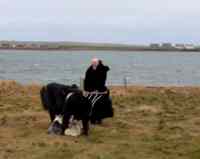
Well, and like, sure all those who identify as male are the son of some Papa, even if many of us are not the children of the declared parent. Today we treat of a peculiar group of schismatics centred on Papa Stronsay in the Orkneys. Here we be:
The peninsula to the south is part of Stronsay and Whitehall in the all that remains of the Orkney herring industry. Back in the day before WWI, 300 herring boats operated out of Whitehall and 1500 fishwives were employed landside gutting the catch and salting it away in barrels for export to the Baltic probably through Hanseatic ports like Lübeck in exchange for salt. It must have been like the Main Tickle in Newfoundland where, they say, you could walk across the harbour one boats at a time. For scale the distance from the Whitehall pierhead to the Point of Graand on Papa Stronsay.
There are a number of places named Papa - Papa Stronsay, Papa Westray, Pabbay [where we were August 2017] and they are all named in tribute to the sea-faring away-from-it-all Irish monks who took the gospel and themselves all over Europe but seemed to prefer brutal isolated [isola = island, after all] outposts nearer to god but far from the madding crowd. All that cockle-shell travelling goes back more than 1,000 years before the Northmen, with bigger boats and a more acquisitive demeanor, more or less put a stop to exposed monasteries.
Papa Stronsay, all 74 hectares of it, was bought from its farmer by a group of catholic schismatics in 1999. These boys called themselves The Sons of the Most Holy Redeemer aka The Sons, and are affiliated with the Society of St. Pius X aka SSPX. That was founded by Bp Marcel Lefebvre in 1970 because he and others wanted the catholic church to carry on on its same old same old ways and ignore the agreements of Vatican II. They really didn't approve of all that Vat.II accessible stuff - mass in a language familiar to the congregation, the priest celebrating it facing the people rather than the altar. I believe [hallelujah] that most of SSPX including The Sons were accepted back into the Church of Rome by Pope Benedict.
Despite the remoteness of their Golgotha Monastery on Papa Stronsay, The Sons seem to be part of the global village: a) being down with youtube when they find a seal Phoca vitulina in their cloister and drag it back to the sea on a sheep-hurdle [R]. They also blog away with the best of them, propagating their way of life to the world. I don't know what the original Irish monks would have thought of current developments.
Islands? We've lots.
Subscribe to:
Posts (Atom)