Monday, 7 July 2025

Spot the diff

25+ years ago, we were down the farm cutting bushes from one of the field boundary walls. Somewhere under the bushy debris along the East face of the wall there lies a pair of secateurs. We were younger then and, even without a formal inventory, could remember all the tools we had brought down for the task and had used over the previous couple of hours. It was lunchtime and none of us had the oomph to turn over 50m of spiny vegetation for an outside chance of recovering a tool which cost (then) €3.99 in Lidl. Javi was with us in those days, so there were three people to blame. We are always losing stuff . . . because we have so much stuff to lose. After the loss of the secateurs and a handy 90cm spike/crowbar, I painted most of the tools with red-and-yellow stripes [as L].

We were down in Enda's Corner tidying it up in advance of a film-crew and the spring of my current Lidl-secateurs went sproinnng into the vegetation. I didn't see it go, it just wasn't there, so finding it was to be a needle in a haystack affair. I didn't even start! I make the effort to retrieve nails and fence-staples in such circumstances because they can come back to bite you; but a wee bitty spring, not so much. And even if painted yellow and red, it would still be invisible to my rheumy olde eyes.

The machete / 'sward-sword' shown L is one of three which we inherited from The Beloved's Uncle Jim. He had commissioned them from the local smith in Kano, Nigeria and carried back to Ireland many years before 9/11 and the subsequent security theatre. We lent one of them to 'someone' years ago, never to be seen again, but I use the remaining pair on the reg'lar for brambles, bushes and briars. I periodically touch them up lethal sharp with an angle grinder. Indeed, two weeks ago I was trimming back the veg at the start of the lane beyond Harry's gate . It was a project, so I left the sword in place when distracted from the task by counting sheep, making tea and collecting the post. A week later, the goddam tool was not in its accustomed place, so I spent some time over about three days hunting and rehunting for it near Harry's gate and in all the usual places. It should have been here: can you spot the difference?

The old wooden chair has become a rack for small tools used in and about the polytunnel. So of course I checked there but only saw the handle of one of our pair of swords [as R above]. On the 19th time of looking, I knelt down to check behind the chair and under the table again. From that perspective, the blades of two swords were readily apparent . . . Bob the Autoconfused having covered the second handle with an inverted paper coffee cup.  Having a place for everything and everything in its place is a necessary but not sufficient solution to the lost tools problem.

StopPress:  that sproinged spring down in Enda's Corner? After my triumph with the once and future sword in the chair, I wondered how hard it could be to find that spring. Not that hard, it turned out: I got down on my knees to part the grass and saw it within 5 minutes. It was easier than expected because the spring was not the feeble / invisible helical wire I had in m'head, but a robust sausage as thick as a pencil. I have repatriated and threaded it back on the secateurs with anti-sproing spring string [as R].

Don't give up ♬ ♪ ♫ ♩
You know it's never been easy
Don't give up
'Cause I believe there's a place
There's a place where springs belong

Friday, 4 July 2025

Too long too easy

In the early 1970s, when I was getting to college, people were beginning to apply evolutionary theory to help understand the human condition. The basic idea was that, through comparative anthropology / primatology we could speculate about the social structures of early humans. It could then be suggested that some of the drivers of social relationships might be genetically hard-wired rather than learned anew each generation. This was controversial because biological determinism, if it was hard-wired, might make it impossible for the dispossessed to get a fair share of the cake. These ideas came to a head when EO Wilson [obit] published Sociobiology in 1975. An earlier exponent of the idea that 1 million years of evolution in anatomically modern humans might impinged on how soccer teams or boardrooms worked was Lionel Tiger and Robin Fox, The Imperial Animal (1971) [review]. You could hardly choose more eponysterical author names for a book about biological anthro.

Robin Fox has a daughter Kate Fox who works as an experimental sociologist in Oxford. She is married to author neurosurgeon Henry Marsh [whom prev], not that it makes any difference - she's a person in her own right, not a chattel of the men in her life. I got her chunky book Watching the English: the hidden rules of English behaviour. (2004, 2ndEd 2014), out of the library recently. It's 225,000 words [far too] long and not enough chips. There aren't many copies in the Irish library system and there was a reserve on the title, so I didn't read every word. There's a chapter on the relationship of English people to English television, for example. We last owned a telly 40 years ago (in England), so all that is a closed book to me and I skipped that chapter.

Other sections made my skin crawl with shivers of recognition, so I didn't dwell on them either. What I did read is readable and amusing in a breezy sort of way. It is based on experimental work, so is not a series of anecdotes and opinions. The experiments are science but not as hard scientists might recognise it. I'm not getting snitty/sniffy here: I had my name on a number of papers in biomedical immunology which had small samples, large error bars and quite woolly conclusions. Those conclusions are quite likely irreproducible, if anyone could be bothered to replicate our underpowered experiments.

Our results were based on molecular biological assays where the reagents cost a lorra money and patients and controls were limited. €500,000 doesn't go far in Eppendorfia. Fox's research is cheap: like bumping into people in railway stations and counting the number of times they say sorry; or sitting in the pub eavesdropping on blokes slagging each other off as a surrogate for showing affection . . . and counting the insults. But it doesn't seem to be based on thousands of interactions. Maybe it doesn't need to be. Fox's theme or thesis is that the English are funny. Irony rules! Self-deprecating humour is a key ingredient in social lubrication in England. I do that, it's how I was brought up (in England). The English also tend to be punny which is an acquired taste and I'm glad I don't have to endure the careful arched-eyebrow delivery of clever word-play any more. 

StopPress: Had a visit yest from a friend who lives in Newry and commutes daily to Dublin. In contrast to the English, they talk to each other on the train. Only among Team Carriage C, mind: wouldn't know anything about those Others from Carriage A. But Carriage C has a Christmas party and all the other elements of successful Third Spaces. Brits are missing something walled up behind their newspapers immersed in their devices not making eye-contact 

Wednesday, 2 July 2025

Eating for Gaza

Our friend and neighbour La Torbellina de Tenerife is up-and-at-'em again. She is the most active person I know when it comes to bringing relief to the dispossessed: be that refugees, travellers, single parents or the troubled.  On 21 May we got an invitation to come along to the village hall on the Solstice and eat middle-eastern food to raise funds of Gaza go Bragh - €15/plate.

I ignored it. I was in the middle of Preparation Yomp and was by no means certain I would be back from France by 21Jun25. The next easiest response is to pay the money with no intention of eating disturbing foreign food - most of us in Ireland realise that neither side in the current conflict will entertain bacon-and cabbage and spuds. A more adventurous response is to buy a ticket and give it a go. Over the last 30 years there has been a culinary revolution in Ireland: frozen pizza and pierogi are available in Aldi . . . for all. There is a Chinese take-away in Borris!

When I did get home on 18Jun25, I found that The Beloved had volunteered [no pressure!] for a) kitchen prep on Saturday morning b) being Provost of Serving in the evening. The emotional and logistical energy for such event is a significant drain on any available calories and it can be handy just to have someone, anyone, to assist with the decision making. That's how we came to be constructing 250 koftas for 3 hours on Saturday forenoon; along side two veg-choppers-chaps [Ukraine, Espain], a spud peeler, and a chef du salads.

We were allowed home for a late lunch and a brief siesta, but requested-and-required to rock up to The Hall for 18:00hrs for a gates-open at 19:30. There are seats for 200 in the hall, that's the limit set by the insurance and #punters were close to that.

Notes to self . .  and those who imagine a similar event.

  • Don't employ absolute beginners to make kofta. Team Barbecue were delayed in their timetable because, 7-8 hours after being massaged onto the skewers the lamb-mince was ready to drop off. It helps a little if each layer of skewers is separated from the next by a sheet grease-proof paper. Bamboo skewers are better than steel.
  • Shunt families with small children to the front of the line! 19:30 is bedtime for kids. This is what they do in Plum Village. As well as a Provost of Serving; appoint a Dragoon of Customer Management.
  • Have everyone find a table [with their mates but also with strangers] and sit. Make sure some sort of snack and a drink is within reach. Have the Dragoon of C.M. bring each table up to the serving table in turn. That's the way it was done at the Christmas Do at The Institute. People sitting down and chatting are less likely to get hangry when the barbecue is delayed by kofta-inkompetents. 

It was all go for the next several hours. I did try the kofta, and the garlic & paprika roast potatoes and the falafel: anything I could manage to get down standing up without a plate. Quite apart from raising money for water-bowsers in Gaza, such events raise the spirit of community engagement. Seeing your neighbours eat tabouleh and not fainting is also positive grist for the mill of multicultural Ireland. 

Seeing a vat of houmous bi tahina made me certain that my beloved, half-Lebanese, MiL and her sister were looking down through their harp-strings disagreeing about the details: 
more salt ukhti . . . 
NO, less lemon ukhti . . . 
you can't take lemon out ukhti [insert Hausa proverb here]. 
But at least they agreed with La Torbellina that gargantuan over-catering was the way forward.

Monday, 30 June 2025

Sisnedop aiv - suite et fin

When the walking stops, the Camino continues. But only if the trudge has tilted the scale a bit?  In Just- spring when the world is mud-luscious early June, The Boy and Me, we walked 100 miles 160km the wrong way up the Via Podensis. Prev I - II - III - IV - V. wrong? only in the sense that most people are walking that section of the GR65 towards Compostella, or at least Roncesvalles, rather than towards Le Puy or Geneva. On the straight sections we saw them shimmering through the heat-haze stacked in diminishing size like planes coming into to land as night falls. Rarely did any pèlerins stop to talk - bonjour et bon chemin was enough acknowledgment. But from those who did pause we gleaned valuable information about our road ahead and its resources . . . and gave as good as we got. There was time enough talk at dinner each night. 

Apart from my trip-and-fall old chap's accident we scraped through uninjured. The Boy confessed to being shagged out at the end of Day 1, a clicking hip on Day 2, and a blister on his pinkie toe on Day 6. My feet had been pushed beyond integrity by a 40km route march towards Santiago in 2004. Too many blisters to ignore, so I went at them with a clean needle >!pop!< and surgical spirit. Truth to tell, my heels never really recovered from the insult. In my preparation for this year's trek, I did consider going to a podiatrist to trim down my keratin burden heel-and-toe . . . either a podiatrist or a farrier. But I put that plan on the long finger for so long, that it was too near to The Off to risk change down there.  Likewise, getting my EU passport in hand. Likewise updating my EHIC European Health Insurance Card. My 10 digit EHIC number from 2021 [enough to give a unique # to every person on the planet] has been replaced for 2029 with a 14 digit EHIC number [enough to give a unique number to every cell in my body].

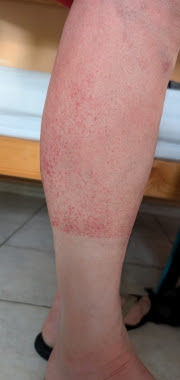
Because we were walking in a state of grace, we were both spared The Wolf aka Tinea cruris, scrot rot, dhobi itch, jock itch, intertrigo inguinal, Eczema marginatum. But my legs were brightened by a rather wonderful case of Disney Rash aka exercise-induced vasculitis, hiker's rash: an inflammation, commonest in elderly women, of the subcutaneous capillaries of the lower leg [as R on my own-self leg]. The combination of unwonted exercise, high temperature and susceptibility will do it for you. Not the same as sunburn which is a) epidermal b) uniform in colour c) painful. A case of the Disney's is a good example of the breakdown of a homeostatic system as we age. Although it looks alarming, it resolves itself quickly once the insult is mitigated. Children don't get hiker's rash because their peripheral temperature control is much better regulated and their capillaries are springy.

You can see [R] also that socks provide some protection - against sun and as support-hose. It also seems that we made our move in a timely manner. This last weekend the Béarn sections of the GR65 were suffering 40°C daytime temperatures. Phew wot a scorcher!

Friday, 27 June 2025

Lavendaria

The late Duke of Edinburgh had a quip "biggest waste of water in the world: pee half a pint and flush two gallons"; which I've cited before. I give similar side-eye to putting clothes, and household 'linens' through a washing-machine after a single use. This partly driven by the easy availability of the tech [cheap electricity; the complex of builders, surfactants, enzymes, and fresh-smell in detergents; cheap water] and partly by a fear of smelling of anything other than  fresh-smell and flowers. My students generalized this anti-pong aversion from their own and others' oxters to pretty much everything in the lab - especially anything wafting from a Petri-dish. Believe me, you wouldn't be so keen on the scrub-a-dub if you had to suds the clothes in the bath - which I did for a couple of years in a rented flat in the 1980s - let alone toting a basket down to the communal lavendaria down by the river. When I walked up the remote Atlantic coast of Portugal in 1989, communal clothes-washing by hand was still A Thing. In 2004, walking from Portugal to Santiago with The Boy, the village lavendaria were still there, but unused. I packed two shirts for seven weeks. Part of the ritual of landing for the night was to wash today's shirt and hang it out to dry while wearing tomorrow's for the evening.

For the second week in June this year, I was again marching with The Boy, and living out of backpacks. At the first gîte, a washing machine was available for a nominal €2 extra. One of the other pilgrims said we could throw our kit in with his, which worked out well for everyone. It was the south of France, the sun was still up, the clothes bone-dried before we went to bed. At the Gîte Communal in Navarrenx, two days later, Aurélien l'hôte had formalized this water-saving practice: Please don't wash your smalls in the hand-basin, throw them in that basket and I'll put on a wash before dinner. If they are not dry from hanging in in the morning, I run everything through the tumble-drier. I'd rather not, and I guarantee they'll be dry before you leave tomorrow.

Laundry on the Via Podensis is now institutionalized and hand-sudzing is a thing of the past. 

Apart from the laundry water that disappears down the plug-hole to add enormous volume to the water needing treatment, there is also the residual water in the damp clothes. M'daughers are sharing a tiny flat in Dublin and have to dry clothes on a rack in the living room. The water has nowhere to go so there is a perennial damp problem. Now that everyone has a washing-machine at home, the next white-goods must-have will be a de-humidifier.

There is no truth in the the etymology of laundry having anything to do with laying sheets out on a lawn to dry. Laundry is rather a corruption of old French lavandier one who washes, ultimately from Latin lavar to wash. And lavender Lavandula spica [as above L] has nothing to do with it either, despite the old fashioned custom of putting sprays of that plant in amongst the bed-sheets.  Lawn  n., a fine white linen/cotton 'Cambric' fabric, associated with the vestments of Anglican bishops derives from the town of Laon in NE France. Cambric aka otoh comes from Cambrai = Kamerijk a weaving town 100km further North in French Flanders.

Wednesday, 25 June 2025

Boo-hoo j'ai tombé

When I was young I used to run downhill. I was too broken-winded [asthma] to make <puf> much <puf> progress <puf> upwards.  I don't mean run on a downhill path; rather my joy was leppin' from tussock to rock planning my route 2 or 3 enormous steps in advance. Nothing bad ever happened - because I was immortal back then. Or more accurately: my tendons were resilient and springy and my eyes and feet talked to each other with me having to think at them. In the 70s, not so much? When she was about my now-age, my mother was visiting. She helpfully gathered some dishes after dinner tripped over a rucked rug in the kitchen and broke her fall with a broken wrist. It was bad timing because she was due to fly back to England the next day and A&E thought it was better to turn her care over to the NHS when she got there.

I spent my last 10 days as a 70 y.o. marching through France with The Boy. It turned out to be possible to walk 20+ km a day without [either of us - he do be pushing 50] crocking up entirely. It was hot, it was tiring, but twinges and pangs resolved themselves within a couple of hours and a decent night's sleep delivered us fresh for another day's graft.

Until, on Day 5, on loose gravel in the hamlet of Castillon-d'Arthez, my right ankle turned and I parachute rolled to my left to protect it. I was off the ground immediately and it wasn't until a few minutes later that I noticed blood trickling down my fore-arm from a few punctures in my left elbow. The Boy <"medic"> said it wasn't worth covering with a plaster until the bleeding stopped. So I trudged on trying to keep blood spattering the dest rather than my trousers. We paused 5m further along the GR65 at the épicerie at Pomps for bevvies and sandwich makings and I went back to the tap behind the Mairie to wash the blood off my arm [to not frighten the horses, like]. 

As well as weakness in the plumbing, my aged at no longer bounce-back resilient body seems to be defective in its Factor VIII response because my elbow was still leaking when we arrived at our gîte for the night. What was really concerning me, as we continued to pound le chemin, was the increasing stiffness in my turned ankle. The boy relented, after I washed my arm for the third time that day at one of the robinets d'église, and applied a sticking plaster just big enough to cover all the holes in my elbow. That night was the first and only time we were requested to stand behind our chairs before dinner while the host said grace. 

Whether it was the prayer, or the excellent dinner, or a tremendous midnight orage thunder-storm, or 8 hours with no weight on my ankle or a bonny breakfast; the next morning my feet were ready to go. I'd left no blood on the sheets, either; although the swelling on my elbow was the size of half a small hen's egg.  My unspoken anxieties of the night before about Uber, bus and stretcher contingencies to get us to Aire sur l'Adour on schedule evaporated as another sunny day in paradise rose up to meet us. We walked 31km that day and were rewarded with ice-cream.

Monday, 23 June 2025

The church as refuge

I promised more copy on the process of pilgrimage. Which seems a little pretentious because we were only a week on the chemin at the beginning of June; we were going the wrong way; I don't believe the credo. Nevertheless we chose to walk the GR65 because it was the direct continuation of my solo run from Santiago to France in 2004. the GR65 also happens to be the Via Podensis, one of the main pilgrim autostriders to Santiago de Compostella. 

Actual practicing religious pilgrims are a minority, even amongst those who are collecting stamps in their credentials along the way towards obtaining their Compostelle certificate when they finally arrive at the City of God. The Boy was toting a [gîte and restaurant locating] device with access to GBs of data. On about Day 4, after asking for requests, he fired up Spotify to play a bewildering number of different versions of Ultreïa. He was in his on-line element. A while later, noting ear buds attached to a hiker, he stopped the feller and offered to swap Spotilists. The other chap wasn't interested: he was listening to prayers with an occasional break for Gregorian chant.

Compared to the Spanish section of the Camino Frances, the Via Podensis not too busy, it doesn't require crampons and is reasonably well served for dinner bed and breakfast . . . and water.

Nature I loved, and, next to Nature, Art Water I loved, and, next to water, shade:

The striking commonality of all the medieval churches along The Way is how chill they are; even if the sun is broiling your hat outside. Cool and quiet, a bit dusty, maybe; but there are seats and anyone can afford to take five minutes for reflection. If you can't spare five minutes in your race to the next hostelry; then your need to take 15 minutes!

Churches have graveyards, graves have flowers, so there is usually water somewhere in the churchyard. If it is roof-water caught in a rain-butt, you may not fancy drinking the stuff; but you can slop some over your face and neck. Several isolated churches announced the presence of eau potable from a reg'lar tap. Fill your water bottle chaps, it may be 10km to the next village. 

We had planned to stop in the village of Pimbo on our penultimate night but had been advised by a kind and energetic fellow earlier in the day to push on to a magical gîte in Miramont-Sensacq. But the church in Pimbo had a pretty garden and an invitingly cool interior: so we stepped inside. There to find that the parish recognised that some travellers might be penniless but nevertheless need shelter:

Yes, a rough blanket and a sleeping mat will be sufficient. It was now 13:20hrs, we were 2 hours from Miramont and day's end. We could power onwards in the hope of getting the best bunks . . . or . . . we could wait until 2pm when the gelataria in the square opened. "Black cherry for me" I announced and sacked out under a tree. When I came to, The Boy was coming out of the shop with two bowls of ice cream and two ice cold drinks. "Black cherry sorbet for me", he said "and I couldn't resist a boule de stracciatella on the side".  And that, folks, is how the village became known as Pimbo-les-trois-boules.