Showing posts sorted by date for query Neanderthal. Sort by relevance Show all posts

Monday, 3 November 2025

Allied again

Almost by accident, at the start of the academic year in 2018, I got me a rainbow silicon rubber wrist band sporting the slogan "⚧ The Institute ⚧". I wore that accessory rain shine and shower 24/365. Whatever about signalling to students and Others that I was on their side, it reminded me every day to check my privilege (and mind my gob). That ⚧ symbol did A lot of work at The Institute - reducing the number of wheel-chair accessible bathrooms so that Management could preen themselves on having gender neutral bathrooms on campus. Habit is strong within me and, after I retired two years later, I continued to wear my wristband although I encountered minority students once a year rather than every day.

Then, in the middle of October, struggling into an inherited sweater, my wristband broke. At seven years, it had lasted me longer than the sweater, but I was still a bit bereft. I sent a picture of linear silicon and a message "Boohoo, Ally No More" to my right-on offspring.


A week later, we had a multi-generational friends&family knees-up and two younger people, friends-of-family, whom I'd never met before, presented This Old Ally with replacement merch. a) a new wristier made of pastel rainbow plaited wool [new for old shown above] 

b) a brace of Ally-pins which I wore in the lapel of my charcoal-grey 100% woolmarked interview / funeral / wedding / knees-up suit. I won't take this clobber into the shower, not least because the suit is "dry-clean only" but will sport it when I'm out and about. There are plenty of opportunities for an Ould Buffer to be passive-aggressive; to be passive-inclusive, not so much. A few days later, I went for a yomp up the hill with Gdau.I now approaching 14. She said that, if I said something dopey about chromosomes in a discussion about gender and sexuality, her generation would likely forgive me. Making some allowance for the Old, in the same way as my generation used to get up off bus-seats for them. Unless it was clear that my comments were uttered as cruelty or a wind-up. Then again, it seems that 14 y.o's can be quite neanderthal in using casual racist slurs. 

Friday, 20 September 2024

Kindred

It's 40 years since we published our definitive catalog and [trivial] statistical analysis of neogene tooth metrics. At that depth of time, I cannot remember if we included any Homo neanderthalensis in the dataset . . . they may have been 'too recent'. Didn't care either way, because Neanderthals have never really floated my boat. Although The Blob has been 'interested' in the idea of palaeolithic denisovan / neanderthal / sapiens pals making nookie . . .

Then I was more or less ordered to get Kindred out of the library. That would be Kindred: Neanderthal Life, Love, Death and Art [review] by Rebecca Wragg Sykes. It's pretty good. A Lot of progress has been made in tech and archaeological practice over the last 20-30 years. 

① It is now much easier to record electronically the  x y z co-ordinates of every bone and artifact so that the whole structure can be reconstructed in fully zoomable rotatable 3D back on the lab computer screen.

② Archaeologists have found the patience to reattach stone chips which were sundered by neanderthal blows 50,000 years ago. This can inform about the percussive techniques used in the first place. Scanning microscopes can find differences in the wear grooves on neanderthal teeth and tools. A modern database has been built up to record the what wear results from scraping hides and how that differs from severing tendons or dis-articulating bone. Comparative flint-knapping is almost a profession in  modern archaeological circles.

③ DNA! I was in the lab next door when Dan Bradley was extracting ancient DNA from ancient bones, and parchment pages to make sense of the history of domestication and incest in Ireland and Europe. Neanderthal DNA is perhaps 10x older but, with luck and care and PCR, enough DNA of sufficient quality can be obtained from neanderthal bones to recognise it as distinctive and distinctively different from "us" Homo sapiens. As 23andMe will tell you, there has been detectable inflow of neandergenes into our ancestors . . . but apparently not in the other direction.

There's a lot we don't know, but it is wonderful how much information has been wrung from a few tonnes of bones representing another way of being a bipedal hominid ape. It's like an alternative running of the experiment over 600,000 years.

A peculiar footnote on p113: " . . . Aboriginal knappers paid as much attention to the overall appearance of their scrapers as Westerners do to their pencil-sharpeners" i.o.w. not at all? What colour is your pencil-sharpener? I have no idea!

When oh when will Usians get with the program and learn about centimeters? Obvs, the USA is the largest English-language book-buying market in the World, so no author wishes to gratuitously alienate readers by giving all distances in versts. But really, everybody [who can read a 400 page academic-adjacent  book about Neanderthals] understands metric even if we in Ireland still weigh babies in lbs and know our height in ft&ins. The editors at Bloomsbury have used cm, m, km, m2, kg as primary measurement while appending equivalents as in, ft, mi, yd2, and lb in (brackets). Consistency is the hobgoblin of small minds but I will point out that 0.5m is variously made equivalent to 1½ft, 20in & 2ft. Number-crunchers gotta data, and I went through the first half of the book to clock the range of values given for m/ft ratios (converting mi to ft by * 1760 * 3 and in to ft by /12): count N=50; mean 0.309; st.dev 0.023; min 0.25; max 0.4. That std.dev is pretty tight: the mean is 1-2% above the everybody knows value of 30.5cm. There are officially 3.281 feet to the metre or 0.3047 m to the ft.

I really like the editorial decision to use micro drawings of palaeolithic artifacts at colophons through the text - raptor-claw [L], pierced shell, flake, feather. Feathers? Many neander-sites reveal a disproportionate number of avian wings, often corvids. I propose that black wings made great eyebrow enhancers 70,000 years ago in France.

There's an effective index but no list of references: proper order for a "popular" science book. It's coming up for Christmas: might make a nice gift for a reading teen. We defo need more archaeologists.

and More women in science!

Friday, 18 March 2022

perchance to dream

Baron Cuvier (1769 - 1832) confidently maintained that, from a single fossil bone he could infer the entire skeleton . . . and by extension a great deal about its life-style and diet. Archaeologists do this all the time: four rocks in a rough circle, dusted with charcoal, becomes a hearth; a chipped flint becomes an arrow head . . . which infers a bow - which points to carnivory.

My latest random book from the library is How to Think Like a Neandertal,(OUP, 2011) by Thomas Wynn [anthropologist] and Frederick Coolidge [psychologist] reviewed. You might think that a rather optimistic brag, given that all we have to go on is a suitcaseful of Neanderthal skulls. On average these have a larger endocranial volume than the average [1300cc] among "modern" humans. But we know that a bigger brain doesn't correlate well with intelligence. Lord Byron [2000cc] was not twice as smart as Anatole France [1000cc] and certainly not more compassionate.

Wynn and Coolidge both work at U Colorado, although in different departments and had been working  together on the evolution of cognition for ten years before they published their book on Neanderthal thinking. Many of their arguments hinge on the fact that the last common ancestor between humans and apes [Pan troglodytes, chimpanzee, is our nearest and dearest] was ~5 mya while between us and Neanderthals there is only 0.5 my. We are accordingly much more likely to have behaviour, practice and thinking like Neanderthals than either of us are to chimps. You can do quite a bit of lifting with that assumption.

If you do free-association with paleolithic hunter-gatherers then caveman is likely to pop into your head. The key thing is that a lot of human [both species] burials have been found in caves. That's partly because other burials: out in the bush, say, are much less likely to have survived. But it's also because lots of these caves have hearths and some have paintings which indicate that humans lived and slept in caves. The in-the-knows of the anthropological world are certain sure that no ancient art works are the work of Neanderthal hands. Work-a-day, functional worked stone axes yes; paintings and sculptures nope. No great ape ever sleeps in a cave because they habitually sleep off the ground in trees - usually constructing some sort of nest to do so. There are obvious advantages to sleeping up a tree if there are predators in the area which have bigger teeth and sharper claws who might fancy eating a small primate if such a dish was available on the ground. BUT when you sleep you lose consciousness and are prone to fall off your perch.

Several adaptations to this state of affairs have become fixed in our species because proto-human apes without those adaptations took a tumble and didn't leave any descendants. One of these fixes is REM paralysis which, in normal people and apes, disconnects the motor neurons when REM sleep starts. That way we can have vivid dreams of chases and extravagant sex without, like, acting them out with a thrash weeeeeeeeee CLUNK! We've never seen a Neanderthal sleep but Wynn and Coolidge [and me] will bet Lombard Street to a china orange that they also experienced REM paralysis.

But Wynn and Coolidge continue to push the idea that Neanderthals are totally on top of procedural tasks like making Levallois stone points, hafting a spear with the best, and hunting down a mammoth for a [mammoth] feed. BUT, they spent 400,000 years making the same-old, same-old paleolithic tools. Modern humans otoh were creatives. Mesolithic people invented nets, weirs and hooks for fishing; probably canoes and paddles; birch-bark containers; textiles from plant fibres; microliths assembled into longer sharp edges as sickels. Primitive stuff I guess, but Neanderthals were not invited to the party.

REM sleep is coincident with dreamtime and dreamtime is powerful magic for creative thinking. The events of the previous day are jumbled together and re-assembled to try to make sense of the buffets of an unpredictable world. Leaving trees and sleeping in caves allowed for longer periods of sleep undisturbed by anxiety about the big tumble. More REM! More creativity! So Neanderthals didn't sleep in caves, but only cooked there? I R Confuse! I could go back to re-read the final chapters of How to Think Like a Neandertal with furrowed brow and more care and attention. Then again, I could not: life is short and the actual data about Neanderthal cognition are few and far between. Drawing plausible arguments, like from rabbits from a hat, don't cut it, especially if the result is to give Neanderthals consolation prizes for pretty much everything and not really acknowledging that, for half a million years, they held their own: living, loving, and lounging around. A different sort of success without agriculture, bell-ringing, cash, dogs, exercise bikes, fajitas, gold, harpsichords, iPads, jigsaws . . . and a despoiled planet.

Monday, 6 December 2021

Virtual evolution

Psychologist William James (*) characterised the world of a newborn child as a “blooming, buzzing confusion,”; we spend the rest of our lives trying to make sense of it all. With the development of language we can explicitly put labels on things out there [Mom; the other feller; the pink dinner, the beige dinner; Mitsy, the cat next door, Cats] but even illiterate animals, like Mitsy, can put things into bins and react appropriately - food = good; sea-water = bad; dogs = proceed with caution. Most folks go through their entire lives (like M. Jourdain in Molière's le bourgeois gentilhomme who is surprised and delighted to have been speaking prose for the last 40 years) doing this with realising they have the skill. Many of us, for example, have been forced into a radical re-think of pronouns in recent years because {M/F, his/hers, ♀♂} is clearly a bit of a BLunT insTrumenT.

I'm a biologist, not a very good one, out in the field, but I think a good bit about taxonomy - the science of classification. I've written about a profound discussion we had sous le pont d'Avignon about how to lump living creatures into appropriate bins. Some schemes work better than others - because they make better sense - they generate more internal consistency; they make the world a bit less random. "Have wings" is kinda useless because it includes wasps, fruit-bats, mansions, buzzards, 747s, football teams, dragons and angels. It's not always obvious either: whales really are streamlined hippos.


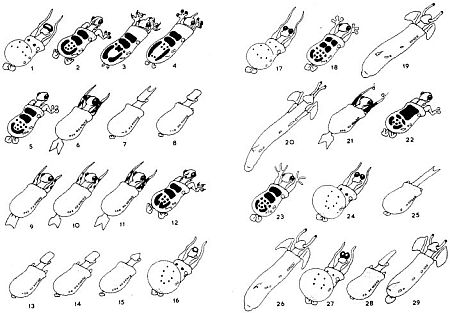
I think this is an important concept to get over and when I was teaching "Evolution" and "Genetics" back in the 80s, I used Caminalcules [selection above: from] as a defined dataset to help students think in classificatory terms. These delightful creatures were invented by Joseph Camin the the 1960s. He started by drawing a cartoon animalcule and imagining how it might evolve. Changes were made to a copy of the original drawing and so, iteratively, through several subsequent generations down several different paths.

At some point Camin aka God called a halt to evolution and assembled 29 extant / living species on a single sheet of paper for a student exercise in practical thunk. The task was to use scissors to cut out each of the 29 Caminalcules and put them into bins of similarity. Like mammalian classification, the task is probably recursive: dogs are more like wolves than either is to foxes; leopards is pretty close to those lads; but cows and bats . . . and wombats are further and further away from Fido. I started doing the same in the 1980s: we'd work in pairs initially; pause, compare notes, discuss, adjust and finish up with a solution that pleased everyone in the room. Usually next year's class was in close agreement with their prev peers.

An additional task is trying to infer the ancestors of the 29 leaves at the end of the branches but that was more than my students needed. Having The Answer in the fossil drawings which Camin had made seemed a bit luxurious to me. In the 1990s, I shifted countries and emphasis and started working on DNA and protein sequences and using them to infer evolutionary relationships; and the pattern and process of evolution along the way. In the 90s there was no fossil DNA (and no fossil-fossil missing link whales, for that matter) so a great deal of the effort was inferring ancestral states in the sequence tree.  This century, Dan Bradley and Lara Cassidy at TCD [yes yes and lots of others across the world] have opened up another dusty can of worms by getting to sequence ancient DNA. Now you can ask 23andMe just how Neanderthal your brow-ridge is.

(*) It might be worth noting that William's younger brother was writer Henry "The Turn of the Screw" James.

Friday, 14 June 2019

Who am I?

After What is Life? and Is there a God? the fundamental existential question might be Who am I? and Where do I come from? For most of us it's straightforward: we have a Mammy and Dad, siblings, a birth certificate. If we ever want to know Where are my people buried? then we can just ask The Folks . . . or Auntie Em, if the parents are reticent or dead. Things are not so easy when the birth-cert father turns out not to be the genetic father. But that can provide an interesting insight into the relative weight of genes and environment nature vs nurture.

My Brother txtd me one evening to ask if I'd ever sent some spittle to 23andMe [prev], or equivalent, for DNA testing. My response "I wouldn't do it without you. These tests are grand for telling you that you have red hair and cystic fibrosis [which you surely knew already] but are much less reliable at telling you how much Neanderthal, Jewish or Xorgian 'blood' you have and therefore not worth $100 of edutainment".  It is marginally more interesting to send in a batch of sibling spit because that will give everyone a handle on what the error-of-estimate is when they say that you are 43% Cajun. otoh, if the genetic pedigree answer is wildly different between sibs, it strongly implies non-paternity in some members of the family. Which is not necessarily something that we all wish to bring to the surface. I've ruminated on the issue before.

It turned out that The Brother's after-dark interest in paternity was triggered by the fact that he was talking to 'one of Berthold Wiesner's children'.  Maybe even the swaddled infant on Wiesner's lap [R]??
Never 'eard of 'im!  But I assumed, in the conversational context, that Wiesner was one of the pioneers of DNA sequencing technology.

Turns out Wiesner is rather the opposite of non-paternity, having been the sperm-donor for an estimated 600 children born 40 weeks later in and around the London Fertility Clinic of his wife Mary Barton. In those patriarchal times, it was unthinkable that failure to conceive might be anything other than the woman's fault. In her previous marriage, as a medical missionary at the frontier of the British Raj, Mary had seen the shitty end of the stick being brought down violently on the heads of women for failing to deliver a son. She realised that it takes two to tango and that male infertility was going to be at least as much of a problem among affluent Brits as among Pathans up the Khyber. In 1939 she was divorced and in 1943 married Wiesner an, originally Austrian, physiologist who was interested in the hormonal control of pregnancy.

Over the next few years Dr Barton told her clients that she could sort them a teaspoonful of quality semen from a stud of highly intelligent, good looking donorS. But the most convenient source of this precious bodily fluid was her husband who was at least symmetrical and not demonstrably stupid. When they published their interim findings in the BMJ in 1945, there was a predictable shit-storm of condemnation from Geoffrey Fisher, the predecessor of Michael Ramsey as AB of C, and Pope Pius XII. The full text of the 1945 paper is a real eye-opener about the causes of infertility and practicalities of insemination. Cases of married men with viable sperm who just cannot get it up make me wonder whether the poor chaps just weren't excited by women. For blokes who have a very low sperm-count, the clinic could provide an in vitro centrifugal sperm concentration service. The authors realise that asking the husband's brother for a contribution is fraught with ethical and practical difficulties. AI provided an opportunity to check the semen for infective microbes . . . and do something about it.

After the very public hoo-har, the clinic pulled in its horns [fnarrr!] but carried on the same services discretely and profitably for another 20 years. By the time Wiesner was all wanked out retired, an estimated 1500 successful conceptions had been carried out at the clinic. The clinic closed in 1969 and the records were discretely disappeared. Jonathan Wiesner, the legitimate son of Barton and Wiesner got his DNA sequenced in 2007, which data serves as a template against which possible half-sibs can identify themselves. Thirty, all above average of course, have since joined the club.  Not ALL of Mary Barton's deliveroos were 'by' Wiesner. Other suspects include JD Bernal [prev] and JBS Haldane [prev] - the still [R] is from the film Offspring by Barry Stevens Not a Son of Wiesner but who has discovered a congenial half-brother in his search for genidentity.

Because patriarchal me knows where I come from [King's County etc.]. I'm tickled, rather than shamed, by the idea that my great-grandfather was the 'natural' son of the Laird and his red-headed cook.

Thursday, 15 February 2018

Eurogene - the map

I told y'all that you should go to Dublin on Darwinday to hear Dan Bradley talk about the Genetic Origins of the Irish. But I know that some things you can't delegate: you just have to do them yourself. Accordingly, I leapt into the Little Red Yaris at 1705hrs and drove to Dublin to hear the news from the frontiers of biogeography. But the news is always based on the olds and the most beautiful and informative picture of my 2018 [at top: far better copy] was published in 2008! I may well have been entranced by that map when it came out ten years ago, but I've since forgotten all about it. Heck, I've forgotten my car-keys and where I left my glasses as well.

That map is Fig 1 in a paper in Nature: Genes mirror geography within Europe which sampled the sequenced genomes of 3000 Europeans (and four Turks) and tallied up each person's state at 500,000 different variable sites in their DNA sequence. That's a shed-load of data and you can't make much headway by ticking off (3000 x 3000)/2 x 500,000 cases of Sean is different from Jean here but the same there, while Giovanni is different again. Well actually you can, and that's what John Novembre et al. did in 2008. They put the whole dataset into a hopper called Principle Components Analysis and gave it all a good shake and a jiggle. PCA reconciles all the internal inconsistencies, and calculates the position of each person in N-dimensional hyperspace. No, I too only have a hazy notion of what that really means but in practice it calculates how near or far each person is from each other person in the dataset. It will come as no surprise when it turned out that the quartet of Turks looked really similar to each other genetically and rather different from the Europeans . . . and the Irish too: like each other, quite similar to Brits and Scots and less like Poles and Greeks. A lot of that difference will smooth itself out over the next 100 years as our 200,000 resident Poles make babies with their Irish neighbours.

You can do these sort of studies because the cost of generating the primary data has collapsed over the last 30 years. The first ever chunk of genomic DNA, yeast Saccharomyces cerevisiae chromosome III, was contracted by the EEC (=EU) 30 years ago at 320,000 ecus (=€) or €1 /base. We carried out the first non-trivial added-value analysis of that data - one of my three big ideas in science. With that stepping stone achieved, planners looked to sequencing The Human Genome: it cost €300,000,000 (10c per base) and took ten years. Now you can sequence A human genome for €1,000; it will take a day; and there is enough server power to do many genomes in parallel. So 3,000 genomes is quite affordable in a big science sort of way.

What is most striking about the distribution of genomes across the most explanatory axes of the PCA landscape is how closely it maps onto the geography of Europe.  The pale blue of Greece and the Balkans is nearest to Turkey over on the right; the grey Italian peninsula runs parallel and a little more distant; and further away again is a purple peninsula of Iberian genomes. At the opposite end of the continent, the Irish intercalate with the Brits; the Scandinavians have both shared and separate identity etc. etc. If you look closely, you can see Paddy-No-Pals off on his own in the sea like as sort of Uber-Irish outlier. Maybe she is not Paddy at all but Caitlín Ní Uallacháin. Also note the five rogue ITs in the sea at bottom left of the diagram; they do indeed have Italian passports but they are actually Sardinians. There is no evidence here that the compatriots of Szilárd, Wigner, von Neumann and Teller come from Mars.

I was doing a similar analysis waaaay back in 1980s. I took me 2 years of tramping the streets of towns and cites in New England and the Canadian Maritimes, scoring genetic variation in domestic cats Felis catus to gather a sample of 10,000 cats in 35 different populations diagnosed for 7 genetic variants. (35 x 35)/2 x 7 is quite a bit smaller than (3000 x 3000)/2 x 500,000 !! But it was all my own work. One finding was that genetic distance was correlated (highly significant statistically) with geographic distance but that relationship only explained 16% of the variability in the sample. 84% of the variation was noise - some of which could be accounted for by the history of the patterns of French, English and Dutch colonisation in the 1600s. That was what my PhD thesis concluded aNNyway.

When you cough up your $100 to get your DNA sequenced, 23andMe will compare your DNA to a database like this one and place your genome on the map. Unless you are truly and incestuously descended from the Pharaohs, your genome will be a mess of fragments from the miscegenation of your ancestors. 23andMe will give you a summary sound-byte like "50% Irish; 25% English; 20% French; a toe from the Maghreb and a Neanderthal fingernail". You may take that assessment with a huge pinch of salt because the data will be inherently noisy.

Monday, 24 July 2017

Snow White inside

I'd like to think that one of the running themes in The Blob is that there is no such thing as little utility in black and white thinking. Der Reichskanzler was kind to children; there is some value to a belief in god; not everything the other side says is utter nonsense. On Sean Moncrieff's Newstalk FM radio program, he noted that the twitter-storm went on for 36 hours after they had a piece on the unborn (both sides going at it hammer and tongs) while a feature on homelessness among Irish 'born children' elicited only 5 comments.  But those issues are metaphorical black and white, although quite edgy. When it comes to actual black and white animals, the firm ground on allocation and definition is hard to find.

An old logic puzzle hinges on the fact that all swans are large white long-necked ducks [family Anatidae] which allows us to assert that any a) large b) white c) long-necked d) duck is a swan and failure at any of the enumerated criteria makes the thing you're considering a non-swan . . . until you go to Australia and encounter Cygnus atratus [R]. Naseem Taleb wrote The Black Swan as an investigation of certainty and our failure to correctly process information from outlier events - "unknown unknowns" like 9/11 and the inexplicable Harry Potterism of Google - to help us deal with the future. Taleb's book has plums in it but there is also a lot of duff to chew through [critical Guardian Review] and Taleb himself can sound simultaneously know-it-all and woolly, which doesn't help illuminate the plums. Black and White animals? Should make Blobbistas think pandas [no not those pandas] or rhinos or ice-floes and polar bears.

Bears, you say? Well I was reading about the unfortunate irony that the bear on the California State Flag [L] is extinct; less than 75 years after the Gold rush of 1848, the last grizzly bear Ursus arctos californicus in California was shot and killed in Tulare County in 1922.  Note that the California Grizzly is a subspecies of the Brown Bear Ursus arctos which, as a species,

 is a long way from being extinct but the key conservation-biology question remains: whom should we save if we are to retain the greatest possible genetic and ecological variation. Because variation is the stuff of evolution and we know not when a Black Swan event will put the survival of the species at risk. But when that event occurs, genetic variability is the best hedge against an uncertain future. We now have molecular tools to gather the genetic data to help conservationists make these hard decisions - El Blobbo has covered such studies for: fairy penguinsrhinos - giraffes - elephants - wildebeest - Tasmanian devils - whales.

We need that molecular data because brown bears are bigger than a bread-box and quite variable as to size and colour and so there has been a tendency to pronounce that specimens deserve their own sub-species because of a trivial difference in size, or habitat or feeding or colour.  This is partly due to ambition - getting to name a [sub-]species ensures your immortal fame while acknowledging your specimen as essentially-the-same-as is much less exciting. WWF has to hope that taxonomic lumpers eventually win over splitters: it's cheaper that way, because then they don't need to save two morphs.  You want to be a bit careful on defining things by skin/fur colour: a rat, black as my hat, ran across our yard the other day but I knew it couldn't be Rattus rattus, the black or ship [plague] rat, but rather a melanic form of Rattus norvegicus which has been so successfully invasive on the Shiants, the Scillies and Ile Bouvet.

Mais revenons nous a nos ours. There is the Black Bear Ursus americanus, for example, which is a good, reproductively isolated from Ursus arctos, species. The last common ancestor lived 5 mya, about the same separation as between us Homo sapiens and chimps Pan troglodytes according to molecular clocks. And there are melanic forms of the 'brown' bear just like there are blondies, red-heads [prev], dark-brown and sandy-coats. Grizzly refers to the grey de-pigmented tips to the hair shaft which give a distinguished pepper-and-salt look. At the other end of the spectrum is the polar bear Ursus maritimus which are definitely white but not so definitely a good species! It turns out that one of the 90 named subspecies of brown bears Ursus arctos sitkensis is endemic to the ABC islands in the Alaskan panhandle. ABC for  Admiralty, Baranof and Chichagof Islands, the largest northerly lumps of the Alexander Archipelago from which the city of Sitka faces out across the broad Pacific Ocean.  When they looked at the DNA of these beasts it turns out that they have distinctly polar-bear chunks of their genome.  It is now suggested that a population of polar bears was stranded by retreating ice on the ABC islands at the end of the last ice age. In absence of available male polar bears, some females acceded to the attentions of roving brown bears from the mainland and delivered healthy offspring. We know it was that way round because the ABC brown bear (a single individual, as far as I can make out) is most polar-like (6.5%) on the X chromosome than in the rest of the genome (1%).  Those healthy offspring grew up and started to look for potential mates in their turn and found only brown bears and so the polar-bear contribution has been stochastically diluted over the last 10,000 years. It's a bit like, if you send your saliva off to 23andme, they will analyse the DNA and tell you that  at least one of your ancestors had a romantic interlude with a Neanderthal. There will be no detectable difference on the heaviness of your brow-ridge but the DNA will bear a distinctive other-species signature. The algorithm can quantify the amount of miscegenation.

So there's hope for polar bears as the ice caps shrink and their habitat gets destroyed and they have to swim further than the cubs feel comfortable about. They have been there before and survived for some time in a brown-field site. Good news for seals?


Saturday, 6 May 2017

Updates etc 060517

Last week I was on a bit of a pulley jag showing some footage whereby you can achieve some mechanical advantage with levers and especially with pulleys. I got a tsk from my pal Russ saying that I shd have mentioned the eSpanish windlass as another way of making things move.  I have mentioned the eSpanish windlass in the context of applying a torniquet to a sheep's leg.  It is a really nifty appropriate technology tool for, say, tightening up a length of fence and Young Bolivar and I used them when building the woodshed last Summer to force the telephone-pole uprights upright.  to .  This is how the thing is made, with diagrams and safety notes.

The same principal is at work with a windlass winch, except instead of the rope shortening by twisting about itself as with the Spanish, the slack of the rope is taken up by being wound around a log.  Another log at right angles applies the necessary leverage. In using this tool it is not necessary to behave like a neanderthal misogynist git who is (marginally) politer to his dog than his wife and various hapless twigs.

But there's more!  Here is a flip-flop winch which allows a single person to set up and use a system with a rope and two stout sticks to shift a heavy object.  Or two stout sticks and a couple of fit young Germans

And then there is a Chinese windlass where the key for leverage is a difference in the circumference of the axle. Never heard of that: very clever the Chinese.

All those solutions to weight moving are temporary examples of bricolage with what is available at hand in the forest.  It you want to make a more permanent capstan with a curious mixture of modern tools and medieval technology check this video out.

Last week one of the links made a comparison with the Man Who Planted Trees. Here is another such story from an island in the Brahmaputra [prev]. The importance of trees in stabilising riverine banks is illustrated in this report on slumping in the levees downstream from Oroville.

Saturday, 30 April 2016

Walking on water

The Given Note
On the most westerly Blasket
In a dry-stone hut
He got this air out of the night.
Seamus Heaney
The Blasket Islands (next parish Boston) are the most westerly extension of the Western European Archipelago - what we have to call the clatter of islands which the Brits and Irish (and a gallimaufry of every other nationality on Earth) call home.  Apart from being home to the fiddler tribbed in Heaney's poem [above and RTE] the Blaskets are also the most significant European nesting site, after the Faeroes, for  Hydrobates pelagicus the storm[y] petrel, Mother Carey's chickens, guairdeall [IE] stormvogeltje [NL]; stormsvala [SE]; Sturmschwalbe [DE]; pétrel tempête [FR]. This, the smallest of seabirds, is named in English for St Peter who, in a famous biblical story, tried to walk on water. Actually the name petrel is more likely an onomatopoeia for the pitterel-patterel they make when skimming the surface scarfing up small fish and crustaceans for dinner. Mother Carey?  may be a corruption of Madre Cara, the blessed virgin. Don't rush off to the Blaskets in hope of adding this bird to your twitcher's checklist because except for 12 weeks of the year, there is nobody home.  The birds return only to mate, lay one white egg, and raise the fledgling before they depart again for their storm-tossed wandering life at sea. They only survive on islands which are free of introduced cats and rats [not Kerguelen so]. When you weigh an ounce /25g, your surface to volume ratio is so adverse that you must keep eating all the time just to keep warm. But for the evidence of almost uncountable numbers of storm petrels, physiological ecologists would have to conclude that these tiny birds had been assigned to the dustbin of extinction.  But hey, there are worse ways of making a living than on a world cruise.

Nevertheless, living on the edge they can't handle really terrible weather and will fly for shelter when they feel a storm brewing. Since man left the safe confines of life on the land, stormvogeltjes have sheltered in the lee of ships and boats when the going gets rough. Mariners have long viewed them as heralds of the coming storm and will use their appearance as a cue to shorten sail and batten down the hatches.  But they will also, in the Neanderthal recesses of their minds, curse the bird for bringing the storm. And in the perverse logic of superstition it is bad luck to kill a storm petrel.

My more literate Russian readers will be hopping from one foot to the other waiting for me to mention Maxim Gorky's poem The Song of the Stormy Petrel which he wrote in 1901 in support of the Revolutionaries who were hoping, planning, plotting to overthrow the Tsar and create a socialist paradise out of Mother Russia. Wait no longer Comrades: Между тучами и морем гордо реет Буревестник, чёрной молнии подобный. which, being translated means: Between the clouds and the sea proudly soars the stormy petrel, as a streak of black lightning.  You can get the whole poem and an English translation here.  I must add that to my favourite poems about birds along with the Kingfisher Alcedo atthis and Dis al.

Gorky wasn't the only one to associate Hydrobates pelagicus with a troublesome harbinger of dramatic change. The storm at sea presaged by the petrel's appearance was a powerful metaphor for a political storm brought about by revolutionaries. Padraig Pearse and his cronies, in formenting their rising against 300 years of Tory misrule in 1916, also recognised the propaganda value of the small apparently insignificant bird that brought a huge storm in its wake.

100 years later, a trio of our friends-and-neighbours submitted a proposal to the GPO Witness History Public Art scheme called ‘Stormy Petrel/Guairdeall’.  As I said before, the centennial of 1916 got two bites at the cherry: once during Easter Week 2016 and again on the date Easter Week fell in 1916. What Alanna O’Kelly, Brian Hand and Orla Ryan wanted to do was recognise a small apparently insignificant group of women who played a key role in the boys' games that went down in flames and guns during April 1916 in Ireland Dublin.  I have amended the last sentence because the rising was essentially limited to the city centre of Dublin. A couple of handfuls of  women set off from Dublin with written and/or rote remembered orders for the local commanders to rise in support of the events that were about to unfold in the GPO in central Dublin. But they were comprehensively dismissed by the Men in charge in the provinces. Having delivered their messages, these doughty female patriots then had a far more difficult journey back to town . . . the shit having hit the fan and the British military on high alert.

How to celebrate the role of women in a long-ago-and-still-too-close rebellion which failed but which served as the catalyst for the foundation of a new state in 1921 just 5 years later?  O'Kelly, Hand and Ryan are from The Arts Block, so their tributes wasn't in the form of spreadsheets, pie-charts and data analysis.  It was more in the vein of evocation, allusion and empathy.  Not trying to document what happened but to show how the actions of Elizabeth O'Farrell, Eily O'Hanrahan Kitty O'Doherty and the rest impact on, and can inspire, our lives today.  The Stormy Petrel / Guairdeall collaboration is taking the revolution to Vietnam later in the year!  Because we are neighbours, we were invited to a performance of the 'living installation' in the courtyard of the GPO last Monday. We were warned that the performance would be running a) as soon as the audience entered the courtyard b) through and around the audience for about 25 minutes. An interesting experience; flat out obvious "he's beHIND you" pantomime, it was not.

At one point, a young woman starts running desperately through the crowd carrying a violin case. This evokes many things in different imaginations: given the violence of 1916, quite possibly an echo of the 1929 St Valentine's Day Massacre.  Not knowing the details and anecdotes of the journeys of Mother Pearse's chickens, I was probably missing a key reference. Would it be fair to say that Science tries to make things clearer but the Arts strives to make things more obscure?  ANNyway, just when things were getting tense with the relentless slapping run of the girl, her violin case burst open and the family silver spilled out on the ground with a tremendous clattering >!clang!<.  In the ringing silence that followed, the nearest performers got down on the ground and started, with infinite care and attention, to pick up the silverware and secrete it about their person. But here's the thing: none of the audience helped!  We were ALL institutionalised into believing that the girl's accident was 'out there'; in a far country; at another time; irrelevant to our cosy modern lives.

I take it from this that, if we learn anything from history, it is that we learn nothing from history.  The majority of citizens of Dublin in 1916 were mostly annoyed that their equanimity and privilege [Dublin was a long way from Flanders or Gallipoli] was being disturbed by Connolly and his Yahoos. The dispossessed of Dublin, of which there were teeming thousands in the tenements of the North Side, saw it as a heaven-sent opportunity for a little light looting. It wasn't until after bullets and the fires and the judicial executions, that people started to re-imagine the past with themselves in a heroic role.

Damn and blast it! if we cannot even pick up a silver fork to help a poor girl in a play, what are we going to do about a million refugees in Greece, or 6000 refugees in the Calais Jungle or the thousands of refugees currently lodged in unprocessed limbo in Ireland. "Pass the marmelade, darling" ???

Wednesday, 26 June 2013

Where do we come from?

The Irish radio station Newstalk has a science magazine programme called Futureproof.  Last Saturday live in the Science Gallery, they did a piece on genetic testing.  The programme's presenter Jonathan McCrea had sent (this is one he did earlier) a saliva sample off to a company in California called 23andMe and they had sent back the results. McCrea was given his results live on the wireless (wired up to a galvanic skin response stress detector) so it was interesting and informative - for McCrea obviously but for the studio audience as well.  McCrea was relieved to discover that his risk of developing Alzheimer's was rather small - because his grandmother had descended into that darkness. He also found that he was 'clear' of known genetic predispositions to cystic fibrosis, breast cancer and some other hazards.  Good for him!

One of the experts on the programme was geneticist and blogger Kevin Mitchell from TCD's Genetics Department. Mitchell addressed another issue that can be teased out from the scads of genetic data that 23andMe is able to wrest from a gob of spit.  The medical prognoses are clearly about McCrea's future.  The pattern of genetic variants also allows The Company to make inferences about where his people are buried. McCrea has a genetic profile shared by many of North European descent including a substantive subset of these variants which point to ancestors from the Hiberno-British Archipelago.  Back further we now know that some modern humans (us) got the ould leg over some Neanderthals before these-our-cousins joined dinosaurs and dodos on the Extinction Express to Oblivion.  So there was an opportunity to jest about the percentage of McCrea's genome that was Neanderthal in origin - a tad above the European average but probably not significantly so. You can make jokes about brow-ridges and Neanderthals and it is deemed to be inoffensive because they're all long dead.  On the global scale of things, the Irish are quite genetically homogenous - not as pure-bred as Icelanders but much more so than, say, US Americans.

If such a programme was broadcast in São Paulo it could get a little more edgy because African ancestry in Brazilians is very poorly correlated with actual skin colour.  Yet darkness is strongly correlated with social class and it is not correct to say that Brazil has no racial prejudice.  So there might not be so much badinage when it is revealed that the 'white' presenter has rather more African ancestry than the 'black' lady who makes the tea off set.  Mark Shriver a genetic anthroplogist from Penn State has shown a lesser but demonstrable amount of black-in-white and white-in-black in US citizens.  Famously in the descendants of Thomas Jefferson and his slave (and wife's half sister!) Sally Hemings, whom he started bonking when she was less than 16.  I've given joy to the growing multiculturalism in Ireland; these genetic tests may help us park racism and take everyone as we find them - all of them, not just the epidermis.

I might mention that the 4th hire of 23andMe was an Irishman called Brian Naughton who got his first degree in Genetics at TCD.  If you sign over $99 to The Company, they'll send you a kit to receive your saliva and within 6-8 weeks they'll get back to you with results.  20% off for second and subsequent samples! If you send a copy of your TCD degree you get it all for half-price (kidding!).  Dau.II is now rooming with another geneticist in Dublin who has shelled out for a test.  Yesterday Dau.II asked if I thought it was a good idea for us all (Bob and Boblettes) to get tested.  She and her sibs have a rather rich brew on the ancestry front (Irish (both left and right footers), Scots, French, Lebanese, Sahel African) and the grand-daughter includes another continent in hers.  I've had a rather fond conceit that my maternal grand-father was London Jewish but my Mum denies this (vehemently), so maybe $99 would help settle the question?