Wednesday, 12 January 2022

The root of the matter

Radical! Metafilter flagged up a beautiful database of drawings of plant roots, meticulously excavated and recorded by v. Prof. Dr. Erwin Lichtenegger (1928-2004) and Univ. Prof. Dr. Lore Kutschera (1917-2008), leader of Pflanzensoziologisches Institut, Klagenfurt, Austria.

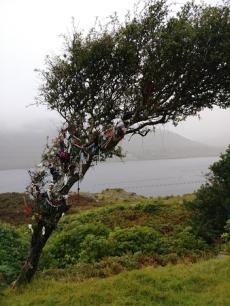
Where we live the two commonest hedgerow trees are ash/es fuinseog Fraxinus excelsior and hawthorn/meidoorn sceach Crataegus monogyna [R with a light dusting of fairy tributes] Hawthorns are always getting uprooted in storms, ash never - they just rain branches down from on high. Eight years ago, starting a new job at The Institute, I was required to teach environmental chemistry. I was commuting to work through horizontal winter weather and I had an idea for a practical experiment for the students. "we" would measure the mineral content [Li, Na, K] of leaves (more accessible than roots) in these two species from two different sites. 

Hypothesis: trees roots of each species selectively take
minerals they need from whatever soil they find themselves in
OR tree roots take up whatever is locally available indiscriminately. 

There is nothing obvious in the tree-root drawings which explains why hawthorn is so often from mother earth untimely ripped. It must be some aspect of the structural integrity of the roots and/or the interface with the soil which would need instruments to measure.

As is the nature of science, the results were eh maybe, needs a bigger sample. The other result was that one of the students insisted that I supervise his final year research project. Then he decided that 'we' should apply for post-graduate funding, which five years later resulted in his PhD. And I never followed up the location.vs.species experiment because the following year, the institute hired a qualified environmental chemist, and The Man had me teach some other module for which I was supremely unqualified. I dunno about the students, but I learned a lot on that job.

Monday, 10 January 2022

Dangling for science

I'm borrowboxing The Arbornaut by Meg Lowman [eponysterical because she is, for preference, high in the canopy and started her career as a rare woman in a man's world]. It's a massive fail on my network that I'd never 'eard of Lowman until I browsed the book from the largely empty prairies of the Borrowbox inventory. There are tree-huggers [meeeee!]whose contact with trees is an embrace at shoulder height and there are Arbornauts who get up up and away into the canopy where most of the interesting stuff happens. A helluva orgy of beetle consumption and sex for starters. Terry Erwin famously revised upward the number of species on the planet in 1982 by insecticidal fogging a section for tropical forest canopy and counting the number of beetles which rained down to the forest floor onto collecting sheets. His Fermi answer was 30 million species, although EO Wilson has upped that to 100 million by throwing archaea and bacteria into the mill.

Meg Lowman escaped from rural upstate New York to a PhD program in Sydney NSW where she wanted to study the effects of environment on leaf abundance. She had to devise all her own hypotheses and the protocols to test them because nobody had done that sort of thing before. Leaves of mature trees were only available after they had been felled and it is hard to do time-longitudinal studies on something that is about to become board-feet. With consultation from spelunkers, she invented and designed a tree-climbing harness which allowed her to dangle from a branch high in the canopy and have both hands free for taking notes, holding calipers and swatting off spiders and midges. Later on she was sundowning after a day's field work and bounced into existence the idea [but not the patent!] of a permanent walk-way through the off-ground habitat. That greatly enhanced access for the Citizen Scientists she recruited through Earthwatch and also made repeat measurements of exactly the same trees possible. Before that she had been sling-shotting lead-weighted fishing line over branches to haul up the rope for her arbornaut harness.

It soon became apparent that the most significant impactor of leaf life and density was herbivory by insects. Until Lowman went a-sampling and a-counting, botanists had guessed that 3-4% of the leaves were consumed by insects. Her work required that number to revised upward by 10x. Trees are supporting a huge biomass of chomping coleoptera.

Meg Lowman [R] is about my age but she doesn't seem to be retiring anytime soon. Possibly because she took her two chaps into the field with her, and grew to appreciate their keen eyes, she has gone out of her way to mentor young women in science from Abyssinia to Assam [and that's just the As!] because she herself had zero [to the nearest whole number] female role-models for science in school and college. 

She surfaced my horizon recently in the Guardian Ethiopia [bandwidth-sapping pictorial essay] where she is mentoring the priestly guardians of the only tall trees left standing in the country . . . surrounding the existing churches which have, so far, been able to resist the drive to get more land under cultivation [tef!] to feed the vaccinated [smallpox rather than covid, of course]  millions. Again, she was a woman in a man's world but they recognised that she brought essential information and different ways of seeing to the table. Wordier story in National Geographic.

The priests rowed in behind a solution that is parallel to that which built the landscape we inhabit in rural Ireland. The stones were picked out of the fields surrounding the church forests [enhancing productivity] and used to build a wall around the sacred property sufficient to deter wandering livestock; and so protect the regenerating seedlings on which the sustainability of the woods depends. 

I've mentioned before that during a life-time in science, the pay-off is that I've had three good ideas. Meg Lowman seems to have an unusual ability to ask interesting questions about what she sees, as she wanders the world. Not only that, but she also has a knack for designing experiments to address these questions. And further, the dogged patience to crank through a project over weeks and months generating data and analysing it. And she's funny with it. Lest all this start to seem too sunny, you must realise like many [most?] women in science, Dr Lowman has been serially bullied by powerful men in her orbit despite being objectively successful by all the metrics which count. She articulates a "tall poppy" hypothesis that she has been serially bullied by powerful men in her orbit because objectively successful by all the metrics which count. Hats off! . . . and, well really; these alpha males can go crochet their chest-wigs.

Meg Lowman is #99 in my women in science series.

Friday, 7 January 2022

Succession: Alnus to Salix


Did I mention that the laneway up to our house almost washed out on Christmas Day? I did. There's going to be a lot more of that mega-weather in the future; so it might be prudent to think about priorities and the contents of your Go Sack while you're still cosy on the sofa. In our case 1) get vehicles down what was left of the road as the right of the road was getting scoured 2) address the cause of that downstream flood 3) attempt to divert water from upstream of the house. We dealt with these top priorities in exactly the wrong order BUT I was/am happy that we got those three tasks on the emergency To Do List. Preparing the BrusselSprouts, laying out another roll of TP and clearing the floor of wrapping-paper were all waaaay down on that List.

I wasn't until a full week after Christmas that we really took on board that there had been a simultaneous crisis at the far end of the property where our fields end at the County borrrder. For about 500m that border is coterminous with the Aughnabriskey, a tributary of the River Barrow which serves a catchment of several hundred hectares of boggy upland and dry heath. Although these uplands have some capacity to adsorb rainfall, a helluva lot of storm-water has to flow down a stream bed which in high Summer is about 4m across and 15cm deep. The field from whose edge I took the photograph is called the field over the river because it hangs over a 10m drop to the river bed. 

The field on the other side of the stream is the first bit of flattish land encountered by water as it courses off the hills and in an ideal world would serve as a callow allowing storm water to lose its energy as it spreads across a wider area. Farmers in general are not happy to own callows because standing water is heavy, compresses the soil beneath, and cannot graze cattle. Banking off the downstream callows causes the water to back up and town of Clonmel is flooded pretty much every winter on the regular [bloboprev]. Ultimately because private property trumps the common good in the Irish constitution.

My neighbour acquired a mighty tonka-toy tracked digger a few years ago and has used this monster to grub up the stream bed and build a berm along the edge of his field in an effort to prevent the meadow getting flooded. The paltry efforts of one man, even with a 120cm digger-bucket at hand, can do little in the face of acre-feet of running water - remember 2017 Oroville? that was concrete . . . or rather gone-crete. Anyway the berm was breached and neighbour pulled out 6 or 8 well grown alders Alnus from our side of the river [pink arrows in the pic] because they had been undercut and were damming the flow. We might have wished to be asked first but farmers tend to view trees as an obstruction even if there isn't an emergency. It would have protected our bank better if the roots had been left in place, too. I guess we have some fire wood for the 2023 season.

Yesterday I went down the fields between showers with a big-arsed iron bar and a bag of rooted willow Salix cuttings which have been sitting in a bucket of water since last winter. If we avoid another 100mm/24hrs deluge this winter then the roots of these pioneers will stabilise the bank better than any number of big stones. note to self: more willow cuttings needed.

Wednesday, 5 January 2022

Fermi? No problem

. . . was beyond his ability to answer . . . so long as in was numerical; and interesting. He is remembered today for his power of estimation - quickly delivering a good enough answer. He tended to go off the boil when he had to do the dreary bump-and-grind to get a precise answer; leave that to 'computers' driving desk-calculators; and move on to the next Big Problem. I'm getting a handle on Enrico Fermi [L,L having just been introduced to Wolfgang Pauli L,R by Werner Heisenberg L,C] by listening to my latest borrowbox audiobook The Last Man Who Knew Everything: The Life and Times of Enrico Fermi, Father of the Nuclear Age [2017] by David N. Schwartz not to be confused with The Last Man Who Knew Everything: Thomas Young, the Anonymous Polymath Who Proved Newton Wrong, Explained How We See, Cured the Sick, and Deciphered the Rosetta Stone, Among Other Feats of Genius [2006] by Andrew Robinson. One could a) ask for shorter titles b) a little more imagination in the publishing world. Fermi has far less credibility than Thomas "Rosetta" Young as a Man Who Knew Everything because he really focused his considerable intellect on the physics of small things.

David Schwartz is the son of 1988 Nobel Physicist Melvin Schwartz, so he must have grown up immersed in the language, and presumably the relationship helped get him access to people and papers to compile his biography. Fermi must have been an asset, because he was welcomed to the United States direct from receiving the 1938 Nobel Prize for Physics in Stockholm. The family packed heavy leaving for Sweden because they had no intention of returning to Fascist Italy after Mussolini cranked up state anti-semitism. Fermi's wife would have passed for Jewish and her father later died in a concentration camp despite being an Admiral and wealthy. After Pearl Harbor, the Fermis became officially enemy aliens but by then Enrico was a key figure in the Manhattan project to develop nuclear weaponry before Nazi Germany: first at Columbia U in NYC, then at U. Chicago and finally off to Los Alamos. 

Having read biographies of Richard Feynman, I was familiar with much of the narrative of Los Alamos but Schwartz's book has a good explanation of why the design of a plutonium bomb needed to engineer an implosion towards a core rather than firing two sub-critical masses at each other - which would work for a bomb using Uranium235 whose properties Fermi's team had nailed in the first sustained, controlled nuclear reaction in a repurposed squash-court back in Chicago on 2nd December 1942. Fermi had a roving brief in Los Alamos - a sort of EnricoTheScientist for lesser mortals to bounce ideas off. But he seems to have been quite ambivalent about the ethics of developing such a powerful weapon - especially after it became clear that the Germans were out of the war in the Spring of 1945. But there is rather a poor paper trail for Fermi and he died in 1954 = +60 years before Schwartz mobilised to write his book; so there is plenty of leeway for speculation about Fermi's motives and his actions.

One of his most famous actions was to drop pieces of paper as the blastwave propagated from the Trinity Test at Alamogordo on 16th July 1945. Those paper fragments travelled 2.5m from their launch point above Fermi's head; from which he was able to calculate the power of the explosion as ~10 kilotonnes of TNT. Much more expensive instrumentation delivered a figure of 18 kilotonnes the following day. It was a classic case of a good enough Fermi solution using an elegant appropriate technology experimental design.

Freeman Dyson's research program gets trashed by Fermi - Hans Bethe collaborates - Murray Gell-Mann pushes Fermi's comfort zone.

Monday, 3 January 2022

A fragment of the True Bomb

We had a spill of rain on Christmas Day and there was a bit of damage to the lane . . . although the water gave the drain a good flush through - removing the soggy sycamore [Acer pseudoplatanus] leaves that I should have swept up in the fall. There are some things that are best done with machinery, if available; but some a best done with hand-tools. Clearing drains is better with a slash-hook and shovel because even the 30cm bucket of a digger will do damage by ripping out stably embedded rocks and allowing more severe erosion next flood-time.

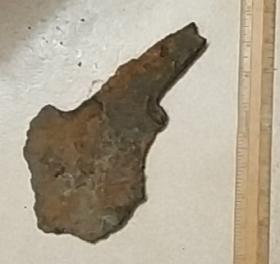
On the subsequent days several members of my family and I were tricking about with shovels, wheel-barrows and rakes: selectively transferring small rocks and gritty material from the drain to the lane so that the postman could deliver all the missing Christmas cards without doing a sproinnngg on his suspension. A week later, it is almost on a can't see the join level. There was an interesting turn up for the book about halfway up the lane. I was lifting loose stones from the bottom of the drain, when a very flat one came up in my hand - about 20cm x 12cm and shaped like South America [R]. It has a couple of the same square bosses which appear on the piece of the True Bomb which demolished the house we live in 81 years ago on 2nd Jan 1941. So, provisionally, we have another fragment of that tragic jigsaw.

I'm not going actively looking for more because it is hard to properly establish provenance without the help of an archaeologist or a forensic metallurgist and their equipment. And don't mention metal detectors - there are buckets [literally buckets in at least two cases] of miscellaneous iron-mongery thrun in the ditches across the property.