Wednesday, 12 April 2023

A fleeting signal

 The Boy is back home in Ireland with his family for Easter. We had planned to run an Easter Egg hunt in our 1 acre woodland. Last Summer we had the arborist in for two days work putting manners on the 13-15 year old trees with some judicious thinning. It's lovely down there, with the canopy gone, some colourful spring flowers are getting their time in the sun before nettles Urtica dioica and brambles Rubus fruticosus choke them out. Some natural pathways are meandering round the acre: so that those so inclined can do walking meditation: after the arborist I went round pruning off the eye-pokers. 

But the optimistic elder care roster collapsed under coronarama and other interventions - we are none of us getting any younger. Accordingly we were down on Costa na Déise. We made a couple of visits to the quietly delightful Japanese Garden in Tramore, where Irish / Greek / American / Japanese story-teller Lafcadio Hearn spent some time as a youth. Gorra season ticket now, so we'll be back!

Easter Monday, after lunch, between showers, The Boy and The Bob took his daughters down to the strand at Kilfarrasy. The wind was really too bitter brisk to go swimming so we ambled about doing beachy things: digging holes, throwing stones and writing messages to the naiads. Whereas I have a fine cursive hand for sand-writing, I cannot frame a picture to save my life:

What I meant to say was
THE SAND IS A
PALIMPSEST
. . . which is surely true between the tides. Less so in the Sahara where jeep-tracks from WWII are still etched. I had more to say:

I think, with Linda McCartney widely available, even vegetarians can agree with that sentiment. The Gdaus are in beach-combing school and found this large rusty buoy on Inisheer on a visit the week before Easter.  

The parents stoutly maintained that there was no room in the car; so that buoy was sadly left behind.

Monday, 10 April 2023

All wired up but not ready to go

I am still digging into the bran-tub of ear-book delights that is Borrowbox. The integrated search algorithm is laughably useless. If you search hopefully for essayist Anne Fadiman, Borrowbox is as likely to deliver Anne of Green Gables or a biography of Anne Boleyn as Best Hit as anything written by, say, Anne Fadiman.  There is a little more utility in Bbox's if you liked that you might like this feature. Come what may, butterfly me will be happy with a wide variety of reading matter - mainly non-fiction; but I'll take a good novel if a) I've not read it before and b) someone I know (and who knows me) recommends. I also browse hopefully through the N=3,000+ non-fiction inventory: I've been agreeably surprised before

It doesn't altogether surprise me that I've just found and romped through another ear-book about end-of-life issues. Death Interrupted: How Modern Medicine Is Complicating the Way We Die [2022] by Canadian ICU doctor and former chopper paramedic Blair Bigham. As you see [R] Bigham is young and fit with knotted sinewy fore-arms - all the better to deliver a heart massage for you my dear. In the earlier version of his caring self, as a paramedic, doing CPR - on roadways, at the bottom of stairs or on his chopper - was what he did. Having delivered the client to the ambulance bay at the nearest emergency care hospital, Bigham and his para-partner could return to base job done. After a mentor had persuaded him to enroll as a grown-up in med school, the 30-something got a more holistic / skeptical view of this as an end-point.

In ICU, there is a lot of kit, some very expensive, and the hospital pharmacy is bursting with meds to try on- and off-label. At the beginning of the pandemic in early 2020 I zoomed into a couple of lab meetings run by my old boss in Immunology. A couple of ICU doctors at one of the great Dublin teaching hospitals were also on these calls because they were getting a higher higher degree researching the innate immune response to viruses. These two young doctors were between mighty sessions intubating, pain-killing and racking their brains for something - anything - which might keep these deeply ill patients alive rather than, like, dead. Most covid patients who rocked up in ICU didn't make it. We know that. What was not really talked about were those who were discharged from ICU and later from the hospital. Later on, Long Covid was recognised as A Thing: people whose QALY - quality adjusted life years - had taken an uncompromising tumble to feeling crap pretty much every waking moment. 

One phenomenon to which Bigham gives some side-eye are the facilities in the USA known as LTACs - long term acute care facilities. It's gotta be an oxymoron? acute means severe / emergency / in-the-moment; it can hardly be long-term and still in the English language. But LTAC is big business - consuming $5billion annually - since Congress 40 years ago authorized increased payments for patients who required more care. It became a new business model: keep the bodies breathing and the bonus Medicare checks would keep rolling in. No expectation that clients would ever leave the facility except in a box. The perverse incentives were cranked up when ICU discharge was deemed to be successful if the patient was still alive 365 days later. Bigham implies that your loved one's care will step down to 'warehouse' on that crucial 1st anniversary of admission. It might be worth asking cui bono? who benefits from this way of life - but not as we know it outside, Jim.

It is welcome to have an insider's skeptical take on modern Western medical practice as it impacts the end of our days. I got much less sense of skepticism from the discussion of transplants; or organ harvesting as some call it. Is it true that the PRC obtains kidneys for party apparatchiks from condemned members of Falun Gong - or is that just othering the existential threat from Asia? For Bigham, using the usable parts of someone who has recently checked out is A Good Thing. With a new liver, kidney, heart-valve or cornea, a very sick person can get an enormous fillip in their QALYs. But whoa! perverse incentives alert. As dead bodies becomes increasingly an asset in parts, the definition of death, especially the timing of death has had to shift its ground. Social researchers from 2053 will look back on current practice with a different perspective. It won't be dissimilar from our current acceptance / embrace of boxing as a sport. That may seem like a wtf non sequitur but both boxing and keeping the dead alive is - for reasons [ie ca$h mon€y] - meting out a casual cruelty on human beings. . . by creatures who drive around in status cars.

Sunday, 9 April 2023

Easter 2023

Christ is riz!

Friday, 7 April 2023

Please send more stamps

A little toot on the Isn't Bobby Clever horn?

I don't do Fiendface or Instah, but over the last several years, I've tuned into Metafilter for my para-social life. At the end of last month, Paul Slade, a British MeFite asked a question about some WWI post-cards which he'd bought. We've met Slade before with his long-form investigation of Kit Williams and the Masquerade hare.

It seems that a clutch of post-cards had been written home in 1915 by a future Tory grandee while he was in boarding school at the other end of the country. It was relatively easy to work out who Robin the Author was but one of the post-cards was covered with numbers and symbols whose meaning was harder to make out than the regular upper-class intra-family slang which filled the other missives. 

Eeee but I do like a good puzzle! I've clipped part of the message [picture top] in the scraggy hand-writing of a 12 y.o. for whom penmanship was not on the curriculum of his very expensive education. When my mother died in 2020, I inherited a small plastic bag containing my own letters home written almost exactly 50 years after young Robin's. My handwriting was terrible too. It wasn't until I started inventing myself aged ~15-16 that I developed a reasonably consistent cursive hand. By then I'd twigged that good handwriting is quicker than scrawl, quite apart from being easier to read.

It's not much to go on (30 words = 150 characters) but if you've inhabited the mind of a small chap writing home from  an Institution, it's defo easier to imagine what could be written: it's rather a reduced instruction set of concepts. Have a go, yourself? But I'll not hold it against you if it's couldn't be arsed. One approach:

  • Vowels 
    • My first observation was that the message is a mix of numbers, letters and symbols; but that only the numbers 1-5 occurred. I hypothesized that these might represent the 5 vowels a e i o u in that order. 
    • 3 appears twice as a single word, so that has to be a or I, the latter being more likely. 
    • 2 is far more common than the other digits which accords with the high frequency of e in normal English. 
    • English allows double vowels ee and oo, but not aa ii uu so the 44 in line 6 is likely oo. 
    • The diphthongs in the message are also consistent with my hypothesis in standard English 45 = ou;  21 = ea; 32 = ie. I'd have rethink my program if the text was indicating ua ia or  ui
  • Consonants 
    • with vowels sorted, similar thinking can be used to assign each of the symbols to English consonants. 
    • The first line starts dea? which gives us the symbol for r. 
    • Doubles: The last word in line 3 is ?eKK. There aren't many possibilities there ?ebb, ?ecc, ?edd aren't in common English but ?ell is, with ?ess also possible. 
    • If that word does end in ll the next word is ?ould which must be could or would. That l also helps with the last word on line 4 ?lea?e. Crossword solver [or similar] is your friend: that combo must be cleave, oleate, please, or sleaze. The same word appears on line 4 but also in the PS at the top of the card - gotta be please. Young Robin being a politely demanding chick still. This sub-solution is handy because s is the 3rd commonest consonant after t and n and appears 10x in the message.
    • More doubles 
      • M5MM? appears twice at the end of the message - could that be Mummy?
      • From what we've already deduced, the first word in the last line reads le??er, which could be lesser or, if Robin is Afrikaans, lekker but I'll bet on letter. 
And there you have it. I think the standard operating procedure outlined above would have utility for any simple substitution cipher. I wasn't the only person to solve the puzzle. Answer on Metafilter.

Wednesday, 5 April 2023

Style stiles

 I had a very expensive education and that's been really good for my career in table quizzes. But the extra-curricula bits have been at least as useful. When I was into Am Dram during the first couple of years in College, I used to help make the sets. Somehow the College Carpenter [a rank below Bursar but above Dogcatcher] was also seconded to this activity. He asserted that I'd get straighter saw-cuts if I held the saw with three fingers and pointed the index finger along the blade in the direction I wished to cut . . . and it was so. When I'm in the zone, I can saw a timber so that the end is square.

After I'd finished all the exams in my final year in secondary school, there were still several weeks of [fully paid up] term left that Summer. Rather than allowing me and my fellow young patriarchs to idle away the days playing cards and drinking rough cider, we were offered a variety of voluntary activities. I signed up for stile-construction on public footpaths, with a couple of my peers. We were told to cycle out into the country and report for work at a particular farm; where tools and timber would be available for the task. By the time we arrived, the farmer had assembled a bucket of nails, a hammer and his second-best saw. We trailed after him round the farm-yard as he sourced random bits of old timber and half a dozen fence-posts. We knew they were fence-posts because one end of each had been roughly pointed.

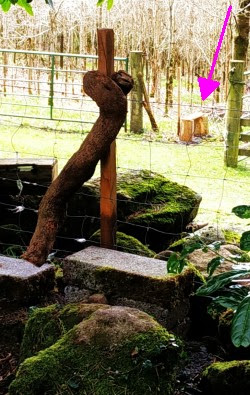
I think, over the course of a week, we created 3 stiles to facilitate walkers on the foot-path which ran through that farm. They looked more or less like this. The first attempt was ragged-arsed mess which I imagine the farmer ripped out and replaced from pure shame after we left. But at the end of the week three quite unhandy chaps had learned something and it's possible that those latter stiles are still in place 50 years later.

The G.kids are due for Easter. When they were last here, they spent a good bit of time in the 0.4 ha woodland which we planted 15 years prior and got thinned last Summer. After they had returned to blighty, we found a crude shelter in one corner of the woods, such as might have been constructed by an extremely indigent hunter-gatherer clan. It is clear they don't need supervision or leadership down there. Their Auntie N, clearly anxious to be rid of their company, decided that a couple of stiles were required to more easily negotiate the two lines of sheep-wire between kitchen and woods. And it was so!

The thing about stiles is that they are designed to facilitate walking people while baffling sheep. Anyone with experience of sheep will know that they baffle easy; so stiles can be built in a wide variety of <ahem> styles so long as they provide some sort of steps on either side of the fence. Appropriate tech rules in my book and it's better if nobody goes to the creamery or agri-store [or Ikea?] to, like, buy a flat-pack stile kit. The first style [above ]}is little more than 3 x 4in solid concrete blocks that have been waiting for the call for a decade + a new fence-post to steady the hand. As a concession to soft city folk, I planed the top foot of the post to lay the splinters. The far side of the fence is a drop of about 1m from a rough stone-faced ditch. We settled the stile-local stones to provide firmer footing; and Job Done!

For the lower stile, the fence runs across the field called Crowe's which was a regular meadow in 2007. Steps were therefore required on both sides . . . and two strands of barbed wire also needed removal. I found two chunky logs, not [yet] split for fire-wood, and the same height = 15in = 400mm and we settled them on a bed of gravel  so that they were a) stable b) still the same height against the fall of the hill. Nailed together with a red cedar plank, with another partly planed fence post for hand-hold the second stile was easier to construct than the first - if that be possible.

If that-all sounds bish bosh bash super easy, I'll just add that when we started the project we really had very little idea how the final version would look. If I hadn't found two same sized logs, something else would have formed the foundation of the solution. Concrete blocks don't really have that olde world rustic look but they have the virtue of being flat on two sides and just the right size for a reasonably fit adult to lift without courting a hernia . . . and available a short wheel-barrow journey away.

I spend the rest of the afternoon sawing tree-stumps out from the developing pathways in the woodland. Some of the stumps left by the Forester last summer are already starting to coppice and that's an asset but a stump in a pathway is a trip-and-fall hazard.

Monday, 3 April 2023

Worst scone in The North

In about 1985 I emphatically threw in the towel on buying bread in, like, bakeries; and started making the family's bread myself. For many years, I bought dried yeast as industrial ½kg tins although recently I've been pitching into Polskie Sklepy on the regular for 100g of fresh. But I wouldn't be Irish if I didn't make soda bread occasionally and I can knock up a batch of scones before unexpected guests have shed their top-coats and galoshes. A key trick I learned from YT a tuthree years ago is to put the dough through several cycles of roll and fold à la croissant: each fold gives an extra loft of lightness.

Croissant?! Hat-tip to Felicity Cloak of the Guardian whose croissodyssey round France I read and reviewed two years ago. Travel books need a trope to hold the narrative together and also a ruthless editor to prune away the boring bits. Cycling (if you have an leather arse) round France (if you have a smatter of french) in search of the perfick croissant is a project with which I could get along.

Starting before Cloak but finishing later - because her project was comprehensive rather than a sample - Sarah Merker [L] has been on a journey to try a scone at every National Trust tea-room in England, Wales and Norn Iron. Anyone finger wagging about the planetary burden of all that excess travel can cast their mind back to 2013 and reflect on their own carbon footprint when Merker started her project. 20/20 hindsight is a piffling talent. Her sconodyssey was picked up by the Press Association as Merker closed in on the last few NT scone outlets. When she finally sat down at The Giant's Causeway, the story was picked up by the Guardian and other media, achieving 15 hours of fame. Really you could think of far worse ways to spend your leisure time. There is a book.

I dipped into this rich confection to taste the State of the British Scone and liked the recipe of logistics, taste-test and local history. But when every scone in the nation seemed to score 5/5, contrary me dug in to find the worst scone in Northern Ireland. Years ago, we were in Avondale House, Parnell's gaff in Co Wicklow, because the grounds are full of fresh air and big trees. It was, literally, grand; but tea-time was a big disappointment because the café had no scones and the yoghurts were 4 days beyond their sell-by - harumph!. It turns out that that the scone at Carrick-a-Rede merits only 4/5 "The scone was unfortunately dry - I don't think it was fresh, but I've been wrong about that before - and the cream helped to alleviate things". Obvs we shouldn't condemn an outlet on a sample size of 1 and 4/5 is 80% or a 1st Class Honours Degree mark. But I'll gripe by proxy at "there was a choice of fruit or raspberry and white chocolate" wot-the-scone!? what ever is wrong with serving a good plain scone [I like a shake of coarse wholemeal in the mix]? It's like when The Fərmentary overcooked a batch of their croissants and confessed they might be able to save and serve by covering them with icing and almonds. The best cooking is not fancy gimcrack; it is simple ingredients in perfick combination.

Sunday, 2 April 2023

Aprille shouers

. . . are wet and . . .