Sarcophilus harrisii is about as cute as your average dog or cat [and R] but has had a bad press in Tasmania, especially in livestock country, where it goes by the common name Tasmanian Devil. Since Thylacinus cynocephalus the Thylacine shot to extinction 80 years ago, Sarcophilus harrisii has been the world's largest carnivorous marsupial, which is to say not very large. But it has the distinction of having the most powerful jaw muscles of any extant mammal, which it uses to crush bone and rend sinew. When you look at them in captivity being hand-fed by the staff, you can't really understand why anyone would take against them. But I guess Australian farmers would give you a different story of dead lambs. The 'Harris' who first described and named the species, was George P.R. Harris a short-lived and perhaps dissolute government surveyor who picked the site on which Hobart was built.
Sarcophilus used to be the Australian Devil because fossil evidence indicates that it was distributed all over continental Australia in the Pleistocene. But, with the coming of man and dingos, the smaller carnivore has been in retreat and has been confined to Tasmania for the last 3000 years. Note: current taxonomy lumps dingos, domestic dogs and wolves into the same species Canis lupus. It seems that Sarcophilus is not long for this world and, in this instance, humans are only partly to blame. It's true that they attracted a bounty for hunters in the 19thC but they have been protected by law since 1941. Some believe that Sarcophilus has been instrumental in limiting the extent to which European red foxes Vulpes vulpes have invaded Tasmania. Foxes are a decided pest elsewhere in Australia; so that's a good reason for wanting to Save the Tasmanian Devil; t-shirts; mugs.
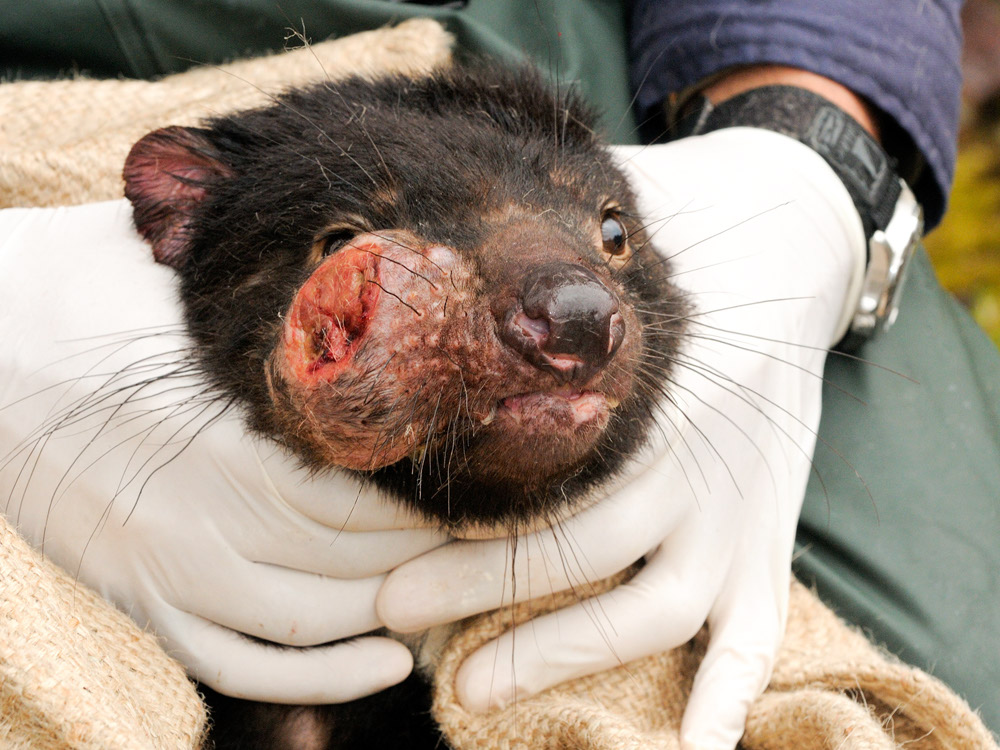
The main threat to Sarcophilus over the last 20 years is a foul transmissible cancer called DFTD - devil facial tumour disease [picture for the well 'ard]. This is presumably some sort of virus but is associated with abnormal chromosome count. It was first observed 20 years ago and can spread from animal to animal by contact. The tumours blurf up in and around the mouth as weeping sores that interfere with feeding, and presumably make the wee things feel real crappy and so soon enough kill the poor creatures. Estimates of the effect this is having on numbers vary wildly between 20% and 80% mortality and there are some regions of Tasmania where the disease has not yet been observed. Anyway, between DFTD, roadkill and trigger-happy farmers the population of the species has declined 60% in the last 10 years. Sarcophilus does not breed well in captivity but DNA sequencing has allowed scientists to sequester 98% of the genetic variablity in zoos; with the intention of returning the species to the wild after the virus has played itself out. Keeping this one species on the planet is estimated to have an interventionist price-tag of US$11million. Not as cute a pandas Ailuropoda melanoleuca? or Orang utans Pongo abelii? there are 5000 species of mammal we can't save them all.
Now IFLS reports that a second transmissible tumour has been isolated from Sarcophilus which also causes facial tumours but appears to be genetically distinct. That's weird because transmissible cancers are really rare in any species and to have two infecting one small marsupial carnivore makes you think that there may be a defect in their immune system. "To have one tumour may be regarded as a misfortune; to have two tumours sounds like carelessness."
Ah go on then: list ye well tae The De'il's Awa' Wi' The Exciseman by Ewan MacColl
Wednesday, 6 January 2016

Tuesday, 5 January 2016
Not very Neisseria
It's a while since Uncle Bob was giving you some second hand advice about the Pox Neisseria gonorrhoeae. Two years ago I was asserting that injectable gentamicin given simultaneously with oral azithromycin would knock gonorrhoea out of any orifices in which it might be lurking since your last fling of unprotected sex. Even Wikipedia now says that gentamicin is not effective for either gonorrhoea or its partner chlamydia. I don't mean to imply that these two bacteria are particularly closely related, Neisseria are part of the betaproteobacteria which includes Bordatella petussis the cause of whooping cough. alpha- gamma- delta- and epsilon-proteobacteria are the other named sections of this part of the bacterial tree and they include an awful lot of known human pathogens. Chlamydia, OTOH, is off in a distant group about as far as possible from the proteobacteria while still being Gram-negative.
At the moment the blast of choice against Neisseria is a double-whammy of injected ceftriaxone and the same old oral azithromycin. Using outmoded antibiotics like gentamicin and penicillin is foolish because the strain of N.gonorrhoeae which your patient has is almost certain to be resistant those drugs. They will nevertheless upset your intestinal flora and may lead you to a iatrogenic [doctor-caused] infection by Clostridium difficile which will be really difficult [hence the name difficile] to shake. Giving ceftriaxone without azithromycin or vice-versa will precipitate a similar disaster. In March there was an outbreak of ceftriaxone-resistant gonorrhoea in Leeds, which proceeded to romp through several cities in Northern England. If you're a doctor in rural Ireland you have maybe a couple of years when your young and promiscuous patients will respond well to ceftriaxone, but someone in your parish may already have gone on a stag-party to Bradford or Newcastle and brought the more robust strain home to roost. So please treat all cases with the double-drug combo. Not least because chlamydia is definitely not responsive to ceftriaxone.
The thing about the pox is that it is not very nice, but it's also not very fatal. Indeed 50% of infected women are asymptomatic. We are looking to go back to endemic, more or less untreatable gonorrhoea after two generations where, so long as you got yourself tested and treated, you could get yourself cured. I guess it's not your fault that penicillin was over-prescribed in humans by doctors who failed to have adequate continuous professional development CPD courses and used as a growth-promoter in chickens under an insane policy of nil-regulation of 'agricultural' antibiotics. BUT you could use a condom! It's safer: getting Neisseria is not nicer.
At the moment the blast of choice against Neisseria is a double-whammy of injected ceftriaxone and the same old oral azithromycin. Using outmoded antibiotics like gentamicin and penicillin is foolish because the strain of N.gonorrhoeae which your patient has is almost certain to be resistant those drugs. They will nevertheless upset your intestinal flora and may lead you to a iatrogenic [doctor-caused] infection by Clostridium difficile which will be really difficult [hence the name difficile] to shake. Giving ceftriaxone without azithromycin or vice-versa will precipitate a similar disaster. In March there was an outbreak of ceftriaxone-resistant gonorrhoea in Leeds, which proceeded to romp through several cities in Northern England. If you're a doctor in rural Ireland you have maybe a couple of years when your young and promiscuous patients will respond well to ceftriaxone, but someone in your parish may already have gone on a stag-party to Bradford or Newcastle and brought the more robust strain home to roost. So please treat all cases with the double-drug combo. Not least because chlamydia is definitely not responsive to ceftriaxone.
The thing about the pox is that it is not very nice, but it's also not very fatal. Indeed 50% of infected women are asymptomatic. We are looking to go back to endemic, more or less untreatable gonorrhoea after two generations where, so long as you got yourself tested and treated, you could get yourself cured. I guess it's not your fault that penicillin was over-prescribed in humans by doctors who failed to have adequate continuous professional development CPD courses and used as a growth-promoter in chickens under an insane policy of nil-regulation of 'agricultural' antibiotics. BUT you could use a condom! It's safer: getting Neisseria is not nicer.
Monday, 4 January 2016
Whisk(e)y

The leader of the entrepreneurs on the Suir is a chap called Mark Reynier who comes from a line of London wine merchants and so is well connected in the ethanol world. He must have connexions elsewhere too, because he got a chunk of fabulous publicity in New Yorker article a tuthree years ago about another venture. Reynier was on holiday in Islay [pronounced eye-lah] and came across a moribund distillery between the peaty uplands and the rocky shore of the island. It was called Bruichladdich and he believed it made a shockin' good malt whisky. Alone among the distilleries of Islay, it didn't adulterate the distillate with a whiff of peat. Indeed, Laphroaig, the most well known single malt from the island uses a bludgeon of peat which is an acquired taste “like chewing on a well-tarred fishing boat” but at least it's a taste. The big money in beers and whiskies is in product that tastes of bugger-all: think Budweiser or any of its euro-fizz equivalents. Most people want something cold and fizzy and mildly alcoholic to chug down after a game of rugger or when watching real men play rugger on the TV while they sit on the sofa running a commentary. Real ale [by implication for real men] is a niche market. Bruichladdich also stars in this BBC Travel piece about adventures in booze. Reynier has made a success and some money from Bruichladdich and has now set his sights on Waterford.
You need immensely long pockets to launch a whiskey distillery. You have to run a pay-roll, service your debt, maintain the plant, purchase the raw material and warehouse your product for years before you make your first sale. The raw material is malt, which is barley Hordeum vulgare that has been wetted and allowed to sprout. It's pretty much the same as beer in the sense that the sugars for the fermentation are supplied by the breakdown of the starch in the barley seeds. A lot of the plant at Cherry's brewery will be left in place: the company needs enormous vats to brew a mash to allow the yeast Saccharomyces cerevisiae to generate some alcohol: as much as possible, by fermentation. Fermentation is an energy-inefficient way of processing sugar: two-thirds of the product is ethanol which is toxic to most living things and one third is carbon-dioxide.
It was really interesting listening to Reynier talk about the struggle ahead. Don't imagine that, as an independent, you're home free when you finally bring your product to market. You will then be going head-to-head with huge industrial combines like Diageo, Remy-Cointreau, MillerCoors, Anheuser-Busch InBev. The last two sell 80% of the beer retailed in the USA - under a clatter of brands, it is true, but all marketed from the same board-room. Your new product will be a) new b) authentico and c) wow your pals. It might even impress a few local publicans, who will want to shop local and support a neighbour. But if Loco, your new beverage, starts to sell well it will erode the sales of Guinness, Heineken and Red Stripe and that will be noticed by their reps as it eats into their commission. They will be instructed to make the publican an offer that will be really difficult to refuse: be it cut price Guinness or cut off the supply of Guinness. The mega-conglomerates make money at each step of the process and can easily afford to take a pounding at the retail end if it drives an upstart to the wall.
I heard a small on-topic joke over the holiday which I will share with you. Two middle-aged pals get well down into the world of single malt whisky, tasting their way through the enormous variety available. One evening they come across a chewy malt that is everything they've been dreaming about - it is The One. Jim savours the taste and says "Bob, if I die first will you be sure to pour a dram of this stuff on my grave". "To be sure I will, Jim", his friend replies "but it will be a terrible waste if I don't drink it first."
Sunday, 3 January 2016
boy Boyan buoy boom
Boyan Slat was a teenager from Delft in Nederland who, a very few years ago, went diving in Greece and met more plastic bags than fish. Bummer! It must be like swimming in raw sewage discharged directly into the Estuary of the Three Sisters - the Rivers Nore, Suir and Barrow - between Counties Wexford and Waterford in SE Ireland. This wonderful marine shoreline, where I learned to make dams and eat sponge-cake as a nipper, is called Waterford Harbour, which might sound okay as a sewage outfall. "The Estuary of the Three Sisters" sounds like it is violated by untreated effluent. Like being beaten with various implements as a child, sucking up dilute coliforms in the sea off Duncannon Strand never did me any harm. buoy
He first articulated his idea of a tethered boom passively concentrating and gathering the plastic fragments in his 1st Talk at TEDx Delft in October 2012. He got up on stage, he made his pitch and then went on with his day-job as a student. Then, the video went viral! He started to get 1000+ e-mails a day and was able to crowd-source $80,000 in 15 days. $80k was enough to employ some Effectives and encourage lots of volunteers. The team worked really hard, both getting wet and running computer simulations, dealing with the long list of economic, ecological, ethical and engineering objections to the idea of corralling trash, the concentrating, abstracting and recycling it. The results of this research and rebuttal have been published in a 530 pp report "How the Oceans can Clean Themselves" which has [great metaphor] ocean-plastic covers! Slat was in a position to give a Second talk in NYC June 2014 to the assembled team which summarised some of the solutions to the objections. As you gather the plastic fragments, they cried, you will gather up and destroy the plankton as well: not so, but even if all the plankton which encountered a boom was killed, the ocean would take 7 seconds a year to replenish the lost microbes. At $6 per kg gathered, it will never be economic, they sneered. Not so: the feasibility studies suggest a cost of $0.20 and at that price, the recycled plastic, like the book's cover, can be sold at a profit to pay for itself. Team Slat reckons there may be 7.25 million tons of extractable plastic bobbing about awaiting collection. Solar panels atop each collecting station will give the power to run the centrifuges to separate the particles by size. As Boyan wraps up his second talk:
I contrast to me, idly bloggin' about the trials of full-facial meeting-the-environment as a youth, Boyan Slat a) had an idea for cleaning up the offensive plastic and b) did something to progress it. He's become a bit of a buoy wonder. Under October on our 2016 Kitchen Calendar we have:
"Nobody made a greater mistake than he who
did nothing because he could do only a little".
did nothing because he could do only a little".
Edmund Burke
I've written about the North Pacific Gyre before. As with Three Sisters / Waterford Harbour, the words matter: when described as the Pacific Garbage Patch it conveys a wholly unrealistic image of the density of plastic detritus which is only about half-a-kilo per sq.km. That might be orders of magnitude more than other less vortexy regions of the ocean but it's still not very much. It's a bit like trying to find all the bits of a fragmented 35g 2lt pop-bottle on our 7 hectare farmlet, except that it's floating rather than being caught in the brambles.
"It's one of those things that couldn't be done but . . . then were done."
Saturday, 2 January 2016
Christmas Xword answers
I guess nobody [could be bothered to] finished the Christmas 2015 Crossword that I put up a couple of weeks ago to keep my hand in. But I'm certain sure that you're all panting for the answers. I'll add some annotation so you have a clue about what was going on in my head.
 Clues Across
01ac. ---, Gropius, Werfel Mahler: Alma Maria Schindler married successively the composer, the architect. and the novelist.; 04ac. aka Chaldean Aramean Assyrian synonyms; 09ac. Glutton; Morus spp. Gannet; 10ac. 10o28N 61o15W isle Trinidad; 12ac. Nb named for dau of Ta Niobe Niobium is directly above Tantalum in the periodic table ; 13ac. Арха́нгельск in English Archangel port on Arctic Sea; 15ac. Devonian outcrop Tor geographical feature in Devon and Cornwall; 16ac. Boudicca's people Iceni; 17ac. Wm 021013 Ml 160313 Ramsey the dates refer to Blob Posts; 22ac. Drugged geologist?; Stoner - joke! 24ac. 86Rn Radon; 27ac. One of the Padidae Tit a class of small bird; 28ac. Snowbird RV Winnebago trade mark of a type of mobile home in whc a snowbird might live; 31ac. Tribromofluoromethane Halon flame retardant and ozone destroyer; 32ac. Flight from LHR to SIN Longhaul; 33ac. The original Hun Attila; 34ac. Benzene girl's name Kathleen "ni Houlihan" Lonsdale; 35ac. Черное море полуостров Crimea - a Black Sea Peninsula;
Clues Down
01dn. 150t Holocaust 060714 [Lac-]Mégantic; 02dn. Birthplace 1714 UK king Hannover - George I was Elector of H.; 03dn. [Bible] interpreter Exegisist; 05dn. A huge block of ice Serac often formed by intersecting crevasses in a glacier; 06dn. A yiddischer gossip Yenta; 07dn. λ 430nm Indigo wavelength of light; 08dn. Uncancerous lump; 11dn. C.cainii or Fr C.sativa Marron which is both a type of crayfish and the French for chestnut.; 14dn. Cardiac nerve bundle His which runs from the AV-node to the Purkinje Fibres; 18dn. Shandean postscripter 200114 [Robert] Merton; 19dn. Geastraceae fungi Earthstar; 20dn. Commiphora africana resin Bdellium; 21dn. 1/5 of the Iroquois nations Onondaga; 23dn. Globus [cruciger] Orb part of the crown jewels; 25dn. Inventor of Kevlar 020714 [Stephanie] Kwolek; 26dn. What Alexander did in Gordium Unknot - maybe with his sword maybe with more subtlety; 29dn. C2H5- Ethyl; 30dn. Heraldic tincture Azure;
01ac. ---, Gropius, Werfel Mahler: Alma Maria Schindler married successively the composer, the architect. and the novelist.; 04ac. aka Chaldean Aramean Assyrian synonyms; 09ac. Glutton; Morus spp. Gannet; 10ac. 10o28N 61o15W isle Trinidad; 12ac. Nb named for dau of Ta Niobe Niobium is directly above Tantalum in the periodic table ; 13ac. Арха́нгельск in English Archangel port on Arctic Sea; 15ac. Devonian outcrop Tor geographical feature in Devon and Cornwall; 16ac. Boudicca's people Iceni; 17ac. Wm 021013 Ml 160313 Ramsey the dates refer to Blob Posts; 22ac. Drugged geologist?; Stoner - joke! 24ac. 86Rn Radon; 27ac. One of the Padidae Tit a class of small bird; 28ac. Snowbird RV Winnebago trade mark of a type of mobile home in whc a snowbird might live; 31ac. Tribromofluoromethane Halon flame retardant and ozone destroyer; 32ac. Flight from LHR to SIN Longhaul; 33ac. The original Hun Attila; 34ac. Benzene girl's name Kathleen "ni Houlihan" Lonsdale; 35ac. Черное море полуостров Crimea - a Black Sea Peninsula;
Clues Down
01dn. 150t Holocaust 060714 [Lac-]Mégantic; 02dn. Birthplace 1714 UK king Hannover - George I was Elector of H.; 03dn. [Bible] interpreter Exegisist; 05dn. A huge block of ice Serac often formed by intersecting crevasses in a glacier; 06dn. A yiddischer gossip Yenta; 07dn. λ 430nm Indigo wavelength of light; 08dn. Uncancerous lump; 11dn. C.cainii or Fr C.sativa Marron which is both a type of crayfish and the French for chestnut.; 14dn. Cardiac nerve bundle His which runs from the AV-node to the Purkinje Fibres; 18dn. Shandean postscripter 200114 [Robert] Merton; 19dn. Geastraceae fungi Earthstar; 20dn. Commiphora africana resin Bdellium; 21dn. 1/5 of the Iroquois nations Onondaga; 23dn. Globus [cruciger] Orb part of the crown jewels; 25dn. Inventor of Kevlar 020714 [Stephanie] Kwolek; 26dn. What Alexander did in Gordium Unknot - maybe with his sword maybe with more subtlety; 29dn. C2H5- Ethyl; 30dn. Heraldic tincture Azure;
Friday, 1 January 2016
The Draupner Wave
The sea can be rough - very rough. And sailors can tell tall tales - very tall tales. It would be interesting to bring science or at least real solid objective evidence, for some of the extremes of weather experienced at sea or at the edge of the sea. At Christmastime last year, I wrote about the mysterious disappearance of all three lighthouse-keepers from Flannan Isle, which was the subject of a poem and much speculation. I suggested that they had been taken up to a new life interplanetary sex, but it seems more likely that they were swept out to sea by a freak wave and died despite following standard operating procedures. And it must have been a helluva a wave to wipe out Henry Winstanley and his [second] Eddystone Lighthouse in 1703. Neither of these events left any eye-witnesses let alone iPhone footage. That's the problem: waves far out of the ordinary are no-survivors sort of events. How far is out of the ordinary, given the natural variability of all natural phenomena? A Rogue Wave is defined as being more than 2x the height of Hs or SWH [significant wave height], which in turn is the average of the highest 1/3rd of waves in a recorded wave-train. These are the highest waves we have on record and this wave is twice the size, that's what a Rogue Wave is.
 Then on the afternoon of 1st Jan 1995, exactly 21 years ago, the first Rogue Wave was recorded directly with down-pointing laser sensor instrumentation set up on the Draupner Oil Platform about 190km of the coast of Norway. At the time the SWH was a frightening enough 12m (twice the size of our two-storey house) but the wave itself [seen above at 265s] was 25.4m high! You can see that it is not the extreme tail of any normal bell-shaped distribution but rather an entity from a different place in physics. The physics also says that a large [12m, say] wave might deliver a punch equivalent to 6MT/m2 6 million tonnes to the sq.m. The mother of all Rogue Waves might whack you with 100 MT/m2; as water is more or less uncompressible and inelastic, this can be felt like a slab of concrete hitting the side of a ship and whisking off anything that is sticking out and/or not battened down.
There is a plan to visit the new grandchild in England in a few days time: I shall be wearing a life-jacket and two pairs of long woollen underwear . . . and a hard-hat.
There is a plan to visit the new grandchild in England in a few days time: I shall be wearing a life-jacket and two pairs of long woollen underwear . . . and a hard-hat.
Avanti 2016
G'day, g'day, it's Friday the 2016.


It was a lot more dramatic on the R. Barrow at Graiguenamanagh, where the Duiske stream tumbles down through the medieval town at the back of the shops lining Main Street. Lots of narrows and culverts to get blocked if the flow is mighty and a few bushes or plastic bags get caught. As seen [L] the water came through the backs of the houses and exited through the front doors turning the street into a surf park. On the quays below the Barrow rose inexorably until the cruisers appeared to be moored in midstream, it hasn't been like this since . . . 2009, oh and in 2008 . . . Successive Irish governments have shirked the responsibility to deal with rainfall and flooding in wet ould Ireland. We now have a fancy new motorway system but we have dozens of substantial towns whose central business premises are uninsurable because they are too frequently under water. Maybe we're all expected to pile into cars and do the weekly shop in a mall 50km away off Exit 9 of the M11. A good dose of Machiavelli is required to deal with the conflicting interests. Farmers down stream from Clonmel don't want to have their fields under 2 meters of water every third Winter - it compresses the soil something awful, but they may have to suck it up to benefit 100 fellow-citizens upstream who sleep with gumboots next to the bed.
Met Eireann is promising us another 3 weeks of successive tropical storms with rain and wind. Seems like so far I was naive/wrong about the Gulf Stream being blocked by melt-water from Greenland ice-fields.
Subscribe to:
Posts (Atom)