Thursday, 23 May 2013

National underpinnings

I do love a good polemic.  So I appreciated the sustained contempt in this essay in Slate about the lack of choice and/or grotesque lack of imagination which the several United States have sunk into designating their state bird. If the state legislatures are going to do this, could they not pick a different one each?  Clearly not: 10% of them have chosen a single species: Mimus polyglottos, and seven (!) others have chosen Cardinalis cardinalis.  Nicholas Lund has some great and eye-catching ideas for a complete re-jig of the system.  And what is the point anyway?  What do you do, if you live in Peoria IL, with the information that your elected reps have chosen the Cardinal to represent your state?

Europeans have got to remember that the United States are just that, not really much more like a single country than is the EU.  So you can see why each state might need a flag, an anthem, a motto - states have had such things since their leaders wore armour - and modern states probably need a website. After that it becomes a little twee.  Most of the states have a state . . . bird (as above), flower, tree, butterfly, rock, gemstone, animal. I'm not judgmental, so I'm not going to opine on where twee-but-sort-of-useless slips into absurd. And sometimes it's not so much the category - loads of (dairy) states choose milk as their beverage and Florida pushes OJ, all fairy nuff - as the choice. Wouldn't you cringe to know that your elected reps had designated kool-aid (NE) or Moxie (ME)?  Is that what they serve at state banquets in Maine?  Those of us who are old enough can remember certain murderous associations with kool-aid, so we're not surprised to learn that Utah has designated a state fire-arm. Browning M1911, seeing as you ask.

It's well known that Europe, particularly anglo-phone Europe, has for the last two generations been slavishly aping the USA in all things cultural, so I'm proud to report that the countries of the EU have stolen a march on Uncle Sam.  In an Order-in-Council published by the European Commission this week, it is announced that each of the states of Our Union now have designated underwear.  These choices are all unique, and informed by geographical area, climate and culture.  Note also that the order of precedence in the EU is determined alphabetically by the name of each country in its own first language.  So Austria is demoted from the top.  India has a similar system and West Bengal, fed up with being the last state called to vote in parliament and other indignities, is in the process of changing its name to Pashimbanga to get further up this list.

Belgium European union-suit Bulgaria pair of boxers
Czecho gingham pants Denmark lungi
Germany freikorperkulturohne Estonia felt long-johns
Ireland green combinations Greece sandy monokini
Spain boyshorts France cambric French-cuts
Croatia cheekies Italy cheekini
Cyprus copper drawers Latvia V-string
Lithuania T-back Luxembourg G-string
Hungary rice-paper briefs (1) Malta C-string
Netherlands hemp bloomers Austria red & whitietighties
Poland European midways Portugal Brazilian bikini
Romania wresting singlet Slovenia Slovoggis
Slovakia Bratislingerie Finland bark long-johns (2)
Sweden woollen long-johns UK Viyella Y-fronts
(1) if they're hungry they need something to eat (2) well 'ard the Finns
 Phew, I'm glad that's over!  I've spent more time this evening finding out about underwear than I've spent shopping for the th{i/o}ngs in my entire life. Other folk spend much more time on these matters. The Underwear Expert, as he is proud to call himself has some advice for those making their 2013 purchases.  But is it “This season, many brands are embracing the most natural of spring colors with a number of green underwear styles and designs that emphasize man’s natural bounty.”  OR “While hot pink was a big trend last season for underwear for men; lighter shades of pink underwear as well as pink’s cousin, fuchsia, have emerged as the new trend for the spring season.”

And after all this unscientific nonsense, let's reflect on the cost of a G-string compared to, say, a kilt. You can buy a kilt length of McKurosawa 100% wool tartan for about £50 - 100cm long by 140cm wide: £35 per sq.m.  You can buy teeny underwear online from Victoria's Secret, for about £12.50.  Let's guesstimate the dimensions - I don't have such a thing about my person - generously at an equilateral triangle with 15cm sides. As everybode kno the area of a triangle is half the base x the vertical height.  The vertical height can be calculated with trig: sin60 x 15cm OR with Pythagoras: AF2 + CF2 = AC2, so the height CF = SQRT(225 - 56.25) = 13cm, and the area is (13 x 15/2) or about 100sq.cm.  There are 10,000 sq.cm in a sq.m, from which you can cut 100 undies.  That's £1,250 a sq.m !!  You can see why the Scots (supposed to be near with their shillings) don't bother.

Tuesday, 21 May 2013

Nirenberg and Matthaei 1961

Thar she blows, as it appears in every biochemistry or genetics textbook.  An iconic image for our molecular biological times.  But have you ever asked why UUU is always shown in the top left-hand corner, as if that codon was first?
Nobody really knows why, but to a very close approximation, all proteins in all organisms incorporate just 20 amino acids and the same ones at that. Since Crick and Watson sorted out the structure of DNA 60 years ago this Spring, everybode kno that the information in DNA resided the linear ordering of just four 'bases'.  We all now familiarly refer to them by their initials A T C and G.  (It is too much for this post to explain but in some nucleic acids T is replace by another base designated U, so sometimes this list is written A C G T/U).  C&W showed that the thing worked as a replicator if A always paired with T and C always with G. But it was a mystery as to how the linear ordering of DNA bases translated (now a technical term for the process) into the linear ordering of amino acids in proteins.  Elementary (my dear Crick) math shows that two bases weren't enough to code for 20 amino acids because there can only be 16 of these 'dinucleotides': AA AC AG AT - CA CC CG CT - GA GC GG GT - TA TC TG TT.  It seemed extravagant to suppose that 4 bases AAAA AAAC AACA etc. were required because there are 256 possible permutations there.  Triplets (AAA AAC ACA ACC etc.) on the other hand seemed like Goldilocks' porridge to be 'just right'.  Those 64 possibilities had a comforting biological redundancy.  Crick the unarguably brilliant theoretician and others sat down with pencil and paper to work out how the encoding could happen.  The first coherent internally consistent solution came from left-field - a physicist and cosmologist called George Gamow came up with a diamond code which hinged on the fact that, if you squinted, the structure of DNA could be seen as a repeated series of diamond-
shaped indentations. Gamow accepted as necessary-and-sufficient that the coding was triplet-based and further that was that each hole was symmetrical so that CXG would determine the same amino acid as GXC and further still that the middle base for a given amino acid could be either of the complementary pairings A or T, C or G.  So CAG CTG GAC GTC would all code for "Z" while CGG CCG GGC GCG for "Y" etc etc.  When the end bases were the same as each other there were only two possibilities for each encoding rather than four as above - ATA or AAA for amino acid "N", ACA or AGA for "M" etc.  Remarkably, and I can imagine Gamow getting the shivers when he realised this, such an arrangement yields 12 four-way codings (accounting for 48 DNA triplets) and 8 two-way codings (accounting for 16 triplets).  12 + 8 being <shazzam!> just right to service the known 20 amino acids.  It was so neat it had to be true.  For various reasons of compelling permutational math Sydeny Brenner and others later showed that Gamow's code couldn't be true.
Francis Crick then stepped up to the plate with a hypothesis that a) the code was triplets b) the order didn't matter - so ACC CAC ACC all coded for amino acid  "J", ACG, AGC, CAG, CGA, GAC, GCA all for "I", solo AAA for "H" etc.  His solution required 4 one-way codings (4 triplets); 12 three-way codings (36 triplets) and 4 six-way codings (24 triplets). This mathematically compelling and biologically more reasonable solution cleanly explained the presence of 4 + 12 + 4 = 20 amino acids and 4 + 36 + 24 = 64 DNA triplets!  Begodde it was neat, and if poor Gamow had been deluded, this just had to be true.  Some of the excitement of the time is conveyed by Sydney Brenner's eyebrows in this series of soundbyte interviews at the wonderful archive of interviews at webofstories.  If you want more details of the math, you could do worse than read this great essay by Brian Hayes at American Scientist, where several other zany-with-hindsight codes are described in colour.

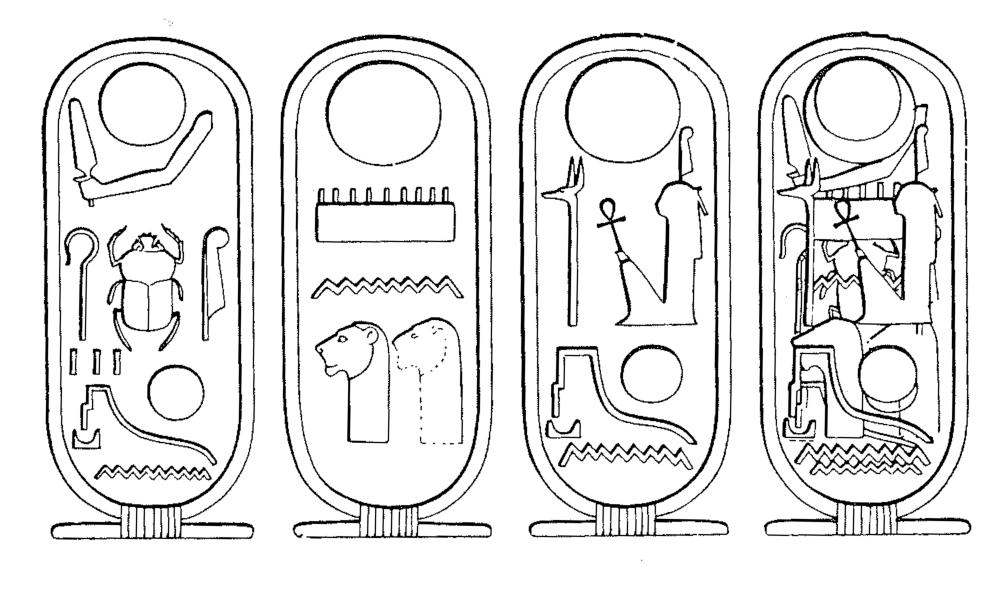
Meanwhile back in 1961 at NIH, a couple of more-or-less-unknown biochemists Marshall Nirenberg and Heinrich Matthaei, instead of looking at the ceiling thinking, were looking at the lab-bench experimenting.  They put together the contents of a typical cell in a test tube, fed into the sludge a molecUUUUUUUle consisting entirely of the base Uracil and generated an artificial protein consisting entirely of the amino acid phenylalanine. The first step, UUU=Phe, in cracking the code had been made, like Thomas Young's insight that cartouches in hieroglyphic script represented proper names. The other codings were knocked off over the next tuthree years by Nirenberg, Matthaei and many others and the real genetic code was revealed to be a robust but quirky kludge of contingency, accident and evolution. Nirenberg shared the 1968 Nobel prize with Holley and Khorana, and Matthaei didn't, adding to the list of controversial awards associated with Mr Dynamite's legacy.  I've always supposed it was because nobodaei could spell his name properlaei.

Sunday, 19 May 2013

Map of the Nation

Ever wondered what the circumference of the world is?  It's 40,000km to the nearest couple of miles.  And that's not a coincidence - it's a definition.  In the turmoil after their revolution, the French Academy of Science decided to put manners on us all by replacing yards, cubits and Flemish ells with a single universal measure of length, which they chose to define a the 10,000,000th part of the distance between the North Pole and the equator.  It took the designated engineers Mechain and Delambre the best part of seven years to triangulate between Dunkerque and Barcelona and extrapolate the distance to make the calculations. With the best science of the day, they made some assumptions about the shape of the earth which meant that their official meter is out by 200 micrometers (about the width of the dot on this i).  Tsk!

At about the same time, the British Government decided it would be a sound idea to make accurate maps of the South coastal counties of England, so that if the revolutionaries decided to swarm across the channel in a waft of garlic, the local militia could get to invasion beaches in the shortest possible time.  And out of this, the project to map the whole country was born.  It also explains why the mapping was carried out by a branch of the army.

All this is amply explained by the wonderful Map of the Nation: a biography of the Ordnance Survey by Rachel Hewitt, which was given to me by El Asturiano as I left Dublin at the end of 2012 to start work at The Institute.  It's taken me nearly six months to finish it partly because I've been somewhat busy, but mostly because the font is miserly small and unaccountably hard to read.  But it's worth it for the introduction to the technology and hardship of cartography in the olde days when you had to get out in the rain with your Gunter's chain and theodolite and hope that the gales wouldn't carry away your sail-canvas tent in the night.  The Ordnance Survey started in the South of England (Sheet 1, Kent 1801), and it took them two generations to work their way North and West to knock off Sheet 108 Denbigh in 1870 and cover the whole island.  It is one of the peculiarities of history that Ireland got served first and the Other Island was fully surveyed by 1845.  Which is handy because we thus have an accurate record of what the country looked like when it supported 8 million people before the famine. For example, the field you must walk through to see The Ringstone is called Crowe's and if you look at the 1840 map you can see a black square at the bohereen end of the field.  That was presumably the cabin where Mr and Mrs Crowe and their (numerous?) progeny lived. 5 years ago when we dug up part of the field to plant trees we unearthed lots of broken china at that spot on the map.

After independence, Ordnance Survey Ireland continued to work away in Phoenix Park and they have released an amazing zoomable historical map resource which allows you view the original 1825-1845 survey, the update 50 years later, and a sample of modern satellite pictures which you can over-lay.  I've picked the two views of Borris Co Carlow on the left because they show the rise and fall of the railway in Ireland.  In 1840 (in colour) the South of the village was barely populated, but the advent of the the railway changed
all that.  The GSWR branch-line lasted almost exactly 100 years 1858-1963 but only the viaduct is left now.

Rachel Hewitt's book is the offspring of her PhD thesis and a trove of data and history and vignette and technology.  William Wordsworth and William Rowan Hamilton both feature prominently in the Irish part of the tale. Read it to find out why you need two 20-foot-long glass rods if you want to start mapping a nation.

Saturday, 18 May 2013

Coderdojo

I was in a dreary workshop earlier this week and my eyes drifted off the task and onto a whiteboard saying but one word  Coderdojo (yes, in red) and suddenly I was alert.  Because CoderDojo is the coolest, possibly the most important innovation to come out of Ireland this decade.  The brain-child of James Whelton when he was a schoolkid in Cork and midwifed into a global phenomenon by global phenomenon Bill Liao, CoderDojo is a forum to encourage young people to write computer code rather than coat-tail on the millions of person hours that other people have put into writing computer code for you.  I'm not saying that young fellers aren't "active" as they steer Lara Croft by the hips through a labyrinth filled with Uzi-toting heavies; their brains (and other parts) are engaged in the process with problem-solving, planning, and imagination necessary for many of the games they while away the hours at.  It's not the same as TV, which is utterly passive.  But the quality of the graphics and the complexity of plotting must make an aspirant coder feel like s/he's at the foot of Mount Unsurpassable.  CoderDojo is billed at the antidote to that sense of disempowerment.

CoderDojo the template, the concept, the dream has spread to more than 75 places in Ireland (not to mention Burundi, Slovenia and Sweden) and one of them is The Institute every Saturday morning.

With my background, at various times capable of coding in six different languages, if I failed to volunteer, I'd lose my own face.  So this morning, I made myself a CoderDojolunteer badge and turned up in terminal-suite A313.  As Scratch and Javascript are about as opaque to me as Sanskrit, I didn't think I'd be much help . . . and I wasn't.  But I was able to tell the kids that ctrl-C and ctrl-V beats footling about with a mouse and, that cut&paste&modify is quicker and more reliable than typing similar lines in again and again.  I know now that making a working analogue clock appear on the screen requires typing more than 100 lines of javascript.  That's pretty onerous, given that javascript knows that testobj is different from testObj, but a lad of 12 might not.  But I also know that several of the Codistas had the bottle to keep plugging away for two hours and catch their numerous typos to create something nifty that can be built on.  If you can create a black clock you can surely make a green one or a smaller one; but can you make one that runs backwards?  Or a 24 hour clock?  And if you can build a clock face, you've got the speedometer and the rev counter sorted for your own Grand Theft Auto.  But you've got to slog it out at the beginning.  If you can put the graft in with programming, you suddenly find that you can put the graft in on other difficult or time consuming tasks - learning french irregular verbs, or cleaning your room or telling the school bully that you're not having it any more.

More next week!

Charity

I was up in Dublin again on Thursday - this is getting to be a habit - and after a heavy day's meetings we went off to the pub to celebrate a new a job (not mine, I just got one) and a new child-in-waiting (not mine, I've been genetically dead this last decade) and so I missed the bus home and had to wait for the next one. I elbowed my way past all the young people and got a seat in the front of the bus and, as often happens, another senior sat in beside me. Folks over 60 like to see where they're going and view public transport as an opportunity for a natter, while those under 40 see it as something to be endured.  While waiting for The Off, this bloke (slightly the worse for dhrink but far from legless) tried to blag his way onto the bus, because "he'd lost his wallet" and "sure didn't the driver know him" and "wasn't he up-and-down that route all the time".  The driver, quite properly, wasn't having any of this.  His job is to take money for the company and deliver us safe to where we want to go.  I've stuck my hand in my pocket before in such cases - who'd want to go to Castledermott in the middle of the night unless they had to? But despite assurances that I'd get the money back, and being compelled writing my address on the various scraps of paper, I've never seen folding-money in the post.  Nevertheless, what can you do?  Well you can do nothing and as happened a few years ago when I had to catch the bus in a hurry to get home and didn't have my phone to arrange a pick-up from the bus stop. I went up the aisle asking if anyone would send a txt on my behalf and the dozen or so me-people on the bus all resolutely looked out the window.  ANNyway, I was geeing myself up to do the human thing again, when the old dear beside me leaned forward and said she was good for a tenner.  It was too complicated to offer to go halves as I had intended and everyone knows that I am near when it comes to cash. So she stumped up, the bus-driver calmed down, the indigent got on and insisted on making tipsy-gracious small talk and asking for the lady's address.  Well, it being Ireland and a narrow corridor of Ireland at that, they soon established where their people were buried and a rattle of acquaintance was topped by the fact that his god-parents (deceased) had been her next-door neighbours.
So she has a better chance of retrieving her investment in kindness than I ever did.

Tuesday, 14 May 2013

pee glorious pee

warm water and nitrates . . . but not immediately.  The nitrogen in urine is mostly urea (NH2CONH2) and ammonia (NH4+) and so not easily or directly usable by your plants.  They much prefer to obtain their nitrogen as nitrates (NO3-), so depend on the microbes in the soil to do the conversion.  This is done in a two-step process:
1) ammonia to nitrite: carried out by Nitrosomonas
2) nitrite to nitrate: carried out by Nitrobacter.
So that's a reason why it's not efficient to pee straight on your vegetables, the intermediates (and some time) are necessary.  Back of an envelope calculations and a bit of scoping out the internet suggest a) that the average adult voids 1.2 lt (make that 3 yankee pints) a day, mostly water but including about 10g of nitrogen.  This is enough, if spread about judiciously and through the year, to provide 50-100% of the nitrogen requirements for plants sufficient to feed an adult. So that's kind of neat in a self-contained way. But a 1% solution of this stuff is muy potente, not least because urine is also rich in salt, so it's better to cut it 1:10 with water.  I'm glad I found that all out, and therefore I'm glad I got to teach The Nitrogen Cycle for the Environmental Science Module at The Institute

Monday, 13 May 2013

100-up

100-up is much better than Bib-Label Lithiated Lemon-Lime Soda which was the first incarnation of 7-up - less fizz but more substance.  This is my hundredth post and I'll indulge myself in a tiny Retrospective.  It turns out, as near as dammit, that I've dropped about 100 names in those hundred posts.  I've sorted them by first name because we now seem like old friends and the good people at blogspot/blogger provide a search function for Science Matters that will satisfy your curiosity about "What could Bob possibly have to say about Gene Wilder?".  In many cases the answer will be not very much! Sorry.
Abraham Lincoln; Ada Lovelace; Alexander Bell; Amedeo Avogadro; Andre Lwoff; Andrew Harrington; Aoife McLysaght; Barry Dalby; Benjamin Disraeli; Bill Clinton; Charles Babbage; Charles Darwin; Charles-I Stuart; Chris Hayes; Christian Goldbach; Craig Venter; Daniel Day-Lewis; David Attenborough; David Fahey; David Haussler; Dionysius Exiguus; Edsger Dijkstra; Edward MacNeil; Emil Zatopek; Eugene Cernan; Ewan Birney; Francis Coppola; Francois Jacob; Frank Ramsey; Gene Wilder; George Dawson; George McClellan; Gerd Gigerenzer; Jacques Monod; James Gleick; James Joyce; James Lovelock; James Murray; James Ussher; James Watson; Jan Jansky; JBS Haldane;Jean Danjou; Jim Kent; Jim Peters; Jocelyn Bell-Burnell; Johan Kjeldahl; John Hinde; John Keats; John Lonergan; John Seymour; Joseph Conrad; JS Haldane; Karl Landsteiner; Karsten Hokamp; Ken Wolfe; Leslie Liebermann; Lynn Margulis; Malcolm Gladwell; Mary Mulvihill; Matt Groening; Matthew Broderick; Maximillian I of Mexico; MC Escher; Michael Ramsey; Michel Thomas; Michelangelo  Buonarotti; Nan Doyle; Neil Armstrong; Paddy Lydon; Patricia Arquette; Paul Crutzen; Paul McCartney; Percy Shelley; Peter Medawar; Pope PiusX; Ralph Leighton; Raj Padam; Richard Chamberlain; Richard Feynman; Richard Haldane; Ronald Graham; Saint Cunigunde; Sian Croose; Sinead O’Brien; Skip Lovelady; Sophocles; Stanislav Jungwirth; Stephen Fry; Sukiyabashi Jiro; Tony Blair; Varro Raetinus; Walter Bagehot; Widukind Lenz; Wilkinson, Mr; William Hurt; William McBride; William Shakespeare; 

Clearly these may be gathered into bins or made to form themes (several Haldanes, many geneticists, some film-stars, a surprising number of Jims).  But several of them appear to be, in the tradition of "googlewhacks", un-met by google-light:

Your search - "Amedeo Avogadro" "Sukiyabashi Jiro" - did not match any documents.
Your search - "Johan Kjeldahl" "Emil Zatopek" - did not match any documents.
Your search - "Lynn Margulis" "Varro Raetinus" - did not match any documents.
But it is the destiny of googlewhacks to fade as soon as the spiders of Google find the site that reports them, so there will be soon at least one site on Google that reports the meeting of these unlikely couples.