Showing posts sorted by relevance for query bangalore. Sort by date Show all posts

Monday, 22 April 2019

Overheads

When I was at the Business Expo 2019 on a pen and post-it gathering expedition, I was lapelled by a seller when I paused near Blacknight solutions an Irish web-hosting and support service. I boasted mentioned that I'd set up a web-server and written my first web-pages in 1994 . . . possibly before she was born. In those early web days, before Dreamweaver, you had to write the HTML by hand in a text-editor. Because the <paininthetits> tags </paininthetits> were awkward to write, and unforgiving of typos, my markup was very simple. The signal [text and diagrams and links] to noise [necessary HTML to split paras] was about 90% words vs 10% <tags>, so it was very efficient even it it looked a bit clunky.

Now the ratio is worse than reversed. Here on Blogspot a recent 775 word posting requires 120,000 bytes of bandwidth to be read in Ballyhaunis or Bangalore.
What Total Text Ratio
Words 10,500 775 7%
Chars 120,000 4450 3%
This problem magnifies if you have fat graphics, or widgets, or ads, or demography-capturing software installed. Why is this a problem? Because 10% [and rising] of the world's electricity is being consumed by internet servers and every extra superfluous redundant fat electron on some dipshit website requires another hydro-electric power station in the Rockies. The other side of the coin is the quixotic pursuit of rural fibre-to-the-farm broadband in Ireland. Why does Bob Bó, living up the remote bohereen in Co Carlow, need broadband? Because it takes 25Mb of HTML nonsense for him to access the Co-op website to order 10 sacks of Ewe and Lamb Muesli [mmmm good].

I tried to explain this to the Young Marketeer from Blacknight but I could see her eyes glaze over with here's-another-batshit-crazy-old-bloke frustration. Because she was convinced she had it all covered:
Blacknight's server is on the right with their huge bandwidth connexion to the Rest of the World. Their client is the Provider on the left. Blacknight want to design a really swish sexy clickable website for their client: all the client needs to do is provide Blacknight with some copy [mission statement; phone numbers; picture of the CEO; dreamy background of green fields and munching dairy cows [4096 x 2048 pixels = 4Mb] . . . and a loada money, of course. Their server serves the data out and the orders come surging in . . .

Except that Bob Bó, not to mention Bhavesh Bangalore, needs to find 10 minutes between milking the cows and breakfast to download the Home Page, let alone get down to the order form. For my money, ISPs and web-hosters could play their part in the band-width crisis. Like we could all play our part in the carbon wars - if we could hold back from consuming energy [wear a sweater inside in winter; don't drive to the shop twice a day; let the kids walk to school] then we wouldn't need another power-station. If clickers need to upload a huge JPG or a fat javascript before they can get down to business, then the designer is at fault. All those megabytes on Dropbox and Friendface - they count carbon too.

Thursday, 10 August 2017

I am become Mark

Interesting repost from Tywkiwdbi about charity-scamming.  Using the sprat of a $check$ you become caught as the mackerel that will keep being solicited`by the whores of the charity sector.  I've commented before about overhead in the fund-raising sector. You are exhorted to do some research before you Give: to ascertain how much of your donation goes to front-line services and how much filling the waist-bands of the CEO, the Board of Trustees, the Fund-raising Liaison Officer. We were naive enough to get some of our work published in what some have flagged as being a predatory journal - an academic journal which lives off the page-charges rather than for scientific credibility.

This has had the unfortunate effect of flagging my mail-box for "we'll have some of that money, stupid " campaigns. Targetting your mail-campaigns is less crucial now that you no longer have to pay to put a stamp on an envelope but being efficient must have some benefits. These solicitations have been quaintly illiterate and wonky on apostrophes and I will not be responding to them directly.  I enclose an editted list, so as to help you-the-reader get "your vast expertise and eminent contribution" Out There.

The breadth of subjects which some of these publications embrace is almost as butterfly-like as The Blob: aging, badgers, calendars, drugs, engineering, flags, genetics, haematology, islands, jokes, karyotypes; languages, maps . . .
  • Dear Dr. Bob Scientist, Greetings for the day!! I am glad to reach you on behalf of World Geochemistry 2017 Organizing Committee, after having a view at your vast expertise and eminent contribution in the research relevant to Geochemistry. We urge you to speak . . . wide range of subjects, to foster learning, inspiration and wonder . . .Warm Regards,, James Michael, Program Manager 
  • Dear Dr. Bob Scientist, Greetings of the day! In view of your past publications & research areas, we would like to invite you to the special edition on Community Medicine: Population Health. We are also receiving articles for our Special issues on Entertainment-Education, Community Mental Health Services, Cortisol, Upper respiratory tract infections, Undernutrition, Anaemias. Grace Christy. Jacobs Journal of Community Medicine
  • Respected Bob Scientist, Hope this mail finds you in jovial mood! Dentistry [Journal Impact Factor: 1.08] Journal editorial team is in quest of clinical and research articles in subjects such as Prosthodontics, Operative dentistry, Implantology, Endodontics, Periodontics and Dental materials. Kindly let us know your interest towards our invitation. We are waiting for your response. Suruchi Ahuja, Journal Coordinator, Dentistry.
  • Dear Colleague,  Greetings from Pollution Control 2017. We have attempted to contact you earlier regarding the Conference and as we are aware of your busy schedule and your engagement in many other activities, we would like to take the pleasure of contacting you again regarding registration towards Pollution Control 2017. It is to inform you that we are providing huge discount on registration packages. Katherine McKnight, Conference Manager.
  • Dear Dr.Bob Scientist, I hope you are doing fine. I am pleased to introduce you to the Journal of “Archives in Chemical Research” .The journal is inviting eminent personnel’s for the contribution towards the upcoming Issue. Best Regards, S.Shreena, Journal coordinator, Archives in Chemical Research.
  • Dear Author/Researcher, International Journal of Medical Research and Pharmaceutical Sciences, Invites you to submit your research paper for publishing . . . Editor in Chief:
    • At least that's blunt and impersonal rather than faux-chummy.
  • Attn: Bob. How are you today ?. I have an urgent transaction i want to disclose to you and which will be of great interest to both of us. Thanks. Mr. patel Hassu. READ BELOW CONTENT AND GET BACK TO ME. You may have heard about huge sums of money being stached away and some hidden in private houses,water tamks,warehouses and some shops in shopping malls in Nigeria, Recently Nigeria Government placed certain percentage etc etc.
  • Dear Bob Scientist B, Greetings from the Journal of Climatology & Weather Forecasting. Please consider this friendly reminder! It’s a great privilege to write an expert like you about our journal ‘Journal of Climatology & Weather Forecasting’ comprehends focused and broad areas of research . . . Oceanography, Sea surface temperature anomalies, Flood, Thunderstorm, Radar reflectivity, Vertical wind shear . . .in Climate and Weather. With regards, Jerry Pinto, Journal Manager
  • Dear Dr.Bob Scientist, Greetings from Advanced Materials 2017! We are happy to bring to your notice that Conference Series is hosting the “13th International Conference and Exhibition on Advanced Materials and Nanotechnology”. Regards, Karthik Daniel | Program Coordinator | Advanced Materials 2017.
  • Dear Dr. , Hope you are doing great! We are pleased to inform you that we are launching “Special Issues” for the journal of Virology & Retrovirology Journal. We respectfully invite eminent expert like you to handle (as Editor) a special issue of your interest mentioned below. Looking for your response on publication and your recent project you are working on. Many thanks, Hinemoa Grace.
  • Dear Hope this email finds you well! We are pleased to announce a Regular Edition on "Pollution". At the onset, we cordially invite you to submit a manuscript to the upcoming edition on “Pollution.” Jenny Meyer, Editorial Office- SM JOURNAL OF ENVIRONMENTAL TOXICOLOGY (SMJET)
  • Dear Colleague, We are currently accepting submissions for Original Articles, Reviews, Short Communications, and Case Reports. We also have a Special Section that includes Letters, Experiences, Interviews and other type of publications from all fields of International Journal of Nursing Didactics (IJND), Journal of Medical Biomedical and Applied Sciences (JMBAS). Best regards, Dr Vivek Daniel Editor.
  • Dear Bob Scientist, On behalf of Editorial Board of the British Biomedical Bulletin, I invite you to submit a manuscript to be considered for upcoming issue. The journal aims to publish articles in all aspects of research on Women’s Health, Issues and Care that include topics such as Cell Biology, Developmental Biology, Genetics, Computational Studies, Biophysics, Immunology, Translational Medicine Biomedical Research, Physiology, Pharmacology, Biochemistry, Personalized Medicine, Surgical Instrument etc.
  • Dear Dr.Bob Scientist, The Committee welcomes papers on Journal of Aging Research And Healthcare. Manuscripts submitted before July 23, 2017 will be published within in 14 days. Each invited author should make every effort to present his/her paper in this journal by presenting the best innovative article.With warm regards, John Abraham, Editorial Office, OAP 616 Corporate Way, 
This extra traffic is not enough traffic to annoy me and it would be easier to delete this nonsense quietly. But there is a research project here trying to identify, by house style "Greetings of the day!!!!" etc., the journals which come from the same stable. You may imagine that the corporate overheads are less than the "National Cancer Research Institute": probably no more than a hard-working entrepreneur in Bangalore with a cousin in the US who is prepared to check the PO Box in Austin TX which at rare intervals receives a manuscript. You should no more believe that Mr Enterprise O'Bangalore (BA Bombay, failed) is called Grace or Katherine than my call-centred pal who identified herself as Attracta Looney. I guess on the face of it, I'd rather become a Mark for these wannabee Maxwells than like J. Robert Oppenheimer "I am become Death, destroyer of worlds"

Wednesday, 21 September 2016

Go Nobó

I do so have friends. I do have social life. There is life beyond The Blob and The Institute. An old friend from London had Irish business to transact in Kinsale and took a lay-over in the Sunny South East for the weekend. We got invited to dinner, which we ate outside watching the Sun set over Bannow Bay. As you might expect when wrinklies get together, the talk was about retirement, pensions and grandchildren but also about the diminishing store of aged parents. Like the boys night in, which I've been passing with 91 y.o Pat the Salt each Sunday evening since February, one of my pals goes up to Dublin every week to spend the night with his widowed mother and sleep in the bedroom that he ceased to occupy more than 40 years ago. He fixes dinner, fixes the gutters, and they might go shopping together while he's there with the car.

A few weeks ago, knowing her fondness for ice-cream, he saw a tub of Nobó ice cream in the freezer section and popped that in the basket. A week later, he was back home and asked his Mum how she enjoyed the Nobó "Oh, I didn't like it at all, dear, I threw it away". Ho hum, I guess the older generation [I soon won't be able to use that phrase, as our parents shuffle off and my generation steps up to the plate for the final play of the game] is quite conservative in their tastes. Isn't it also true that as we age, our taste-buds fall off, and we're reduced to requiring a snow of salt and/or lashings of sugar to taste anything at all at all.

On cue  last weekend, along with fruit crumble dessert, a little tub of  Fresh Lemon Nobó made its appearance, along with Créme Fraiche and plain yoghurt. When we were all growing up in the 60s, none of that would be available, except the fruit crumble, which would have been served with either
  • a ferociously yellow [prev yellow confection] gloop made from milk, sugar and Bird's Custard Powder [cornflour + colouring]
  • fresh cream, possibly whipped
  • plain vanilla ice-cream which would have been flat white in Ireland or pale yellow in England
We've come a long way in 50 years: milk treated with many different species of lactic acid bacteria has raised the variety of dairy products available in Ireland from milk, butter, cheese [two sorts only: red and white], cream and buttermilk. All the extra LABs makes life more interesting and possibly, just possibly, improve the make-up of our intestinal flora [actimel etc.].  But with the increased choice, there has been an epidemic of neuroses about food. It seems that more than half our tree-hugging friends are lactose or gluten intolerant or both and must have more expensive alternatives to ordinary bread and cheese.

There is no doubt that gluten intolerance exists. It is an auto-immune pathology called coeliac disease and can cause distressing feelings of bloating and abdominal discomfort because the intestinal flora cannot handle certain of the wheat storage proteins. I've never heard of anyone dying of coeliac disease although the symptoms are persistent and no fun. There may even be a coeliac "epidemic", in that the incidence seems to have increased up to 5-fold over the last 50 years. But that's from a very low base: was 0.2% in the USA, now scraping 1%; and up to 3% in some Scandinavian countries. This could be more diagnoses as parents and GPs get to recognise the symptoms and/or it could be a 'real' increase driven by changes in the weaning pattern in The West. Or from the wholesale turn-over destruction of the gut flora with repeated doses of oral antibiotics for sniffles and ears ache?

There is far better evidence that lactose intolerance exists, indeed it is the norm in human adults. From an evolutionary mammalian perspective, milk is a super food for infants: every dietary requirement from 0 to 6 months supplied in a one-stop stop. After about six months - as the teeth start to erupt! - the poor old breasts are no long sufficient to supply the growing monster, and extra food needs to be supplied. Lactose, milk sugar, is a disaccharide, as is sucrose, cane sugar, but it consists of glucose and galactose rather than glucose and fructose. Lactose is sweet and delicious but requires an enzyme called lactase to break the bond between the two mono-saccharides as the first step in converting everything to glucose which is the basic internal sugar currency for mammals. In the normal development of most humans, the genes that go to make lactase are switched off when they are no longer required shortly after weaning. In a few human cultures, 10 or 20,000 years ago, some bright spark had the idea of domesticating certain artiodactyl species - cows, sheep and goats mainly - and feeding on their nutritious mammary exudates.
This cunning plan would have come to nothing without a co-incident mutation in the upstream control region of the lactase genes. Instead of turning off in childhood, this mutation allowed the persistence of lactase into adulthood. Lactase is only 'expressed' in certain cells along the lining of the small intestine which leak the material into the lumen of the gut. But only in these cells in some individuals. The map [R from UCL] shows that there are 3 foci where this mutation is at all common: Northern Europe, West Africa and the Middle East. In Ireland pretty much everyone - code red on the map is >90% - can convert milk sugar, and Chicago policemen with lactose intolerance are exceedingly rare.  If you're Chinese, say, or Ashkenazi Jewish or a !ung bushman from the Kalahari, you really shouldn't try ice-cream as you'll find it is 'too runny'.

I know one case of milk allergy, which is different from lactose intolerance, this chap's lips puff up at the least touch of dairy like people who are peanut allergic. Allergic reactions can be fatal and should be taken very seriously. In Ireland, the genetic epidemiology suggests that almost all of the half of my Irish friends who are faddy and demanding in their diet are really suffering from a First World problem. They should try spending a few months in an Ethiopian refugee camp where the EU is unloading its powdered milk lake and wheat mountain. It will be like a medieval witch trial, the true coeliacs and Jews will die, and the neurotic will come back to eat buttermilk scones like the rest of us.

Mais revenons nous a nos Nobós. Nobó, like Deliveroo, was gestated in NYC where everything is available !instantly! but born in Ireland: the brain child of Rachel and Brian Nolan. They are young and hip and media-savvy - nowhere on the Nobó website, for example, does it mention their last name: surnames are for old people. As we've seen above, old people are not the demographic for Nobó. Like Deliveroo, the website is slick and band-width heavy: movie clips, big graphics, luscious pictures and engaging style. If you're accessing the web from a dial-up in Bangalore - if you work in the call-centre for an Irish insurance company, say - then you'll get a lot hungrier before you download the information about a local stockist. But $2-a-day men are not the demographic either.

It will be really frustrating for the fellow in Bangalore because after the long wait, there will be no local stockist because as of this week, Nobó is only available in Ireland, and a handful of outlets in the UK including, conveniently close to Dau.I in Stroud, one in Cheltenham: Wholefoods, Gallagher Retail Park, Tewkesbury Road, Gloucestershire, GL51 9RR  . . . and a rash of them in the United Arab Emirates [all located on the zoomable stockists map so you can pick up the nearest Nobó-shop from your smartphone]. Four in the vicinity of the Dubai Marina for example [L].  I guess either Brian or Rachel has an enterprising cousin out in the Middle East.

I make something of a blood-sport reviewing craziness in the food industry but I will say for Nobó is that the ingredients are pared down to the essentials. Ice-cream usually has a quite frightening table of contents: E-numbers, emulsifiers, guar-gum, stabilisers, colours. But this isn't ice-cream, 'tis a long way from cream it was r'ared, it's a new confection based on the saturated fats in coconut milk and avocado rather than on saturated animal fat and lactose. The product list is, currently, trim as well. Six varieties:
  • Choc and toasted almonds
    • Coconut Milk, Honey, Avocado, Cocoa Powder, Water, Toasted Almonds, Irish Sea Salt
  • Fresh lemon
    • Coconut milk, honey, avocado, fresh lemon juice 6%, vanilla extract, pure lemon oil
  • Passion fruit and mango
    • Coconut milk, honey, passionfruit 11%, mango 8%, avocado, vanilla extract
  • Irish salted caramel
    • Coconut milk, coconut sugar 13%, brown rice syrup, avocado, vanilla extract, Irish sea salt 1%
  • Mint humbug
    • Coconut milk, coconut sugar, brown rice syrup, avocado, vanilla extract, peppermint oil 1%
  • Vanilla coconut
    • Coconut-milk (71%), honey, avocado, vanilla extract (2%)
So they are quite within their rights to claim No Dairy, No Gluten, No Eggs, No Soya, No Refined sugar, No Colourings, No Stabilisers, No Nasties. Just a note of clarification. Coconut milk is not the thin grey stuff than slops about inside the un-cracked nut - that is coconut water. Coconut milk is made in a very similar way to butter. The white flesh is grated and heated up with water to release the saturated plant fat which floats to the top. It is viscous, white with a creamy mouth-feel.

I was persuaded to try a sliver of Nobó on my crumble on Saturday - I'm not an ice-cream fan any more, I ate too much as a graduate student. The Nobó was fine, a bit more like a sorbet than regular ice-cream but that's okay and probably healthier. The brand has won prizes, positive reviews and accolades but I cannot web-easily find out how much the stuff costs. It will probably turn out like when my sister-in-law complained about the price for getting the family's Land Rover Discovery serviced. The manager of the dealership responded "If you have to ask how much a Land Rover costs to run, Madam, maybe you should choose a different marque".

Saturday, 14 September 2013

Blue colourblind

Because these images are clipped from http://allrgb.com/ their originals all have exactly the same amount of information in the Claude Shannon information theory sense.  The conceit at allRGB being that you are tasked to create a 4096x4096 pixel image that includes all 256x256x256 = 16777216 possible RGB colours from #000000 to #FFFFFF.  The fact that you can describe the effective information in the left hand picture with far fewer words than the fractal tree in the middle or the Mandelbrot detail on the right gives a clue about how we keep pictures small on The Blob. I care about these things after the years when every byte that came onto my computer at home had to squeeze up a thin 15km-long copper wire.  I use the wonderful IrfanView to reduce the size of pictures by half or to 10% and the byte-count collapses to the benefit of my copper-wireaders in Bangalore, Ballygobackwards and Bohemia.  Somewhere on the checker-board is cerise, magenta, sky-blue and kelly-green and every colour you've ever seen on a screen, but effectively it's "8x8 512pixel squares alternating light and dark grey" which  description is 52 x 128 bits or about 0.2kb.

The Mandelbrot link above points to his 24/7 talk at the 2006 Ignoble Awards.  That's 24 seconds to talk comprehensively about something than matters, followed by a 7 second executive summary.  Poor old Benoit blew it on the talk (any rambling or parenthesis and the time-up whistle comes before you've finished the first sentence) but summarised his huge contribution to the understanding of our world as "Beautiful, damned hard, increasingly useful, that's fractals".  Like with Globish, such constraints force us to think about what we really mean to say.  Eric Lander, a good showman, has clearly thought about and practiced his nanolecture on the Genome and thought about his summary "Genome, bought the book, hard to read".  And although her talk on Biology is too wordy and technical I like Dany Adams' summary "If it can get infected, it's biology".

And while we are on colour, what are we to make of the La Bandera Astoriana which Wikipedia says is an alpha and omega suspended from a golden (Pantone PMS 109 yellow) Cruz de la Victoria on a blue (Pantone PMS 829) ground?  Because . . . there is no such colour as PMS 829!  I've asked El Asturiano about this anomaly but he took a lurch sideways to tell me about The sacred cave of Covadonga and King Favila who was killed by a bear. The Bear is celebrated by Asturian Republicans, which is rather like the Catalans celebrating the Fall of Barcelona in 1714.   More discussion on the Asturian flag's blue tone.

And thanks to The Blue (Metafilter) for starting me down that rabbit hole.

Wednesday, 8 August 2018

Pilipina OptiMax

If you think that Bangalore is the call centre capital of the world, you are sooo yesterday and I need to update your racial stereotypes. Because, the person at the other end of the line is most likely to have been speaking Tagalog with the kids at breakfast. That's business process outsourcing (BPO) and it employs more than a million call centre operatives in the Philippines. That's 1% of the total [105million!] population including pensioners and infants. Apparently, the speak better, accent-neutral, English than elsewhere in the poor world.
If you're working for buttons in a call centre in Luzon or Manila and you have ambition to do better for your family, you might decide to take your fully-trained telephone manner to your cousin's garage and start your own business. Call centres do two quite different things. Either a) waiting for the orders or complaints to come in or b) cold calling an endless list of numbers trying to sell something that the callee doesn't yet know they need.

Empresa a) is subject to optimization: the company want to employ the fewest people [at the lowest wage] so that the customer is not made to wait an unacceptably long time. I'm sure that, in the instant gratification world, the time we are prepared to wait on hold listening to Greensleeves is diminishing. But you defo don't want to have your employees looking at the ceiling or chatting among themselves. Presumably the big places run on shifts because there are people awake 24/7 somewhere in the world. And I guess that more people come into work when the USA starts to wake up and finds their Amazon parcel hasn't arrived or they need a new smartphone. And there should be a hierarchy on the floor, beginners handling the routine calls; more experienced workers dealing with the rarer or more technical problems [thank you for your call, we value your custom, I am transferring you to technical support]; and I imagine that there are hard-nosed people who can take anger, contempt and abuse without losing sleep about it. I wrote before about choosing a nom-de-call, like Attracta Looney, so that you could leave the work at work

With Empresa b) you want, rather, to maximise the return on your investment in cold-caller salary. One way must be to set targets and identify an Earner-of-the-Week and let go those who consistently fail to deliver the fish. Two factors here 1) efficiency of the operatives = how many successful calls per billable hour 2) the cost per operative. The second factor is why there are fewer call centres are operating in Waterford - it's the minimum wage, silly.

I encountered the hierarchy on the cold call side this year, when I was set up by a 'junior employee' to talk to a 'penions expert'. That didn't turn out well for the Junior when his ambition sort of outstripped his ability.
Q. What's lowest form of life on the call centre payroll?
A. A robot!
Both His Blobbiness [self] and The Beloved have independently encountered one of these bottom feeders in the last week.
<Dring> <dring>
Hello
Your account with Eircom has been compromised, the sky is about to fall on your home, crushing your loved ones. Press 1 and we will protect you.
<drrrmmmmm>
That business model must work. Some people, a bit simple, or technophobic, or groggy with sleep, press 1 and tumble into a rabbit-hole down which we were both too afeared to venture. The responders must be fewer [the robovoice is the opposite of empathic] than for a personable and enthusiastic real person. But The Company isn't paying the robot; only the workers in the second circle of hell. I presume that the latter will be calmly asking for credit card details, PINs and passwords as the only way to stop the sky falling now.  There is no illegal or exploitative activity going on wherever you live: that happens abroad.

Tuesday, 30 October 2018

Profitable Publishing

The Profits in Publishing vimeo which I cited on Sunday 21Oct18 and mentioned on the next Tuesday is an hour long investigation of commercial scientific publishing by Elsevier, the biggest of the Big Five publishers of academic journals. The others being Wiley; Springer Nature; Taylor Francis; and Sage. There is a longish tail beyond that of ever smaller ventures trying to make an honest living of out very short print runs. There  isn't a huge potential readership for highly specialised journals filled with dense papers on obscure topics. The Journal of Raptor Research; Journal of Chromatography & Separation Techniques; The Journal of Linguistic Geography aren't going to sell like Harry Potter, but each requires a secretary; part of an office; some stamps and a computer. Those costs have to be laid off across a narrow list of subscribers; therefore the cost to each seems hefty. Nevertheless these journals and the people who work for them have standards; they want to publish quality information based on evidence.

The quality is assured by the process of peer review. Each submitted paper is carefully read by two or three experts in the field who will only allow it to be published if it achieves a minimal level of coherence, clarity and, well, correctness. These publishers therefore need to be differentiated from 'predatory publishers' who will print any ould shite so long as the authors pay a few hundred dollars. Some papers in these bottom-feeders may contain good science but they haven't been critically reviewed. Now that everything is digital, the overheads are modest and lots of entrepreneurs from, say, Bangalore, with a cousin in, say, Buffalo NY to check the PO box will set up in business with a spam-shot to e-mailing list lifted or purchased. Last year I shared some of these nonsense solicitations.

The income from For Profit Publishing is chunky by any standards. 50% of the subscription costs to UK university libraries was devoured by the Big Five. In fine, Elsevier garnered £42,000,000 followed by Wiley at £19,000,000. The publishers divide and conquer by insisting on negotiating with each Librarian [like U.Michigan's L] separately under a non-disclosure agreement. They also bundle their products in such a way that it seems advantageous to take out subs to rather more journals than you strictly need - a bit like cable TV.

Elsevier is said to operate on a 30-40% profit margin, not least because all their intellectual effectives - the editorial boards and the peer-reviewers - work pro bono for the good of their narrow community. Being on the Editorial Board is a feather in the cap of those seeking promotion or a new job in a different university. They say that it should take a day and a half to adequately review another person's submitted manuscript. It's more than checking for typos and ensuring that all the citations in the text are referenced in the bibliography . . . and all the references are cited. Referees should: check the calculations and statistics; make sure the graphs are labelled sensibly; see that the columns of the tables add to the row and column totals; know if the substantive results are novel; insist that their own papers are acknowledged. This is why editors send manuscripts out to 2-3 referees: one is bound to say it all looks okay having spent 25 minutes scanning through it.

The current editor of Proceedings of the Royal Society, the world's oldest still running scientific publication, explained that the purpose of scientific publication is four-fold:
  1. To maintain an archive of findings
  2. To register who did what and who has priority
  3. To disseminate scientific finds so that we all know what has been established and by whom
  4. Finally, verification of findings or publication of contrary data is vital for the mission.
The problem with the current capitalist [L Creative Commons is another CC way forward] is business model is <surprise, surprise> that the richer and well endowed countries / institutions get access to the cutting edge science. The poor otoh get left in ignorance or, at best, months behind their fellows in hOxford, Heidelberg and Harvard. Brian Nosek arch-priest of crap-detection, whom we've met before, was astounded to find so many people working in his field on the science of implicit cognition in Belgrade. The main driver turned out to be street-light science: much of the literature on implic.cog. was available free-to-reader with subscription. Other fields of psychological research were locked inaccessibly behind paywalls.

The Privilege of Patriarchy is paramount. The three most prestigious medical journals are The Lancet; JAMA [Jo Am Med Assoc] and NEJM [New England Jo Med]. Tallied reveal that 40% of the authors in NEJM live within 150km of the NEJM office in Boston. They probably play golf together and make dynastic marriages among their offspring too. The prestige of a pub or two in NEJM ensures continued access to the grants that fund the research, the NEJM referees also work pro bono for the NIH to allocate money to the best and most interesting research. That's just an example, the in-group of any paywalled journal operates in similarly incestuous ways and sincerely believes that they are completely objective in their judgement.

They could be a little less smug and little more self-critical. They might learn how it is that Indian surgeons can with high efficiency success carry out surgical procedures at 10% of the costs charged by Stanford. Publishers soak the well-endowed institutions. Harvard has something like $35 billion invested which generates an income of $1.7 billion a year to lubricate the running of the University. That's about 30x more than the journal subscription bill for ALL the universities in the UK. The endowment gives the top Universities an edge which hinges at least in part from access to all the published literature. The endowed are terrified of losing access / advantage and so are putty-soft across the haggle-table from the rapacious sales-force of The Big Five.

But there are bright pinko-lefty eruptions here and there: some researchers have banded together and fought their way to the promised land of Open Access. Three years years ago next week, after a long process of trust building and establishing common interest, led by the editors Marta Dynel from U.Łódź and Johan Rooryck, U.Leiden, the entire board of Lingua, the preferred journal for linguistic research, resigned in protest against owner Elsevier's access policy. The rebels immediately launched a new journal Glossa, more in keeping with their business ethical views. Elsevier considered these do-goodniks financially naive; but they would, wouldn't they? Here's an interesting graphic showing the distribution of costs at Ubiquity Press the publishers of Glossa.
Watch the Profiterole Publishing vimeo; it's the horse's mouth.

Sunday, 12 May 2019

Y ever not?

Yo Ho Ho?
If you've got 3.5 minutes and could use some harmless fun you might listen to 3 short snippets from Yesterday's RTE1 Playback [from 10m30s to 14m will do].

Wednesday, 8 November 2017

Captcha schmapcha

Before my bike-fatal road traffic accident, I had to park my wheels [synecdoche!] all over town. I needed a lock which was good enough to deter Bicycle Thieves but not so awkwardly heavy that I couldn't easily cycle with it on board. I found it also helped to deliberately 'distress' the frame with decals, mud spatter and and customising the handle-bars with sticky-tape. That and parking my bike next to a more obviously desirable bike (with crappier security). It was an optimisation problem.
It's been similar for the Interweb since it started going all ugly and commercial 20 years ago. Commerce, even if it was only counting page-views, created a war between 'genuine' human browsers-of-the-web and 'bots which were trying to game the system to the advantage of Bangalore Spambot Inc.  One solution to this sheep vs goats problem was the invention of Captchas [acronym: Completely Automated Public Turing test to tell Computers and Humans Apart]: where further progress into a site required you to solve a pattern-recognition problem which was easy for people and difficult for 'bots.  It is a wonder of the human condition that we-the-people are so good at this: it is honed by a million years of evolution successfully recognising tigers in the long-grass [count 'em solution].

Google acquired reCaptcha Inc in 2009 and threw a lot of software engineers at the problem and they were able to deduce humanity simply from the clicking style. I guess the 'bots click on the middle pixel of the tick-box while humans miss the bulls-eye and take longer to hit the outer rings as well.
Captcha got so distorted that although computers could figure them out 99.8% of the time, ordinary people were foxed 50% of the time and that meant lost business. How much do I want to access This Site? Enough to spend two minutes being told that I'm an idiot? Is there another place I can more easily do business? Megalithomania turned up to see The Ringstone, unannounced, on my birthday, a few years ago. I thought it would be nice to make contact but was so frustrated by the Captcha-portal
that I finally said "feck it, this guy doesn't want any feedback".

Things have improved recently where language and experience skills are added into the mix [R]. It requires an extra load of clicking but not too much and a cute mini-puzzle can be a bonus rather than a frustration - the 3rd Law of the Internet is "You can never have too many kittens". But this is not without its cultural-exclusion problems. If you normally write in arabic or cyrillic you may be less adapt than me at untangling distorted roman letters. A well known push-back against the Blacks have low IQs finding questioned whether the dispossessed knew what the words meant when the IQ test was designed by Dr Strate Whyte-Mail PhD from Stanford: Which jacuzzi is the odd one out? A reCaptcha puzzle I was recently presented with asked me to count the number of shop-fronts rather than kittens.  I could imagine a smart chap from Doha asking "what's a shop-front?". I recently labelled one of my graphs for 2nd Year ResMet course "Arbitrary Units" and two of the kids didn't know the word arbitrary in that context. I had similar probs with "salient" a few years ago.

And of course, it's war. If google and others are trying to separate humans from machines, curious researchers are trying to push the envelope to see if they can break in. Recent research published in Science and reported by George Dvorsky has developed a new way of looking at mangled letters and gets the right answer two times in three. I'm about ready to go back the parchment and quill pen.

Tuesday, 10 September 2013

Globish

Ho hum, back to work. The Institute is going through a Corporate Strategy Internal Consultation Process. The President has given every member of staff and a generous handful of students a day off from the regular business of the college (like preparing my Human Physiology lectures, hmmm?) to brainstorm our response to drafts of our Core Values and Strategic Themes. These appear under the Mission Statement (which we were not called upon to parse yesterday). Do you feel your eye-lids drooping? Do any of these phrases perk you up?:
learner-centred experience that engages
proactively seek creative collaborations
transparency and stewardship of resources
optimise the learner experienc
peer-review and quality enhancement culture
ensuring access and progression opportunities
They are all clipped from the proposed Core Values and Strategic Themes. Do you speak like that? I don't. So I suggested that all these Values, Goals, Themes should be passed through a Globish scanner. Which you can find here. This is particularly important because there is a cohort of people from outside the EU who will pay The Institute full fees but for whom English is a second or third language. Globish was created for such people. The words in red in this post are not.

A third of the words comprising half the letters in the "perky phrases" above are not.  Reading text with different colours is hard, no?  So imagine what it's like if you're reading the Mission Statement in Bangalore or Krasnoyarsk or Tianjin, trying to decide whether to invest your time and money in The Institute or a place where they speak Plain English.

I first heard about the Globish Corporate-speak scanner from Bill Liao who founded WeForest.org to plant trees in the Third World and save the planet. He insisted that their Mission Statement be Globish acceptable:
WeForest: Making Earth Cooler
How cool is that?!

Monday, 18 November 2013

Doris Lessing - pricker of pricks

Doris Lessing struck out last night after a long innings having been born in 1919.  Along with a lot of women of her generation, Lessing was a favorite author of The Beloved.  I didn't devour the whole opus by any means but I read the first two of books in her Canopus in Argos series, as well as a couple of others.  When the first CinA book Shikasta came out she attracted several disapproving reviews from the Pundits of Literatureland.  They had her comfortably binned in leftist-feminist-lit, where she had been a luminary because she wrote so well that she was easy to read. She was also so open in her exposure of her own struggles for identity and a true life under her own terms that she elicited admiration, empathy and probably a little uneasiness in her readers.  Much later when she was asked which of her books should be saved from the fire, she claimed that CinA was her most significant work.  The response of The Critics was all too similar to celebrity wine-tasters who can identify, describe and critique the difference between Chateau Mouton Richfocker and LIDL Old Red Biddy when they have the bottles in front of them but are shown up as mere boozers when put to a blind tasting without the labels.

As a feminist and lefty Lessing deplored the cult of celebrity and the fact that unknown (women) writers, no matter how brilliant, were going to have a hard time getting their work out in the public domain because of the patriarchal complacency that pervaded English-language publishing. In 1982, to expose the hollow men she wrote a compelling new novel called The Good Neighbour and submitted it to her own publisher under the name Jane Somers.  He turned it down so her agent hawked it round a number of other publishers until Philippa Harrison at Michael Joseph said ''I read it and loved it, and rang him [the agent] up and said it reminded me of Doris Lessing. It has a lot in it that's consistent with Doris's ''Golden Notebook.''.  This is not anywhere near as bad as Robert Pirsig having ZAMM rejected by ten dozen publishers before becoming a best-selling cult classic; but it's not a great record for the publishing industry either. The facts of the matter were summed up recently by data culled from Amazon: "Diary of a Good Neighbor" by Jane Somers (sales rank 2,434,345) and "The Diaries of Jane Somers" by Doris Lessing (sales rank 23,323.).

Does it remind you of the review process in scientific publishing?  The referees are anonymous but the authors are not.  If you get a manuscript to review from the Top Gun in your field and you're really busy that week, there must be an awful temptation to give it a once over, jot down a few comments to show that you've done something and give it your imprimatur.  OTOH, if you get a manuscript from Ravishankar Nobodi from Bangalore Technical University, you might find in yourself a tendency to lean the other way.

A couple of months ago John Bohannon of Harvard, Science, Discover etc. published the results of his Lessing-like exposure of scientific publishers.  Being a scientist he would have regarded the trials of Jane Somers as almost an anecdote.  He wrote a little computer programme that generated dozens of more or less similar marginally interesting cure-cancer papers and submitted each one from a fictitious institution to 300 different on-line open-access journals.  He had read enough crap papers in his time that he was able to include such obvious flaws in the data presentation and reasoning of each manuscript that any competent reviewer would reject it.  The papers were, on the contrary, accepted by about 60% of the editors that were able to make a decision informed by peer-review.  But it's a little bit worse than just exposing incompetents.

Open-access was born as an antidote to a business model that existed through most of the 20th century: authors submit their manuscripts to journals which charge a subscription for access to the information.  (Over)-specialisation in science meant that there was a rather limited demand for the "Journal of Narrow Field Studies", so the fixed costs (the editor's limousine, the champagne-fuelled editorial meetings, the printer's set-up) were spread over a short print run.  Accordingly the subscriptions tended to the astronomical, and researchers at smaller under-endowed colleges were unable to access key findings in their field. The Institute where I work for example cannot afford Nature On-line. Open-access publishers aspired to make all the material available for free to everyone.  This policy is clearly only feasible since electrons have replaced paper as the publishing medium.  Even with electronic publishing, however, running a journal costs money and OA raised this by charging authors (or their grant-giving bodies or their institutions) for the privilege of getting their material into 'print'.  Bohannon's clever project has exposed the gross concordance of interest in this idea - everyone benefits if a paper is published, nobody benefits from its rejection.

Doris Lessing had been ill for a long time since suffering a stroke, but I feel sure she would have enjoyed and approved of Bohannon's cunning plan.

Monday, 5 January 2015

Asian Dustbowl

I mentioned the Aral Sea in passing while I was bigging up Baikal last year. Such a mention was appropriate because the Aral Sea itself is "in passing" having shrunk to a fraction of its size in the last two generations. The dustbowlification (technical term) of the Aral basin is a story of poor planning and narrow sectional "thinking" that failed to look beyond . . . the nose on Stalin's face.
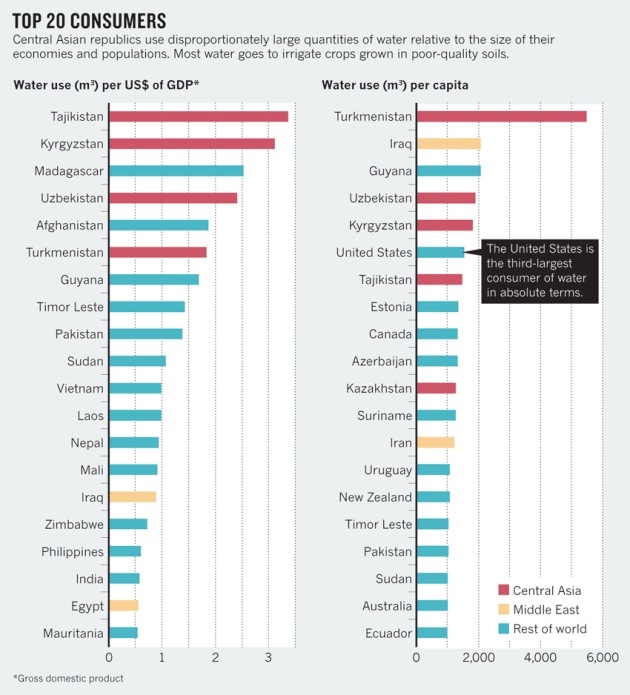
The 2nd October issue of Nature has a handy update on the situation. In the bad old days of the Soviet Union they had a monolithic government that allowed statewide planning and a rough-shod clashing of heads together. Since the break-up of the USSR, Central Asia is left with a clatter of independent republics including Kazakhstan, Kyrgyzstan, Tajikistan, Turkmenistan and Uzbekistan. These countries have varying levels of: freedom of press, scrupulously fair elections and support of scientific research; but they all need water. Therefore, to competing interests of farming, fishing, ecology, industry, car-washing and flushing toilets is added jingoistic posturing of national interests. Two ways of looking at water-consumption, are particularly informative if you want (and who doesn't nowadays) to think of water as a commodity.  This exposes the fact that the *stans consume a lot of water per head of population but also don't leverage the "precious commodity" to generate wealth. Using water for agricultural purposes on land where there are other handicaps to farming productivity (nutrient-depleted soil; unaffordable fertilisers) is, frankly, bonkers.  The example given is that a tonne of wheat produced in Turkmenistan requires 3,000 tons of irrigation water while a tonne of wheat produced in North Kazakhstan can manage on rain water alone.

Elsewhere in the same issue is a personal view on the politics of water by Moshe Alamaro. He points out that you can use elementary maths to inform your political decisions about who gets to use the water and how much they should pay for it. California is currently in the middle of a devastating drought and is proposing to fine its citizens for wasting domestic water. That will annoy the citizens without making a significant impact on consumption: only 15% of fresh water passes through homes and the hoped-for 20% reduction will only save 3% of the remaining water.  It's surely better to look at bigger consumers (notably agriculture) and then ask which sections benefit the economy most. That 'benefit' could be a straight financial accounting - contribution to GDP or taxes.  Or it could factor in social capital - which sections employ the most people, for example.  Water is water and it would bear scrutiny as to why San Jose can charge $40 per acre-foot to farmers but skins industry $600 for the same quantity.  An acre-foot is 1200 tonnes, so the cost to consumer is 3c and 50c a tonne respectively!  Rather less than what Irish Water was proposing to charge domestic consumers (€4.88) in October 2014, before the government caved in to free-the-water radicals and reduced the charge to half nothing.  Okay okay, I know the farmers of the Santa Clara Valley don't get their water chlorinated.

What future for the Aral Sea?  It can possibly recover if you reverse recent historical policy and let the water flow from the Himalaya to refill the basin. By the 1960s, Lake Erie was oxygen-depleted dead from phosphate-triggered eutrophication. This was partly from agricultural run-off but partly from huge growth in the laundry detergent industry following the post-war boom in washing-machines and other white-goods.  In 1972, the US and Canada passed the first Great Lakes Water Quality Agreement which put  statutory limits on phosphate dumping but also invested $8bn in sewage treatment plants to recover phosphate from the through-flow. It cost money but fish are back in the lake now.  For Aral, they don't need the $8bn, they just need to stop abstracting water from the rivers.

There are business models for what to do with a lot of unemployed melon farmers. India generates a quarter of its foreign currency earnings from IT (all those call centres in Bangalore are included) and other Asian countries are moving away from subsistence to knowledge economies. No more than Ireland, the *stans have a literate, well-educated citizenry that could persuade the next IT megacorp to locate in Samarqand, Almaty or Tashkent - a lot more exotic than Dublin! Why, for 2 pins or 2 million Kazakh Tenge a year, I'd go and teach Science out there.

Friday, 15 July 2022

Coder DoBro

My latest Borrowbox 👂earbook is Coders: The Making of a New Tribe and the Remaking of the World [Penguin 2019] by Clive Thompson, who writes for the NYT and Wired. It's read rather well by Rene Ruiz and is an interesting dive into TechBro culture and its sense of manifest destiny: the delusion that Silicon Valley is a meritocracy. All those white frat-boys who retired on their money before they turned 30 and believe that the $$$s showered down because of their unique native genius. There is a shiver of truth in that someone had to have the idea (and someone had to implement it in code) which changed how millions of people interact with the world.  But lots of .com millionaires were just adequate coders who were available when required . . . and prepared to pull a few all-nighters to prepare product for launch day.

So now we have a FAANG culture driven by Harvard and Stanford math-geek graduates - and their wannabees - who are complacent in their bubble, intolerant of difference, and profoundly ignorant about the real world. Facial recognition software that is excellent at distinguishing one spotty white face from another but flags all black faces as "gorilla". That sort of thing is a failure of imagination as well as ethics. It all your bros did the vom in Harvard Yard back in the day because they couldn't hold their liquor, then there is nobody to pull you up on the narrowness of your worldview. Foosball in the Google workplace? That seems a peculiarly adolescent perk to have fitted as standard.

Thompson unpicks this sense of entitlement with several compelling counter-examples. The most obvious one is the up-and-down history of women who code. The first ever coder was Ada Lovelace [1815 - 1852] after all and most of the early "computers" were women. The boys thought that the interesting stuff was the well 'ardware - voltmeters, vacuum-tubes, screwdrivers and left all that typing and card-punching to girls which became software. Of course, when it became apparent that coding was mentally challenging, fulfilling, fast-moving and, well, the point of all the hardware then the boys stopped disparaging and started displacing. Even today front-end, user interface is considered soft while back-end, server-side is where the real men hang out. Serial misogyny since 1948. Grace Hopper - Margaret Hamilton - Margaret Dayhoff - etc. etc.

Another nice story is about the foundation, by Rusty Justice and Lynn Parish of Bit Source in Pikeville, in the Kentucky rust belt. This gave the lie to the easy dismissal of [ex-]coal miners as burly, dusty, not-very-bright rednecks. If they were clever problem solvers, after all, they would surely be financial traders in NYC. Not so, coal miners do very little with a pick and shovel anymore. They operate, tune, fix, optimize really expensive and temperamental equipment in adverse circumstances where time is money - miners are problem solvers. Bit Source has been hiring and training them as programmers, architects, designers, managers, support technicians, and SCRUM masters and selling their skills and insights across the US including Wall Street. Once-upon-a-miners get to stay in Appalachia and earn good money solving other people's problems. "I'm the only one I know who speaks hillybilly and javascript" YT5mins.

A couple of times Thompson indicates the wrong-headed folly going to college to read computer science or math or physics in order to ease your path into retire-at-thirty territory. Upskilling in C, Java, Python, CSS, SQL will only give you tactical skills. And that market is systematically undercut by hardworking coders in Bangalore. You'd be better off, and have better fun if you go Arts Block for your undergrad: history; languages; exegesis of scripture or the world literature canon; philosophy [R who?] will teach you cogito ergo sum. It will also expose you to different ways of seeing and force you to acknowledge that there are several ways to skin a cat. You can learn Java later. Liberal arts encourages strategic rather than tactical. And heck, if you don't make a million from thinking big at least you'll have the perspective to accept that pursuit of money is deeply unsatisfying.

Coders: good stuff, recommended.

Wednesday, 29 July 2020

UPS US

The Boy sent me a book, I don't know where it started but someone handed it to UPS and it has disappeared into the Black Hole of their web-of-shelob.  It started on its journey on Monday 20th July 2020. Thereafter it was acknowledged by UPS:
Tues 21-07-20 9:39 United Kingdom Label Created
Tue 21-07-20 20:30 Bristol, UK Shipped
Tue 21-07-20 22:27 Tamworth, UK Arrived at Facility
Wed 22-07-20 7:35 Tamworth, UK Departed from Facility
Wed 22-07-20 19:00 Finglas, IE Arrived at Facility
Thu 23-07-20 3:00 Finglas, IE Departed from Facility
Thu 23-07-20 8:54 Waterford, IE The address is incomplete
Thu 23-07-20 16:12 Gave them Eircode Change is in progress. 
Fri 24-07-20 2:00 Waterford, IE Arrived at Facility
Fri 24-07-20 9:00 Waterford, IEDelivery by end of day
Mon 27-07-20 9:00 Waterford, IE Delivery by end of day
UPS is a vast international organisation they will ship a terracotta warrior or a skunk's head [it's the rabies testing innit?] from anywhere in the World to anywhere else. So long as you have an 18 digit tracking number you can find out where your package is. That's so long as everything goes to plan.  All bets are off if things are the least bit difficult.

Some time between 23-07-20 3:00 Finglas and 23-07-20 08:54 Waterford, my parcel was at perihelion to where it wanted to finish up. But it whooshed past at full Doppler . . .receding towards Waterford. Later that day it went for a jaunt through the next county.  Being in the wrong county, it never arrived here. That's when I first phoned the customer service line. I spoke the tracking number to their robot and s/he [sounded like a shebot] repeated it back to me, so I know their system had captured it. Eventually I got through to a real person [sounded Irish] but I had to repeat my tracking number >arrrgh<. I offered my Eircode, and he took it but was told that UPS marched to a different drummer; using Eircodes only as a last resort. Eircode was and is a huge boondoggle but it's a nationally rolled out boondoggle that is now seamlessly linked to, say, Google maps.

Friday 24/07 UPS.COM promised us delivery by the end of the day.
Monday 27/07 UPS.COM promised us delivery by the end of the day.
Tuesday 28/07 it was "Your package has arrived at a local UPS location and is still being processed for delivery." So I phoned again, got my tracking number bot-registered but had to say it again to the human operative [sounded Bangalore, female] but when she asked me to repeat the number, I hung up.  Richard Feynman has a story about getting paid an honorarium for doing a bit of public speaking. He said he'd accept but only on condition he'd only have to sign his name 13 times. But the necessary bureaucracy required . . . 14 signatures!  So massive moderate fail UPS!

STOP PRESS: the parcel is now 160km N of Waterford back in UPS Sorting:
In Transit 29/07/2020 6:20 Finglas
Another fly-past expected this morning . . .

Thursday, 21 January 2016

Bleeding bonkers

The Gardai were called to a house-party in Cork City during the early hours of Tuesday 19th Jan because part of it had spilled out onto the street in the form of a blood-soaked naked man who was attempting to eat the pavement. Inside there was more blood and more people off their heads. The discarded packaging and interviews with coherent people in the house seemed to indicate that 2-CB was the immediate cause of the paranoia and hallucinations.  It's not clear where the blood came from but there is no reason to suspect "gastrointestinal effects and kidney problems" which were quickly flagged as possible side-effects of this class of drugs.  Even the designated chemist on Newstalk-FM radio this morning had difficulty with "2,5-dimethoxy-4-bromophenethylamine" so everyone settled on 2-CB in the subsequent discussion.

The Health Service Executive HSE, and the Gardai, promptly issued a warning to young people to "just say No" to illegal drugs and floated the idea that, whatever the adverse effects of phenethylamines in general and 2-CB in particular, any "2-CB" you buy on the interweb is unlikely to be made in an FDA-approved laboratory; you might get poleaxed by the congeners/by-products that haven't been completely purified out after manufacture of the active principle. By-products might even 'stretch' the product a bit so you can get more pills from each run?  I think it's important that people a) know what they are talking about [that's the science] b) appreciate how their statements will be taken up by the intended audience [that's the common sense - empathy - politics - psychology].  We had an interesting discussion at the Wexford Science Cafe the evening after the Cork story broke in the national press. Because one of our number works for the Environmental Protection Agency, we were talking about an EPA report on emissions from a waste-processing plant in Port Laoise that broke in the Spring of last year. We were actually talking about the coverage of the EPA report which was tendentious to the point of being wrong: there is no story if the EPA goes in, tests the air, and pronounces it within EU safety guidelines. It's 'better news' if you can get an unqualified person, preferably an elected representative, to castigate the report as a 'whitewash'. It's certainly better for the election prospects of said representative.

BUT my point was that we-the-scientists have a duty to do the science diligently and reproducibly but also to convey the results in a way that is easily understandable by intelligent people who are not science-trained. The latter might be called Pinker-pinter skills. Where it is politically important, the bar has to be set lower: understandable by the publicans, bookies and auctioneers who stand for election without ever having been to college (and more power to them for doing so!). Writing research grant applications nowadays typically requires another task: the writing of a lay-summary - 300 words explaining the purpose of the project in words that a public representative or a tax-payer can understand.  Partly because of "The Curse of Knowledge" this is damned difficult to do well.

What are you going to do if you're young-and-foolish and bored and have some spare cash andif a bunch of alien suits tell you not to do something?  As I rounded off the story of CD28 in Northwick Park two years ago, such a statement might even alert drug-free youths that there's a more exciting world out there (or in there, because the excitement is all in your head)  . . . and have them take Mum's credit card off to Slovakia to order up some of that 2-CB.  The comments under The Independent article are informative about the effects of 2-CB and related compounds, written by people who clearly have experience in the field . . . which none of the HSE talking-suits have.

Mais revenons nous à nos drogues. If you want 2-CB on the street you may find it easier to ask for Nexus, Bromo, Eros or Spectrum.  The key element is  β-phenylethylamine (β-PEA) which is a perfectly natural minority neurotransmitter found in the central nervous system of many mammals including us, but also in chocolate and some other foods that have been subjected to microbial fermentation. Because it's a natural product, there are natural enzyme systems for breaking it down and limiting its a) effect-time b) toxicity. It also makes it rather difficult for drug enforcement agencies to ban the possession of β-PEA. Mescaline (3,4,5-trimethoxyphenethylamine) [R above] is another chemically related natural product; in this case derived from the peyote Lophophora williamsii cactus. Mescaline has a long history of being used by people to mess with their brains. Aldous Huxley's book the Doors of Pewrception, which I read as part of my very expensive education, brought the idea of tripping on mescaline to a wider appreciation in the West.  He wasn't the first or the last celebrity to brag about the experience.

What's going on?  According to my Human Physiology course, neurotransmitters and hormones travel a short (NT) or longer (hormones) distance to interact with a particular protein 'receptor' embedded in the cell-membrane of particular cells. This causes things to happen inside that cell. The very same natural NT may have either an excitatory or inhibitory effect on different cells - there are more receptors than there are NTs and hormones so the latter all have to multi-task. The dosage will be very finely tuned.  Drug companies seek to interfere with this natural system either with agonists (enhancing the effect of the NT) or antagonists (knocking the NT or its receptor on the head).  Drugs delivered in lumps in mg [huge!] quantities are neecessarily a very blunt instrument as we saw with the artificial delivery of Factor VIII to haemophiliacs. Mescaline is presumably peyote's way of encouraging herbivores to piss off and eat something else. Only people have considered that a little of what you fancy here does you good.

Many of the marketable β-PEA derivatives were first dreamed up and synthesised by Alexander and Ann Shulgin in the 1990s. Alexander was converted to the benefits after a session with mescaline and devoted many years to chemical experimentation in the field. They wrote a text-book for do-it-yourself psycho-active chemistry called PiHKAL: A Chemical Love Story: it's an acronym, stupid - Phenethylamines i Have Known And Loved.  Because Shulgin is a giving sort of guy, he put all the protocols up on the interweb: here's how to make 2-CB at home.  It reads like real chemistry "A solution of 100 g of 2,5-dimethoxybenzaldehyde in 220 g nitromethane was treated with 10 g anhydrous ammonium acetate, and heated on a steam bath for 2.5 h with occasional swirling. etc etc."

What to do? The debate hinges on whether we should make psychoactive drugs illegal. That will shift the manufacture to a shed next to a brothel in Bratislava or Bangalore and the supply to a really edgy group of hard chaws.  Or is it safer to bring experimenting with your mind under government control? That way, the possibility of disastrous break-down in quality control is minimised and the government makes a tidy income from the trade like they do with alcohol and tobacco. I think I'd rather the money went to the government than to a bunch of violent and unstable hoods. But it's not going to happen.