We were over in England visiting family including my favourite 22 y.o strong woman Dau.I. Somehow, we fell to talking about handbags . . . as you do when getting in touch with your feminine side. I was going on about the over-specification of stuff, so that The Man could sell you two items where one generic item would do for two related purposes. My rucksack, older than Dau.I, has a main section, 33lt in extent with two side-pockets which can each take a 1 litre water-bottle, there are other parts but it is not really much more complicated than that. 15 years after I bought that, I announced my intention of going on my long walk through Spain. My work-mates clubbed together to buy me a, then modern, ruck-sack that was a labyrinth of zips and Velcro and about 17 separate compartments. It was about as handy as Rowan Atkinson's multiple-zipped trousers. It weighed 2x more than my old pack and so, in the final packing I took the lighter, older model.
ANNyway, Dau.I was talking about a pal of hers who, having acquired a baby, had bought a hospital/nappy/diaper bag which was full of dinky sections and compartments: for the nappies, the wipes, a spare Babygro, probably disposable gloves, a baby's juice bottle, mother's 15ml slug of gin etc. etc. She said that the most obviously handy thing was that the bag came with a tiny changing mat. Not as a changing mat, because it was really too tiny; but it was really suitable for sitting down on a wet seat while waiting for a bus. The upshot was that she went off to Amazon to see whether there was a hospital/nappy/diaper bag that would do for carrying six novels, a writer's notebook and the other hape-o-stuff that she lugs about on a daily basis. You can imagine the outcome: for the next several weeks her interweb experience was seen through a gale of advertisements for gripe-water, baby-buggies, mobiles, pop-up books and all the paraphernalia that modern babies require/acquire. I had a similar experience last year with a ludicrous red toaster, which haunted my interweb for about a month.
Years ago, I was privileged to teach courses in molecular evolution and bioinformatics in Norway and Finland. It was under the auspices of EMBnet, the European quango of which I was the Irish node. The latest EMBnet wheeze was to print several hundred neoprene mouse-mats with a map of Europe and the EMBnet logo. My Finnish minder asserted that these were really handy in Finland for sitting at bus-stops without freezing your arse off. All very well for you, slim-hips, I thought, a sofa-pilot like me would need four mouse-mats and some duct-tape to hold them together. I really enjoyed teaching in Finland, the students had a very dark sense of humour that would often crack me up.
Talking about dark sense of humour, The Beloved was ear-wigging on our earlier conversation about nappy-bags and contingent advertisements. She suggested that the only way to get Amazon off your back was to look for books like "Grieving through miscarriage". See how the Amazon algorithm deals with that!
Monday, 11 January 2016

Sunday, 10 January 2016
Bodger
François Jacob and Jacques Monod are grandes fromages in the world of molecular genetics because they characterised the first operon - a group of bacterial genes that are switched on together and serve a co-ordinated function - in Escherichia coli. For every hundred people who can open an eppendorf and have heard of the lac operon, not more than five will know or care about bricolage. This is a concept delivered into the Anglophone world of science by Jacob in an essay and later as a book. The bricoleur of every French village and neighbourhood is the fix-it bloke - the fellow who can give your ancient TV a new lease of life; brace the broken handle of your wheelbarrow with a broom-handle and some duct-tape; re-purpose a coffee-tin as a really loud bell for your kid's bicycle.
Contrary to what is implied, the concept, the vocation, is not limited to France but is also found in England, where such chaps (usually chaps??) are called bodgers. Norman Heatley, whose birthday (10th Jan 1911) falls today, was a bodger with a PhD from Cambridge. He gave shape and made functional the arm-waving cerebral ideas of the academics around him. That his great triumph happened during the desperate privations and short-supply of WWII Britain, made it easier for him to shine because he could turn make-do into can-do like nobody else. His own assessment was "Because it was wartime there were very great scarcities of everything. I am not a very good scientist, but I am very good at improvising". His task was to scale up the production of penicillin, a delicate, hard-to-purify, chemical produced by some strains of the fungus Penicillium.
Ah yes, we know the Ladybird Book story about penicillin: it was discovered in a happy accident by Alexander Fleming. He left some bacterial cultures out too long and a spore from a blue-green mould landed on the Petri dish and killed all the bacteria within reach. That was in 1928, but after some desultory tricking about with the strange fungus which came to nothing, Fleming moved on to other projects. He never really twigged how the bacteria killing property might be useful. Fast forward 10 years to Oxford, when the newly appointed Professor of Pathology Howard Florey started to assemble a team to discover novel bacteriocidal products. One of the first hires was a chap from Germany via Cambridge called Ernst Chain who read the literature and thought that Fleming's mould had promise. The Prof agreed and set Chain and Heatley to purify enough of the active principle to carry out a controlled experiment on its efficacy. They started the work in Oxford but their methods were hopelessly inefficient if weirdly exotic. The mould they had grew best on Petri dishes but they could not piffle about with those small quantities. Casting about in the hospital broom-closets, Heatley found a stack of unused bed-pans and mobilised those, along with biscuit-tin lids, to grow stacks of Penicillium cultures.
Eventually they had enough powder, which was only 1% pure, to administer to 4 mice which had been infected with Streptococcus. Four mice similarly infected were left untreated and died overnight but the penicillin-treated mice all survived. Huzzah! With that fillip it was game on, but they couldn't get sufficient support in England - there was a war on! Accordingly they flew out to Peoria Illinois to develop a protocol that could produce larger quantities of the miracle cure (which didn't save either of the first two people who were treated). Bed-pans and biscuit-tins were all very well in England but Peoria was properly funded and they could call in any equipment they needed. Despite the best work of Ernst Chain, the team chemist, they couldn't discover an efficient way to produce penicillin artificially. They fell back rather on screening hundreds of Penicillium strains isolated from all over the world. Eventually they found a particularly fizzy mould on a canteloupe in a nearby market, which not only produced larger quantities of penicillin, but was also happy growing in a huge vat. Rosin Cerate has more details. Every time I browse researchblogging.org which is less than once a month, I discover a stonking good essay Chris Drudge: previously on The Blob about medieval medicine.
We had about 30 years of ad lib penicillin which made a number of killer bacterial diseases trivial infections. We squandered the treasure using it as a growth promoter in chickens, so all the bacteria that used to yield to penicillin are now resistant.
Fleming, Florey and Chain were awarded the Nobel Prize in 1945 and were showered with medals, awards and honorary degrees especially Fleming who seems objectively to have done least in the process. Heatley clocked an OBE in 1978, and lived long enough to be recognised by receiving the first honorary Medical Degree by Oxford University in 1990. Florey's successor as Prof of Path Sir Henry Harris summed up the relationships: "Without Fleming, no Chain; without Chain, no Florey; without Florey, no Heatley; without Heatley, no penicillin.".
As a bodger myself who once made an exceedingly uncomfortable arm-chair out of a tea-chest, I take my hat [I once made a hat out of the bottom of a trouser leg] off to Norman Heatley whose Heath Robinson bodging saved millions of lives and made a helluva lot of fat chickens.
Contrary to what is implied, the concept, the vocation, is not limited to France but is also found in England, where such chaps (usually chaps??) are called bodgers. Norman Heatley, whose birthday (10th Jan 1911) falls today, was a bodger with a PhD from Cambridge. He gave shape and made functional the arm-waving cerebral ideas of the academics around him. That his great triumph happened during the desperate privations and short-supply of WWII Britain, made it easier for him to shine because he could turn make-do into can-do like nobody else. His own assessment was "Because it was wartime there were very great scarcities of everything. I am not a very good scientist, but I am very good at improvising". His task was to scale up the production of penicillin, a delicate, hard-to-purify, chemical produced by some strains of the fungus Penicillium.
Ah yes, we know the Ladybird Book story about penicillin: it was discovered in a happy accident by Alexander Fleming. He left some bacterial cultures out too long and a spore from a blue-green mould landed on the Petri dish and killed all the bacteria within reach. That was in 1928, but after some desultory tricking about with the strange fungus which came to nothing, Fleming moved on to other projects. He never really twigged how the bacteria killing property might be useful. Fast forward 10 years to Oxford, when the newly appointed Professor of Pathology Howard Florey started to assemble a team to discover novel bacteriocidal products. One of the first hires was a chap from Germany via Cambridge called Ernst Chain who read the literature and thought that Fleming's mould had promise. The Prof agreed and set Chain and Heatley to purify enough of the active principle to carry out a controlled experiment on its efficacy. They started the work in Oxford but their methods were hopelessly inefficient if weirdly exotic. The mould they had grew best on Petri dishes but they could not piffle about with those small quantities. Casting about in the hospital broom-closets, Heatley found a stack of unused bed-pans and mobilised those, along with biscuit-tin lids, to grow stacks of Penicillium cultures.
Eventually they had enough powder, which was only 1% pure, to administer to 4 mice which had been infected with Streptococcus. Four mice similarly infected were left untreated and died overnight but the penicillin-treated mice all survived. Huzzah! With that fillip it was game on, but they couldn't get sufficient support in England - there was a war on! Accordingly they flew out to Peoria Illinois to develop a protocol that could produce larger quantities of the miracle cure (which didn't save either of the first two people who were treated). Bed-pans and biscuit-tins were all very well in England but Peoria was properly funded and they could call in any equipment they needed. Despite the best work of Ernst Chain, the team chemist, they couldn't discover an efficient way to produce penicillin artificially. They fell back rather on screening hundreds of Penicillium strains isolated from all over the world. Eventually they found a particularly fizzy mould on a canteloupe in a nearby market, which not only produced larger quantities of penicillin, but was also happy growing in a huge vat. Rosin Cerate has more details. Every time I browse researchblogging.org which is less than once a month, I discover a stonking good essay Chris Drudge: previously on The Blob about medieval medicine.
We had about 30 years of ad lib penicillin which made a number of killer bacterial diseases trivial infections. We squandered the treasure using it as a growth promoter in chickens, so all the bacteria that used to yield to penicillin are now resistant.
Fleming, Florey and Chain were awarded the Nobel Prize in 1945 and were showered with medals, awards and honorary degrees especially Fleming who seems objectively to have done least in the process. Heatley clocked an OBE in 1978, and lived long enough to be recognised by receiving the first honorary Medical Degree by Oxford University in 1990. Florey's successor as Prof of Path Sir Henry Harris summed up the relationships: "Without Fleming, no Chain; without Chain, no Florey; without Florey, no Heatley; without Heatley, no penicillin.".
As a bodger myself who once made an exceedingly uncomfortable arm-chair out of a tea-chest, I take my hat [I once made a hat out of the bottom of a trouser leg] off to Norman Heatley whose Heath Robinson bodging saved millions of lives and made a helluva lot of fat chickens.
Sunday seaworthy 100116
We had two [choppy] trips across the Irish Sea since New Year. I've come across a couple of nautical links over the same time-period.
- From Timber to Tide a man builds and sails his own boat.
- Enduring mal de mer: a sweet story about a young fisherman losing his lunch but not the respect of his family and friends.
- Cool water. An elderly Thames barge-skipper, looking uncannily like actor Michael Caine, sings a shanty
- Sarf Australia. Shanties? You can't do shanties without tribbing Bert Lloyd
- Waulking the wool. Women sing work-songs too!
Saturday, 9 January 2016
Edgy
John Brockman was born in 1941 in Boston and has been an active agent for change and a facilitator of dialogue especially in science and at the Arts-Science borrrrder. He doesn't seem to have done any primary scientific research himself but knows a lot of the movers and shakers. Somewhere along the way I've acquired a copy of his When we were kids: how a child becomes a scientist [Jonathan Cape 2004]. I really like this book, not least because Brockman is a very light editor and lets real scientists talk about their formative years. If you have a child, you might with advantage read such a book and tilt the process in your home so that your kid is exposed to science as a way of knowing. That book features, for example Blobistas like Alison Gopnik, Lynn Margulis, Steven Pinker, VS Ramachandran. It also has a chapter by Marc Hauser, Harvard Wunderkind,who has since been drummed out of the regiment after a spectacular fall from grace. In 2014, I wrote crossly about that fall and Brockman's unseemly scrabble to distance himself from the bad apple by purging the historical record. tsk!
Brockman has given a lot of traction to science-in-the-public-domain by setting up the Edge Foundation which holds periodical seminars in which the usual suspects get together round a table in some salubrious setting to talk about science and the interface between Science and the Arts and between science and popular culture. The suspects are likely to include cool-tech musicos like Peter Gabriel or Brian Eno. These seminars are edited and broadcast on the interweb and they're often worth listening to if you like your information in chunks longer than a tweet. For the last several years, the Edge has been able to monetize the intellectual ferment by asking an Annual Question and publishing the answers in hard-copy. They don't ask you or me, they ask those scientists who are gabby enough to have a presence in Brockman's circle of friends . . . the sort of chaps [yes, very often chaps] who are asked to give TED talks. The model is essentially the same as When we were kids: ask successful STEM-folks their opinion on X, edit the answers and order an initial print-run of 20,000 running up to Christmas.
They had a really good question in 2008 What have you changed your mind about and why? I clipped all 166 answers off the interweb and clagged them into a monster PDF which I then sent it to all my techy pals. Few had the patience/stamina to read it. But that's a really important question because it indicates that real thought has been going down rather than re-churning our old certainties about gravity; the non-existence of god; the biological world being shaped by evolution. That's why a symposium among/with some monster-minds from disparate fields has the potential to generate something new. At scientific conferences, and TED fests, and Edge symposia, the really interesting interchange happens off camera over beers rather than at the plenary session in the big auditorium. Although attendance at the plenary session is also an essential part of the process: your reaction to and extrapolation form the talks by the Young Turks on stage is the stuff of progress.
I'm clearly conflicted about John Brockman and The Edge. I bought a copy of This will Make You Smarter the book of the 2011 question What scientific concept will improve everybody's cognitive toolkit? I never read it. I can't find it on my bookshelves so I may have given it to some young scientist when they survived their PhD viva. There's only so much of reading other men's flowers that is tolerable or useful. I'm more and more convinced that you need to smell the people you have dialogue with: the pheromones are somehow important for tuning the crap-detector. Another problem with the format is that there are no citations and no references, so while you might be stoked to hear what maverick gerontologist Aubery de Grey has to say about next-generation antibiotics, the piece provides no leads to follow up the ideas, but thank god for The Blob: read this.
I must say I find the 2016 Question What do you consider the most interesting recent scientific news what makes it important? deeply unimaginative. Whatever we might gain from hearing about the thoughts of some of the smartest folk in the room, we can get less from their thoughts about the thoughts of someone who is not in the room. If I didn't read 2011 having paid ready money, I'm not going to do more than dip into 2016 and advise you to do the same. It is entirely possible that the 194 contributors are not tribbing people outside the conference marquee - they are rather clapping each other on the back for being the mirror of their own brilliance. Then again <confliction alert> you could do worse than read Robert Sapolsky, Edge stalwart, being impassioned, erudite, articulate on Ebola and Science. Or if you are a scientist who has published something in 2015, you might reflect, like Judith Rich Harris, on the truthiness of science: "There are too many journals publishing too many papers. Most of what's in them is useless, boring, or wrong." Hmmm, boring question, answers on the button.
Brockman has given a lot of traction to science-in-the-public-domain by setting up the Edge Foundation which holds periodical seminars in which the usual suspects get together round a table in some salubrious setting to talk about science and the interface between Science and the Arts and between science and popular culture. The suspects are likely to include cool-tech musicos like Peter Gabriel or Brian Eno. These seminars are edited and broadcast on the interweb and they're often worth listening to if you like your information in chunks longer than a tweet. For the last several years, the Edge has been able to monetize the intellectual ferment by asking an Annual Question and publishing the answers in hard-copy. They don't ask you or me, they ask those scientists who are gabby enough to have a presence in Brockman's circle of friends . . . the sort of chaps [yes, very often chaps] who are asked to give TED talks. The model is essentially the same as When we were kids: ask successful STEM-folks their opinion on X, edit the answers and order an initial print-run of 20,000 running up to Christmas.
They had a really good question in 2008 What have you changed your mind about and why? I clipped all 166 answers off the interweb and clagged them into a monster PDF which I then sent it to all my techy pals. Few had the patience/stamina to read it. But that's a really important question because it indicates that real thought has been going down rather than re-churning our old certainties about gravity; the non-existence of god; the biological world being shaped by evolution. That's why a symposium among/with some monster-minds from disparate fields has the potential to generate something new. At scientific conferences, and TED fests, and Edge symposia, the really interesting interchange happens off camera over beers rather than at the plenary session in the big auditorium. Although attendance at the plenary session is also an essential part of the process: your reaction to and extrapolation form the talks by the Young Turks on stage is the stuff of progress.
I'm clearly conflicted about John Brockman and The Edge. I bought a copy of This will Make You Smarter the book of the 2011 question What scientific concept will improve everybody's cognitive toolkit? I never read it. I can't find it on my bookshelves so I may have given it to some young scientist when they survived their PhD viva. There's only so much of reading other men's flowers that is tolerable or useful. I'm more and more convinced that you need to smell the people you have dialogue with: the pheromones are somehow important for tuning the crap-detector. Another problem with the format is that there are no citations and no references, so while you might be stoked to hear what maverick gerontologist Aubery de Grey has to say about next-generation antibiotics, the piece provides no leads to follow up the ideas, but thank god for The Blob: read this.
I must say I find the 2016 Question What do you consider the most interesting recent scientific news what makes it important? deeply unimaginative. Whatever we might gain from hearing about the thoughts of some of the smartest folk in the room, we can get less from their thoughts about the thoughts of someone who is not in the room. If I didn't read 2011 having paid ready money, I'm not going to do more than dip into 2016 and advise you to do the same. It is entirely possible that the 194 contributors are not tribbing people outside the conference marquee - they are rather clapping each other on the back for being the mirror of their own brilliance. Then again <confliction alert> you could do worse than read Robert Sapolsky, Edge stalwart, being impassioned, erudite, articulate on Ebola and Science. Or if you are a scientist who has published something in 2015, you might reflect, like Judith Rich Harris, on the truthiness of science: "There are too many journals publishing too many papers. Most of what's in them is useless, boring, or wrong." Hmmm, boring question, answers on the button.
Friday, 8 January 2016
Halmahera
Any fule kno that Charles Darwin dreamed up the theory of evolution by natural selection from his experiences studying differences in the genitalia of barnacles, pigeons with feathered feet, the pollination antics of orchids, deaf cats, and watching chimpanzees Pan troglodytes in the zoo. I say 'dreamed up' this great explanatory theory, but really it was an insight based on deep knowledge of his biological material. He found that different species are not all completely different, but gradedly different: we look shockin' similar to our parents, have common traits that mark us as human, are clearly more similar to chimps than either of us are to dogs or horses. If you can access biochemical rather than just anatomical information then you find striking similarities between us and yeast or even bacteria. Darwin's insight was to come up with a coherent theory that explained how this gradation of similarity might have come about. Darwin was well-heeled and came from money, and he married Emma the Potter's Daughter and her fortune, so there was no need for him to earn a living hewing coal or driving a train.
My fatal flaw as a scientist is 'finish', when I've solved the latest puzzle to my own satisfaction, I'm all jitzy to start on the next thing rather than writing everything up and submitting it to a journal so that the rest of the world can see what we've discovered . . . and possibly call "rubbish!" and do their own parallel experiments. Darwin's Big Idea was worked out in its essentials in his unpublished First Notebook on Transmutation of Species (1837) less that a year after returning from his round-the-world trip in HMS Beagle 27/Dec/1831-02/Oct/1836. It lay there festering/gestating/fermenting for more than 20 years until he was galvanised into writing it up formally and submitting it for peer-review. Where it would have been a shoo-in because Darwin was so well connected in the scientific world. The event which evoked the galvanic response and forced Darwin to expose his theory to the public was a letter from Alfred Russell Wallace. Who? What? Where?
Wallace's family had far less money than the Darwin-Wedgwood's, although neither did he grow up in a cardboard box eating maggots. Far from going to Cambridge University, however, a further slump in the Wallace fortune required him to leave school at 14 and start earning his keep. He trained as a surveyor and worked at a variety of jobs until at the age of 25 he shipped out to Brazil with his pal Henry Bates to see if they could make a fortune hunting exotic beetles and butterflies for sale to collectors and institutions back in England. From there, after adventures that today's youth only experiences on-line, He travelled to the Dutch East Indies to continue bug-hunting and paying deep attention to the natural world in all its tropical mind-jangling diversity.
 His parallel and independent theory of natural selection did in fact come to him in a dream as he sweated through another bout of malaria on the island of Halmahera [map above] halfway between Sulawesi/Celebes and New Guinea. Shortly thereafter he mailed "On the Tendency of Varieties to Depart Indefinitely From the Original Type" a summary of his new ideas to Darwin with catalytic results at the other end. Halmahera is also one of three small islands where Semioptera wallacii Wallace's standardwing bird-of-paradise [Picture L], which he discovered and described in the same momentous year of 1858. He felt that was his notable contribution to science. But as a collector at the geographical frontier of science, numerous species are named after him: fungi, plants, lice, snails, dragonflies, loads of butterflies, dozens of beetles, at least 20 birds and three mammals: a marsupial Myoictis wallacei, a primate Tarsius wallacei, and Wallace's stripe-faced fruit bat Styloctenium wallacei. Today is Wallace's birthday (8th Jan 1823), so it's a nice place to stop his story at the height of his scientific success. Scientists subsequently saw fit to drum him out of the boy's club because he continued to be 'out there' with his ideas about things that all scientists now agree upon aka any fule kno.
My fatal flaw as a scientist is 'finish', when I've solved the latest puzzle to my own satisfaction, I'm all jitzy to start on the next thing rather than writing everything up and submitting it to a journal so that the rest of the world can see what we've discovered . . . and possibly call "rubbish!" and do their own parallel experiments. Darwin's Big Idea was worked out in its essentials in his unpublished First Notebook on Transmutation of Species (1837) less that a year after returning from his round-the-world trip in HMS Beagle 27/Dec/1831-02/Oct/1836. It lay there festering/gestating/fermenting for more than 20 years until he was galvanised into writing it up formally and submitting it for peer-review. Where it would have been a shoo-in because Darwin was so well connected in the scientific world. The event which evoked the galvanic response and forced Darwin to expose his theory to the public was a letter from Alfred Russell Wallace. Who? What? Where?
Wallace's family had far less money than the Darwin-Wedgwood's, although neither did he grow up in a cardboard box eating maggots. Far from going to Cambridge University, however, a further slump in the Wallace fortune required him to leave school at 14 and start earning his keep. He trained as a surveyor and worked at a variety of jobs until at the age of 25 he shipped out to Brazil with his pal Henry Bates to see if they could make a fortune hunting exotic beetles and butterflies for sale to collectors and institutions back in England. From there, after adventures that today's youth only experiences on-line, He travelled to the Dutch East Indies to continue bug-hunting and paying deep attention to the natural world in all its tropical mind-jangling diversity.
More islands, including the one (Cocos)
where Darwin had another of his great ideas.
Thursday, 7 January 2016
Small but perfectly formed
We've just returned from a voyage across the sea to England to visit with the rellies. The star attraction was the new grand-daughter, hereinafter called GD2, who was launched into the world a very few days before her great-grandmother slipped out of it. I'm sorry they never got to smell each other, but at least, through the wonders of Skype, the younger one could be seen from afar. She was given her first name, in the normal Western way, by her parents. In 1800, a dozen given names accounted for almost all people in England. Mary (24%) and John (22%) were the most common names for boys and girls, but the top ten names were used by 82% and 85% of girls and boys respectively. No child is called Mary or John anymore, and the distribution is much flatter: at The Institute, it's rare to have two people in a lab-section [N=18] with the same name. The fashion now is for names that were unknown 200 years ago: Brett and Chesney; Dylan and Errigal. At least those sound like the name you could give to a person (or a horse, indeed); celebrities and others seem to give damn-fool names to their children simply to shock their parents: Frou-frou, Tinkerbelle, Plum-duff. They should rather look to the future and imagine how much unwonted attention a really bizarre name is going to bring down on the head of their offspring, as it gets flushed down the toilet at primary school. For the last 40 years I've been awed by a woman I heard on the
wireless years ago, who changed her name to "Veranda Porch" pour épater la bourgeoisie. And The Beloved's
oldest sister did cold-call telephone-selling for a while a few years ago and was
advised to pick a pseudonym, so that she could be clearly identified but
could walk away from the job at the end of the day. She chose "Attracta Looney".
ANNyway, back to GD2, who was given a second name a week ago by a couple of Buddhist monks, originally from Sri Lanka. The child's mother was brought up in Northern England in the Buddhist tradition and they have a naming ceremony which has less water than a Christian baptism but an equivalent focus on inducting the newest member into the community. I like the idea that two bhikkhus [those who live attentively, are present, dignified and irreproachable, containing mere desires and emotions, and restfully patient in all circumstances] unrelated to the child get to choose a 'spiritual' name as an timeless counter-balance to what the parents pick. Sumedhā as you ask: meaning Great Wisdom. No pressure, kidder!
ANNyway, back to GD2, who was given a second name a week ago by a couple of Buddhist monks, originally from Sri Lanka. The child's mother was brought up in Northern England in the Buddhist tradition and they have a naming ceremony which has less water than a Christian baptism but an equivalent focus on inducting the newest member into the community. I like the idea that two bhikkhus [those who live attentively, are present, dignified and irreproachable, containing mere desires and emotions, and restfully patient in all circumstances] unrelated to the child get to choose a 'spiritual' name as an timeless counter-balance to what the parents pick. Sumedhā as you ask: meaning Great Wisdom. No pressure, kidder!
Wednesday, 6 January 2016
The devil's away
Sarcophilus harrisii is about as cute as your average dog or cat [and R] but has had a bad press in Tasmania, especially in livestock country, where it goes by the common name Tasmanian Devil. Since Thylacinus cynocephalus the Thylacine shot to extinction 80 years ago, Sarcophilus harrisii has been the world's largest carnivorous marsupial, which is to say not very large. But it has the distinction of having the most powerful jaw muscles of any extant mammal, which it uses to crush bone and rend sinew. When you look at them in captivity being hand-fed by the staff, you can't really understand why anyone would take against them. But I guess Australian farmers would give you a different story of dead lambs. The 'Harris' who first described and named the species, was George P.R. Harris a short-lived and perhaps dissolute government surveyor who picked the site on which Hobart was built.
Sarcophilus used to be the Australian Devil because fossil evidence indicates that it was distributed all over continental Australia in the Pleistocene. But, with the coming of man and dingos, the smaller carnivore has been in retreat and has been confined to Tasmania for the last 3000 years. Note: current taxonomy lumps dingos, domestic dogs and wolves into the same species Canis lupus. It seems that Sarcophilus is not long for this world and, in this instance, humans are only partly to blame. It's true that they attracted a bounty for hunters in the 19thC but they have been protected by law since 1941. Some believe that Sarcophilus has been instrumental in limiting the extent to which European red foxes Vulpes vulpes have invaded Tasmania. Foxes are a decided pest elsewhere in Australia; so that's a good reason for wanting to Save the Tasmanian Devil; t-shirts; mugs.
The main threat to Sarcophilus over the last 20 years is a foul transmissible cancer called DFTD - devil facial tumour disease [picture for the well 'ard]. This is presumably some sort of virus but is associated with abnormal chromosome count. It was first observed 20 years ago and can spread from animal to animal by contact. The tumours blurf up in and around the mouth as weeping sores that interfere with feeding, and presumably make the wee things feel real crappy and so soon enough kill the poor creatures. Estimates of the effect this is having on numbers vary wildly between 20% and 80% mortality and there are some regions of Tasmania where the disease has not yet been observed. Anyway, between DFTD, roadkill and trigger-happy farmers the population of the species has declined 60% in the last 10 years. Sarcophilus does not breed well in captivity but DNA sequencing has allowed scientists to sequester 98% of the genetic variablity in zoos; with the intention of returning the species to the wild after the virus has played itself out. Keeping this one species on the planet is estimated to have an interventionist price-tag of US$11million. Not as cute a pandas Ailuropoda melanoleuca? or Orang utans Pongo abelii? there are 5000 species of mammal we can't save them all.
Now IFLS reports that a second transmissible tumour has been isolated from Sarcophilus which also causes facial tumours but appears to be genetically distinct. That's weird because transmissible cancers are really rare in any species and to have two infecting one small marsupial carnivore makes you think that there may be a defect in their immune system. "To have one tumour may be regarded as a misfortune; to have two tumours sounds like carelessness."
Ah go on then: list ye well tae The De'il's Awa' Wi' The Exciseman by Ewan MacColl
Sarcophilus used to be the Australian Devil because fossil evidence indicates that it was distributed all over continental Australia in the Pleistocene. But, with the coming of man and dingos, the smaller carnivore has been in retreat and has been confined to Tasmania for the last 3000 years. Note: current taxonomy lumps dingos, domestic dogs and wolves into the same species Canis lupus. It seems that Sarcophilus is not long for this world and, in this instance, humans are only partly to blame. It's true that they attracted a bounty for hunters in the 19thC but they have been protected by law since 1941. Some believe that Sarcophilus has been instrumental in limiting the extent to which European red foxes Vulpes vulpes have invaded Tasmania. Foxes are a decided pest elsewhere in Australia; so that's a good reason for wanting to Save the Tasmanian Devil; t-shirts; mugs.
The main threat to Sarcophilus over the last 20 years is a foul transmissible cancer called DFTD - devil facial tumour disease [picture for the well 'ard]. This is presumably some sort of virus but is associated with abnormal chromosome count. It was first observed 20 years ago and can spread from animal to animal by contact. The tumours blurf up in and around the mouth as weeping sores that interfere with feeding, and presumably make the wee things feel real crappy and so soon enough kill the poor creatures. Estimates of the effect this is having on numbers vary wildly between 20% and 80% mortality and there are some regions of Tasmania where the disease has not yet been observed. Anyway, between DFTD, roadkill and trigger-happy farmers the population of the species has declined 60% in the last 10 years. Sarcophilus does not breed well in captivity but DNA sequencing has allowed scientists to sequester 98% of the genetic variablity in zoos; with the intention of returning the species to the wild after the virus has played itself out. Keeping this one species on the planet is estimated to have an interventionist price-tag of US$11million. Not as cute a pandas Ailuropoda melanoleuca? or Orang utans Pongo abelii? there are 5000 species of mammal we can't save them all.
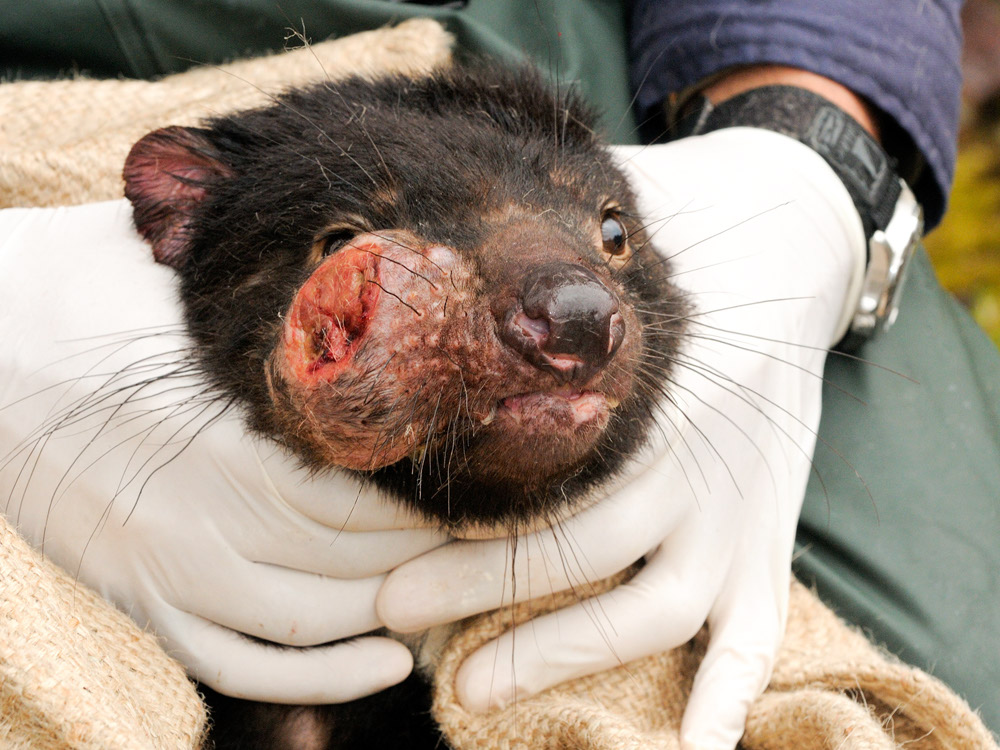
Now IFLS reports that a second transmissible tumour has been isolated from Sarcophilus which also causes facial tumours but appears to be genetically distinct. That's weird because transmissible cancers are really rare in any species and to have two infecting one small marsupial carnivore makes you think that there may be a defect in their immune system. "To have one tumour may be regarded as a misfortune; to have two tumours sounds like carelessness."
Ah go on then: list ye well tae The De'il's Awa' Wi' The Exciseman by Ewan MacColl
Subscribe to:
Posts (Atom)