Saturday, 7 September 2013

Bloody Borodino

The Battle of Borodino - Бородинское сражение - is billed as the bloodiest ever fought by La Grande Armee of Napoleon.  The Russians had been retreating eastwards since Napoleon had crossed the border at the R Niemen in the middle of June 1812, at the head of 286,000 soldiers - a city on the march.  This retreat was strategically the correct thing to do, but politically impossible and at the end of August the Russians changed generals and appointed Prince Mikhail Kutuzov as CnC.  The Russian army fought the French to a standstill on 7th Sept 1812 just 125km from Moscow and continued their retreat as a functional unit

Scientists often measure things and often they see if two variables are correlated.  So, for example, very early on in my career at The Institute, I put forward the hypothesis that the abundance of the 25 elements that have a function in the human body might match their abundance in the lithosphere.  Science has the whole world as its bailiwick, whereas history has a far more constrained range of information sources - mostly written for events of 200 years ago.  So you'd think that, with everyone working through exactly the same material there would be some agreement about the data.  Not a bit of it!  Wikipedia summarises Mikaberidze's work reporting wildly different estimates of the number of soldiers fighting on the two sides.  25 historians have gone to the library and had a go at this task.
A perfect example of zero correlation (r = 0.008)!  You'd think that if Historian X was extravagant with his estimates s/he'd big up both sides to make it seem more majestic/horrific.  And similarly Historian C for conservative would be careful not to exaggerate - either side. They can't even agree on the ratio: estimates here range from there being 20% more Russians to 40% more French.  Well really!  Is it any wonder that scientists look at the output of The Arts Block and think it is woolly, irreproducible and wholly subjective?  Part of the problem is that this battle acquired rather active legs for Soviet propaganda; and no French historian could be expected to approach the task without some sort of baggage.

There is a little more agreement about the frightening level of casualties.  The French lost 35,000 (about a sixth of them dead on the day, the rest wounded; almost all of whom would starve or bleed to death or be murdered by looters over the next few days - the French were at the very end of their tether for supplies).  The Russians found that they had lost 45,000 effectives - being a Home Match the survival rate among their wounded would be marginally better than for the poor French boys dying so far from home for La Gloire.  Historian Gwynne Dyer, in his book War compared the carnage at Borodino to "a fully-loaded 747 crashing, with no survivors, every 5 minutes for eight hours."  A metaphor which puts 9/11 into perspective. 
The Math: Boeing 747 capacity 525 * 60/5 * 8 = 50,000; which is counting almost all the wounded as 'no survivors'.

Two extraordinary things came out of the debacle: 
  1. Tchaikovsky's commemorative 1812 Overture. 
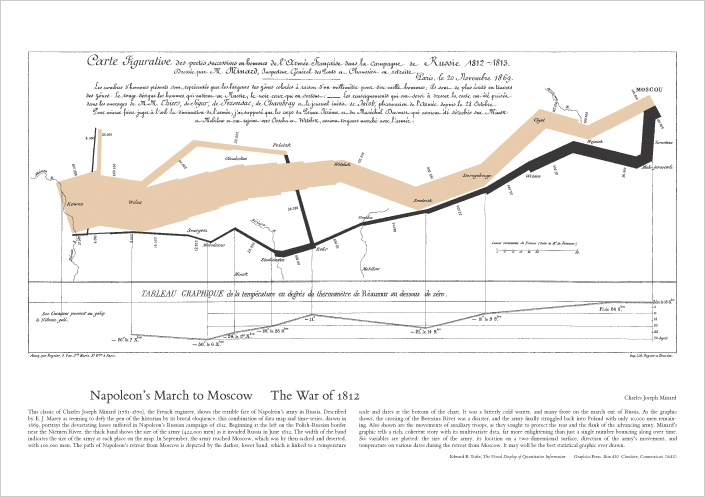
  2. "Probably the best statistical graphic ever drawn, this map by Charles Joseph Minard portrays the losses suffered by Napoleon's army in the Russian campaign of 1812." Says graphics-guru Edward Tufte, who will sell you a copy of Minard's chart as a poster. 
Little enough positive in the balance against smashing 80,000 fit young men to bloody rags, isn't it?

Friday, 6 September 2013

Zen and The Art

I'm delighted to report that Robert M Pirsig is alive to celebrate his 85th birthday this morning.  I've had many occasions on The Blob to reflect on the enormous gulf that yawns between the Arts Block and Science.  It's a gulf which exists mainly because so few of us dare cross over to the alien other shore and really talk to the natives.  Pirsig was born smart and had academic parents, so as a child he tested with an IQ of 170 - the poor little scruff.  He followed the cycle familiar to the parents of many gifted children in school, which was incapable of interesting him, let alone challenging him. And, of course, because he was different, he was bullied. They even forced him, a south-paw, to write with his right hand until he developed a crippling stammer.  He graduated the hell out of there at the age of 15 and went directly to the University of Minnesota.

He read biochemistry in college, hoping/expecting to thereby know everything, but instead of knuckling down and remembering the Kreb's Cycle he was stopped dead with the unsettling realisation that there might be, indeed must be, a number of different explanations for whatever observation or measurement you might make about the world.  His existential crisis drifted him right off course until he flunked out of College and joined the US Army.  Two years later he resolved to finish his education but signed up for courses in Eastern Philosophy rather than Western Blotting.  And he has made valuable independent contributions to Philosophical thought at least partly because he had spent time in Korea (army) and India (Benaras Hindu U): "I remembered a quote from Alfred North Whitehead which read: 'The first thing you can learn about Western philosophy is that it is all footnotes to Plato.' Metaphysics of Quality [Pirsig's stomping-ground] was not that. Plato and Socrates insisted on all terms being defined. If you start with a term that is undefined, like Quality, it is no longer a footnote to Plato." Interview here.

So he is one of a small cohort who carried out some serious committed exploration on both sides of the gulf . . .  and went mad.  Paranoid schizophrenic, electro-convulsive therapy mad, not merely a tad eccentric. 

Having had his mind whacked off centre for far too long, he got well enough to take a long bike trip across America with his 12 year old son Chris.  The voyage was written up as Zen and the Art of Motorcycle Maintenance which in June I suggested was too much for Summer reading.  It's a strange book which everyone found difficulty to categorise - it was rejected by 120 different publishers before it got printed.  But lots of people loved it - indeed it went cult-viral, perhaps because it gave parity of esteem to the diligent exercise of the mind and skilled labour of the hands.  So something like this where the narrator Phaedrus reconciles core concepts in Buddhist and Hellenic philosophy:
"Quality! Virtue! Dharma! That is what the Sophists were teaching! Not ethical relativism. Not pristine "virtue." But areté. Excellence. Dharma! Before the Church of Reason. Before substance. Before form. Before mind and matter. Before dialectic itself. Quality had been absolute. Those first teachers of the Western world were teaching Quality, and the medium they had chosen was that of rhetoric. He has been doing it right all along."

is intercalated with a paean to the consummate skill of an elderly welder:
"He sparks the torch, and sets a tiny little blue flame and then, it's hard to describe, actually dances the torch and the rod in separate little rhythms over the thin sheet metal, the whole spot a uniform luminous orange-yellow, dropping the torch and filler rod down at the exact right moment and then removing them. No holes. You can hardly see the weld. "That's beautiful," I say."

And through it all runs the father-and-son road movie.  How could you not want to read it?  The text appears to be all here and if you like your books bound, Amazon has it for a penny.  Don't bother with the title-ripoffs:  Zen and the Art of: Knitting/the Internet/Happiness etc. there is no nourishment in them.


Thursday, 5 September 2013

Werner Werner Wenders

I mentioned in passing a while ago Aguirre Wrath of God / Aguirre, der Zorn Gottes.  It was by far the most troubling and gorgeous-looking films we showed in the TCD Film Society the year I blagged myself onto the committee.  The Beloved was reading French out in the The Other Place and we often went out to see offerings by the French Film Society.  In TCD, because of the predilections of our rather autocratic Chair, we signed up for rather more German cinema than I would have wanted.  Werner Herzog, Rainer Werner Fassbinder, or Wim Wenders seemed to feature almost every week: The Goalkeeper's Fear of the Penalty Die Angst des Tormanns beim Elfmeter was another film we saw that year.  But I thought then and nowthat the French School, Chabrol and Truffaut more than Godard, were cooler and didn't seem to try so hard.  At heart I am happier when my films are 'fluffy' rather than challenging but it's hard to make this sort of position credible to film buffs.  15 years later Wenders directed Wings of Desire Der Himmel über Berlin which is definitely worth digging out again, especially if you're a fan of Peter "Columbo" Falk.

Then I left College and as I got stuck into work at Graduate School and work-work so subtitled cinema slipped out of my life.  Then about ten years ago The Boy started to send us odd films on DVD and I was gob-smacked to realise that Werner Herzog was still around and now producing documentaries. (*Fassbinder had long ago chemicalled himself to death after shagging a lot of people and offending everybody at some point.)  If you haven't seen Herzog's latest short sharp shocker about killing while phoning, you aren't obeying orders.  And if you don't like fluffy, you may check out Herzog's quietly compelling Encounters at the End of the World: emphatically not a TV documenary about 'fluffy penguins' in Antarctica but rather a fly on the wall look at the misfit and eccentric people who choose to live in the Big White - es ist wunderbar, meine leser.

I don't know if all his work has a theme but three of the most well-known Herzog documentaries: Little Dieter Needs to Fly, Grizzly Man and Wings of Hope are about people struggling alone in the wilderness.  Wings of Hope has a particular and peculiar resonance for Herzog because, while he was scouting locations for Aguirre, he was booked to fly on the same plane that blew up in mid-air and delivered biologist Juliane Koepcke alive into the middle of Amazonia.  She walked herself out of there covered in leeches and suppurating sores, but alive.  Herzog was alive too because his PA scrubbed his booking.  But it must be hard to shake that sort of might-have-been loose from your dreams.  ANNyway.  Heute, es ist der Geburtstag von Werner, Prost!


Wednesday, 4 September 2013

Saving us from privates

It's exactly 15 years since Larry Page and Sergei Brin incorporated Google as a private company.  They had secured funding of $100,000 the month before and a few months later, finding that it was dragging them away from their core business of being Stanford graduate students, they tried to sell the company for $1million.  No takers.  The company currently turns in profits in excess of $1million every hour.  So it is big.  According to Alexa.com the web-analysts, www.google.com is #1 in terms of traffic.  The Blob is still part of the looonnnggg tail, languishing at rank 13,544,646. But we're scrabbling towards the top! I got excited a few weeks ago when, after 7 months, I posted my 100,000th word. But that's small potatoes compared to the total traffic on Google-owned servers (which includes ALL of blogspot.com) which amounts to 24 petabytes (10^15) a day.  That's small per capita as well.  I've been thinking up lashing out and posting around 2500 bytes of more or less original content each day.  Those petabyte/days divided by everyone on the planet (7 x 10^9) say that the average person (including my 2 y.o. granddaughter and people in New Guinea who have never seen a telephone) is posting about 1000x more material than me. But I bet it's mostly photos of their pals acting the idiot.

On dit que a third of the traffic is pictures of naked ladies - or is that the whole of the interweb rather than Google's substantive chunk of it?  I think it's probably the whole interweb because Google makes some effort to keep its engines and our minds clean.  When GoogleInstant, their name-guessing feature, was launched three years ago this month they took the trouble to protect us from ourselves.  I've asked them to tweak Stephen Wolfram higher on their guessy-list, so far to no avail.  You can see the list of verbis prohibitum at huffpost. And try a few out for yourself. Verify:
argos [whoa - there's more interest in cheap jewellery and kitchen-kit than books)
amazon.co.uk 
amazon.co.uk
amatsu
amateur football league
amateu  (no guesses!)
I'm glad for that because I don't want to deal with amateurs - they don't contribute to the economy.


Tuesday, 3 September 2013

Vetting vexations

Well really! As Bill Bryson sighs when beset by some bureaucratic tyranny or outrage to his old-fashioned sensibilities.  Almost exactly three months ago, I wrote about submitting the form for Garda Vetting, so that I could help CoderDojo help kids program computers.  It was a trip down memory lane for me and my mother.  She got involved because the Gardai want to know every address you've lived at since you were born - and I couldn't remember the house number of the house where I celebrated my 4th birthday.  Good job she's alive and not raving at 93, eh?  Because I'd have my application refused if it was incomplete.

I don't think it's been refused, but it has been returned, via CoderDojo Central in Limerick IT, because my signature is sufficiently legible to show an identifiable middle initial. The "Unprocessed Garda Vetting Forms" Form includes this eventuality in a list of 14 (common?) causes for Unprocessing:
  • Forename - Initials must be clarified
You'd think that, if the lads at the Garda Central Vetting Unit GCVU, trained researchers both, can verify the domicile of a pre-school child in Norwood, South London more than 50 years ago, it would be possible to track down my M.I. given that my name, address and PPS # are on the same form.  Maybe not?  So if it's a problem sufficiently common as to appear on a subsidiary UGVF form, why not change the original form, with a note "if you have a signature legible enough for us to identify any included initials, please clarify what these initials stand for?  How difficult would that be?  How much time and money would it save? 60c in a stamp for me and 20 minutes at the minimum wage changing and re-dating (very important for GCVU) the original form, another 15 minutes trying to find an envelope, call it €5 all told.  Same amount at LIT and GCVU - they've got to be better paid than me but know where the envelopes are.  Parsing my GCVU reference number suggests that 6000+ people have applied for Vetting this year. If 1% of them are Unprocessed because the Form is poorly designed that's nearly €1000 wasted: enough to make a nice contribution to the Garda Benevolent Fund.

And what did they imagine the T stood for? Thomas?? Well really!

Monday, 2 September 2013

Cooking in a Bedistter

Dau.II left for her new life in Cork today.  She'll be living with her bloke and two others in a flat very close to the City Centre and has been gathering the necessary batterie de cuisine for such an adventure.  She and her mother took a trip to Ikea and bought a very modest amount of kit and she's taken our best bread knife because I find the older 'second-best' handier.  She'll be living a flat with a bathroom and a living-room and a kitchen, as well as a separate room to sleep in.  When I left home almost exactly 40 years ago, after a disastrous interlude in "digs", I (and later we) lived in a succession of Dublin bedsits.  One book I brought from home was Katharine Whitehorn's Cooking in a Bedisitter, first published in 1961.  It was very useful for Starters (in several senses of that word).

One of the things she recommended was always to have a damp cloth available while cooking -  because the nearest tap might be in the bathroom on the landing upstairs. She had a very short list of what was essential for equipment in a kitchen that was a corner in the room you did all your living except ablutions.
1 really sharp knife 1 piece of flat wood 1 decent pan 1 BIG frying pan
1 little saucepan 1 bowl (not plastic) 1 fish-slice 1 tin opener
1 jug saucepan 1 egg-beater 1 wooden spoon nothing else
This doesn't make much of a dent if you're going to be serious about living with less than 100 possessions. Whitehorn elaborates a little on each of these choices.  A single sauteuse, for example, can replace both the decent pan and the big frying pan.  The bowl shouldn't be plastic in case it needs to serve as the top of a bain-marie. The piece of wood may be "the back of a bread-board or tray or bought as an offcut from a hardware store"; it serves as a chopping board.  The jug is marked optional and so is a kettle. The egg-beater is "optional but only costs 3 shillings and though you can beat eggs on a plate with a knife it takes three long minutes to do it".  Choose a tin-opener "that can work without covering the room in blood".

The rest of the book is (it's still in print) full of sound advice tempered with that sort of humour. Whitehorn is also determined that straitened physical circumstances should never limit your imagination or your diet.  The literate Foodie goddess is cited: "No-one who has learned to cook in England since the war can fail to owe and enormous amount to Elizabeth David whose French Country Cooking  ...".  Both authors are readable and entertaining as well as informative. Whitehorn isn't making an objective case for simplicity but rather sharing, with others who are in a similar situation, her real experience of living out a suitcase or a card-board box.  If you have ever been to Aldidl to buy a bag of sugar and some mushrooms and come home with a waffle-iron, an electric chip-pan, or 40 matching tupperware boxes (and no mushrooms) then you may need to reflect on the stuff that's stuffing your kitchen cabinets.

I'm not making a make-do survivalist case in the style of Bear Grylls frying a slice of the liver on the scapula of an elk he's just killed. But I will point out that Dau.II's grandmother grew up in a town on the edge of the Sahel in West Africa. It was quite civilized but she and her sisters used regularly to mince meat using two really sharp knives - it doesn't take very long at all and makes a tough lean cut edible more efficiently than cooking it to buggery for hours.  Sounds bit like "in my day we lived in hole in t' middle o' the road" doesn't it?  Sorry.

Sunday, 1 September 2013

Roadkill

A couple of weeks ago, I wrote about  my FFDE (far from death experience) of being whacked off my bike by a txter i/c car aka careless driver. Maybe what I should have done is follow the actions in this (youtube) Russian dashcam story.  It could have been worse.  Globally, it turned out worse for about 1.3 million people last year who were killed by vehicles on the road - that's more than the number who succumb to malaria.  The Pulitzer Center recently presented an informative, interactive map to display the data. It's getting worse each year, especially in the third world, as more people get rich enough to afford a set of gas-powered wheels, but not rich enough to buy one with adequate tires, brakes and steering, let alone a course of driver education.


If you come from a country other than Ireland you should check out the stats at home.  In Ireland  it reports a rate of 4.7 deaths/100,000. That puts us at the lower end of Western Europe - apart from Portugal the most dangerous countries to travel/walk in the EU are all in The East.  A great many of the third-world countries are colour-coded on an estimate of road deaths rather than reported road deaths.  Pakistan, in the example they choose to highlight, has rate of 17.4/100,000 which is credible while the reported 5,192 deaths would give a rate of 2.9/100,000: lower than Iceland, the safest country. 

I shouldn't be reporting it as 17.4 because the last digit doesn't compute with Wikipedia's estimate of the population of Pakistan (182.5 million) although 17/100,000 does.  And we should take the low estimate for Iceland with a small pinch of salt because of stochastic effects (the law of small numbers).  Only 320,000 people live in Iceland (much less than in Belfast) so if the road deaths p.a. slip from 9 to 11 the death rate leaps from 2.7 to 3.3, so let's call it 3/100,000 for Iceland.  And search The Blob for "spurious accuracy".

And here's an oddity identified by El Asturiano.  Whereas the reported road deaths matches the estimated road deaths for Ireland and Spain, there's a substantial discrepancy for our neighbour the UK.  The Pulitzer people crank up a reported 1,905 UK deaths to an estimated 2,278, neither of us could figure out why.  Is it that none of the road deaths involving Pakistanis living in Britain are reported?  Nope! 2% of UK inhabitants (about 12.6 x 100,000) are of Pakistani origin, and about 50 of these get killed on the roads each year assuming the same rate of their neighbours. So there are still more than 300 unaccounted under-reported deaths in the UK.