Friday, 10 June 2016

Benford

Members of Gamblers Anonymous think otherwise, but the only sustainable way to make money from making bets is to leverage reliable information against the house. Sometimes this can be honest / legal and most people think that putting one over on Las Vegas casinos and even the local horse-and-soccer bookie is a victimless crime. Thus if you hear confidentially from a stable-hand that Running Equine had a visit from the vet and is, after all that fetlock trouble, back at the top of his form, then it is legit to stake your shirt on the 3.30 at Leopardstown. Your info is more up-to-date than the bookie's odds-maker. It's a bit dodgier if you bet with a five year old about whether it will rain on her birthday tomorrow when you have seen Met Eireann's weather forecast on the interweb but you know that she's all out of credit until her birthday. Making money on stocks and shares is supposed to be like the first case and there are sanctions against 'insider trading' where you use privileged / confidential information to bet on the share price falling or rising.  How financial traders square their information with their conscience is a mystery almost as profound as their sources of information. There is something particularly murky in betting that the share-price will fall because there are so many ways in which that can be engineered. Betting that a horse will not win and therefore winning yourself could be the result of all sorts of chicanery but it takes a miracle of converging threads for your horse to win.  It's a bit like Tolstoy's "Все счастливые семьи похожи друг на друга, каждая несчастливая семья несчастлива по-своему" translated as "All happy families resemble one another, each unhappy family is unhappy in its own way."

There is a certain group of people whom you can honestly take with the following suggestion "Go off and gather any set of numerical information about the World - populations of counties or countries; lengths of rivers; chemical molecular weights; street numbers of homes. You give me €1 for every such number that begins with a 1, 2 or 3; I'll give you €1 for every number that begins with 4,5,6,7,8 or 9".  Don't do this with 5 year old children unless you also mug pensioners outside the post-office. Try maths students, who will have sufficiently well-polished crap-detectors to smell a rat, but nevertheless may be gullible enough and greedy enough to think you've lost your marbles. The uneven distribution of these first digits is known as Benford's Law of Anomalous Numbers because it caused a stir when Frank Benford published the idea in 1938.  Simon Newcomb (Canadian-American astronomer, applied mathematician and autodidactic polymath!!) had pointed out one example of the Law in 1881 - as it applied to logarithms. He was induced to investigate the phenomenon because he'd noted that the earlier pages of his book of logarithm tables were more 'worn' than the later ones. Here 'worn' means grubby, dark and impregnated with sweat, sebum and a host of supported bacteria <eeeuw!>.

Benford built on Newcomb's finding and looked at a wide range of numerical data and found that many of them fit a distribution approximated by
P(D) = log (1 + 1/D)
showing the probability of any leading digit D is related to the log of its reciprocal. What this means is that you expect 1 [P = 0.30] to be 6-7x more common than 8 or 9 [P = 0.05].  Obviously not all natural number sets will follow the pattern. There are only a few Grandmothers who are over 100 but lots in their 60s-90s, for example.  This may/shd remind you of Zipf's Law as applied to English words [the, of, and and are super common] and to letter frequencies: in English the commonest are etaoinshrdl[u|c] - jury is out on c and u.

Another distribution that follows a not Newcomb / Benford / Zipf distribution is birth-dates.  They are uniformly distributed through the year and there is no evidence or suggestion that more people are born on the 1st of the month more than the 9th or the 31st. So it would require an exceptional dense and ill-informed person to take you up on your 1-3 vs 4-9 offer - that are no birth-dates that begin with 4-9! I used births - of "you and all your family and significant others" to have my Yr2 Quantitative Methods class to generate a 'flat' distribution that was clearly not Normal / Gaussian / Bell-shaped.  There are some subtleties in the pattern of birthdays through the year which I've investigated before.

Funnily enough, although it is so widely distributed, for a long time there wasn't really a good explanation or proof of Benford's Law. 60 years after his 1938 paper, TP Hall published a neat explanation in American Scientist - which is behind a Sigma Xi paywall.  Some of that is abstracted in a blog-post by Laura McLay and check out the comments of her post too, there's an interesting twist.


Thursday, 9 June 2016

Birding on borrowed time

About 30 years ago, when we lived in NE England, my friend P came to visit from Boston. We decided to take in a short section of the Pennine Way, the original and best long-distance footpath in Great Britain. It runs 430km up thje spine on England from Edale in the Derbyshire Peaks to Kirk Yetholm, just across the border in Scotland.  Most people, especially the through-hikers go from South to North but we went the opposite way: from Alston to Garrigal on the East of the Pennines to the top of Cross Fell and down to Dufton on the West side and then back over the tops to Middleton in Teesdale past High Force waterfall.  Eeee it were lovely: because of the clouds you can often see nothing at all from the top of Cross Fell but the whole of Northern England was laid out before us as we ate lunch on the top.  P, as a professional biologist, had bought a Peterson's Field Guide to the BIRDS of Britain and Europe and proceeded to check off the species as we encountered them. Peterson's has 7 pages, double-columned, listing the common names of each species to facilitate this essential part of the twitcher's life. At the end of her visit, P went back to America and presented her Peterson's to us.  I have checked precisely 5 species: me, I can't see the point.  But I have a couple of very good friends, shining examples of scientific success, who are mad about the birds and have an absurdly long list of species bagged.  Maybe I would have done better as a career biologist if I'd paid more attention to the prettiest and most obvious examples of biological diversity. One of my twitching pals from Ireland started at a very young age on the Wexford Slobs and was Secretary of the local bird-watchers chapter before he was eligible to vote. The other came to it much later, when he was a full professor at one of the Irish Universities. When you reach the top, you have a rather short teaching load and as a Living National Treasure LNT nobody is going to complain if he seizes his binoculars and take two days off in West Kerry after being alerted to an accidental vagrant in a bush on the Beara Peninsula.

Like the LNT, Phoebe Snetsinger came to birding late. IT wasn't until she was in her mid 30s that she paid full attention to a Blackburnian warbler Setophaga fusca - a small passerine with a distinctive yellow and black head.  It's the sort of bird that you can find in your back garden if you live in the NE of the USA and have some trees. Shortly before her 50th birthday, she was given a terminal melanoma diagnosis, (this was years before Pembro and other effective treatments) with 'a year to live', and was thereby induced to ramp up the birding. Northern Mexico, Alaska, New Guinea, Africa. She had money and soon built up a mighty reputation as a dedicated follower of feathered life. There are, certain-sure, birds in tropical jungles which are unknown to science but the best estimates suggest that there are about 10,000 different species of birds on the planet.  That's about 2x the number of mammals. Phoebe Snetsinger clocked off 8,300 of them before she died in 1999, in a car-wreck in Madagascar.  At the time that was the highest score recorded. She out-lived the year-to-live by almost two decades and spent much of her remaining time peering through a telescope or binoculars at little brown jobs LBJs, which make birding such an agreeable challenge. Her memoir Birding on Borrowed Time [review] is temporarily out of stock on Amazon. That could be because it's her birthday today which features as the Google Doodle.

Birding is an excellent training in patience, attention and ecological awareness. To find your birds you have to internalise all sorts of aspects of their habitat and life-style.  Swans Cygnus olor don't nest in trees, blackbirds Turdus merula eat worms but not midges, swallows Hirundo rustica eat midges but not worms. Behavioural traits can be as important in diagnosis as the detailed anatomical differences among the the LBJs. By all accounts Phoebe Snetsinger was a walking encyclopedia of all aspects of bird life and good company too.  I reckon she made a difference.

Wednesday, 8 June 2016

Novarupta 1912

We haven't had a really big volcanic eruption this century, so you might think we're due one. In my lifetime we've had Pinatubo in the Philippines in 1991 which was 10x bigger than when Mount St Helen's in Washington state USA blew its top in 1980.  The death toll was about 10x in the more recent eruption as well.  But both of these Herculean ruptures of the Earth's crust are knocked into a cocked hat by the 6-8th June 1912 emergence of a new geographical feature in the arm-pit of the Alaskan Peninsula.
They named it the Novarupta dome and for many years after the events of 1912, everyone believed that the principal source of the ejecta was Mt Kitmai about 10km East of the dome.  You can see [L in centre] how relatively unexciting the dome is compared to the surrounding mountains but this is just the plug on a truly massive eruption. When geologists came to investigate the bang a few years later, they noticed that Kitmai had acquired a huge central caldera and assumed that this was the pipe through which the magma and matter had passed on its way to the fresh air. More recent careful investigative work on the tuff and tephra that remains on the ground has made it clear that the caldera was created when the supporting underburden had been sucked out towards Novarupta and the central part of Kitmai collapsed into the void [illustrative cartoon]. Altogether the 3 day wonder blurfed 30cu.km of matter into the atmosphere and along the ground. This is 3x the volume of Pinatubo and 30x bigger than Mount St Helens. Which makes it sound like like a giant among volcanoes.

But there are bigger! Novarupta was about the same size as Krakatoa East of Java down in the bottom left of the infographic [R]. Notice that the largest eruptions are a long time ago, but that doesn't mean that something similar couldn't happen in our lifetime. When the 1912 eruption occurred in Alaska it was even more sparsely populated than today. The largest state in the US is home to less than 700,000 people giving each one 2sq.km to roam in.  The eruption was preceded by a series of earthquakes that induced almost all the people living in the area to go stay for a few days with Auntie Flo in Anchorage, so that number of fatalities was far less than teeny-tiny Mt St Helens 68 years later. You have to know when to shift your duff in the face of impending disaster.  Otherwise you might finish up like Harry Truman, an 83 y.o. innkeeper at the foot of Mt St Helens who was much interviewed in the run-up to the 1980 eruption. He was always good for a salt-of-the-earth soundbyte for the camera crews "If the mountain goes, I'm going with it. This area is heavily timbered, Spirit Lake is in between me and the mountain, and the mountain is a mile away, the mountain ain't gonna hurt me boy."  He was entire misinformed about the power of trees to stop a moving wall of lava, becoming literally the salt of the earth when his lodge was vaporised by a pyroclastic flow which covered the site 50m deep.

Tuesday, 7 June 2016

Till somebody loses an eye.

When I worked in TCD, I helped run the Transition Year work experience weeks, which were held twice a year in my then Department. We used to ring-fence 10% of the places on the course for The Dispossessed: students from a school in TAP, the Trinity Access Programme, which privileged certain ghetto non-fee-paying schools with which we shared the Inner City. In general, kids from those schools wouldn't apply for the course [a response that goes with the territory of being dispossessed]; so I made some effort to push the option at the science teachers at each school. One of them was so taken with my enthusiasm that she asked if I'd be willing to guest-lecture a class on 'Science' with her 11 year olds.  That was quite a good fit because I wasn't limited to my published research but could do whatever!  Spoiled for choice, I thought I'd help them to generate some real data and then show them that they should be real careful with accepting such data - and indeed any data without critically evaluating it.

I generated a bunch of random numbers between 1 and 100 and had these ready on cards - one for everyone in the audience.  Each student was asked to reflect on and remember their number. I then asked them to estimate the population of Spain in millions given that Ireland is home to 4.6 million people, and to write this down on the back of the card.  The theory, according to the intrinsic bias concept of 'anchoring', was that students with high numbers would pitch their estimate of # Spaniards upwards while students with low numbers would guess lower.  I picked Spain because at 46.4 million [2015], the real number was about midway between 1 and 100. Well, that was a total bust. There was no relationship between card-numbers and population-numbers as was obvious when I plotted them out on the board. Maybe the sample size [N=30] was too small; maybe they didn't know what Spain was; but maybe the known fact of anchoring is a lot of nonsense.

I still had half a lesson to fill and I said that we would now carry out a hypothesis-driven experiment with dry ice = frozen carbon-dioxide. I had brought a big styrofoam box full of the stuff and also some 35mm film-canisters. I wrote before about how these handy little snap-lid plastic vials can be filled with dry ice and blow the lid off with a satisfying >!pop!< it's a handy party trick.  But that's not science.  Having an idea about some natural phenomenon and carrying out an experiment to better understand the natural world - that's science. For a science experiment you should have a hypothesis / theory to test; which means you have to focus on particular elements of the general phenomenon.  I showed them the party-trick from the teachers desk. Tghe taecher herself was seated at the back of the class to protect them if I went Postal or protect me if they rained me with spit-balls.

I showed the class me putting a small chunk of dry ice in the first canister and carried on talking about what a hypothesis was until the little lid spun up into the air with a satisfying crack. I suggested that we could do an experiment with black canisters and white ones to see if one set fired off before the other. I talked a bit about black-bodies and how they might absorb more heat from the room, that this might speed up the sublimation [solid -> vapor] process inside, and . . . so we had a testable hypothesis. "I have here 6 black and 6 white canisters; who wants to take part?; you have to time how long it takes between me adding the fragment of dry-ice and when the lid pops off; we can do this several times to see how reliable the experiment is".  Cascade of offers to mind one of the canisters.

I doled out the canisters and put in the pea of dry-ice and went back to the front of the room to await events. Then I noticed that a young chap with a buzz-cut had picked up his canister and was staring expectantly at the lip which was pointed directly at his eye. Nooooooo! I roared, put the canister down. Everyone put their canisters on their desk and sit back out of the way. Pop! . . .  pop . . . pop-pop-pop-pop-pop. This is what it looks like almost too fast to see . . . like a bullet. Nobody was injured but my hysterical shout dropped my street-cred through the floor. The experiment as stated didn't work very well either: the data were noisy as well as loud and this hypothesis was neither accepted nor rejected with that sample size. Out the corner of my eye I could see the teacher appreciate just how far I was adrift from what she thought was advisable to carry out with her students.

Monday, 6 June 2016

stilt-walking nonsense

A bizarre combination of circumstances (twitter?) has pushed this post up on the Google rankings, so you may be here because your crap-detector needs polishing is finely tuned [edit 09Nov16 in deference to pointed comment by scary-lady] . Before you go off and read about endorphins and happiness check out / skip these other handy and informative Blobs:


Now you can get the dope on happiness [exec summary - it's complicated]:
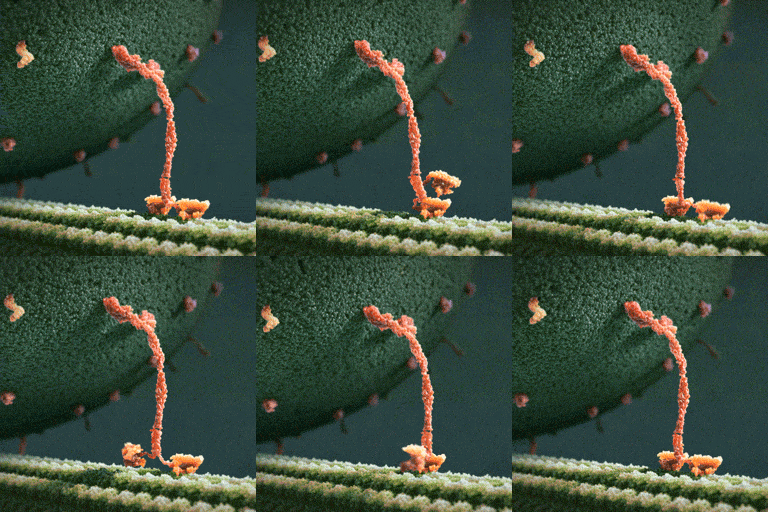
Palomino, who should know better, recently sent me a little movie-gif with an explanatory caption "What you see is a myosin protein dragging an endorphin along a filament to the inner part of the brain's parietal cortex which creates happiness. Happiness. You're looking at happiness.”

We all have our domain of expertise.  Jeremy Bentham, spent his life thinking about political philosophy so was able to be confident in his dismissal of The Declaration of the Rights of Man and the Citizen as "nonsense on stilts". Last Saturday I was talking to our amazing diagnostic plumber and was able to share the old joke about the itemised invoice. Michael-the-plumber seems to be able to work out what's wrong with pretty much any system involving liquids valves spiggots and/or electricity  . . . and fix it with €30 in parts and about the same in labour. Me, I teach Human Physiology, so I've had to internalise the relative size of the working parts of a cell.  I wish I could transmit this knowledge to my students!  I've tried to present it as a scale-of-the-solar-system metaphor, with only partial success.

ANNyway, the scaling of the endorphin /myosin / happiness-is-a-drag cartoon seemed all wrong but it took me 10 minutes to tie down some numbers so that any scale bar could be shown to be internally inconsistent.  My initial response there fore was :
Yerp?  It's a cartoon, X. And whatever is going on the caption doesn't match the scaling.  Myosin is a long string of a protein about 2000 AA / 160nm long.  Endorphins OTOH are chunky but much small molecules about 30 AA long.  The huge green thang in the gif could be a cell - 10,000nm in diameter  but it looks too small to be 100x wider than the myosin is long.  So I'm at a loss but my skeptic hat is throbbing.

I then went off to google the source of the gif and its caption: "myosin endorphins" and found that many people had been trawling the interweb along similar tracks "myosin endorphins snopes" was, for example, one of the top Google guess-the-punter's-mind completions.  This led me to a much more realistic answer: "That's kinesin transporting a vesicle along a microtubule."

So I gave myself a big duh-slap and wrote:
Silly me.  If it's too big to be a macromolecule and too small to be a cell it must be a sub-cellular organelle:
And cited myself about questions of size as above. Everything I know is in The Blob, but there's so much crud in there that it's hard to find relevant bits of information.  What's a vesicle?  It's a small membrane-bound thing of which every cell has dozens to hundreds. The vesicle in the cartoon might be loaded with endorphins, in the same way as a lysosome is loaded with hexosaminidase, but conflating the two is like saying that the passenger is the bus.
Postscript:
According to Google it's my birthday today.  It is not. Like the happiness-is-a-drag meme has been circulating as truth for the last 6 months, Today-is-Bob's-bday is another example of GiGo - garbage in garbage out. I've no idea who / when / how Google+ acquired the incorrect data. It's always best to put the truth down in these cases, that way you're not required to remember your lies. Yest, I had to fire-up the new wifi dongle over the phone with an operative who was required only to speak to the Named Subscriber.  As The Beloved is in France for two weeks I had to stoutly assert that, like the Boy named Sue, my folks had called me Roberta - and I knew her birthday when asked: phew!

Sunday, 5 June 2016

A joke for Sunday

True story. We were all at Pat the Salt's birthday party on Saturday, even the exiled Dau.I home from being a dinner-lady in a school in England because it's mid-term over there. A fellow worker in the school-catering trade is also from Ireland and was relating a story about a wedding that she was at as a young wan. Following an afternoon dancing with grand-dads and knocking back the vino, she took herself off to the Ladies to freshen up. She was disconcerted to see a sort of bar or indentation across the bridge of her nose, like you might get if you had spectacles. Except that she didn't need spectacles. Frowning, her fuddled brain realised that the line was from continued contact with the opposite rim of many wine-glasses. She was worried and she went to consult with her cool Aunt Kate.

"Auntie Kate, look at this mark on the top of my nose. D'ye think I have a problem with alcoholism?"

"Arragh, not at all Pet, you just need to use a straw"
Se non è vero, è ben trovato.

St Tudwal's Fantasy Island

The WEA [Western European Archipelago] is what I choose to call the British Isles because a large chunk of the second biggest island is Not British.  For nearly 80 years the Republic of Ireland has been able to dispense with the Saxe-Coburg und Gotha Windsor family as heads of state, and yet spend as much time ogling Royal Weddings and idolising Princes as everyone else on the islands. Like any geographical feature, the WEA is fractal: no matter what scale you consider there is little groups of islands; islets; reefs; rocks; boulders; rocks; pebbles; sandgrains. Let us zoom in [R] to a pair of tiny islands off the coast of Wales. They are tucked in under the heel of the Lleyn Llŷn peninsula in North Wales, very close to Abersoch, whose sandy beach you can see in the NW corner of the Sat-pic. Everyone speaks Welsh in Abersoch except the hoards of visitors who come for the beach, jet-skis [the white streaks in the picture], wind- and wave-surfing and regular dinghy sailing.

The islands were known in the past as the Studwalls but that's a clear corruption of St Tudwal's and in Welsh they are called Ynys Tudwal Fawr [W] and Ynys Tudwal Fach [E]. Each is about 10 ha. in extent and privately owned. The one nearer the coast was bought by Bear "Everestless" Grylls, celebrity outdoorsy hard chaw, in 2001 - a snip at £95,000.  It's not freehold but the 70 years remaining on the lease should see him out.  They should see his kids out too if <scandal> he continues to leave them out on isolated rocks in a rising tide. He is strong believer in the "better drowned than duffers, if not duffers won't drown" school of raising children.  It was all pre-arranged with the RNLI whose lifeboat was called out to 'rescue' Grylls Jnr. Head Office RNLI affected to be aghast when it was revealed that <frisson> a child had been endangered.  They had to temper their aghastity because another stunt of Lt Cmdr Grylls - jet-skiing round the biggest chunk of the WEA - had raised loadsa money for the RNLI.

Up until 31 May, Ynys Tudwal Fach was owned by Roma Barrack aka Carla Lane, who died on the last day of May in the fullness of her years. She was famous for creating and writing a number of iconic TV sitcoms that wrought humour from the edges of life.  In 1991, she bought Tudwal E as a wildlife sanctuary.  The previous year she had created Animal Line trust with her vegetarian pals Rita Tushingham and Linda McCartney to be nice to animals. The St Tudwal's are, for example, one of the few places in the densely populated WEA where harbour seals Phoca vitulina [seal prev] can haul out on a beach without being annoyed, or shot at, by people.  Some vegetarians can be priggishly self-righteous in their dietary preferences [not Ms Barrack, of course de mortuis nil nisi bonum].  She was given a gong - OBE - by the Brits in 1989 for services to writing but returned it in 2002 when PM Tony Blair trumped her OBE with a CBE [higher] award to the director of an animal testing laboratory. You can follow up on the war between the lab HLS and PETA [People for the Ethical Treatment of Animals] on your own time.

Rats and mice have been on St Tudwal's for at least 500 years, but Lt Col Grylls has eradicated the rats - what price wildlife presentation?  Five years ago, someone decided that Carla Lane was a legitimate target for a wind-up and installed a huge McDonald's Golden Arches on the roof of her medieval chapel / hermitage. What price private property?
More blessed isles on The Blob.