News from the creche is that we acquired another (ram) lamb yesterday morning, more or less 3 weeks after our freebie. As I enumerated earlier after the ultra-sound scanning, we are expecting another 16. One of the ewes having had a heart-attack and died a couple of weeks ago, we are already two lambs down on our tally. Yesterday arvo I left work early intending to do a little light chainsaw work. Instead I found myself dragooned into clearing out one end of the poly-tunnel to receive the maternity ward. We are due a brutal enough storm tomorrow afternoon and it seemed a little unfair to subject the newborns to a soaking wet cold night if it may be avoided. Handling sheep is always a little more complex than "let's keep them in the poly-tunnel for a couple of weeks". You have to get them in the door first and that involves running some temporary sheep wire out in a funnel pointed at the entrance. Meanwhile the doors had thrashed themselves to fritters in the Darwinday storm, so a gate had to be found to close the gap . . . and some fence-posts and a couple of rolls of sheep fence, and some staples, screws, a hammer, the cordless drill (which inevitably was low on juice), the post-driving short-handled sledge-hammer. And it all had to be done now as light was failing and a fine drizzle set in from the West. For once it all went forward as planned, the sheep followed the bucket of feed and O'Manch and I were able to hoosh the stragglers into the tunnel with the gate. I knew there was a reason I'd kept 6 honeycomb-cardboard interior doors - they can be re-purposed as corral.
When we had finished tinkering about shifting this and making-do with that, O'Manch asked what we call people who fix things up (apart from goll-darned genius). I was delighted to hear that in Spain the skill is called bricolaje just as French has bricolage. Bricolage has a particular place in the hearts of evolutionary biologists because of the pivotal essay by Francois Jacob which introduced us to the word. I asked O'Manch what they call the fellow who does bricolaje and, after denying that there was such a word, he offered manitas which is the same as our handyman, and isn't quite the same. He also denied that there was anyone in his home-town who fitted the description bricoleur and claimed that if something went wrong you called in a particular specialist. But I know, if I were to ask either of his grand-fathers, they will be able to identify the Mr. Fixit, el Fijador, in their neighbourhood even if that chap is now long dead.
Showing posts sorted by relevance for query o'manch. Sort by date Show all posts
Showing posts sorted by relevance for query o'manch. Sort by date Show all posts
Saturday, 5 April 2014

Friday, 25 April 2014
www.hostel.blob
O'Manch is leaving us tomorrow: tying up his few belongs in a handkerchief, cutting a stick out of a hedgerow and going on to seek his fortune in London Dublin. He's got a few leads and contacts but he intends to hunt out a place to stay and a job to come back to after he returns from eSpain, whither he is Ryanair-booked for the first half of May. For the short week that's in it, he's booked into a couple of different hostels. I have a wide experience of hostels in Dublin, I haven't heard of anyone who has spent more bed-nights in more different hostels in that city. When I came back from a long walk in Spain ten years ago this summer, I had a part-time job in Dublin so it seemed foolishly extravagant to rent a room when I was only going to use it 2 nights a week. On the Camino de Santiago, I'd slept in a wide variety of different places, some scabious, some humble but clean, some quite smart. There was effectively no correlation between the amount of money you were expected to pay and any objective assessment of quality of accommodation.
It therefore seemed foolishly extravagant to spend €50+ on a hotel when an occasional Dublin bed could be had in a hostel for €12 including breakfast. Very shortly after that I discovered www.hostels.com which cut you a great discount with a credit card and a couple of days notice. I consciously decided to try a number of different places as a scientific experiment. Data! Most people don't do this: they are so restless that having gone to one city and stayed somewhere good bad or indifferent, they never go back to that city again. They never find out if the accommodation was scuzzy that week because the regular cleaner was sick. You have to take with a pinch of salt the star ratings that appear on booking consolidators: each one is but a clatter of anecdotes. So here's The Blob's data-driven list.
All of these places include breakfast (tea, toast, cereal, fruit, OJ) and clean sheets, bring your own towel and flip-flops for the showers.
 O'Manch has partly taken my advice and partly gone off researching on his own - following the stars or a notional score out of 10 on www.booking.com, which he claims gets him a cheaper bed than hostels.com. I've talked about the Illusion of Control before, but probably not enough. You can do all the research you want, pour the data into an ExCel spreadsheet and analyse it up the wazzoo. But your happiness, or at the least the quality of your night's sleep, will depend on the particular cohort of people with whom you are sharing your room on the night. There is no prior data available for:
who will be oblivious as they ruin of your equanimity. But
will ruin much more.
It therefore seemed foolishly extravagant to spend €50+ on a hotel when an occasional Dublin bed could be had in a hostel for €12 including breakfast. Very shortly after that I discovered www.hostels.com which cut you a great discount with a credit card and a couple of days notice. I consciously decided to try a number of different places as a scientific experiment. Data! Most people don't do this: they are so restless that having gone to one city and stayed somewhere good bad or indifferent, they never go back to that city again. They never find out if the accommodation was scuzzy that week because the regular cleaner was sick. You have to take with a pinch of salt the star ratings that appear on booking consolidators: each one is but a clatter of anecdotes. So here's The Blob's data-driven list.
All of these places include breakfast (tea, toast, cereal, fruit, OJ) and clean sheets, bring your own towel and flip-flops for the showers.
- Isaac's - original and best; a converted warehouse a minute's walk from the main bus station. It's noisy and friendly, has a functioning kitchen. The lobby is the dining room which is kind of welcoming. No en suite bathrooms. El Asturiano stayed here when he was fresh off the boat from Gijón: within a few days he'd networked a job and a place to stay.
- Jacob's - owned by Isaac's but purpose built round the corner, the lobby looks like that of a 3 star hotel and is often milled with people as another tour-bus disgorges its load of American or German tourists but none of them are eating their dinner: the kitchen and dining room are in the back and have no windows.
- Avalon - a bit out from the City Centre but still within walking distance. Spacious communal areas, Busy and friendly. I was woken, the whole dorm was woken, at 0400rs one morning as three Aussie back-packers started a water fight.
- Kinlay House - which sounds like a homeless shelter but isn't, is a converted Victorian office building with a magnificent staircase and consequent high ceilings at least on the ground floor. The street door is always locked so you have to get buzzed in, which strikes me as unwelcoming. Nice breakfast.
- Times, College Green - all the accommodation except reception and luggage is upstairs which is rather nice - you can look down on the busy street and the back of the police-station from the kitchen. The building is old and rickety and maze of stairs and corridors. After all the experiments this is where I finished up as a regular sleeper.
- Times, Camden Lane - should be quiet (it's certainly hard to find the first time) as it's down a little laneway between Camden and Harcourt Streets. But in fact the night-street is deafening as drunken revellers pour out of Copper Face Jack's looking for somewhere to urinate. The partying was pretty wild inside the hostel as well and, as an early riser, I used to clear up the broken glass before I sat down for a morning cuppa.
- Ashfield House - 100m from O'Connell's Bridge and round the corner from The Times College Green. Tall & thin with steep stairs. Street outside is very busy and the place always seemed dark with little natural daylight. But that's the case for a number of other places.
- Abigail's - right on the river with views across to the North-side and all upstairs. It is built like a continental boutique hotel but with 6 people in each room instead of a couple. They don't start breakfast until 0900hrs, perhaps to discourage itinerant workers in favour of hangover nursing back-packers.
- Litton Lane - pokey, perky hostel located on a narrow lane up from the river: more or less opposite Abigail's. It is decorated with musical material because it used to be a recording studio where all the greats cut a disc.
 |
| 4.5 for roncadors/snorers |
 |
| 3.5 for axe-murderers |
Sunday, 16 March 2014
Okay then, Rugger it!
I'm not quite the least sporty person I know, but I really don't pay much attention to such antics. I used to share a house with two long-haired botanists and their long-haired cat. On Wednesday nights I'd get home after an evening shaking out rhythms on a repinique with the samba school of which I was then part. The lads were then deep into the sofa watching Match of the Wednesday, and I used to sit it out with them making snarky comments about the referee and outrageous English puns on the players names. All good fun and mostly harmless. My attitude to sporting fixtures is the same as Dr Johnson's view of the Giant's Causeway "Worth seeing? yes; but not worth going to see". You wouldn't catch me spending ready money to see a match of aNNy sport, but I'm not going to sweep my cloak about me and Leave The Room if one appears on the television.
Yesterday evening, it was Ireland's final match in the 2014 RBS Six Nations Rugby tournament. If they could beat France, they would be best overall for the year (huzzah!). It was also Brian O'Driscoll's last match in a Green Jersey. La Manch' is staying with us to learn English and he's keen to get as much as possible out of his time in Ireland - drinking Guinness, eating bacon&cabbage, saying "Jayzus" a lot, and downloading hours of Irish music. He announced that he was going down to the pub to watch the Match. I wasn't sure if the nearest pub - deep in GAA-land - would be showing the match, so I said I'd drive us in to the metropolis of Borris (pop. N=800; pub N=8) and we'd watch it together. The Beloved had gone and bought him a bright Irish Rugby T-shirt so it would be clear that for the next hour and a half he would be O'Manch. Accordingly, 10 to 5 found us on stools at the bar in O'Shea's drinking beer. It was quite civilised, a generous dozen people waiting for the match to start and stools for everyone who wanted one: rugby is a rather a minority sport in Ireland. Up to the age of about 13, I used to play Rugby myself, but the rules have changed since then and we were about equally confused about why penalties were imposed when the referee blew the whistle.
 The other thing that has changed is HD TV with slow-motion replay, so you can see what happens to someone's head when it is brushed out of the way by a walking mountain like Bastareaud. In real-time you see a successful, not to say courageous, tackle. You can see it here at 18:39. In slow-mo you can see what whip-lash is all about. Sexton was concussed, orthopedic-collared, and stretchered off the field. He seems to be alright now, and the fact that he scored two tries in this crucial International match probably makes him think his whacking was worth it. The final score was down to a two-point difference, if France had scored at all in the last few minutes it would have meant a turn over. Perhaps as important, it would have meant that England would have won the six nations, the prospect of which causes quite normal well-educated Irish people to have kittens.
A victory for Ireland against France in Paris - a great event for the St Patrick's Day weekend.
Yesterday evening, it was Ireland's final match in the 2014 RBS Six Nations Rugby tournament. If they could beat France, they would be best overall for the year (huzzah!). It was also Brian O'Driscoll's last match in a Green Jersey. La Manch' is staying with us to learn English and he's keen to get as much as possible out of his time in Ireland - drinking Guinness, eating bacon&cabbage, saying "Jayzus" a lot, and downloading hours of Irish music. He announced that he was going down to the pub to watch the Match. I wasn't sure if the nearest pub - deep in GAA-land - would be showing the match, so I said I'd drive us in to the metropolis of Borris (pop. N=800; pub N=8) and we'd watch it together. The Beloved had gone and bought him a bright Irish Rugby T-shirt so it would be clear that for the next hour and a half he would be O'Manch. Accordingly, 10 to 5 found us on stools at the bar in O'Shea's drinking beer. It was quite civilised, a generous dozen people waiting for the match to start and stools for everyone who wanted one: rugby is a rather a minority sport in Ireland. Up to the age of about 13, I used to play Rugby myself, but the rules have changed since then and we were about equally confused about why penalties were imposed when the referee blew the whistle.
A victory for Ireland against France in Paris - a great event for the St Patrick's Day weekend.
Sunday, 6 April 2014
Trash: 2014 Organic: 2010
I wrote last year about walking the county road with Dau.II, her friend and three bin-bags. We were encouraged by An Taisce and our tree-hugging friends to pick other people's rubbish out of the local ditches, drains and roadside verges. Actually it was a couple of weeks later in April last year and that made the work a good bit harder because the grass and nettles were well up: both obscuring the rubbish and making it harder and wetter to pick up. Yesterday was The Day Appointed but I was all for giving it a miss. We're busy with the lambs and the attendant civil engineering works and I still wanted to tidy up a few sceacha (Crataegus monogyna). But the */!@%$! chainsaw wouldn't start, so mid-morning I trekked off to visit Rene my favorite bricoleur down in St Mullins to see what he could do. Under his attention, the saw came back to life and we sat awhile having a cup of tea talking round the houses about food-labelling and fish-farming.
 We've all long been aware of the difference between Irish Smoked Salmon (sourced who knows where but smoked in Ireland) and Smoked Irish Salmon (grown in Ireland but smoked who knows where). Rene showed me an empty package of Smoked Irish Salmon : organically farmed mild oak smoked salmon. On the back, the product claims to be Smoked Irish Organic Salmon (Salmo salar) slices. He knows a lot about fish-farming having started the first eel (Anguilla anguilla) farm in the Netherlands a generation ago and he has an idea about what corners are necessary to cut if you want to supply one of the big UK margin-slashing supermarket chains. He was also a bit bamboozled by the Euroleaf symbol (see right) which appeared under the bar code. But maybe that's because he hasn't got out much these last four years: "From 1 July 2010, the use of the EU organic logo is compulsory for organic pre-packaged food produced within the European Union." He maintained that the only thing organic about the product was the saw-dust used to smoke it. Which, if you read the brown text above, could well be true in the weasel-word tradition that makes a marketable distinction between Irish Smoked Salmon and Smoked Irish Salmon. But the documentation on places where the Euroleaf may be displayed suggest that this hypothesis cannot hold up - and I quote:
Can the logo be used on packaging material of the following products?
By the time I returned, The Beloved and O'Manch had been out for an hour and picked the road clean well into the neighbouring county. All I was able to contribute was an old tire that I'd picked out of the verge the previous afternoon on the way home and the wing of my own car which I had retrieved from a ditch in another part of the county a few days after my argument with that same ditch. TB & O'M had found another two tires and a couple of bagfuls of miscellaneous jetsam. After a bowl of soup we went to the village hall to compare notes with the other trash-pickers and have a community cup of tea and some buns. This annual ritual is worth doing, not only to meet the neighbours, scarf down some free food and clean up our own back-yard but also to discourage the next person who wants to fire something out of the car-window. If the hedges are already festooned with detritus, it is marginally easier to do the wrong thing.
Can the logo be used on packaging material of the following products?
- Sardines in organic olive oil: NO
- Organic salmon: YES
- Wine made with organic grapes: NO
- Soup made of organic vegetables: YES
- Wool from organic sheep: NO
- Milk from a dairy farm in conversion period: NO
- Other organic animal products, where only national rules exist (rabbits, snails, deers, etc.): NO
- Pet food: NO
By the time I returned, The Beloved and O'Manch had been out for an hour and picked the road clean well into the neighbouring county. All I was able to contribute was an old tire that I'd picked out of the verge the previous afternoon on the way home and the wing of my own car which I had retrieved from a ditch in another part of the county a few days after my argument with that same ditch. TB & O'M had found another two tires and a couple of bagfuls of miscellaneous jetsam. After a bowl of soup we went to the village hall to compare notes with the other trash-pickers and have a community cup of tea and some buns. This annual ritual is worth doing, not only to meet the neighbours, scarf down some free food and clean up our own back-yard but also to discourage the next person who wants to fire something out of the car-window. If the hedges are already festooned with detritus, it is marginally easier to do the wrong thing.
Sunday, 13 April 2014
Resonance
After the Darwinday storms I went up the hill behind the house to look at the Coillte forest that was planted 35 years ago on Dreelan's farm. O'Manch had reported that there was quite a bit of wind-throw on the edge, including one tree that had blown down against the prevailing wind to lie across the path. I was surprised at how little damage there was - they say that the Sitka spruce Picea sitchensis plantation on White Mountain, 15 km South of our place, looks as if Hurakan god of storms had scythed it all down. This is predicable as native Sitka grows in extremely wet soils, and is genetically programmed for a very shallow root system: that's partly why it is so extensively planted on marginal land. What really surprised me however was the fact that several trees deep in the Dreelan forest had snapped off 5-10m up with no evidence of them having been struck by a falling tree. I suspected that this was due to harmonic resonance when the wind was gusting at just the right speed to treat trees of a particular height like an insufficiently elastic violin string. I've floated this idea past a number of tree chaps and nobody has said it is complete bollix.
 Yesterday was the anniversary of another example of harmonic resonance: the collapse of the Broughton suspension bridge in Salford. On 12 April 1831 a platoon of the King's Royal Rifle Corps returning to barracks after an exercise out of town were amused by the fact that the bridge appeared to bounce in time with their marching step. It's not often that squadies get access to a fair-ground ride while in uniform. Some of them exaggerated their step for a lark which was enough to snap a defective bolt and the bridge collapsed into the water 5m below injuring some 20 soldiers, some seriously. That caused a policy change in the British Army requiring soldiers to 'break step' when crossing any bridge and you can still see notices advising this on the end of some bridges. Marching soldiers may have the capacity to collapse bridges but the wind definitely does: thrilling newsreel footage of the collapse of the Tacoma Narrows Bridge in 1940. In that case, the wind was far less (about 65km/h) than the Darwinday storm but it was just the right speed to sustain and synergise the movement, like a child thrusting her legs back and forth to get a swing to reach the very sky. When the London Millennium Bridge was opened in June 2000 synchronous movement by large numbers of pedestrians caused a resonant lateral movement of the bridge which came as a total surprise to Arup the consulting engineers.
 There is a study to be done, or at least a Blob-post to utter, on the empathic movement of strangers walking along streets in the same direction - Arup assumed that these would be random but they were wrong! Dublin has her own Millennium Bridge, like London's limited to pedestrians so more more engineering than architecture. I always feel a little queasy crossing it because your foot doesn't make contact with the surface quite when you expected it to, so it is a little like trying to cross the deck on a large ferry at sea. This detectable bounce is generated by the people walking around me - and my enormous self, of course.
 Resonance is not only an issue for horizontal engineering projects, it is also, like the trees in our forest, a significant issue for vertical hubris such as the Burj Khalifa (830m) and Taipei 101 (510m), recent holders of the World's Tallest Building title. (Empire State Building 380m). Taipei 101 springs up in a region prone to typhoons and earthquakes, so cannot be built out of Lego. As it gets higher any structure gets heavier and the foundations need to be more massive. Nevertheless they embedded a 660 ton harmonic mass damper (see right hanging on its suspension cables) near the top of the building. This sphere is 5.5m in diameter! Dublin's Spire in the middle of O'Connell Street, known by local wags as the stiletto in the ghetto, although only 120 m tall, incorporates a mass damper so it doesn't bend itself out of shape in a breeze of the resonant frequency.
Wednesday, 16 March 2022
Blow out
It's an anniversary of sorts this week because we moved into the house on the evening of 17th March 1997 - 25 years ago! We have a mighty poly-tunnel in the garden behind our house. We reckon it's been there for 15 years now; so we've had the tunnel for longer than we've not had it. I just can't imagine how we handled the the laundry before we had somewhere to hang everything without needing to keep a weather eye open for rain. And the tunnel has been useful for high-ventilation entertaining during Coronarama. The plastic is holding up but is getting opaque from sun-bleach even if I scrub the algae off - this significantly reduces the productivity of things photosynthetic. The failures have almost all been caused by rotting of the ordinary building timber to which we anchor the sheet of plastic. Replacing the punky rotten timbers as and when they fail has been a bodger's [meeeeee!] paradise and the overall look is patchwork.
It took a pounding during the Darwinday storm of February 2014. The Beloved and O'Manch, our then wwooffer, had to hold onto one edge of the plastic which had rrrripped off its foundation. It was like Cape Horn apparently but after 40 mins the wind abated and they were able to tie the thing down. Our neighbour, with a much smaller suburban polytunnel was looking out at the storm through the kitchen window, heard a bang and watched the whole thing thrash over the ditch into the neighbour's field. Mostly through the scots pines and hedges provide a rather sheltered micro-climate: in February, for example, Storms Dudley, Eunice and Franklin were weathered not a bother.
Last Saturday the county was subject to a yellow wind and rain warning, not worthy of becoming a named storm. As evening loomed The Beloved asked if it was okay to leave the door to the tunnel open over-night. I answered in the affirmative and then thought better of it and jinked up through the rain to close up. Imagine my concern to find that half of the door-frame at the far end of the tunnel together with its attached corner of plastic was thrashing about; detached from its bottom moorings.
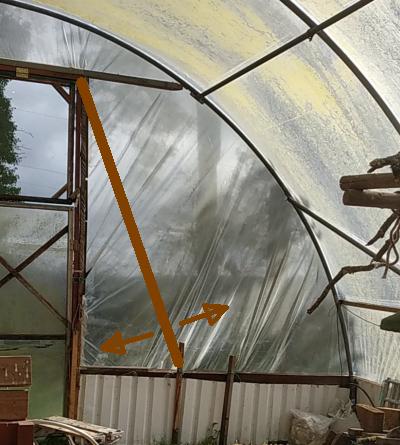
That couldn't be left open all night; not least because it could get thrashed to buggery before breakfast. I don't have an emergency first-aid kit for storm-wracked but I've been beach combing for years and had a handy selection of cordage to hand. It was really just a question of which rope was strong enough but thin enough to thread between the door and its frame. In about 40 minutes, before full nightfall I had secured the flapping spar and cinched it tight with a Spanish windlass, whc I've used before.

- some prosthetic timber to shore up the punky rotten end where the door-jamb met the plastic supporting horizontal
- a packet of miscellaneous steel braces bought many years ago as a too cheap to refuse, these will come in handy somewhere, sometime
- a selection of 5.0 x20, x30, x40 and x60mm woodscrews
- the new Erbauer cordless driver and drill set whc The Boy found me as a hot UK deal before Christmas
- fence staples
- 1.5m square fence posts
- beach-cord to tie bits together
Saturday, 22 September 2018
Vanity brows

We had a UK week in mid-August with The Boy and his family. His new engineering firm had recently lost their Man in Singapore and TB volunteered to spend a week out there in a holding action to not lose the two valuable clients. It was short notice but he knew he should look his best and decided that getting his unruly monobrow threaded had to be part of the protocol. You can do it yourself: you just need 60cm of dental floss and two steady thready hands OR, as The Boy chose to do, you can put yourself in the hands of the professionals. He went down-town and into the first shop that seemed appropriate. We all know that women a) are more likely to care about unruly face-hair b) have a higher pain threshold. I think that he was as surprised as everyone in the shop when, feeling the first pass of the plucking threads, he started from the chair with an unexpected
"Jesus, Mary and Joseph"
He endured the rest of the ordeal without further outburst, which secured him a small round of applause from the girls when he went to pay.Threading is the least of it on the eyebrow front: you can get extra hair put in, or fake it with a bit of delicate tattoo: it's called microblading. Removal with waxing, plucking or trimming is also possible. I guess there must be In eyebrow shapes and shame-in-the-office if your brows are deemed to be so yesterday. One of the system failures experienced by old men is that the mechanisms for controlling where hair sprouts tend to break-down. Tendrils sprout from the ears and nose and start curling up up and away from the eye-brows. Accordingly I tend to give a rough pass on the eyebrows with my electric hair/beard trimmer [last time in a barber 1997] when my face is before the mirror. If I don't do this, I know I'll get distracted while driving when something grey loops down and waves in my peripheral vision.
As with so many things that are more or less useless - soccer, boy-bands, painting - there is a lot of money to be made from grooming for looks rather than grooming for lice. Look at [the left eyebrow of R] Anastasia Soare, she's the Eyebrow Queen and a billionaire having arrived in the US from Romania without a word of English 30 years ago. Aspirants to that career can get a diploma in Cosmetology. Just make sure it is approved by the Confederation of International Beauty Therapists and Cosmetology (CIBTAC)
Sunday, 15 February 2015
scanning the ewes
Last year about this time, the ultrasound man came to scan the ewes and predict who would give birth to what. The data:
Total 17 ewes 19 lambs; average 1.2.
Compare that with this year's data which we obtained around tea-time yesterday evening:
Total 14 ewes 19 lambs; average 1.4. So the rate is better but we'd still have gone bust if this was a commercial undertaking rather than a penance for our sins in a previous life. The ideal is to have an average pretty damned close to 2.0 but not higher; and you want a peaked distribution: all twins, no empties, few triplets. The runt of our triplets is still very small despite us feeding her supplementary milk for months (at €15 the bag for Lamlac powder). Last year we needed (or had) four people to run, heave, push the ewes into the scanning chute - our good-neighbour Carmen dropped by to deliver some cakes for O'Manch and found herself writing numbers with a spray-can on the flanks of 17 sheep. Since then we've upgraded our sheep handling unit to incorporate a sheep-chute half a metre wide and 10 metres long. This more or less forces the ewes to form an orderly queue following each other through the scanner to freedom. Somebody said that we should do this necessary scanning with the least possible stress to the ewes which aspiration was a long way from the reality of stress levels for either two- or four-leggers. We all did commendably well, all things considered.
Not least, we separated the empties and put them in with last years (un-tupped) lambs and a sentimental pensioner, where they can survive on whatever grass there is. We can thus concentrate our concentrated feed into the mothers. Turns out that we had 4 ewe lambs not 3, which only came to light when we were loading the second batch of ram-lambs into the trailer for the butcher. What are we like? So we now have eight not-load-bearing sheep in our haggard saving me from having to mow the lawn for a few weeks . . . win! And we have reconciled the lamb-count numbers on the flanks with the official numbers on the ear tags, so we'll keep proper fertility records from now on - promise.
 We are now accepting applications, from people with small hands and no need to sleep, to come help with the lambing starting at the beginning of April. Actually that coincides with a two week gap in the Institute's teaching term over Easter; and I think that several members of the family will be home over that period. Must remember to buy some Lamlac.
| Empty | Single | Twins | Trips |
| 5 | 6 | 5 | 1 |
Compare that with this year's data which we obtained around tea-time yesterday evening:
| Empty | Single | Twins | Trips |
| 3 | 4 | 6 | 1 |
Not least, we separated the empties and put them in with last years (un-tupped) lambs and a sentimental pensioner, where they can survive on whatever grass there is. We can thus concentrate our concentrated feed into the mothers. Turns out that we had 4 ewe lambs not 3, which only came to light when we were loading the second batch of ram-lambs into the trailer for the butcher. What are we like? So we now have eight not-load-bearing sheep in our haggard saving me from having to mow the lawn for a few weeks . . . win! And we have reconciled the lamb-count numbers on the flanks with the official numbers on the ear tags, so we'll keep proper fertility records from now on - promise.
Thursday, 26 May 2016
It's a Javi problem
Jakers! you'd think our eSpanish was better: we've had a lot of opportunity to practice it. Currently we have Bolivar, a wwoofer from Venezuela, staying with us for the Spring/Summer. Two years ago it was O'Manch' a young chap from La Mancha who could prune vines and play the piano. The first instar was Javier, from suburban Madrid, who spent nearly a year with us in the mid 1990s. We haven't been exclusively espagnolophile: for a couple of Winters we hosted Tadek a self-sufficient strawberry farmer from NE Poland.
Mais revenons a nos Javis. He was living with us to help with the children and the logistics of running the farm; in return he was clocking up social welfare credits back home in Spain which he could parlay into a year's unemployment benefit when he returned . . . and getting help with his English. Every Saturday morning when I returned from a working week in Dublin, he was hopping from one foot to the other to do blokey things with me rather than doing Lego with two small girls. One such day, early in our relationship, I suggested that he clear out the drain than runs beside the lane which bisects our property. This task is important because a clogged drain will fail to carry water, which will spill out into the roadway and sweep it all to buggery. I know: it's happened to us twice in the last 20 years. Javi's response was an incredulous "But Bob, that is one hundred metres!" . . . of head-high brambles, small saplings, enormous rocks and invisible quantities of other problems. Not being one to ask something that I was unwilling to undertake myself, I replied "Okay, Javi, let's do it together. We'll start at the bottom and see how far we get.".
40 minutes later, we had not only cleared the drain with slash-hook and sprong, rake and secateurs, but we had piled the mountain of brash onto a large plastic sheet and dragged it down to the haggard for burning. Five minutes after that we were settling down to a nice, and well-deserved, cup of tea. Seemingly insurmountable problems that yield to solution if you start pecking away at them somewhere became known in our family as Javi Problems. Not so difficult in the execution as anxiety makes them feel when you fail to grasp the nettle. We both learned something that day.
Javi's other problem was that he lacked any personal space, he had a bedroom but the girls were still quite likely to be roaring in the night and would occasionally wake him up, far too early, to finish last-night's Lego project. We had cleared out one of the ruined granite sheds to live in while the house itself was being stripped to its bare-bones and essential services / luxuries installed like running water; a front door that kept out mice; electrical sockets in all rooms; under-floor heating and windows that you could see through. In order to live in the shed we had created a timber box inside the granite shell and dry-lined it with sheet-rock [walls and ceiling] and tongue&groove pine boards [floor]. That plan was roughly shaken when we were evicted from our home in Dublin before the house on the farrrm was finished. So the shed was filled with furniture and boxes & boxes & boxes of accumulated possessions. Javi knew we had all the necessities for comfortable life in the house - he was sharing them on a daily basis. The material in the shed must, he reasoned, be surplus to requirements; not least because it had not been used for nearly two years.
One Friday at dinner, he tentatively raised the idea that IF we sorted through the clutter in the shed THEN he could shift his much smaller parcel of stuff and himself into the vacated space. We were willing, the next day was sunny and we sorted through 40 cu.m. of material before tea-time. The nicer furniture was shifted to the local auction-room where it was converted into cash. The much-loved but moth-eaten, wretched, touch-only-with-rubber-gloves sofa was put on top of a pile of empty card-board boxes and burned. We didn't know about carbon-footprint in those far-off simple days. It was a wrench, but Javi's Socratic method worked "This sofa: are you ever going to sit on it again? You have a nice sofa from Habitat in your living room, which is too small to accommodate two sofas. Can you imagine anyone buying such a sofa? [apart from us, by implication] Shall we just burn it?". Javi won his own place, which was for years know as Casa Javi, now simply The Casa, because it has housed a number of other inhabitants. But it lightened the load on our souls by the mammoth decluttering that he instigated.
Sunday, 16 March 2014
Arrival

Tuesday, 18 October 2016
la heroína de la piscina
We were the second blow-ins to The Valley. The first was a musician and handyman who bought a 2 acre field on a 25% slope and built a wooden house at the top of the plot and an enormous wooden boat at the bottom near the road . . . 40 km from the sea. At least our eccentricities were confined to home-education, Birkenstocks and tree-hugging. Après nous, la deluge d'artistes: visual, conceptual and mental. Without them there would be no Blackstairs Film Society and we'd have to watch films without subtitles. But the only one we're on borrow-a-cup-of-sugar terms is La Torbellina de Tenerife TdT a multi-tasking, multi-talented woman from Spain who married into one of the local families. She was a rock for O'Manch' and Young Bolivar, our long-term visitors and English language students: bringing them eSpanish food and translating when mutual understanding was vital.
After a life-time lifting tureens in the catering trade her back is crook and she has regular therapeutic sessions in the 25m swimming pool of one of the local hotels. Last week her attention was drawn to a family: mother, father and two excited children: a boy and girl probably twins. TdT noted that the mother was focusing 85% of her attention on her smartphone. Something [precognition is quite possibly one of her many talents] made her think ' keep an eye on those kids' and she was thereby distracted from her normal length-swimming regime. Sure enough, a few minutes later the girl ran whooping straight out of the ladies changing room and disappeared beneath the surface of the pool. TdT swam furiously to the spot, dived down, grabbed the child's arm and heaved her like a drowned kitten onto the poolside tiles. She was no longer pink but a terrible blue. But small children have an imperative to live and the girl coughed up some water and sat up. Her father came quickly on hearing the hullabaloo but the mother was still changing . . . apps on her phone. TdT told the father that he might mark the day as his daughter's [re]birthday and he replied that the twins were indeed 4 and the swim was a birthday treat. And the life-guard? Out behind the desk in the lobby sharing his attention between the CCTV view of the pool and his laptop. These goddamned devices will be the death of someone one of these days, why, I was almost killed by device-driven inattention.
The St Adjudor's Saving-from-Drowning club in The Valley is fairly select and the only other member I know about is me. When the girls were small, going swimming was part of the relentless round of off-site edutainment that gave them 12 hours a week in the car listening to audio-books and having roiling discussions about life, the universe, and the Eiffel Tower. Those trips, reading books, and the roiling discussion in the car and at the kitchen table was what constituted their education. Despite hating to get wet socks, sometimes I had to be the adult-in-charge at the pool. I loved being with the girls but I didn't like swimming because it was another of the things I was crap at when I was young. My brother and sister were like fish and passed successively their bronze, silver and gold swimming and life-saving exams and have the medals to prove it. I have a certificate for Swimming One Length of the Drake Baths in Plymouth. I could manage two lengths but my bottle gave out beyond that: it was like my anti-prowess at running. ANNyway, about ten years ago, I was standing up to my neck in the water watching the girls coursing up and down when my reveries were distracted by a commotion down at the deep end. A large woman was splashing about unable to make any progress to the edge of the pool. Without thinking, I swam towards her and by holding my breath and standing underneath her I was able to push the woman by her capacious bottom towards the pool side. And the life-guard? That spotty youth was running up and down the poolside shouting . . . and had also been off-site chatting to the girls at the check-in desk. Apparently, not getting into the water is part of the standard operating procedure. We still had 20 minutes left on the clock, so I went back to standing up to my neck in the water until the girls had finished their antics. The woman's husband cruised up at some point to say thank you, but the woman herself was quite oblivious to the drama she had caused. There is, of course, a certain irony that the only one of our sibship who is not qualified to save anyone is the one who has actually saved someone.
Because, in fairy-stories, things often come in threes, I have another life-saving tale. Maybe 20 years ago, shortly after we had left for Ireland, my late lamented pal Roy was walking along one of lone and level beaches that stretch from the outskirts of Newcastle upon Tyne to the Scottish borrrder. In the distance he could see two boys digging a cave into the face of the sand-dunes. As he got a little closer he realised that only boy was visible and he was jumping about in a peculiar manner. Quick as thought, Roy ran to the scene and saw two sneakers poking out of a heap of freshly fallen sand. With a super-human desperate heave, he hauled the other chap from the embrace of death and helped clean the sand from his nose and mouth. Within a couple of minutes, the boys were running off down the beach joshing and shouting towards the distant and invisible parents. Roy wondered afterwards, but didn't lose sleep about it, if the parents ever realised how close they came to a funeral.
These effin' qualifications are now the tail wagging the dog of all aspects of our lives. Train drivers who are 'qualified' without ever going out on their routes. I stopped using the chain-saw for about 5 years after I'd taken a chain-saw handling course which can hardly have been the intention. An elderly neighbour told us a few days ago that he'd been compelled to take a farm-spraying course after 20 years of spraying farms on contract. "Did you learn anything?", I asked. "A little bit about safety,", he replied, "but the paper-work and the exam were a struggle - I was never any good in school". He passed despite the exam, nobody has any interest in failing sprayers; The Man just need to get the optics right.
Monday, 28 April 2014
One's Company
Looking for china in one of our sheds, I found a number of boxes full of books. My primary feeling was sinking heart - that I had buried these books for 16 years in conditions that were far from ideal and that I had survived for all that time without missing their physical presence. Books like that are just clutter. But I was delirah to discover in the same box three books of 1930s travel which are worth reading again because they did so delight me when I read them first. The first two were a matching pair of Patrick Leigh Fermor's trilogy A Time of Gifts and Between Woods and Water, which I've recently tribbed. With commendable synchronicity I was chatting just recently about the third of these re-found books with my US pal P. It is One's Company by Peter Fleming.
All of these books have two things going for them: they give an idiosyncratic and evocative view of events distant in both time and place and they are really well written. People who have been taught to write grammatically correct English tend to snicker at the Da Vinci Code and other books by Dan Brown: the illiteracy is sometimes enough to stop the flow of the racing narrative because you can't follow who is doing what to whom. When Fermor left England with a copy of Horace as one of two books to carry him across the continent it was in Latin. Before dropping out of his fancy school he had been formally educated in the ancient tongue. That meant that he could recognise a gerund, a subjunctive clause, a preposition or a phrasal verb in either Latin or English. The Horace for a contemporary 18 year old to take Inter-railing round Europe would be more likely Rumpole of the Bailey. I also went to a fancy school but was useless at Latin and I was unable to translate its formality into better writing in English. Having O'Manch staying with us for 4 months learning English as foreign language has been an education for us all. When I was at school I thought all that grammar was just an impediment to the communication; I now realise that grammar is essential for communicating your ideas unambiguously.
Fleming also went to a fancy school - his grandfather was a merchant banker so there was plenty of money sloshing about the family. They still give a Peter Fleming award at that school to recognise excellence in literary composition and he went on, effortlessly, to snag a first class honours degree in English from Oxford. He could have stayed at home in the world of the London literati writing, say, for The Times and the Spectator and he did that, but he also left England and travelled into the interior of South America (Brazilian Adventure), China (One's Company) and Central Asia (Travels in Tartary). These, particularly the first, are the funniest, most laconic and least pretentious travel books you are ever likely to read. Unless you follow them up with A Short Walk in the Hindu Kush or pretty much anything else written by Eric Newby. If you like your upper lip to be stiff while reading, these are the chaps to follow.
I've had occasion to remark about our unconsidered certainties - the background that cannot be seen and so is never questioned: that homosexuality is a kind of curable disease, that it's okay to hit children with sticks, that life is sacred, that boxing is a sport in which civilised people might engage. It would not be true to say that there is a vein of anti-semitism in One's Company - nothing compared to what central Europe was getting geared up to in the 1930s - but casual use of Jewish racial stereotypes (salesmen, clever) has modern readers brought up all standing. Nobody nowadays thinks that a pipe is an essential piece of kit to take to the Brazilian jungle. You will notice this of many books written before WWII. It would be about as true to say that Peter Fleming or Agatha Christie was anti-semitic as to say that the Iona Institute is homophobic or that the driver of the Clapham omnibus (and most of his passengers) is racist. After WWII, of course, in Europe there was rather less point in uttering casual racial stereotypes about Jews because there weren't any.
There's a nice critical tribute by Ben Downing to celebrate Peter Fleming's centenary. And here's an attempt by Robert Ryan to bring him out of eclipse by his younger and ultimately more famous brother Ian '007' Fleming. But forget all that, go and get any of Fleming's books out of the library: real life on the edge trumps fantasy however fantastic.
All of these books have two things going for them: they give an idiosyncratic and evocative view of events distant in both time and place and they are really well written. People who have been taught to write grammatically correct English tend to snicker at the Da Vinci Code and other books by Dan Brown: the illiteracy is sometimes enough to stop the flow of the racing narrative because you can't follow who is doing what to whom. When Fermor left England with a copy of Horace as one of two books to carry him across the continent it was in Latin. Before dropping out of his fancy school he had been formally educated in the ancient tongue. That meant that he could recognise a gerund, a subjunctive clause, a preposition or a phrasal verb in either Latin or English. The Horace for a contemporary 18 year old to take Inter-railing round Europe would be more likely Rumpole of the Bailey. I also went to a fancy school but was useless at Latin and I was unable to translate its formality into better writing in English. Having O'Manch staying with us for 4 months learning English as foreign language has been an education for us all. When I was at school I thought all that grammar was just an impediment to the communication; I now realise that grammar is essential for communicating your ideas unambiguously.
I've had occasion to remark about our unconsidered certainties - the background that cannot be seen and so is never questioned: that homosexuality is a kind of curable disease, that it's okay to hit children with sticks, that life is sacred, that boxing is a sport in which civilised people might engage. It would not be true to say that there is a vein of anti-semitism in One's Company - nothing compared to what central Europe was getting geared up to in the 1930s - but casual use of Jewish racial stereotypes (salesmen, clever) has modern readers brought up all standing. Nobody nowadays thinks that a pipe is an essential piece of kit to take to the Brazilian jungle. You will notice this of many books written before WWII. It would be about as true to say that Peter Fleming or Agatha Christie was anti-semitic as to say that the Iona Institute is homophobic or that the driver of the Clapham omnibus (and most of his passengers) is racist. After WWII, of course, in Europe there was rather less point in uttering casual racial stereotypes about Jews because there weren't any.
There's a nice critical tribute by Ben Downing to celebrate Peter Fleming's centenary. And here's an attempt by Robert Ryan to bring him out of eclipse by his younger and ultimately more famous brother Ian '007' Fleming. But forget all that, go and get any of Fleming's books out of the library: real life on the edge trumps fantasy however fantastic.
Saturday, 19 April 2014
First swallows
It was another gorgeous day yesterday: not too hot, mostly sunny. We were able to get some grass mowed and made some progress on getting a clear space to plant potatoes. It's a bit of a jungle outside the polytunnel but O'Manch worked manfully to clear two raised beds that I constructed several years ago from concrete blocks. They are an orderly complement to the long bed in which he planted out the strawberry runners the day before. It's looking quite protestant. Last night as the evening fell I was sitting on the bench outside the living-room window talking to my mother on the telephone when I noticed the first couple of swallows Hirundo rustica of 2014 weaving and jinking about the yard.
Although Aristotle recognised that some birds migrate annually, he believed that swallows were rather inclined to hibernate through the Winter. Any half astute natural historian will know that in Europe swallows subsist entirely on insects on the wing - you just have to swat one down and analyse its stomach contents. The same h.a.n.h will know that there are very few insects on the wing in Winter, so it would be hard for swallows to make a living at that time of year and . . . swallows are conspicuous in their absence. It wasn't until Thomas Bewick's beautiful and authoritative A History of British Birds (1797) that it was generally accepted that Aristotle's hypothesis could be rejected: swallows go South rather than go into hiding.
It always gives me a lift when the swallows arrive - if our farmlet is deemed habitable by these long-distance travelers, it must be a fit place for us to live. We have kept desultory records of these events over the 17 years we've lived on the side of the mountain:
2014 is thus the earliest we've seen these harbingers of Summer, but I'm not going to predict how much hay we'll win from this information. One day at a time: it was another gorgeous day yesterday.
Although Aristotle recognised that some birds migrate annually, he believed that swallows were rather inclined to hibernate through the Winter. Any half astute natural historian will know that in Europe swallows subsist entirely on insects on the wing - you just have to swat one down and analyse its stomach contents. The same h.a.n.h will know that there are very few insects on the wing in Winter, so it would be hard for swallows to make a living at that time of year and . . . swallows are conspicuous in their absence. It wasn't until Thomas Bewick's beautiful and authoritative A History of British Birds (1797) that it was generally accepted that Aristotle's hypothesis could be rejected: swallows go South rather than go into hiding.
It always gives me a lift when the swallows arrive - if our farmlet is deemed habitable by these long-distance travelers, it must be a fit place for us to live. We have kept desultory records of these events over the 17 years we've lived on the side of the mountain:
1998
|
01 May
|
2007
|
21 Apr
|
2001
|
28 Apr
|
2010
|
24 Apr
|
2002
|
02 May
|
2011
|
27 Apr
|
2004
|
13 May
|
2014
|
18 Apr
|
Subscribe to:
Posts (Atom)