The Irish radio station Newstalk has a science magazine programme called Futureproof. Last Saturday live in the Science Gallery, they did a piece on genetic testing. The programme's presenter Jonathan McCrea had sent (this is one he did earlier) a saliva sample off to a company in California called 23andMe and they had sent back the results. McCrea was given his results live on the wireless (wired up to a galvanic skin response stress detector) so it was interesting and informative - for McCrea obviously but for the studio audience as well. McCrea was relieved to discover that his risk of developing Alzheimer's was rather small - because his grandmother had descended into that darkness. He also found that he was 'clear' of known genetic predispositions to cystic fibrosis, breast cancer and some other hazards. Good for him!
One of the experts on the programme was geneticist and blogger Kevin Mitchell from TCD's Genetics Department. Mitchell addressed another issue that can be teased out from the scads of genetic data that 23andMe is able to wrest from a gob of spit. The medical prognoses are clearly about McCrea's future. The pattern of genetic variants also allows The Company to make inferences about where his people are buried. McCrea has a genetic profile shared by many of North European descent including a substantive subset of these variants which point to ancestors from the Hiberno-British Archipelago. Back further we now know that some modern humans (us) got the ould leg over some Neanderthals before these-our-cousins joined dinosaurs and dodos on the Extinction Express to Oblivion. So there was an opportunity to jest about the percentage of McCrea's genome that was Neanderthal in origin - a tad above the European average but probably not significantly so. You can make jokes about brow-ridges and Neanderthals and it is deemed to be inoffensive because they're all long dead. On the global scale of things, the Irish are quite genetically homogenous - not as pure-bred as Icelanders but much more so than, say, US Americans.
If such a programme was broadcast in São Paulo it could get a little more edgy because African ancestry in Brazilians is very poorly correlated with actual skin colour. Yet darkness is strongly correlated with social class and it is not correct to say that Brazil has no racial prejudice. So there might not be so much badinage when it is revealed that the 'white' presenter has rather more African ancestry than the 'black' lady who makes the tea off set. Mark Shriver a genetic anthroplogist from Penn State has shown a lesser but demonstrable amount of black-in-white and white-in-black in US citizens. Famously in the descendants of Thomas Jefferson and his slave (and wife's half sister!) Sally Hemings, whom he started bonking when she was less than 16. I've given joy to the growing multiculturalism in Ireland; these genetic tests may help us park racism and take everyone as we find them - all of them, not just the epidermis.
I might mention that the 4th hire of 23andMe was an Irishman called Brian Naughton who got his first degree in Genetics at TCD. If you sign over $99 to The Company, they'll send you a kit to receive your saliva and within 6-8 weeks they'll get back to you with results. 20% off for second and subsequent samples! If you send a copy of your TCD degree you get it all for half-price (kidding!). Dau.II is now rooming with another geneticist in Dublin who has shelled out for a test. Yesterday Dau.II asked if I thought it was a good idea for us all (Bob and Boblettes) to get tested. She and her sibs have a rather rich brew on the ancestry front (Irish (both left and right footers), Scots, French, Lebanese, Sahel African) and the grand-daughter includes another continent in hers. I've had a rather fond conceit that my maternal grand-father was London Jewish but my Mum denies this (vehemently), so maybe $99 would help settle the question?
Showing posts sorted by relevance for query 23andme. Sort by date Show all posts
Showing posts sorted by relevance for query 23andme. Sort by date Show all posts
Wednesday, 26 June 2013

Monday, 8 May 2023
2300andMe
I've had a quite a bit to say about 23andme, not least because a very early hire was a graduate of TCD Genetics Dept, my alma mater. 23andMe may be original and best, but there is now a long list of other international corps which will analyse DNA from [cells in] your spittle and find a raft of rellies. I was tempted to submit when I had €100 to spare and thought it would be a bit of a jape. I'm glad I didn't, because like the spoken word and the sped arrow, you can't put the genii your DNA back in the box once you've thrown it out on the wind.

The original Rcd. Atkinson was a small farmer and tanner from Cumbria, who made his money work for him, moved to London and parlayed his assets into a fabulous fortune. He moved in the innermost circles of political power, knew ministers and fixers and was able to secure lucrative government contracts to supply matériel [rum, biscuit, horses, salt-beef, candles] to the British army during the American War of Independence. Along the way he acquired a controlling interest in a tuthree sugar plantations in Jamaica . . . with the attendant "personnel".
The present Richard Atkinson spent ten years in county archives and family vaults reading reading reading letters, account books, certificates and wills and eventually wrote his first book Mr Atkinson's Rum Contract: The Story of a Tangled Inheritance, published in 2021. Leaving aside the author's hand-wringing, it's a really interesting insight into how the world turned 250 years ago. History, as she is taught, is a tired re-churning of the same old sources - many of which are the books of previous historians. Edmund Burke was eloquent, Charles James Fox was fat, William Pitt the Younger was young - Prime Minister at 24! Whereas Richard "Rum" Atkinson doesn't even merit an entry in Wikipedia. Battles and Generals fill the pages of Encyclopedia Britannica but nobody knows who ran the commissariat that allowed those generals to win those battles.
Mr Atkinson's Rum Contract redresses that imbalance and brings a rich seam of unpublished papers to see the light of day and, as you'd hope and expect from a book-reader and editor, the result is a well organised narrative with a cast of interesting characters. Short reading by author. Generally good fun; pity about the slavery!
Thursday, 15 February 2018
Eurogene - the map

I told y'all that you should go to Dublin on Darwinday to hear Dan Bradley talk about the Genetic Origins of the Irish. But I know that some things you can't delegate: you just have to do them yourself. Accordingly, I leapt into the Little Red Yaris at 1705hrs and drove to Dublin to hear the news from the frontiers of biogeography. But the news is always based on the olds and the most beautiful and informative picture of my 2018 [at top: far better copy] was published in 2008! I may well have been entranced by that map when it came out ten years ago, but I've since forgotten all about it. Heck, I've forgotten my car-keys and where I left my glasses as well.

That map is Fig 1 in a paper in Nature: Genes mirror geography within Europe which sampled the sequenced genomes of 3000 Europeans (and four Turks) and tallied up each person's state at 500,000 different variable sites in their DNA sequence. That's a shed-load of data and you can't make much headway by ticking off (3000 x 3000)/2 x 500,000 cases of Sean is different from Jean here but the same there, while Giovanni is different again. Well actually you can, and that's what John Novembre et al. did in 2008. They put the whole dataset into a hopper called Principle Components Analysis and gave it all a good shake and a jiggle. PCA reconciles all the internal inconsistencies, and calculates the position of each person in N-dimensional hyperspace. No, I too only have a hazy notion of what that really means but in practice it calculates how near or far each person is from each other person in the dataset. It will come as no surprise when it turned out that the quartet of Turks looked really similar to each other genetically and rather different from the Europeans . . . and the Irish too: like each other, quite similar to Brits and Scots and less like Poles and Greeks. A lot of that difference will smooth itself out over the next 100 years as our 200,000 resident Poles make babies with their Irish neighbours.
You can do these sort of studies because the cost of generating the primary data has collapsed over the last 30 years. The first ever chunk of genomic DNA, yeast Saccharomyces cerevisiae chromosome III, was contracted by the EEC (=EU) 30 years ago at 320,000 ecus (=€) or €1 /base. We carried out the first non-trivial added-value analysis of that data - one of my three big ideas in science. With that stepping stone achieved, planners looked to sequencing The Human Genome: it cost €300,000,000 (10c per base) and took ten years. Now you can sequence A human genome for €1,000; it will take a day; and there is enough server power to do many genomes in parallel. So 3,000 genomes is quite affordable in a big science sort of way.
What is most striking about the distribution of genomes across the most explanatory axes of the PCA landscape is how closely it maps onto the geography of Europe. The pale blue of Greece and the Balkans is nearest to Turkey over on the right; the grey Italian peninsula runs parallel and a little more distant; and further away again is a purple peninsula of Iberian genomes. At the opposite end of the continent, the Irish intercalate with the Brits; the Scandinavians have both shared and separate identity etc. etc. If you look closely, you can see Paddy-No-Pals off on his own in the sea like as sort of Uber-Irish outlier. Maybe she is not Paddy at all but Caitlín Ní Uallacháin. Also note the five rogue ITs in the sea at bottom left of the diagram; they do indeed have Italian passports but they are actually Sardinians. There is no evidence here that the compatriots of Szilárd, Wigner, von Neumann and Teller come from Mars.
I was doing a similar analysis waaaay back in 1980s. I took me 2 years of tramping the streets of towns and cites in New England and the Canadian Maritimes, scoring genetic variation in domestic cats Felis catus to gather a sample of 10,000 cats in 35 different populations diagnosed for 7 genetic variants. (35 x 35)/2 x 7 is quite a bit smaller than (3000 x 3000)/2 x 500,000 !! But it was all my own work. One finding was that genetic distance was correlated (highly significant statistically) with geographic distance but that relationship only explained 16% of the variability in the sample. 84% of the variation was noise - some of which could be accounted for by the history of the patterns of French, English and Dutch colonisation in the 1600s. That was what my PhD thesis concluded aNNyway.
When you cough up your $100 to get your DNA sequenced, 23andMe will compare your DNA to a database like this one and place your genome on the map. Unless you are truly and incestuously descended from the Pharaohs, your genome will be a mess of fragments from the miscegenation of your ancestors. 23andMe will give you a summary sound-byte like "50% Irish; 25% English; 20% French; a toe from the Maghreb and a Neanderthal fingernail". You may take that assessment with a huge pinch of salt because the data will be inherently noisy.
Wednesday, 27 May 2020
Law of small numbers
Well I'm very sorry to report that the Corona Contentment and Coping with Cocooning survey coordinated by NUIG has been shuttered for lack of interest. It launched at the beginning of April and got a very respectable Citizen Science response. More than 100,000 residents in Ireland were prepared to share how they were coping with weirding weeks of lockdown. That's important. The Man needs to know the impact of his actions, 100,000 people is data which can provide evidence to inform policy. Without evidence, policy is shaped by grass skirts and maracas, nameless fears and the weaselling of lobbyists. It was a bit of a worry that 63% of the respondents had a university degree, which far outweighed that sort of person in the general population where about 63% of ordinary folks don't have a degree. Insofar as a degree = a government job / currency trader and "working" from home on full salary, that will bias the results towards the happy end of the scale.
Also the median age of respondents was 48, full ten years higher than the median age for Ireland. The 2nd survey a fortnight later, 'they' uttered a call for more young people to respond - because they were more likely to adversely affected and/or just to capture the whole demographic. I agreed and sent a call-to-contribute to all the students [N = 100] I taught this year. The surveyors were hoping to top out the 100k sample size as word got out but actually secured a miserable fall off to about 1/3 of the original numbers. Survey fatigue, I guess. There were some interesting and important results from that survey about the negative impact of putting all our resources in the Corona-basket.
Third survey went out on 6th May, I responded in the same relentlessly upbeat fashion as before, and before.
Anxiety? Poof!
Conversation? For/with the birds!
Dry cough, fever? Nada, nunca!
Indeed I was so busy being Corona-content that I didn't even look at the results of Survey III. Yet I was fully expecting there to be a Survey IV on Weds 20th May; but when I got there it was like the Mary Celeste: echoing corridors and empty rooms. This worthy Citizen Science project had been closed down. No adequate explanation but the numbers told the story. Only 8,700 people had answered the call to Survey III another 2/3rds collapse in responses. Even those small numbers are data to a wonk like me and I plotted them out to see whither they extrapolated for Survey IV. It looks like [below] an exponential decay which is much easier to handle if you transform the data to a logarithmic scale.
 Than strongly suggests that Survey IV would garner only 2,300 responses. Although that is still twice what Gallup will predict the results of an election form, it is worrying small for data anonymity.
What fresh hell is this? We are assured that the survey couldn't be tracked back to us by The Man. Nobody wants to be taken away in shackles because they spoke to the postman in the previous three days and neither of you were wearing an Acme Virucidal Mask © ® €8.99 from Varadkar Holdings. But even at N = 8,700 that assurance is far from being evidence based:
I R 65 and identify as he/him/his, but I was also asked where I was calling from which is a micro-county in the Irish midlands. All other things being equal only ~100 people responded to the 3rd survey from my home county in which only about 0.5% are 65 years old. Things aren't equal because the survey was bought into much more in Dublin that down the country. I am, to the nearest whole number (and it's hard to get fractional people without Madame Guillotine) the only person my age in the whole county and it will be a cinch, for example, to see if I am responding consistently between surveys . . . not least because they asked if we'd completed either of the two previous surveys. In the not-happened Survey IV individual people of pretty much any age would be have identifiable whatever county they hail from.
It don't make nobody no differ if one identifiable 65 y.o. is happier than the old bugger deserves to be. But similar arguments attach to anonymous DNA samples [Science paper 2018] which everyone and his dog is submitting to 23andMe and Ancestry.com. So many people (<2% of those who identify-as-white in North America) have uploaded their genetic data, anonymised to state or county, that it will be a small hack to find the address of an identify-as-jewish identify-as-bloke 60 y.o. in Baltimore who has a predisposition to stroke and Alzheimer's and is thus a poor risk for a medical insurance company. Even if he didn't send his spit into 23andMe, his second cousin in Arizona might have done. And if you're minded to make an anonymous semen donation for your neighbourhood fertility clinic; forgettit, your offspring will find you and want a part of your estate. Every sperm is sacred!
Also the median age of respondents was 48, full ten years higher than the median age for Ireland. The 2nd survey a fortnight later, 'they' uttered a call for more young people to respond - because they were more likely to adversely affected and/or just to capture the whole demographic. I agreed and sent a call-to-contribute to all the students [N = 100] I taught this year. The surveyors were hoping to top out the 100k sample size as word got out but actually secured a miserable fall off to about 1/3 of the original numbers. Survey fatigue, I guess. There were some interesting and important results from that survey about the negative impact of putting all our resources in the Corona-basket.
Third survey went out on 6th May, I responded in the same relentlessly upbeat fashion as before, and before.
Anxiety? Poof!
Conversation? For/with the birds!
Dry cough, fever? Nada, nunca!
Indeed I was so busy being Corona-content that I didn't even look at the results of Survey III. Yet I was fully expecting there to be a Survey IV on Weds 20th May; but when I got there it was like the Mary Celeste: echoing corridors and empty rooms. This worthy Citizen Science project had been closed down. No adequate explanation but the numbers told the story. Only 8,700 people had answered the call to Survey III another 2/3rds collapse in responses. Even those small numbers are data to a wonk like me and I plotted them out to see whither they extrapolated for Survey IV. It looks like [below] an exponential decay which is much easier to handle if you transform the data to a logarithmic scale.
What fresh hell is this? We are assured that the survey couldn't be tracked back to us by The Man. Nobody wants to be taken away in shackles because they spoke to the postman in the previous three days and neither of you were wearing an Acme Virucidal Mask © ® €8.99 from Varadkar Holdings. But even at N = 8,700 that assurance is far from being evidence based:
Pop
|
%
|
Surveyed
|
65 yo
|
|
Co.Small
|
56 K
|
1.2
|
100
|
0.5
|
Dublin
|
1,347 K
|
27.7
|
2,413
|
11
|
Total
|
4,8mill
|
100
|
8,700
|
22,000
|
It don't make nobody no differ if one identifiable 65 y.o. is happier than the old bugger deserves to be. But similar arguments attach to anonymous DNA samples [Science paper 2018] which everyone and his dog is submitting to 23andMe and Ancestry.com. So many people (<2% of those who identify-as-white in North America) have uploaded their genetic data, anonymised to state or county, that it will be a small hack to find the address of an identify-as-jewish identify-as-bloke 60 y.o. in Baltimore who has a predisposition to stroke and Alzheimer's and is thus a poor risk for a medical insurance company. Even if he didn't send his spit into 23andMe, his second cousin in Arizona might have done. And if you're minded to make an anonymous semen donation for your neighbourhood fertility clinic; forgettit, your offspring will find you and want a part of your estate. Every sperm is sacred!
Friday, 14 June 2019
Who am I?
After What is Life? and Is there a God? the fundamental existential question might be Who am I? and Where do I come from? For most of us it's straightforward: we have a Mammy and Dad, siblings, a birth certificate. If we ever want to know Where are my people buried? then we can just ask The Folks . . . or Auntie Em, if the parents are reticent or dead. Things are not so easy when the birth-cert father turns out not to be the genetic father. But that can provide an interesting insight into the relative weight of genes and environment nature vs nurture.
My Brother txtd me one evening to ask if I'd ever sent some spittle to 23andMe [prev], or equivalent, for DNA testing. My response "I wouldn't do it without you. These tests are grand for telling you that you have red hair and cystic fibrosis [which you surely knew already] but are much less reliable at telling you how much Neanderthal, Jewish or Xorgian 'blood' you have and therefore not worth $100 of edutainment". It is marginally more interesting to send in a batch of sibling spit because that will give everyone a handle on what the error-of-estimate is when they say that you are 43% Cajun. otoh, if the genetic pedigree answer is wildly different between sibs, it strongly implies non-paternity in some members of the family. Which is not necessarily something that we all wish to bring to the surface. I've ruminated on the issue before.
It turned out that The Brother's after-dark interest in paternity was triggered by the fact that he was talking to 'one of Berthold Wiesner's children'. Maybe even the swaddled infant on Wiesner's lap [R]??
Never 'eard of 'im! But I assumed, in the conversational context, that Wiesner was one of the pioneers of DNA sequencing technology.
Turns out Wiesner is rather the opposite of non-paternity, having been the sperm-donor for an estimated 600 children born 40 weeks later in and around the London Fertility Clinic of his wife Mary Barton. In those patriarchal times, it was unthinkable that failure to conceive might be anything other than the woman's fault. In her previous marriage, as a medical missionary at the frontier of the British Raj, Mary had seen the shitty end of the stick being brought down violently on the heads of women for failing to deliver a son. She realised that it takes two to tango and that male infertility was going to be at least as much of a problem among affluent Brits as among Pathans up the Khyber. In 1939 she was divorced and in 1943 married Wiesner an, originally Austrian, physiologist who was interested in the hormonal control of pregnancy.
Over the next few years Dr Barton told her clients that she could sort them a teaspoonful of quality semen from a stud of highly intelligent, good looking donorS. But the most convenient source of this precious bodily fluid was her husband who was at least symmetrical and not demonstrably stupid. When they published their interim findings in the BMJ in 1945, there was a predictable shit-storm of condemnation from Geoffrey Fisher, the predecessor of Michael Ramsey as AB of C, and Pope Pius XII. The full text of the 1945 paper is a real eye-opener about the causes of infertility and practicalities of insemination. Cases of married men with viable sperm who just cannot get it up make me wonder whether the poor chaps just weren't excited by women. For blokes who have a very low sperm-count, the clinic could provide an in vitro centrifugal sperm concentration service. The authors realise that asking the husband's brother for a contribution is fraught with ethical and practical difficulties. AI provided an opportunity to check the semen for infective microbes . . . and do something about it.
After the very public hoo-har, the clinic pulled in its horns [fnarrr!] but carried on the same services discretely and profitably for another 20 years. By the time Wiesnerwas all wanked out retired, an estimated 1500 successful conceptions had been carried out at the clinic. The clinic closed in 1969 and the records were discretely disappeared. Jonathan Wiesner, the legitimate son of Barton and Wiesner got his DNA sequenced in 2007, which data serves as a template against which possible half-sibs can identify themselves. Thirty, all above average of course, have since joined the club. Not ALL of Mary Barton's deliveroos were 'by' Wiesner. Other suspects include JD Bernal [prev] and JBS Haldane [prev] - the still [R] is from the film Offspring by Barry Stevens Not a Son of Wiesner but who has discovered a congenial half-brother in his search for genidentity.
Because patriarchal me knows where I come from [King's County etc.]. I'm tickled, rather than shamed, by the idea that my great-grandfather was the 'natural' son of the Laird and his red-headed cook.
My Brother txtd me one evening to ask if I'd ever sent some spittle to 23andMe [prev], or equivalent, for DNA testing. My response "I wouldn't do it without you. These tests are grand for telling you that you have red hair and cystic fibrosis [which you surely knew already] but are much less reliable at telling you how much Neanderthal, Jewish or Xorgian 'blood' you have and therefore not worth $100 of edutainment". It is marginally more interesting to send in a batch of sibling spit because that will give everyone a handle on what the error-of-estimate is when they say that you are 43% Cajun. otoh, if the genetic pedigree answer is wildly different between sibs, it strongly implies non-paternity in some members of the family. Which is not necessarily something that we all wish to bring to the surface. I've ruminated on the issue before.
It turned out that The Brother's after-dark interest in paternity was triggered by the fact that he was talking to 'one of Berthold Wiesner's children'. Maybe even the swaddled infant on Wiesner's lap [R]??
Never 'eard of 'im! But I assumed, in the conversational context, that Wiesner was one of the pioneers of DNA sequencing technology.
Turns out Wiesner is rather the opposite of non-paternity, having been the sperm-donor for an estimated 600 children born 40 weeks later in and around the London Fertility Clinic of his wife Mary Barton. In those patriarchal times, it was unthinkable that failure to conceive might be anything other than the woman's fault. In her previous marriage, as a medical missionary at the frontier of the British Raj, Mary had seen the shitty end of the stick being brought down violently on the heads of women for failing to deliver a son. She realised that it takes two to tango and that male infertility was going to be at least as much of a problem among affluent Brits as among Pathans up the Khyber. In 1939 she was divorced and in 1943 married Wiesner an, originally Austrian, physiologist who was interested in the hormonal control of pregnancy.
Over the next few years Dr Barton told her clients that she could sort them a teaspoonful of quality semen from a stud of highly intelligent, good looking donorS. But the most convenient source of this precious bodily fluid was her husband who was at least symmetrical and not demonstrably stupid. When they published their interim findings in the BMJ in 1945, there was a predictable shit-storm of condemnation from Geoffrey Fisher, the predecessor of Michael Ramsey as AB of C, and Pope Pius XII. The full text of the 1945 paper is a real eye-opener about the causes of infertility and practicalities of insemination. Cases of married men with viable sperm who just cannot get it up make me wonder whether the poor chaps just weren't excited by women. For blokes who have a very low sperm-count, the clinic could provide an in vitro centrifugal sperm concentration service. The authors realise that asking the husband's brother for a contribution is fraught with ethical and practical difficulties. AI provided an opportunity to check the semen for infective microbes . . . and do something about it.
After the very public hoo-har, the clinic pulled in its horns [fnarrr!] but carried on the same services discretely and profitably for another 20 years. By the time Wiesner
Because patriarchal me knows where I come from [King's County etc.]. I'm tickled, rather than shamed, by the idea that my great-grandfather was the 'natural' son of the Laird and his red-headed cook.
Monday, 30 December 2019
Tamga
I just finished The Black Sea by Neil Acherson which has been a journey taking loops a long long way from the littoral of the Euxine Sea. Euxine? = hospitable is an alternative name more commonly used in English when writers were familiar with ancient Greek. We'll get to Tamga [L] in due course.
Euxine reminds me of the Εὐμενίδες, Eumenídes =The Kindly Ones as the 'nice' name of the Erinyes Ἐρινύες = Furies the vengeful chthonic relentless divine instruments of justice in ancinet greek mythology. The intrusive power of Alecto Megaera Tisiphone was so frightening that folks referred to them as Eumenides as a soft answer to turn away wrath. Same with the sea whose standard name in olde Greek Πόντος Ἄξεινος Póntos Áxeinos the inhospitable sea. Áxeinos being a corruption of an old Persian root *axšaina = dark coloured. The sea-bed is littered with wrecks so the transliterated name made some sort of sense.
I've learned a lot of random shite from reading Acherson's book, but that's okay: I'll forget 95% of it within the week. One of the biggest demographic players in the history of the Northern hinterland of the Black Sea were the Sarmatians (no; not Samaritans those lads lived in The Levant and the Good Ones were kind to strangers). Never 'eard of 'em? Me neither. They were one of a rolling cast of interlopers from beyond the frontiers of civilisation. which included at different times Goths, Vandals, Huns, Mongols. Archaeologists are able to have a stab at whether these lads spoke an Indo-European language or Turkic based or something yet more exotic. But I think everyone is agreed that there was lot of miscegenation, and also a lot of language assimilation. 23andMe will have a field day with telling people that they aren't really whom they think they are. Unfortunately, knowing who you are (and where your people are buried) is invested with a lot more certainty than the evidence justifies. Far too often, the definition of Self requires The Other as a sort of definitional ante-mirror. The difference between civilised and barbarous might hinge on whether folk can rub along with The Other rather than polishing up the hatchet for the next pogrom.
For many of these migratory hordes, the Black Sea coast was a temporary posting before they swept off Westward on the tide of history. The Alans, for example, a subset of the Sarmatians, have claims to have named Alençon, Orléans, Valence in France and the Alentejo in Portugal.
One of the more tenuous claims to ancestry is when the szlachta of Poland and Lithuania believed they were direct descendants of Sarmatian horsemen. The Szlachta were the hereditary nobility who, regardless of their economic status or mental capacity, reckoned they were a cut above their proper common neighbours. As Acherson puts it "Its members ranged from princely damilies wealthier than many European kings to muddy-arsed squireens who dug and hoes their own patchhes of rye." Part of the illusion was vested in the peculiar armorial signifiers that, in some eyes, bore a striking resemblance to the Tamgas [a selection shown R] on artifacts that have been recovered from tombs more than 1000 years old. Seems that you'd put the family tamga on a) your cattle and horses b) your spear, quiver and shield and whatever else was valued enough to finish up with you in your grave,
Shown L is a sample of Polish heraldic marks which have been used by particular families for as long as as anyone can remember. I guess its a bit like knights-in-armour in the more familiar to Westerner like me: medieval romances of Roland, The White Company, condottiere and the quattrocento and the Wars of the Roses. Each baron would have heraldic banners to identify the goodies and baddies. But those have been more a mix of geometric shapes and familiar objects and animals: lozenges, wolves, swords and cups rather than the opaque almost-writing symbols preferred by their counterparts in The East.
Wednesday, 26 June 2019
I am your father, Luke
There are three obvious ways where a <surprise> non-paternity is revealed
a) where you are adopted and your legal parents never told you that you were discovered under a gooseberry bush
b) where your Mum kicked over the traces with a chap with whom she wasn't living
c) where, with or without the knowledge of her partner, your Mum went for a spoonful of lovin' at a clinic - insemination by donor.
d) mix-ups with the wrist-bands in the maternity units do happen - but mostly in films
I went into the third c) category in a little detail recently when I heard that Berthold Wiesner had been liberal / flaithulach with his precious bodily fluids from 1944-1964. There I expressed the notion that it wouldn't worry me none if there was a DNA skeleton in our family closet. We already know that my great-grandfather was "a cook's bastard". If another skeleton, with more genes in common, materialised it wouldn't affect who I am.
But that's me, with blunted affect and at least a few steps along the spectrum. Other people are much more invested in their genetic relatives, presumably because they have taken up a contrary position in the nature vs nurture wars. A recent HuffPo story peels back the story on a couple of pally (but unrelated) thirty-somethings who sent some spittle into 23andMe / ancestry.com / myheritage without really thinking through the consequences of discovering whose sperm engendered them. HuffPo is quite huffy about the irresponsibility of people who spend their $100 on DNA analysis for a bit of a larf. The default is that your DNA becomes the company's DNA unless you explicitly try to get the genii back in the jam-jar. Therefore by extension, your family's DNA is then Out There, to be (potentially) battened onto by drug companies seeking the grail of personalised medicine or by a parcel of needy and indigent blood-relations.
HuffPo also dig a little into the competing rights to privacy / disclosure for the parents and offspring. Usually, if there is discordance in what's wanted, it's the offspring who wants a relationship with a biological parent and the parent who has moved on to other relationships and may not want youthful indiscretions to come rattling out of the closet. Almost by definition, at least 20 years will have passed since the fateful fetal meeting of sperm and egg. We've recently had a referendum which said that zygotes (as we biologists call fertilised eggs) and embryos do not have an automatic right to life. But if a pregnancy has gone to term, I think (for now - convince me otherwise) that person has a right to know who their parents are which out-bids any parental right to privacy; however inconvenient or traumatic the appearance of a child-of-loins may be. Especially that applies to the the male parent - whose biological contribution can be weighed in a very small receptacle and so should be made responsible for the consequences of that contribution.
On the wireless a couple of weeks ago we had Catherine Zappone, minister of children, talking about the provisions of the Adoption and Information Tracing Bill which is wandering through the legislative process. She hopes to authorise (and resource!) Tusla - the child and family agency - to consult the records and act as an honest broker between the competing claims of the two generations. Honest yes but efficient and/or tenacious maybe not so much. And the state will be required to divert tax dollars towards servicing this new service. The advocates for the 'bio-orphans' are trying to tease apart privacy and secrecy: with shame embedded in Irish culture it's probably not a good idea to publish DNA parents like we publish tax-defaulters - the neighbours don't need any more salacious gossip-fodder. On the other hand, we don't want blokes hiding behind a cloak of secrecy to evade responsibility. And could we all be a bit more careful when it comes to sex? After all "The pleasure is momentary, the position ridiculous and the expense damnable" . . . and the responsibility onerous - I put it in quotes but it's not from Lord Chesterfield.
Monday, 23 September 2013
QI-talk
Ten year ago today, the QI Talk Forum started with a post about the Battle of Hastings. QI is best known as the erudite TV quiz programme fronted by Stephen Fry, but they publish books as well and support this bulletin board. I didn't hear about the place where Quite Interesting people gathered-with-cockltails for another month, when I sounded off about DNA, and again a week later about Orange, you can search for all my contributions or indeed any contribution about aNNything under the sun. It is always good to get into something when it is small and growing like The Beloved getting in on the Ground Floor of Sinclair's ZX80 and ZX81. Or Brian Naughton being the 4th Hire at 23andMe. I thought at the time that I was quite the Johnny-come-lately as there were 28 people already registered before I woke up to the resource:
I compiled that table about six months ago and put it here as a good example of turn-over. People get involved, they contribute, they drift off or lose interest or get a job abroad. I wrote earlier about something completely different where 51/59 people had changed over a period of three years. That first poster idlerdan only made three contributions, the last in Nov 2003. And users 3 4 6 9 10 11 etc haven't said anything for the last couple of years and so are missing presumed dead-to-QI. I can't remember exactly, but I think I obsessively checked on the first 50 or 100 QI RegNos and found that almost all of them had sprung up like desert blooms after rain and then dried up and blown away. That's proper order.
The numbers of contributors-ever on QI is now nearly 40,000. That's a small town of people all chatting away. And there have been a good many more than 1 million posts, not all particularly exciting. The most recent being "Glad to hear all went well!". But that sums up the Community nature of this virtual place. It's like a family and I think it gives a lot of smart, often young, people support and access to like-minded, curious (indeed some decidedly odd) people, which they may not find in the real terrestrial small town where they buy their newspaper.
I'll take this ten-years-on chance to say thanks. I've learned a lot from all of you. I've been too busy working in The Institute (and bloggin' of course) recently to tune in to QI/talk much nowadays. But I do still occasionally look for jokes.
| RegNo | Name |
| 5 | Flash |
| 7 | garrick92 |
| 8 | Mennochio |
| 12 | Jenny |
| 13 | Frances |
| 18 | JumpingJack |
| 23 | Woodsman |
| 25 | Frederick The Monk |
| 29 | BobTheScientist |
The numbers of contributors-ever on QI is now nearly 40,000. That's a small town of people all chatting away. And there have been a good many more than 1 million posts, not all particularly exciting. The most recent being "Glad to hear all went well!". But that sums up the Community nature of this virtual place. It's like a family and I think it gives a lot of smart, often young, people support and access to like-minded, curious (indeed some decidedly odd) people, which they may not find in the real terrestrial small town where they buy their newspaper.
I'll take this ten-years-on chance to say thanks. I've learned a lot from all of you. I've been too busy working in The Institute (and bloggin' of course) recently to tune in to QI/talk much nowadays. But I do still occasionally look for jokes.
Friday, 20 September 2024
Kindred

Then I was more or less ordered to get Kindred out of the library. That would be Kindred: Neanderthal Life, Love, Death and Art [review] by Rebecca Wragg Sykes. It's pretty good. A Lot of progress has been made in tech and archaeological practice over the last 20-30 years.
① It is now much easier to record electronically the x y z co-ordinates of every bone and artifact so that the whole structure can be reconstructed in fully zoomable rotatable 3D back on the lab computer screen.
② Archaeologists have found the patience to reattach stone chips which were sundered by neanderthal blows 50,000 years ago. This can inform about the percussive techniques used in the first place. Scanning microscopes can find differences in the wear grooves on neanderthal teeth and tools. A modern database has been built up to record the what wear results from scraping hides and how that differs from severing tendons or dis-articulating bone. Comparative flint-knapping is almost a profession in modern archaeological circles.
③ DNA! I was in the lab next door when Dan Bradley was extracting ancient DNA from ancient bones, and parchment pages to make sense of the history of domestication and incest in Ireland and Europe. Neanderthal DNA is perhaps 10x older but, with luck and care and PCR, enough DNA of sufficient quality can be obtained from neanderthal bones to recognise it as distinctive and distinctively different from "us" Homo sapiens. As 23andMe will tell you, there has been detectable inflow of neandergenes into our ancestors . . . but apparently not in the other direction.
There's a lot we don't know, but it is wonderful how much information has been wrung from a few tonnes of bones representing another way of being a bipedal hominid ape. It's like an alternative running of the experiment over 600,000 years.
A peculiar footnote on p113: " . . . Aboriginal knappers paid as much attention to the overall appearance of their scrapers as Westerners do to their pencil-sharpeners" i.o.w. not at all? What colour is your pencil-sharpener? I have no idea!
When oh when will Usians get with the program and learn about centimeters? Obvs, the USA is the largest English-language book-buying market in the World, so no author wishes to gratuitously alienate readers by giving all distances in versts. But really, everybody [who can read a 400 page academic-adjacent book about Neanderthals] understands metric even if we in Ireland still weigh babies in lbs and know our height in ft&ins. The editors at Bloomsbury have used cm, m, km, m2, kg as primary measurement while appending equivalents as in, ft, mi, yd2, and lb in (brackets). Consistency is the hobgoblin of small minds but I will point out that 0.5m is variously made equivalent to 1½ft, 20in & 2ft. Number-crunchers gotta data, and I went through the first half of the book to clock the range of values given for m/ft ratios (converting mi to ft by * 1760 * 3 and in to ft by /12): count N=50; mean 0.309; st.dev 0.023; min 0.25; max 0.4. That std.dev is pretty tight: the mean is 1-2% above the everybody knows value of 30.5cm. There are officially 3.281 feet to the metre or 0.3047 m to the ft.

I really like the editorial decision to use micro drawings of palaeolithic artifacts at colophons through the text - raptor-claw [L], pierced shell, flake, feather. Feathers? Many neander-sites reveal a disproportionate number of avian wings, often corvids. I propose that black wings made great eyebrow enhancers 70,000 years ago in France.
There's an effective index but no list of references: proper order for a "popular" science book. It's coming up for Christmas: might make a nice gift for a reading teen. We defo need more archaeologists.
and More women in science!
Thursday, 23 April 2020
Guilt by flush
Privacy is being constantly redefined as it gets ever easier to pick up information about us. Back in 1994, when the OJ Simpson murder trial was flooding the airwaves, there was a bit more focused over-coffee discussion in the Genetics Department. Not many people, in those distant days, would have known what DNA evidence was and how it was gathered; and even fewer would have been able to evaluate the statistical analysis on which a large part of the prosecution's case depended. The then Professor of Genetics suggested that we should all have our cheeks swabbed and the DNA deposited in a secure database. That way, the police would have a much easier task collaring offenders . . . and the rest of us (all innocent of any crime) would have nothing to fear; and so nothing to lose by rowing in behind this scheme. There are many things wrong with this ostensibly beneficial implementation of Big Data. My first worry (which might have been several hours after the scheme was proposed, because I R slow) was about the secure database. I found it hard to believe then that the Gardai of 1994 would have been able to establish a truly secure database. Twenty years later, my misgivings were vindicated when it transpired that individual gardai were using the secure police database to not mind their own business about various celebrities and the guard's own neighbours. The cited bloboprev was mainly about ubiquitous CCTV cameras and whether they could be used for gossip and tittle-tattle about the lawful but slightly sketchy actions of other citizens.
In 1994, we were in the ha'penny place with what we thought were Big Data, the human genome was more than a twinkle in Robert Sinsheimer's eye but still years from completion . . . and that was just one genome down [hey, thanks Bill and Tony], 7.5 billion to go. 23andMe, the direct-to-consumer genetic testing company, was founded in 2006 and now has thousands of DNA samples on its books each paid for by the punter. But the company is monetising the information by making data available to Big Pharma to find associations between mutations and disease. What's not to like about that? Nothing, I guess, except privacy and the laws of unexpected consequences. When you send your cheek-scrapings and $100 to one of these DNA sequencing companies you have to sign a long-and-long informed consent document. Which is far too long for most people to read with care and attention . . . and in any case there are sunk costs of $100 and on some level the decision has been taken about doing the test. So far 23and Me have resisted the blandishments of law enforcement agencies to access the data to find matches to rogue semen samples and crime scene blood spatter.
But your information is Out There in a world where every week there is another cyber-security breach with millions of files of person data travelling further than Best Intentions Inc. intended. And here's the thing, when you don't read the GDPR terms and conditions attached to your DNA make sure that your children don't read them either; and the same goes for your brothers and sisters who also have half their genetic variants in common with you. And maybe your nieces, nephews and grandchildren have locus standi too. By unwittingly grassing yourself up as having a genetic predisposition for Condition X you are giving up your family as hostages to fortune. Quite apart from tying one of you to a rogue semen sample in the form of oh what a beautiful baby.
This all came bubbling up in my mind on reading a report about covid-19. Arragh Jaysus, Bob, enough with the Coronarama! Sorry lads, resistance is useless in these troubled days. One of the key problems with discovering the impact of covid-19 is working out how many people have been infected. John Ioannidis is now convinced that loadsa people in Santa Clara Co. CA are infected with the virus (and by implication other counties across the USA) which means that covid-19 is no more fatal than season 'flu [calcs tutorial]. One of his caveats is a possible informed consent bias in the Santa Clara data: not everyone would have agreed to have a cotton bud inserted in their throats beyond the gag-reflex.
What the IFLS link reports is a study based in MIT but involving 16 authors from 8 different institutions in 2 countries. They went to a local wastewater treatment plant before and after covid-19 and sampled thedulite shite dilute shute dilute shite. They used RT-qPCR to hunt out covid-like DNA and sequence them. The q in RT-qPCR is quantitative, so their methodology gets a titre / concentration of the virus in that community's sewage. They extrapolate to find, as in Santa Clara Co, that there is waaayyy more SARS-CoV2 out there in Massachusetts than the official confirmed cases would imply. Because The Man, at least in Ireland, doesn't have the will and/or the resources to sequence everyone it is fatuous to base mortality stats on tests limited to sick people admitted to hospital and their front-line carers. So much, same hymn sheet.
But the elephant in the room of the MIT study is that pretty much anyone can pop over the fence of pretty much any waste-water treatment plant [there is security but it's not like Porton Down or Area 51] and find out who lives in the community. I'm not thinking so much about Natural Born Killers holed up after a spree, as people with a tendency to clinical depression, carriers of CFTR cystic fibrosis and generally people who want to mind their own business.
In 1994, we were in the ha'penny place with what we thought were Big Data, the human genome was more than a twinkle in Robert Sinsheimer's eye but still years from completion . . . and that was just one genome down [hey, thanks Bill and Tony], 7.5 billion to go. 23andMe, the direct-to-consumer genetic testing company, was founded in 2006 and now has thousands of DNA samples on its books each paid for by the punter. But the company is monetising the information by making data available to Big Pharma to find associations between mutations and disease. What's not to like about that? Nothing, I guess, except privacy and the laws of unexpected consequences. When you send your cheek-scrapings and $100 to one of these DNA sequencing companies you have to sign a long-and-long informed consent document. Which is far too long for most people to read with care and attention . . . and in any case there are sunk costs of $100 and on some level the decision has been taken about doing the test. So far 23and Me have resisted the blandishments of law enforcement agencies to access the data to find matches to rogue semen samples and crime scene blood spatter.
But your information is Out There in a world where every week there is another cyber-security breach with millions of files of person data travelling further than Best Intentions Inc. intended. And here's the thing, when you don't read the GDPR terms and conditions attached to your DNA make sure that your children don't read them either; and the same goes for your brothers and sisters who also have half their genetic variants in common with you. And maybe your nieces, nephews and grandchildren have locus standi too. By unwittingly grassing yourself up as having a genetic predisposition for Condition X you are giving up your family as hostages to fortune. Quite apart from tying one of you to a rogue semen sample in the form of oh what a beautiful baby.
This all came bubbling up in my mind on reading a report about covid-19. Arragh Jaysus, Bob, enough with the Coronarama! Sorry lads, resistance is useless in these troubled days. One of the key problems with discovering the impact of covid-19 is working out how many people have been infected. John Ioannidis is now convinced that loadsa people in Santa Clara Co. CA are infected with the virus (and by implication other counties across the USA) which means that covid-19 is no more fatal than season 'flu [calcs tutorial]. One of his caveats is a possible informed consent bias in the Santa Clara data: not everyone would have agreed to have a cotton bud inserted in their throats beyond the gag-reflex.
What the IFLS link reports is a study based in MIT but involving 16 authors from 8 different institutions in 2 countries. They went to a local wastewater treatment plant before and after covid-19 and sampled the
But the elephant in the room of the MIT study is that pretty much anyone can pop over the fence of pretty much any waste-water treatment plant [there is security but it's not like Porton Down or Area 51] and find out who lives in the community. I'm not thinking so much about Natural Born Killers holed up after a spree, as people with a tendency to clinical depression, carriers of CFTR cystic fibrosis and generally people who want to mind their own business.
Friday, 16 February 2018
Where do we III come from?
My sense of identity really hasn't exercised me in any emotional way. Coming from Horse-riding-Protestant stock from King's County, my sense of self, and expectation of entitlement, is bred in my bones. Being straight, white, male and middle-class helps too. We know exactly when our family established its patrimony in Ireland - 1643 - and the manor house in Wales from which we migrated. The family takes this ancestry schtick with a pinch of salt, a dollop of humility and a wry smile knowing that my great grandfather was the 'natural son' of the owner of the Big House. My PhD thesis hinged on the idea that by looking at present day populations we could infer something about their ancestry and therefore inform people about the pattern of colonial migration in New England and the Canadian Maritimes. A similar analysis can be driven by looking at much richer and more extensive data of European human genomic DNA variation.
I've looked at this sort of analysis before I through 23andMe, and II though linguistic analysis, and also meanderings about PIE. We are now a little but more confident about where the Brits come from. We used to do this all the time in population genetics and molecular evolution: we inferred ancestral states from present day DNA because the dead are dead and disintegrated beyond yielding sequencable DNA.
 Not any more! The technology for making sense of ancient DNA has moved on really fast and far in this century. The person who has delivered the most quality ancient human material into the public domain could well be Lara Cassidy [R], a 20-something PhD candidate working in Dan Bradley's [bloboprev] Archaeological Genetics lab in Trinity College Dublin. Ancient DNA work is really difficult: you need to be a good pair of hands: dexterous, meticulous, painstaking, tidy in your habits and careful of your data. Any DNA that exists from hundreds or thousands of years ago is going to be degraded, fragmentary and hard to recover. The least bit of contamination: a fallen eyelash or a fingerprint; something left from your last experiment; a cough from the cleaner; will deliver enough contaminating DNA to swamp out any signal from your current sample. Then you must have a completely different set of skills in computational analysis, number crunching and programming. Ancient DNA is like running a time machine: from a fragment of bone [preferably the 'petrous' bone near the ear-hole] we can see certain attributes of the long-ago dead: their sex; their skin, eye and hair colour; their probable height; their susceptibility to disease. It's as if Achilles or Cúchulainn walks again. Cassidy has knocked off numerous ancient DNA genomes! A life-time's work in 4 years.
One of the most fraught questions in Irish departments of archaeology and anthropology is whether we are the direct, genetic, descendants of the builders of Newgrange and the folk of antient legend. Did those people adopt the cultural practices and borrow the tools of more sophisticated neighbours or were those ancient people displaced by the bearers of those tools and artefacts? 100+ years ago, with the British Empire as the invisible background to cultural discourse, the consensus was that superior migrants had brought culture to the benighted West. The next generation was throwing shapes about national identity after a bloody war of independence and 'migration' became a dirty word. The next generation after that adopted a bit of this a bit of that compromise position. Cassidy and her co-workers have now dumped a sackful of data on the fossil-cluttered desks of archaeologists and shown, maybe uncomfortably, that the colonial invasion / physical displacement model is most likely true. Here's the data graphed out [explanatory background yest]:

The further back you go, the thinner the seam of data gets. The earliest DNAccesible human bones in Ireland were discovered by spelunkers in a limestone cave in the NW. They have been carbon dated to the Mesolithic and their owners /users were probably hunter-gatherers. But in terms of Eurogenetics, those bones are on another planet.
 A more recent, and much better preserved skull [L reconstructed head of Our Lady of Ballynahatty] was unearthed at Ballynahatty near Belfast. She is Neolithic and from an era that had embraced farming. The largest cultural artifact of that era, 120km due S but still in Ireland is Newgrange: a mighty pile of engineered stones, some decorated, some sorted by colour, protecting a portal tomb whose access passage precisely aligns with the Winter Solstice. It is older than Stonehenge, older than the Pyramids at Giza. Her DNA profile [marked Bh above] bares no genetic resemblance to modern Irish people but slides neatly into place between Spain and Sardinia; she was clearly European but not our sort of European.
1,000 years later, another cultural transition appears in the archaeological record. It is fatuous and just wrong to think of the Neolithic society which created Newgrange [and the Ringstone, of which we are Guardians] as "banging two rocks together". That society was cohesive, sophisticated, religious, hierarchical and driven by the aesthetic. But the metalworkers from The East bringing copper and tin together in durable bronze weapons & knives; gold fancy-goods; and distinctive domestic pottery were a different culture altogether. The team from Trinity have shown clearly that they were different genetically as as well. Three Bronze Age skulls from Rathlin Island off the Antrim coast of Northern Ireland have now also had their genomes exposed to the public gaze. They are a bit on the edge of the local modern demographic [marked Ra on the genetic map above] but recognisably of and from these WEA islands. It's all been published in, the prestigious, PNAS.
You might think that Lara Cassidy is lucky to have gotten such a fabulous project with which to get her start in science [7 peer-reviewed pubs; two as 1st author; 1 in Science 2 in PNAS; not to mention all the press coverage]. It is not always like that: with the best will and skill in the world you can sign up to a project which has no hope of working out because it has been poorly conceived or grossly underfunded or has an terrible supervisor. But that project was lucky to get Cassidy because her telegraphic CV indicates quite extraordinary levels of achievement = determination and dedication. I've suggested before that you make your own luck, through finding a good fit to your talents and working damned hard at your craft. You can almost hear a Professor Bracknell echoing Oscar Wilde with "To sequence one ancient genome, Ms Cassidy, looks like fortune; to sequence several looks like carefulness."
Bob B'godde Bracknell I wish I'd said that.
Bracknell: You will, Bob, you will next [last] time you are invited to Commons at TCD
I've looked at this sort of analysis before I through 23andMe, and II though linguistic analysis, and also meanderings about PIE. We are now a little but more confident about where the Brits come from. We used to do this all the time in population genetics and molecular evolution: we inferred ancestral states from present day DNA because the dead are dead and disintegrated beyond yielding sequencable DNA.
One of the most fraught questions in Irish departments of archaeology and anthropology is whether we are the direct, genetic, descendants of the builders of Newgrange and the folk of antient legend. Did those people adopt the cultural practices and borrow the tools of more sophisticated neighbours or were those ancient people displaced by the bearers of those tools and artefacts? 100+ years ago, with the British Empire as the invisible background to cultural discourse, the consensus was that superior migrants had brought culture to the benighted West. The next generation was throwing shapes about national identity after a bloody war of independence and 'migration' became a dirty word. The next generation after that adopted a bit of this a bit of that compromise position. Cassidy and her co-workers have now dumped a sackful of data on the fossil-cluttered desks of archaeologists and shown, maybe uncomfortably, that the colonial invasion / physical displacement model is most likely true. Here's the data graphed out [explanatory background yest]:

The further back you go, the thinner the seam of data gets. The earliest DNAccesible human bones in Ireland were discovered by spelunkers in a limestone cave in the NW. They have been carbon dated to the Mesolithic and their owners /users were probably hunter-gatherers. But in terms of Eurogenetics, those bones are on another planet.
1,000 years later, another cultural transition appears in the archaeological record. It is fatuous and just wrong to think of the Neolithic society which created Newgrange [and the Ringstone, of which we are Guardians] as "banging two rocks together". That society was cohesive, sophisticated, religious, hierarchical and driven by the aesthetic. But the metalworkers from The East bringing copper and tin together in durable bronze weapons & knives; gold fancy-goods; and distinctive domestic pottery were a different culture altogether. The team from Trinity have shown clearly that they were different genetically as as well. Three Bronze Age skulls from Rathlin Island off the Antrim coast of Northern Ireland have now also had their genomes exposed to the public gaze. They are a bit on the edge of the local modern demographic [marked Ra on the genetic map above] but recognisably of and from these WEA islands. It's all been published in, the prestigious, PNAS.
You might think that Lara Cassidy is lucky to have gotten such a fabulous project with which to get her start in science [7 peer-reviewed pubs; two as 1st author; 1 in Science 2 in PNAS; not to mention all the press coverage]. It is not always like that: with the best will and skill in the world you can sign up to a project which has no hope of working out because it has been poorly conceived or grossly underfunded or has an terrible supervisor. But that project was lucky to get Cassidy because her telegraphic CV indicates quite extraordinary levels of achievement = determination and dedication. I've suggested before that you make your own luck, through finding a good fit to your talents and working damned hard at your craft. You can almost hear a Professor Bracknell echoing Oscar Wilde with "To sequence one ancient genome, Ms Cassidy, looks like fortune; to sequence several looks like carefulness."
Bob B'godde Bracknell I wish I'd said that.
Bracknell: You will, Bob, you will next [last] time you are invited to Commons at TCD
but it's not about me, it's about More women in science.
Thursday, 19 September 2013
Big Cat, deadly viruses
I'm a bit of a celeb-groupie and
have thrown my underwear on the stage at a good few scientific
meetings. Although I'm not sure what the famous scientists make of, or
do with, my capacious boxers. Readers aside "What is it with yer man Bob's obsession with underwear, could he not keep it in his trousers?". I wrote about how James Lovelock may have remembered me
at a book signing in Dublin a few years back. I left Boston 30 years
ago this month to take up my first teaching position in a British
University. Six weeks later Stephen J. O'Brien
came to visit my Gaffer because they (and indeed we) had a very strong
interest in the genetics of cats big and small. So I missed that
meeting.
Last night I was able to catch up because O'Brien was in the Royal Irish Academy talking about his life's work. Strictly, he was talking about some fragments of his life's work because we didn't have a two day symposium to hear about the whole 750 paper (so far) opus. But those fragments were woven into a compelling story that started with inbreeding in Cheetahs Acinonyx jubatus and reflecting on how this reduction in genetic diversity laid them open to attack by pathogens. The case study was a devastating epidemic of Feline Immune-deficiency Virus (FIV) at a wild-life park in Oregon. From there we went on aromp solemn funeral procession
through the Black Death, Plague, Smallpox, SARS and HIV, tallying up the
thousands and millions of people who have succumbed to infection down
the years. O'Brien's group made a crucial contribution to the fight
against HIV/AIDS in identifying a mutation in the CCR5 receptor (CD195)
which blocks the invasion of T-cells by the virus HIV. If you have two
copies of this gene variant, you will have considerable resistance to
attack by this virus.
You can find out whether you have that resistant status by sending $100 to 23andme in California. Their genetic analysis will not only tell you whether you have a touch of the tar brush in your ancestry but will lay out your details for numerous medically relevant gene variants including CCR5-delta32. But before you go off to celebrate your delta32-homozygosity with a spree of unprotected sex in sub-Saharan Africa, you should reflect on what reg'lar CCR5 is doing on the surface of T-cells. It turns out that, among other things, two copies of the delta32 mutation lays you wide open to infection by West Nile Virus. Indeed, as WNV has spread globally (thanks to those Bs Boeing, British Airways and Budget Travel), you can't safely go on your sex-spree aNNywhere. Dang!
That was an evening well spent and tribs to my pal Emma Teeling from UCD's Earth Institute for making it happen. She worked with O'Brien, on SARS and other things, for three years when he has a Big Cat in NIH. It's just wonderful that international networking can pay such dividends for the education of the Plain People of Ireland. And this was the first in a series of talks to launch the new meta-Department, mega-School, so that's a lot to look forward to
But enough already about saving millions of lives in sub-Saharan Africa, what about ME? After the talk I sidled over to the Honored Guest and introduced myself. I could see that he was, with punctilious politeness, only half-listening to my story of having missed meeting him a generation earlier when suddenly he twigged the connexion between me and my Gaffer in Boston and lit up. He said some blushingly complementary things about the tuthree papers we'd written on the population genetics of domestic cats back in another place and another time. So that was an evening really well spent.
Last night I was able to catch up because O'Brien was in the Royal Irish Academy talking about his life's work. Strictly, he was talking about some fragments of his life's work because we didn't have a two day symposium to hear about the whole 750 paper (so far) opus. But those fragments were woven into a compelling story that started with inbreeding in Cheetahs Acinonyx jubatus and reflecting on how this reduction in genetic diversity laid them open to attack by pathogens. The case study was a devastating epidemic of Feline Immune-deficiency Virus (FIV) at a wild-life park in Oregon. From there we went on a
You can find out whether you have that resistant status by sending $100 to 23andme in California. Their genetic analysis will not only tell you whether you have a touch of the tar brush in your ancestry but will lay out your details for numerous medically relevant gene variants including CCR5-delta32. But before you go off to celebrate your delta32-homozygosity with a spree of unprotected sex in sub-Saharan Africa, you should reflect on what reg'lar CCR5 is doing on the surface of T-cells. It turns out that, among other things, two copies of the delta32 mutation lays you wide open to infection by West Nile Virus. Indeed, as WNV has spread globally (thanks to those Bs Boeing, British Airways and Budget Travel), you can't safely go on your sex-spree aNNywhere. Dang!
That was an evening well spent and tribs to my pal Emma Teeling from UCD's Earth Institute for making it happen. She worked with O'Brien, on SARS and other things, for three years when he has a Big Cat in NIH. It's just wonderful that international networking can pay such dividends for the education of the Plain People of Ireland. And this was the first in a series of talks to launch the new meta-Department, mega-School, so that's a lot to look forward to
But enough already about saving millions of lives in sub-Saharan Africa, what about ME? After the talk I sidled over to the Honored Guest and introduced myself. I could see that he was, with punctilious politeness, only half-listening to my story of having missed meeting him a generation earlier when suddenly he twigged the connexion between me and my Gaffer in Boston and lit up. He said some blushingly complementary things about the tuthree papers we'd written on the population genetics of domestic cats back in another place and another time. So that was an evening really well spent.
Monday, 6 December 2021
Virtual evolution
Psychologist William James (*) characterised the world of a newborn child as a “blooming, buzzing confusion,”; we spend the rest of our lives trying to make sense of it all. With the development of language we can explicitly put labels on things out there [Mom; the other feller; the pink dinner, the beige dinner; Mitsy, the cat next door, Cats] but even illiterate animals, like Mitsy, can put things into bins and react appropriately - food = good; sea-water = bad; dogs = proceed with caution. Most folks go through their entire lives (like M. Jourdain in Molière's le bourgeois gentilhomme who is surprised and delighted to have been speaking prose for the last 40 years) doing this with realising they have the skill. Many of us, for example, have been forced into a radical re-think of pronouns in recent years because {M/F, his/hers, ♀♂} is clearly a bit of a BLunT insTrumenT.
I'm a biologist, not a very good one, out in the field, but I think a good bit about taxonomy - the science of classification. I've written about a profound discussion we had sous le pont d'Avignon about how to lump living creatures into appropriate bins. Some schemes work better than others - because they make better sense - they generate more internal consistency; they make the world a bit less random. "Have wings" is kinda useless because it includes wasps, fruit-bats, mansions, buzzards, 747s, football teams, dragons and angels. It's not always obvious either: whales really are streamlined hippos.
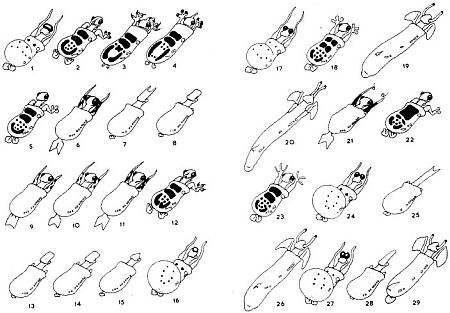
I think this is an important concept to get over and when I was teaching "Evolution" and "Genetics" back in the 80s, I used Caminalcules [selection above: from] as a defined dataset to help students think in classificatory terms. These delightful creatures were invented by Joseph Camin the the 1960s. He started by drawing a cartoon animalcule and imagining how it might evolve. Changes were made to a copy of the original drawing and so, iteratively, through several subsequent generations down several different paths.
At some point Camin aka God called a halt to evolution and assembled 29 extant / living species on a single sheet of paper for a student exercise in practical thunk. The task was to use scissors to cut out each of the 29 Caminalcules and put them into bins of similarity. Like mammalian classification, the task is probably recursive: dogs are more like wolves than either is to foxes; leopards is pretty close to those lads; but cows and bats . . . and wombats are further and further away from Fido. I started doing the same in the 1980s: we'd work in pairs initially; pause, compare notes, discuss, adjust and finish up with a solution that pleased everyone in the room. Usually next year's class was in close agreement with their prev peers.
An additional task is trying to infer the ancestors of the 29 leaves at the end of the branches but that was more than my students needed. Having The Answer in the fossil drawings which Camin had made seemed a bit luxurious to me. In the 1990s, I shifted countries and emphasis and started working on DNA and protein sequences and using them to infer evolutionary relationships; and the pattern and process of evolution along the way. In the 90s there was no fossil DNA (and no fossil-fossil missing link whales, for that matter) so a great deal of the effort was inferring ancestral states in the sequence tree. This century, Dan Bradley and Lara Cassidy at TCD [yes yes and lots of others across the world] have opened up another dusty can of worms by getting to sequence ancient DNA. Now you can ask 23andMe just how Neanderthal your brow-ridge is.
(*) It might be worth noting that William's younger brother was writer Henry "The Turn of the Screw" James.
Friday, 28 August 2020
Lithium, not too much

You can't call it manic-depression anymore because both parts of the phrase are trigger words: threatening or making unhappy some of those affected by the condition. Those affected by the condition include not only the clinical case but a widening circle of family, friends, work-mates, dependents, employees, followers and line-managers. Before An Unquiet Mind came out, each year hundreds of doctors across the world were topping themselves out; leaving grief and devastation behind them. At issue was the fact that disclosing mental illness was likely to see the end of their licence to practice medicine and so they were in denial or struggling but certainly not seeking medical help for a condition which can respond really well to a combination of drugs and psychotherapy. It's not to say that other people don't suffer BADly, it is just to reflect on the irony of it being visited upon doctors who found that they were unable to cure themselves.
The key to my Human Physiology course is homeostasis, the maintenance of everything - blood-pressure; core body temperature; sodium and potassium concentration; gut flora - in equilibrium. This is so important that many of the physiological systems are held to their set point by belts and braces involving nerves and hormones. Often, when things go wrong, you don't go completely off the rails or blow a cylinder-head gasket because of these redundant homeostatic mechanisms acting as a back-stop. The whole pharmaceutical industry is predicated on introducing alien substances to play the part of the original, now off-kilter, actors in the intricate dance of neurotransmitters, receptors, cytokines, hormones and enzymes.
Lithium carbonate was revealed [chance favours the prepared mind] as a calmer of mania by John Cade, an Australian psychiatrist in 1948. At the doses given in the 50s, 60s & 70s Lithium was very blunt instrument. Sure it damped the awkward and time-consuming mania for psychiatric patients in locked wards, but also turned them into ataxic zombies unable to read or concentrate or feel any sense of joy. For a smart, widely-read, widely-reading, creative research scientist and driven author of books and papers Lithium was a disaster. The smart scientist, with a slightly puritan air-force brat upbringing, known as Prof Kay Jamison failed to embrace her meds for all sorts of conscious and unconscious reasons. It was, accordingly, many years before she was able to damp the wild swings between creative genius; cruel, [self-]destructive, shouty, talking-to-unicorns mania; and the black dog of darkest, suicidal ideation. Eventually, she got a great psychiatrist, a couple of really supportive blokes . . . and the Li dosage right for her system. With that sorted she went on to write a) the definitive text-book (with Fred Goodwin) on Manic Depressive Illness. b) An Unquiet Mind. c) The Robert Lowell biography and defg) four other books about madness and genius. Not to mention 3 pages of Honors and Fellowships; eight honorary degrees; 130 scientific papers; and hundreds of students, interns and colleagues who have been touched by her humanity, her restless curiosity and her extraordinary ability to see connexions. Sorry, this is reading like an obituary, she's not dead yet! Check one of her books out of the library: An Unquiet Mind reads real easy and the story is compelling and inspirational.
What do I take from this? That we should be really careful about stigmatizing The Other. That we are all going to need some help getting the full measure of our three-score-and-ten. Spectacles for me; a titanium hip for Sean and Margot [one each, even, they don't have to share]; ventolin for my asthmatic offspring; lithium for those over-active minds; Oxybutynin for over-active bladder. With these medical crutches we can live longer, fitter, independent lives and continue being useful to our families and our communities. Still in Ireland, and doubtless wherever-the-heck you live, we privilege certain types of medical anomaly, notably HIV and Cancer [also: Top Ten -- Wallflower] -- Battens -- Orkambi <tsk!>] and all too often give the bum's rush to research into and financial support for mental illness. I've written a tiny bit to balance the books - Black dog -- Blackrock -- Bressie & Jeffrey -- Community care -- Drummer -- ECT -- Freedom.
Here's another, 23andMe, angle mentioned by Jamison. Many disorders of the mind run in families. Her own family tree, but only on her father's side, is beaded with black circles and squares indicating mania, depression, suicide. Bipolar for sure has a genetics angle: tree example from the Amish. This adds another dimension to the ethics and niceties of putting it all out there in your autobiography. By grassing yourself up to the Judgement of Publass, you are exposing your children, cousins, nieces and neffies to some undesired attention for which they get no royalties. Jamison is more sensitive about this than I am on The Blob as I chatter on about thinly disguised friends&relations.
Monday, 24 July 2017
Snow White inside
I'd like to think that one of the running themes in The Blob is that there is no such thing as little utility in black and white thinking. Der Reichskanzler was kind to children; there is some value to a belief in god; not everything the other side says is utter nonsense. On Sean Moncrieff's Newstalk FM radio program, he noted that the twitter-storm went on for 36 hours after they had a piece on the unborn (both sides going at it hammer and tongs) while a feature on homelessness among Irish 'born children' elicited only 5 comments. But those issues are metaphorical black and white, although quite edgy. When it comes to actual black and white animals, the firm ground on allocation and definition is hard to find.
An old logic puzzle hinges on the fact that all swans are large white long-necked ducks [family Anatidae] which allows us to assert that any a) large b) white c) long-necked d) duck is a swan and failure at any of the enumerated criteria makes the thing you're considering a non-swan . . . until you go to Australia and encounter Cygnus atratus [R]. Naseem Taleb wrote The Black Swan as an investigation of certainty and our failure to correctly process information from outlier events - "unknown unknowns" like 9/11 and the inexplicable Harry Potterism of Google - to help us deal with the future. Taleb's book has plums in it but there is also a lot of duff to chew through [critical Guardian Review] and Taleb himself can sound simultaneously know-it-all and woolly, which doesn't help illuminate the plums. Black and White animals? Should make Blobbistas think pandas [no not those pandas] or rhinos or ice-floes and polar bears.
 Bears, you say? Well I was reading about the unfortunate irony that the bear on the California State Flag [L] is extinct; less than 75 years after the Gold rush of 1848, the last grizzly bear Ursus arctos californicus in California was shot and killed in Tulare County in 1922. Note that the California Grizzly is a subspecies of the Brown Bear Ursus arctos which, as a species,
is a long way from being extinct but the key conservation-biology question remains: whom should we save if we are to retain the greatest possible genetic and ecological variation. Because variation is the stuff of evolution and we know not when a Black Swan event will put the survival of the species at risk. But when that event occurs, genetic variability is the best hedge against an uncertain future. We now have molecular tools to gather the genetic data to help conservationists make these hard decisions - El Blobbo has covered such studies for: fairy penguins - rhinos - giraffes - elephants - wildebeest - Tasmanian devils - whales.
We need that molecular data because brown bears are bigger than a bread-box and quite variable as to size and colour and so there has been a tendency to pronounce that specimens deserve their own sub-species because of a trivial difference in size, or habitat or feeding or colour. This is partly due to ambition - getting to name a [sub-]species ensures your immortal fame while acknowledging your specimen as essentially-the-same-as is much less exciting. WWF has to hope that taxonomic lumpers eventually win over splitters: it's cheaper that way, because then they don't need to save two morphs. You want to be a bit careful on defining things by skin/fur colour: a rat, black as my hat, ran across our yard the other day but I knew it couldn't be Rattus rattus, the black or ship [plague] rat, but rather a melanic form of Rattus norvegicus which has been so successfully invasive on the Shiants, the Scillies and Ile Bouvet.
Mais revenons nous a nos ours. There is the Black Bear Ursus americanus, for example, which is a good, reproductively isolated from Ursus arctos, species. The last common ancestor lived 5 mya, about the same separation as between us Homo sapiens and chimps Pan troglodytes according to molecular clocks. And there are melanic forms of the 'brown' bear just like there are blondies, red-heads [prev], dark-brown and sandy-coats. Grizzly refers to the grey de-pigmented tips to the hair shaft which give a distinguished pepper-and-salt look. At the other end of the spectrum is the polar bear Ursus maritimus which are definitely white but not so definitely a good species! It turns out that one of the 90 named subspecies of brown bears Ursus arctos sitkensis is endemic to the ABC islands in the Alaskan panhandle. ABC for Admiralty, Baranof and Chichagof Islands, the largest northerly lumps of the Alexander Archipelago from which the city of Sitka faces out across the broad Pacific Ocean. When they looked at the DNA of these beasts it turns out that they have distinctly polar-bear chunks of their genome. It is now suggested that a population of polar bears was stranded by retreating ice on the ABC islands at the end of the last ice age. In absence of available male polar bears, some females acceded to the attentions of roving brown bears from the mainland and delivered healthy offspring. We know it was that way round because the ABC brown bear (a single individual, as far as I can make out) is most polar-like (6.5%) on the X chromosome than in the rest of the genome (1%). Those healthy offspring grew up and started to look for potential mates in their turn and found only brown bears and so the polar-bear contribution has been stochastically diluted over the last 10,000 years. It's a bit like, if you send your saliva off to 23andme, they will analyse the DNA and tell you that at least one of your ancestors had a romantic interlude with a Neanderthal. There will be no detectable difference on the heaviness of your brow-ridge but the DNA will bear a distinctive other-species signature. The algorithm can quantify the amount of miscegenation.
So there's hope for polar bears as the ice caps shrink and their habitat gets destroyed and they have to swim further than the cubs feel comfortable about. They have been there before and survived for some time in a brown-field site. Good news for seals?
An old logic puzzle hinges on the fact that all swans are large white long-necked ducks [family Anatidae] which allows us to assert that any a) large b) white c) long-necked d) duck is a swan and failure at any of the enumerated criteria makes the thing you're considering a non-swan . . . until you go to Australia and encounter Cygnus atratus [R]. Naseem Taleb wrote The Black Swan as an investigation of certainty and our failure to correctly process information from outlier events - "unknown unknowns" like 9/11 and the inexplicable Harry Potterism of Google - to help us deal with the future. Taleb's book has plums in it but there is also a lot of duff to chew through [critical Guardian Review] and Taleb himself can sound simultaneously know-it-all and woolly, which doesn't help illuminate the plums. Black and White animals? Should make Blobbistas think pandas [no not those pandas] or rhinos or ice-floes and polar bears.
is a long way from being extinct but the key conservation-biology question remains: whom should we save if we are to retain the greatest possible genetic and ecological variation. Because variation is the stuff of evolution and we know not when a Black Swan event will put the survival of the species at risk. But when that event occurs, genetic variability is the best hedge against an uncertain future. We now have molecular tools to gather the genetic data to help conservationists make these hard decisions - El Blobbo has covered such studies for: fairy penguins - rhinos - giraffes - elephants - wildebeest - Tasmanian devils - whales.
We need that molecular data because brown bears are bigger than a bread-box and quite variable as to size and colour and so there has been a tendency to pronounce that specimens deserve their own sub-species because of a trivial difference in size, or habitat or feeding or colour. This is partly due to ambition - getting to name a [sub-]species ensures your immortal fame while acknowledging your specimen as essentially-the-same-as is much less exciting. WWF has to hope that taxonomic lumpers eventually win over splitters: it's cheaper that way, because then they don't need to save two morphs. You want to be a bit careful on defining things by skin/fur colour: a rat, black as my hat, ran across our yard the other day but I knew it couldn't be Rattus rattus, the black or ship [plague] rat, but rather a melanic form of Rattus norvegicus which has been so successfully invasive on the Shiants, the Scillies and Ile Bouvet.
Mais revenons nous a nos ours. There is the Black Bear Ursus americanus, for example, which is a good, reproductively isolated from Ursus arctos, species. The last common ancestor lived 5 mya, about the same separation as between us Homo sapiens and chimps Pan troglodytes according to molecular clocks. And there are melanic forms of the 'brown' bear just like there are blondies, red-heads [prev], dark-brown and sandy-coats. Grizzly refers to the grey de-pigmented tips to the hair shaft which give a distinguished pepper-and-salt look. At the other end of the spectrum is the polar bear Ursus maritimus which are definitely white but not so definitely a good species! It turns out that one of the 90 named subspecies of brown bears Ursus arctos sitkensis is endemic to the ABC islands in the Alaskan panhandle. ABC for Admiralty, Baranof and Chichagof Islands, the largest northerly lumps of the Alexander Archipelago from which the city of Sitka faces out across the broad Pacific Ocean. When they looked at the DNA of these beasts it turns out that they have distinctly polar-bear chunks of their genome. It is now suggested that a population of polar bears was stranded by retreating ice on the ABC islands at the end of the last ice age. In absence of available male polar bears, some females acceded to the attentions of roving brown bears from the mainland and delivered healthy offspring. We know it was that way round because the ABC brown bear (a single individual, as far as I can make out) is most polar-like (6.5%) on the X chromosome than in the rest of the genome (1%). Those healthy offspring grew up and started to look for potential mates in their turn and found only brown bears and so the polar-bear contribution has been stochastically diluted over the last 10,000 years. It's a bit like, if you send your saliva off to 23andme, they will analyse the DNA and tell you that at least one of your ancestors had a romantic interlude with a Neanderthal. There will be no detectable difference on the heaviness of your brow-ridge but the DNA will bear a distinctive other-species signature. The algorithm can quantify the amount of miscegenation.
So there's hope for polar bears as the ice caps shrink and their habitat gets destroyed and they have to swim further than the cubs feel comfortable about. They have been there before and survived for some time in a brown-field site. Good news for seals?
Subscribe to:
Posts (Atom)