Only Connect! Just a few days ago I was writing about Temple Grandin making the killing floor in abattoirs more efficient and humane. It takes insight and a team of process engineers. Then news came in from Taiwan over the weekend of a bad case of killing flour. In the immediate aftermath, they were able to say nobody died but one of the 500 horribly injured young students has now succumbed. As I expressed my treatises on road traffic accidents and end of life issues, there may be worse things than dying. It's probable that among the injured in many hospitals near Taipei are kids with no eyelids or no skin on one side of their bodies who wish they were dead.
Combustion is all about oxidation: lots of chemicals, when they combine with oxygen, do so as an exothermic (energy generating) process. It's happening in your brain right now as you try to get my drift - glucose and oxygen are being converted to carbon dioxide and water yielding about 16kJ of energy per gram. That's enough to keep a 100W light-bulb going for 2.5 minutes. And 100W is about what is being dissipated through the top of your head every waking moment. If oxygen is in short supply, this exothermic reaction needs help to get started. A candle just sits until a flaring match supplies the energy of activation to get things going. In pure oxygen, the reaction is easier to start. My investigations of explosives have tried to show that the more oxygen incorporated into the chemical, the more energy can be generated: TNT C7H5N3O6 has about 1/3 the explosive power of nitroglycerine C3H5N3O9.
I make a lot of bread, so a lot of flour goes through our kitchen, but it sits there inert in a 2kg bag until mixed with yeast and water. The dough sits like a damp blob [safe] and even after heating to 200oC for 40 minutes to create a loaf it has no likelihood of exploding.The energy is released later in my head - a blob is converted miraculously into The Blob. But if you trick about with the proportions, you can create a neat whoomph at the kitchen table. You can scale that up into a devastating dust explosion in which finely powdered flammable material is mixed in the right/wrong proportions with the 20% oxygen in the air. Coal dust in mines, and flour or grain dust in silos are known to be potentially hazardous. An ignition source is necessary but this can be a lit cigarette or even a static electricity spark from a nylon jump-suit. These are enclosed spaces, so it looks like the dust has to be concentrated w.r.t. the available air.
When I was in school, I had a Summer job working in a flour mill as a general dogsbody. One of my tasks was to make the 19thC mill-buildings air-tight in preparation for the annual fumigation against flour beetle Tribolium castaneum, grain weevil Sitophilus granarius, or just plain mice Mus musculus. It was a soul-destroying task. I was given a large roll of paper tape and some flour and water paste and told to go round all the windows. That was fiddly but the hoist-towers were four or five stories high and made of clapper-board that whistled in the wind. They'd never had an explosion in 100 years because any dust leaked out through the holes in the building's structure.
In was like that at Imperial Sugar in Port Wentworth, Georgia. Granulated sugar was stored in enormous silos and brought to the packing and processing floors by a system of conveyors, lifts, augurs and hoppers all designed by process engineers. Sugar dust was everywhere: in heaps on the floor, on top of rarely-cleaned light fittings, underneath the conveyor belts, in the hair of all the operatives. You may be sure that the workers bristled when they were welcomed home by "Hello, sweetie". Like my flour mill, that worked fine for many years until Health and Safety applied their own agenda to the process and enclosed the main conveyor running beneath the silos: to prevent contamination. That built up the concentration of dust to hazardous levels and, on 7th February 2008, the sugar-dust and oxygen mix met a red-hot faulty bearing and blew up. The fireball travelled up through the silos and set them off which triggered a chain reaction through the factory floor. The blast blew more sugar dust into the air in a frighteningly sustainable fashion. 14 dead and 40 injured. Explanatory 4min video.
The lesson from this is that you have to work quite hard to cause an explosion using flour-dust. Last weekend on 27th June 2015, impressarios at Formosa Fun Coast in Taiwan thought it would be kool to host a huge end of term party reflecting the Hindu Spring festival of Holi where everyone celebrates by throwing coloured dust and water on each other. Accordingly the fun-park ordered 3 tons of coloured corn-starch, called the event Color Play Asia and started to sell tickets. With 1,000 people in the arena each with 3kg to disperse, the dust/air ratio crossed the critical threshold and someone lit a cigarette. Whoomph! It was all over in 20 seconds. The young people, 180 of whom are in intensive care, will be paying for their tickets for some time to come.
Tuesday, 30 June 2015

Stars and Bars
Along with maps, islands, women in white coats and explosions, The Blob has more than a passing interest in Vexillology - the study of flags. Flags can be pretty and are occasionally deeply symbolic and are an essential attribute of national identity. Every country, and probably every county, has a flag and most governments take their flags really seriously: American children pledge allegiance to
the Stars and Stripes at the beginning of every school day. There are elaborate protocols for handling the flag - it must never touch the ground; it must never be used on underwear or paper napkins; if hopelessly ragged it must be disposed reverentially preferably by burning in private.
In the 1860s, America was riven by a bloody civil war about the right of several of the states to secede from the Union because of irreconcilable differences over the right to own slaves. It came to a head over the issue of whether the rights should be allowed to extend into the unincorporated territories and allow slavery in the Wild West. It took half a decade, and more than half a million deaths, to decide that nobody was going to secede and all slaves were to be emancipated. End of slavery is not end of racial discrimination! Humans are inveterate nostalgists, we look back to the past through rose tinted spectacles and cherry pick the positive aspects of times past and air-brush the infant mortality, the casual violence, as well as the lack of smart-phones, cars and frozen pizza.
 The Confederacy undoubtedly took a drubbing and endured two generations of officious Reconstruction to dull the pain of loss: financial, cultural and mortal. There is nobody alive today who experienced the Civil War directly [Albert Henry Woolson, the last surviving veteran from either side, died in 1956 at the age of 109] so it should be possible to put it all behind us and move on. It's okay to dress up in field-grey uniforms and slouch-hats and re-enact Gettysburg. It's okay for the Dukes of Hazzard to fly the Confederate flag [seen R] as they drive around the Georgia backwoods delivering moonshine. It's okay to sell mugs and tee-shirts sporting that flag. It's okay for country and western singers to use the same flag as a banner in front of the stage . . . or is it? If you put it into the context of "I pledge allegiance to the Flag . . . and to the Republic for which it stands . . ." you are bound to ask just what the Stars and Bars stands for. And then you might ask if anybody in the room might be offended by that symbolism. Whatever about what consenting adults do in private, to fly the Confederate flag regularly outside the State Capitol in Columbia, South Carolina surely cannot be okay. It implies that the legislature collectively would like to restore the status quo ante-bellum. It says bring back slavery. That is the position anyway of Bree Newsome and other anti-racism activists. She scaled the 10m high flag-pole [youtube] Saturday morning and removed the offending object but was promptly arrested and charged with defacing a monument. But, as a commenter on metafilter made clear, the flag is not flying over the Capitol, it is flying over a Confederate war memorial next to the Capitol. It is generally considered appropriate to remember dead soldiers even if they fought on the wrong side; if only because "a bayonet is a weapon with a worker at each end".
If you want to take the position that flags are just fripperies and a bit of fun, then I'm with you. I had a bit of a poke at the BLT folks and their flags as an envoi to the equality [good] news from SCOTUS; suggesting that perhaps the best qualified people <?who they?> had probably not had much hand in the vexillological design. Why didn't they listen to Roman Mars? But if you take flags seriously then there are serious issues at stake in South Carolina and elsewhere in the Southern States.
the Stars and Stripes at the beginning of every school day. There are elaborate protocols for handling the flag - it must never touch the ground; it must never be used on underwear or paper napkins; if hopelessly ragged it must be disposed reverentially preferably by burning in private.
In the 1860s, America was riven by a bloody civil war about the right of several of the states to secede from the Union because of irreconcilable differences over the right to own slaves. It came to a head over the issue of whether the rights should be allowed to extend into the unincorporated territories and allow slavery in the Wild West. It took half a decade, and more than half a million deaths, to decide that nobody was going to secede and all slaves were to be emancipated. End of slavery is not end of racial discrimination! Humans are inveterate nostalgists, we look back to the past through rose tinted spectacles and cherry pick the positive aspects of times past and air-brush the infant mortality, the casual violence, as well as the lack of smart-phones, cars and frozen pizza.
If you want to take the position that flags are just fripperies and a bit of fun, then I'm with you. I had a bit of a poke at the BLT folks and their flags as an envoi to the equality [good] news from SCOTUS; suggesting that perhaps the best qualified people <?who they?> had probably not had much hand in the vexillological design. Why didn't they listen to Roman Mars? But if you take flags seriously then there are serious issues at stake in South Carolina and elsewhere in the Southern States.
Monday, 29 June 2015
Gay Community News

John Arthur was the married partner of James Obergefell. What in tarnation are we going to call the equal partners in a same-sex marriage? That's not going to be decided by the rule of law.
But recognition of the legality of same-sex marriage took a big step forward in the 5-4 decision by SCOTUS on June 26 2015 ruling that the marriage contracted out-of-state by Arthur and Obergefell must be recognised by the State of Ohio and Obergefell is entitled to be named as next of kin on the death certificate. I'm sure that will have financial as well as practical and social implications. In Ireland you can leave your entire estate tax-free to your surviving spouse but effectively nothing-at-all to your partner of 40 years. The tax burden is less on gifts to your sister than on inheritance by the woman who has shared your life for decades. The Supreme Court ruling is now and forever known as Obergefell vs Hodges but the Justices consolidated the case with similar challenges to state law from Tennessee, Michigan and Kentucky. It's also interesting that James Obergefell has been straight [sic!?] and consistent through his trials but the defendants have been but straw men of reaction. The case started as Obergefell vs Kasich [John Kasich, Governor of Ohio] when John Arthur was still alive. The case has shape-shifted through Obergefell vs Wymyslo; Obergefell vs Himes before coming to the highest court in the land as Obergefell vs Hodges.
The Supreme Court's decision, which of course applies to ALL 50 states, is as close as it can be and so you may anticipate that this decision is not final except for the compelling tide of history argument. As the old men of the Supreme Court die off they will be replaced by younger people who have more gay friends and more empathy. It is quite worrying that so many of the positions taken by individual judges can be predicted with sufficient accuracy that you can win money by betting on their opinions. It shouts that judicial findings are interpretations of the law through a haze of prejudice and certainty about how things should be rather than a scientific or objective assessment of how things are. I think we can feel smug in Ireland that the issue of same-sex marriage has been determined in the positive by plebiscite rather than by statute. It's probably true that, whatever the legal status of gays in the several states, the majority of voters would rather they were back in the closet and marriages still had a car, a dishwasher, a father, a mother and 2.3 children.
You may feel the need to get with the
Sunday, 28 June 2015
Think like a cow
It is the experience of many who work in science that a disconcerting number of The Effectives appear to be "on the [autistic] spectrum". I don't propose here to critique the diagnosis of this condition except to note that psychiatrists recognise "pervasive developmental disorder, not otherwise specified" PDD-NOS which shouts my-bailiwick-is-getting-bigger-must-go-viral. In my piece about John Nash, I cited a case of an autistic professor of who used to address her lectures to the blackboard until told that the students preferred to see their teacher's face. Apocryphal but it has the ring of truth. It's weird because although autism is characterised by impaired social interaction and blunted affect, I got a surprising amount of empathic support from my then boss when I returned from my father's funeral. I think it is really helpful to rescue PDD-NOS people from the clutches of well-meaning but officious folk who long to step in to help. As a community we really need to set the parameters of "the normal range" as wide as possible, so that the different, the eccentric and the out-there are tolerated and let alone. Actually, with the pervasive planetary worries we face, we should do rather more active listening than mere passive toleration of alternative ways of being. All this is especially true if drugs follows diagnosis as night follows day.
Temple Grandin was born in Boston in 1949 and with hindsight it was a knife-edge as to whether she would now be rocking-rocking in the corner of an institution. She was diagnosed brain-damaged at the age of two and didn't talk until she was four. The full time attention of a nurse and speech-therapist and the support of her mother got her into the school system. That nurse needs the same sort of tribute as we give to Anne "Helen Keller"Sullivan. In school young Temple was lucky to have supportive teachers and administrators because she was unmercifully teased by her peers for being demonstrably different. She finished up in a boarding school for gifted children and went on to get an armful of degrees in various colleges in the USA, culminating in a PhD in animal science from the University of Illinois at Urbana-Champaign. She is now Professor of Animal Science at U Colorado.
The engagement with animal science is not somewhere she happened to finish up but rather a key strand in her life because she claims to think like a cow. Human social norms require a lot of face time. We yak on with/to/at each other, finishing and repeating each other's sentences not so much to convey information as to establish a pecking order and demonstrate empathy. One of of Grandin's 'symptoms' is an extreme sensitivity to noise and the relentless chitter-chatter, not to say roaring and barracking, of school must have been plain hell. Out on a horse was a far better place to be and that's what she spent a lot of time doing.
I'll use that as a segue to mention a very disturbing (because weird and inexplicable) form of sexual harassment reported by Dau.I the Poet. Since she taught herself to read in the month after her sixth birthday, she has been a 'read early and read often' person. She reads on her lunch-break, she reads on the bus, she reads over breakfast and would rather read than watch the telly. She does not read while cycling to work (!) but she does read while walking. More than once, some young lout has invaded her personal space to interrupt her ambulatory reveries by shouting into her face. Nothing clever or articulate: just an inchoate roar. It seems to be saying: look at me, I am ignorant and egotistical and I will be heard. A future in politics beckons.
You might think that someone like Grandin with such empathy for animals would have turned vegetarian about the same time as she turned adult but it didn't turn out like that. Recognising that meat, particularly beef, forms a central part of the culture in which she has lived all her life, she has made money if not a living designing abattoirs! That should make you think about where to fight your battles. The insatiable demand for beef means that cows are killed 24x7x52 [closed Christmas Day] and anything that holds up the flow costs money. Somehow Grandin got a contract to consult for the meat-packing industry and walked through the chute from feed-lot to the killing floor at all time of the day and night. That gave her a cow's eye view of the process and she was able to understand why the bottle-necks occurred when and where they did. If one cow startles and backs-up then a time-consuming, frequently brutal and potentially dangerous intervention was required from the cattlemen with boots and cattle-prods. The example she often cites is when cattle turned a particular corner, one of the flood-lights reflected in a puddle of water and frightened the leading animal. Solution? Dry up the puddle.
Another of Grandin's talents is an amazing visual memory and she was able to take her experiences in the killing fields back to the drawing board and redesign the process so that it was more efficient and far less stressful for the product. No more puddles or shit-slick flooring: non-slip mats throughout. No more abrupt turns: these are replaced by ergonomic curves. No more open sides to the chute: these are poorly controlled and distracting. A light at the end of the tunnel. No more roaring and clanking at the last minute. With these and similar whole-process changes, each animal follows the tail in front, docile and unknowing that only seconds of life remain. The meat hangs better if it is not awash with adrenalin. The throughput goes up and the cost per unit comes down and we get cheaper food. Fewer people are required to work in this shameful industry. More than 50% of slaughtered animals in the USA have ended their days in a plant designed under Grandin's principles. If you eat meat you should see her 10 minute propaganda video for the American Meat Institute. You might also watch it for evidence of what Reggie Edgerton believes about the intra-spinal circuit control of pacing in animals. I'll leave you to find longer video footage of her talks for TED, Google and the BBC.
Just as I forbade you to get judgmental about Alayna Westcom being Miss Vermont, it is as pointless to criticise Temple Grandin for her vocation as it is to criticise her taste in cowboy shirts - she's come a long way West from Boston. She has done far more than me for the net welfare of mammals. But for pity's sake, what are we doing eating meat at all at all?
Since there were ever prisoners of war, there have been slaves; in almost all human societies it has been legitimate to oppress women . . . and homosexuals have often had a rough time too. In my life-time we have, through marches and riots, dialogue and legislation, come close[r] to a true emancipation of these untermensch. When there are 14 billion people our grand-children will look back at our times to ask with repulsion "They ate meat? Every day?". Worthy, counter-intuitive and interesting as Temple Grandin's work has been, it is rather like lining up the deckchairs.
Saturday, 27 June 2015
Little Miss STEMshine
At The Institute we offer a degree called something like Biowonders with Bioforensics. Every year some students sign up to this because they have grown up with CSI on the TV and think they can handle the blood-splatter and skeletons found in the woods. They wait a helluva long time for any of this on the curriculum and eventually pass out with a degree that is more or less useless for getting a job in forensics in Ireland: of which there are about three openings every decade. We are spending next academic year having a strategic review of our courses and one thing we are all determined to do is scotch the 'forensic' lie and call the course Biotechnology for Superheroes for the generation raised on Spiderman movies. Elsewhere you can complete a BSc in Forensic Science and get a job as an autopsy technician [they call it medical examiner and medical technologist]. Presumably the Faculty at U. Vermont devoted some time and effort to developing their course in Forensics - Blood-splatter 101; Advanced Entomology; Handgun Caliber Analysis - rather than merely stapling the word 'forensics' into the Prospectus as a dishonest after-thought.
I know all this because Alayna Westcom, a rather symmetrical female autopsy technician, secured the title Miss Vermont 2015 this Spring. You can't see much of her symmetrical face because she has been raised on the Little Miss Sunshine school of how to respond when you win a beauty pageant. You put both hands up to the mouth, give a little at the knees and shriek "OMG, OMG", while last year's winner drapes your sash and pins a plastic tiara to your hair. Now you could getting snitty about the elements of popular culture than Ms Westcom has chosen to embrace: how parading fit young women in near-nakednessis demeaning gives a rather one-dimensional view of their talents. She contributed to the distractinglysexy twitterfeed, so she has a sense of humor. Although Only confirmed followers have access to @AlaynaWestcom's Tweets and complete profile, which suggests that Miss Dingbat competitors attract a lot of unwanted attention from lurkers, stalkers and oglers. But you could turn it around and say: here is a successful young scientist who has a peculiar hobby. No more peculiar than going to Samba school or doing a little light book-binding in the evening after a heavy day pushing the frontiers.
It may seem that some of the contestants in these competitions are as thick as pig-dribble but then so are a proportion of any profession including college professors. With hindsight, the responses to the question "Should evolution be taught in schools?" by Miss USA contestants are a) varied and b) not unreasonable; although we all snickered contemptuously at the time (2011). Is it just me but do a disconcerting number of these women have sort of up-slanty eyes? What's that all about? Most of these women are white, or 'round-eyes' as the Chinese used to refer to Westerners, but the ideal physiognomy now seems to be going East - is it all the Kung-Fu movies on the TV?
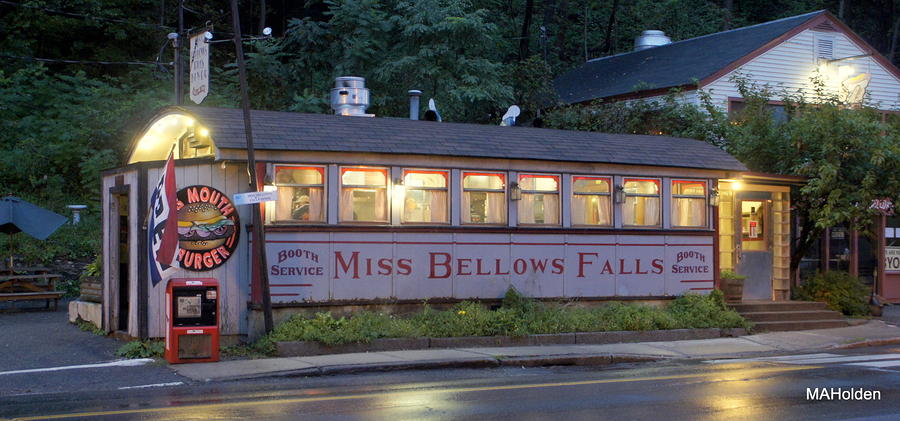
Mais revenons a nos agnelles Ms Westcom has been changing her strategy over her years of competing for the titles of Miss Bellows Falls . . . Miss Vermont . . . Miss America. Over the years, the contestants have been asked to demonstrate that they are not one-dimensional ciphers to be ogled at; but are young women who are worth something in their community. She is still raising wodges of folding money for a worthy charity, and she visits old folks homes. Ms Westcom used to offer a [same-old, same-old] dance routine as her way of showing that Vermont Has Talent. This year however, she has ditched that and her 'extra' is Platform: Success through STEM. That's great, like Harry Potter and Nobel Prizewinners, people listen disproportionately to celebrities. Can't be bad if girls see Alayna Westcom's demo of 'science' and say "that's cool, I'll have some of that" and put an extra effort into their maths homework. The fact that her science demo [L and micro-youtube] is reduced to a 40sec sound-byte is not her fault but integral to the whole superficial nature of these events.
I know all this because Alayna Westcom, a rather symmetrical female autopsy technician, secured the title Miss Vermont 2015 this Spring. You can't see much of her symmetrical face because she has been raised on the Little Miss Sunshine school of how to respond when you win a beauty pageant. You put both hands up to the mouth, give a little at the knees and shriek "OMG, OMG", while last year's winner drapes your sash and pins a plastic tiara to your hair. Now you could getting snitty about the elements of popular culture than Ms Westcom has chosen to embrace: how parading fit young women in near-nakedness
It may seem that some of the contestants in these competitions are as thick as pig-dribble but then so are a proportion of any profession including college professors. With hindsight, the responses to the question "Should evolution be taught in schools?" by Miss USA contestants are a) varied and b) not unreasonable; although we all snickered contemptuously at the time (2011). Is it just me but do a disconcerting number of these women have sort of up-slanty eyes? What's that all about? Most of these women are white, or 'round-eyes' as the Chinese used to refer to Westerners, but the ideal physiognomy now seems to be going East - is it all the Kung-Fu movies on the TV?
Mais revenons a nos agnelles Ms Westcom has been changing her strategy over her years of competing for the titles of Miss Bellows Falls . . . Miss Vermont . . . Miss America. Over the years, the contestants have been asked to demonstrate that they are not one-dimensional ciphers to be ogled at; but are young women who are worth something in their community. She is still raising wodges of folding money for a worthy charity, and she visits old folks homes. Ms Westcom used to offer a [same-old, same-old] dance routine as her way of showing that Vermont Has Talent. This year however, she has ditched that and her 'extra' is Platform: Success through STEM. That's great, like Harry Potter and Nobel Prizewinners, people listen disproportionately to celebrities. Can't be bad if girls see Alayna Westcom's demo of 'science' and say "that's cool, I'll have some of that" and put an extra effort into their maths homework. The fact that her science demo [L and micro-youtube] is reduced to a 40sec sound-byte is not her fault but integral to the whole superficial nature of these events.
Friday, 26 June 2015
Rewalker

This last week, Prof Edgerton has been in the Trinity College Institute for Neuroscience TCIN talking and setting up collaborative research projects. Yesterday he gave a public lecture in the Science Gallery which should get people to think around the box of what everyone knows to be impossible. All too often in science and elsewhere what everyone knows to be true turns out to be wholly unexamined and based on dogmatic assertions rather than any substantive evidence. Our own experience should give us pause to examine the assertion that spinal cord injury is irremediably final and that everything below the lesion is doomed to waste away through disuse. Edgerton maintains that the spine has a large degree of autonomy and can establish patterns of muscular flexion and extension without any external stimulus - they are called Central Pattern Generators CPGs. We know this could be true because we can walk without having to think about it. In UCLA they have induced rhythmic hind-leg pacing in cats and rats which have severed spinal cords. It's a bit of a trick; you have to prime the system with electrical stimulation and/or judicious drugging of the other neurotransmitters - glycine and serotonin were mentioned - that I don't cover in teaching neuromuscular 101. The results are miraculous to behold. Another example is that the process of standing up - really important for self-esteem in the crippled so they aren't always talked down to - is largely reflexive: pressure on the heel starts the whole lurch forward and up that fit people do without thinking. And which is an increasing ask for the elderly, the infirm and the spinally challenged.
One thing that Edgerton mentioned more than once is that a lot of the current cures for neuromuscular problems are worse that useless because the are directed at quelling the disturbing symptoms rather than channelling those symptoms into productive patterns. Spasticity, for example, has much more potential for amelioration than paralysis because you have some movement to work with. As a metaphor, Mormons are required to spend a year of young adulthood spreading the word and they find it much easier to win converts in countries which already have a established belief systems, like catholic Ireland, than in more secular places like France and Britain. The gamma-aminobutyric acid GABA receptor agonist Baclofen is routinely used but maybe should be used less and more training implemented. Drugs are easier to administer than physiotherapy in the same way that they are easier to apply than psychotherapy. Megapharma is the only certain winner.
I'm well out of my depth here but in the questions at the end of Edgerton's talk the idea was floated that conscious thought might be counter-productive in the cocktail of drugs, electrical and physical stimulation that seems to have the potential to make people take up their beds and walk: "no longer conforming to the shape of the chair" as Simone put it. In my years of drumming my head habitually got in the way - and I don't mean that I would accidentally drub my ears with the sticks. No it was that, if I let my hands do the work, I could perform presentably; but if I looked at the wangering hands they would say "whoa, brain taking over and kerFLUB". Again, in my years as a not-very-good sambista we were required on parade to a) percuss [it was a chocalho and later a repinique for me], b) sway from side to side together and c) walk forward. I could do any two of these: if things were going great and I decided to start the swaying then my feet would stop and I'd get rear-ended and heel-stepped by the woman behind me.
I have great hopes that someday Mark Pollock will walk into a room when I'm back drumming and we'll take up where we first met a dozen years ago in Sinead O'Brien's djembe class.
Thursday, 25 June 2015
How to milk a cow.
Several years ago, just before the Celtic Tiger rolled over and died, we had a Polak to stay for six weeks in the middle of Winter. He came from the far North East up near the Lithuanian border. Tadek was even older than me and his farmlet was smaller than ours but he was a good deal more productive . . . except in the Winter when the permafrost precluded pretty much all out-door work. Coming to work with/for us in milder Ireland was better than sitting inside at home eating pork-fat and slugging down the wódka. We paid him a trifle over the minimum wage and he took home more actual folding money than he'd earn in the rest of the year from his hectare of strawberries. The following Summer I went, at his earnest request, to visit with his family. It was interesting. They were cash-poor but close to self-sufficient for food. Every day, twice a day, Pani Tadek would go out into the field with two buckets: one to sit on and one to milk the cow into. It was a protocol familiar to many rural families in Ireland up until they joined the EEC in 1973. There were no economies of scale but the milk was good and you knew where it had been. You also knew your cow(s) intimately. A couple of weeks ago, I was talking to a dairying neighbour, and he said I could have a a few litres of milk at the price he got from Megacorp = 28c/lt just about 1/3 of what we pay in the shops. Eating your own produce has leverage.
 Yesterday I went to deepest South Kilkenny to see the future. The owner, in Owning, of a Lely Astronaut A4 robotic milking machine was having an open day demonstration. You don't need to get your cheek up against the flank of your cows any more. You don't need to get up at 0500hrs either. You train your cows - takes from two days to two weeks - to form an orderly queue and amble into the machine's crush. The front part has a trough with a taste of feed. The other end has all the mad-robot machinery that you'd expect: little rotary brushes like in a car-wash to clean the udder, which is fairly likely to have been lying in a cow pat at some stage during the previous 12 hours and steam cleaners for the milking machinery. You can watch the udder being played over by a criss-cross of lasers such as you might get in a shop's bar code-reader in order to get a 3-D image of the teat locations. Then one by one the teat-cups orientate correctly >!whirr crrrk!< and engage each teat in turn >!ferloop!< and the machine starts to suck. When the milk is stripped from the udder, the pump switches off, the teat-cups release and get steam cleaned, the front gates of the crush slap open and Daisy walks out and back to the field for more grass. The robot knows it's Daisy (or more likely A0245-01723) because she has a transponder on her collar. She can't leave the shed through the electronic doors for fresh grass unless she has been recently milked.
There is a dairy-man, but he doesn't get chapped hands or cowpox. His tool kit is more for cleaning the lines if they get blocked and cleaning the optical sensors so they read correctly and phoning the company when the machine goes wrong. This scales up. Once the computer knows which cow is in the A4, it can respond to the individual cow and to each quarter of her udder. It's normal for the rear quarters to milk slower and less than the front quarters, and if the rear-left has been giving little over the previous seven milkings, that tells the machine to go easy there. Each of the four lines stops at what it senses is the right time. In the past you had to attach the milking device by hand but it would drop off at the end of the process . . . but drop off all together even though one teat might still be giving and another might be raw from dry-sucking.
If the cows are allowed to choose when to get milked they don't go twice a day anymore, they go, on average 2.5x - 3x a day. This means that the milk is left at blood temperature for a shorter period and so potential mastitis pathogens like Staphylococcus aureus get flushed out before they can get a grip and so the somatic cell count SCC is lower. If the SCC (mainly white blood cells for fighting infection) is above a certain threshold, the milk will get rejected by the creamery as not fit for purpose. But there are indications that SCC is in fact higher in automatic milking systems perhaps because continual use doesn't allow the milking lines to be really thoroughly cleaned as they used to be after the morning and evening milking sessions. A lot of other milk qualities are measured in-flow & on-site: temperature, conductivity and colour for starters; and these, theoretically at least, allow some milk [colostrum, high SCC etc.] to be diverted from the bulk cold storage vessel. They also allow, theoretically at least, some diagnostics to be done on the herd - who is getting mastitis, who is yielding the most.
There are questions
Q1. Why do cows have four teats when they generally give birth to a single calf?
Q2. If let alone, will a cow settle into a routine to be milked at the same time each day?
Q3. Will those preferred milking times be scattered through 24 hours or are there peaks driven by, say, the hormone melatonin which has a daily cycle in concentration.
And the economics: statistics for Ireland 2014:
Cows: 1.14million
Dairy farmers: 17,000
Average herd size: 60 cows
Milk yield per cow 5,000 litres
Payment: 28c/lt
Gross payment: 60 x 5000 x 0.28 = €84,000
From the promotional material that was available yesterday it seems that a Lely A4 can had for €45/day or €16,000+ /year. That's a chunk off the bottom line before even the electricity is switched on. Clearly it looks more profitable if your herd is bigger: the A4 and the shed to hold it is a fixed cost. But you can't have an infinitely big herd because it takes 5 minutes for a cow to release all its milk. If this is happening 3 times each cow is occupying the milking machine for 15min each day which says that the capacity for the machine is a little under 100 cows if they spread their occupancy evenly though the day.
Final question. If we are driving the dairy industry forward talking about efficiency, what are we keeping cows for at all at all? Wouldn't it be better for the planet if we grew wheat and maize and lentils and ate them direct instead of feeding all those good things to cows for milk which the Chinese government doesn't want any more. The PRC has just introduced a breast-feeding directive to all their mothers which threatens to collapse the global market in powdered milk.
Subscribe to:
Posts (Atom)